Having 500,000 followers does not make you a business owner. It makes you a media channel — and the gap between those two things is where most creator careers quietly stall.
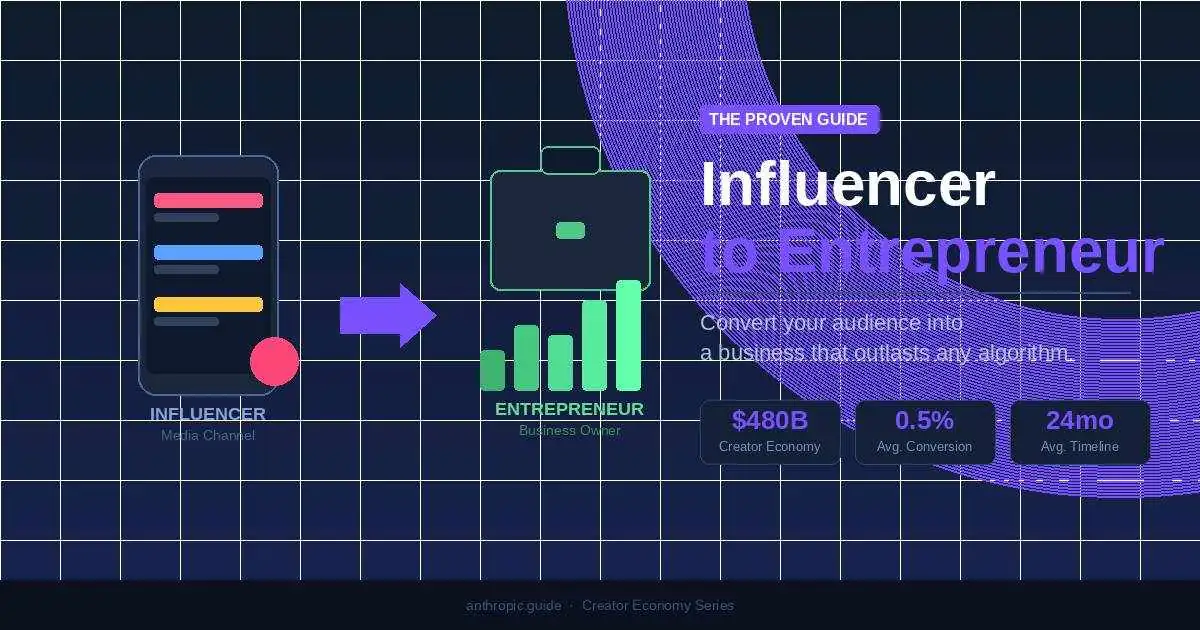
The creator economy is projected to reach $480 billion by 2027, according to Goldman Sachs. Yet most influencers earn income that is structurally fragile: brand deals dry up, algorithms shift, and accounts disappear without warning. One PR crisis can erase years of work in a week.
The creators who build lasting wealth are not simply posting more content. They use their audience as a distribution channel for real businesses — ones that generate revenue whether or not they posted this week.
This guide covers what actually separates influencer income from entrepreneur income, which business models work (and which destroy bank accounts), five real case studies, and the specific mistakes that derail most transitions before they gain any momentum.
What Is the Real Difference Between an Influencer and an Entrepreneur?
Most influencers are freelancers — they trade time and content for sponsorship payments. An entrepreneur builds systems that generate revenue without requiring their personal output every single day. That distinction sounds obvious, but it changes nearly every operational decision you need to make.
An influencer’s income is personal and platform-dependent. Earnings hinge on follower count, engagement rate, and whether brands have budget for your niche this quarter. Take a month off and the income collapses. That is a service business with one employee.
Entrepreneurs build assets. A product line, a paid community, a licensing deal — these generate revenue even when the creator is not publishing. The transition from influencer to entrepreneur does not mean quitting content creation. It means building something that your content feeds, rather than something content alone is.
The Mindset Shift That Actually Matters
The biggest obstacle to this transition is not money or skills. It is identity.
Influencers are trained to optimize for reach, engagement, and follower growth. Those metrics mean almost nothing in a business context. Entrepreneurs optimize for conversion rate, customer retention, margin, and lifetime value. Shifting between those two measurement systems is genuinely hard, and most creators underestimate how long it takes.
After reviewing dozens of creator-to-founder transitions, one pattern stands out: the ones who stalled did so because they launched a product without changing how they measured success. They kept celebrating follower growth while their business had zero repeat customers.
A creator with 150,000 highly engaged followers in a tight niche will almost always outperform a creator with 5 million passive followers at product launches. Depth of trust is a more valuable commercial asset than breadth of reach.
Which Business Model Should Influencers Actually Choose?
The right business model depends on three things: what your audience cares about, what content format you work in, and how much financial risk you can absorb. Most creators should start with a low-overhead digital business before moving into physical products.
Digital Products
E-books, templates, presets, online courses, and downloadable assets require close to zero startup capital. If your audience already watches your tutorials, reads your guides, or follows your aesthetic — they are pre-conditioned to pay for a premium version of what you already give away free.
Justin Welsh built a business crossing $5 million in annual revenue with under 500,000 followers by selling LinkedIn and newsletter strategy courses, running it with minimal staff. That number tends to surprise people who assume you need a large team or significant capital to hit seven figures. You do not, if the model is right.
Paid Membership and Community
A subscription community converts loyal followers into recurring revenue. This model works when your audience wants sustained access to you or each other — which is common in fitness, investing, writing, creative fields, and niche hobbies.
The economics deserve attention: 1,000 members paying $25 per month is $300,000 per year in gross revenue. Most creators would consider 1,000 paying members a small audience. It is not. That is a real business, and it is achievable even for creators most people would call mid-tier.
Physical Consumer Products
This is where the highest-profile creator businesses live — and where most failures happen.
Building a physical consumer brand requires actual capital, supply chain management, quality control, warehousing, retail relationships, and customer service infrastructure. The influencer-to-CPG path is expensive and operationally demanding.
Executed well, it is transformative. Logan Paul and KSI’s Prime Hydration reportedly cleared $1.2 billion in sales in its first full calendar year. Emma Chamberlain’s coffee brand secured a deal valuing Chamberlain Coffee in the tens of millions. Huda Kattan turned a beauty blog into Huda Beauty, now estimated at over $1 billion in enterprise value.
Executed poorly, it is a warehouse full of unsold inventory and a bank account that looks significantly worse than before you started.
Services and Agencies
Some creators productize their own skills: a marketing influencer opens a social media agency, a travel creator launches a concierge planning service. This works as a first step, but it recreates the freelancer trap at a larger scale unless hiring and delegation happen fast.
Business Model Comparison
| Model | Startup Cost | Profit Margin | Revenue Ceiling | Best For |
|---|---|---|---|---|
| Digital Products | Very low | Very high | Medium–high | Educators, coaches, creatives |
| Membership / Community | Low | High | High | Niche experts, lifestyle creators |
| Physical Products | High | Medium | Very high | Lifestyle, beauty, food, fitness |
| Services / Agency | Low–medium | Medium | Medium | Skill-based creators |
| Licensing / Equity Deals | Very low | Variable | High | High-profile personal brands |
How Successful Influencers Actually Built Real Companies
These are not instructional hypotheticals. Each example demonstrates a specific strategy for converting audience trust into business equity — and each came with real complications the highlight reel tends to skip.
1. MrBeast — The Product Launch as Content Event
Jimmy Donaldson launched Feastables chocolate bars in January 2022. The launch video generated tens of millions of views. By 2023, Feastables reportedly exceeded $100 million in annual revenue and had secured shelf placement in Walmart and other major US retailers.
The move most people miss: MrBeast did not use content to promote the product after it launched. He used the product launch as the content itself. The video and the sale were the same thing.
For a creator of his scale, that integration is enormously powerful. It is also nearly impossible to replicate without his specific audience size — worth acknowledging plainly rather than presenting it as a transferable template.
His Ghost Kitchen burger chain, MrBeast Burger, expanded into thousands of virtual kitchen locations through a licensing model, requiring almost no capital from him directly.
2. Emma Chamberlain — Audience Pre-Loading
Emma Chamberlain talked about coffee obsessively in her YouTube videos for years before Chamberlain Coffee existed as a company. By the time the brand launched, her audience already associated her identity with that specific category. The product launch felt like the logical next chapter, not a pivot into selling.
This is the principle of audience pre-loading: consistently create content adjacent to your eventual product category so that when the launch arrives, it does not feel like a sales move. It feels like finally delivering what people had been waiting for.
3. The D’Amelio Family — The Portfolio Approach
The D’Amelio family built a brand portfolio rather than betting on a single product. A Hulu docuseries. A clothing collaboration with Social Tourist at Hollister. Multiple equity positions in DTC brands. Individual partnership deals across each family member.
This model works when a personal brand extends beyond a single content niche and when the audience follows the person rather than the format. It makes diversified revenue possible without any one venture needing to carry all the weight.
4. MKBHD — Equity Over Sponsorship
Marques Brownlee built one of YouTube’s most trusted technology review channels and leveraged that credibility into equity-based arrangements rather than one-off sponsorship deals. In some cases, he does not just get paid to feature something — he owns a piece of it.
The structure is replicable in smaller niches. An influencer with deep credibility in a very specific category — competitive chess, vintage audio, homesteading — can sometimes negotiate equity for authentic promotion in ways that new companies cannot get from traditional advertising.
5. Lilly Singh — Platform as Credential
Lilly Singh used her YouTube platform not to launch a product but to credential herself for mainstream media. She hosted a late-night show on NBC and published a bestselling book. Her transition moved from creator to media personality in a more traditional entertainment sense.
It is a different definition of entrepreneur — she built a career trajectory that YouTube alone could not have provided — and it belongs in any honest account of the possible paths. Entrepreneur does not have to mean consumer products or software.
What Are the Biggest Mistakes Influencers Make When Launching a Business?
Most influencer business failures share the same root cause: treating a product launch the same way you would treat a brand deal. The skills that built the audience often actively interfere with building the company.
Mistake 1: Assuming Followers Convert Automatically
At scale, follower count and conversion rate move in opposite directions. A creator with 10 million followers commonly converts at 0.1 to 0.5 percent. A creator with 50,000 focused, trusting followers in a tight niche can convert at 5 to 10 percent.
Before spending money on inventory or development, test actual demand. A waitlist, a pre-order, a $27 digital product — these tell you something real. If your audience will not pay $30 for a downloadable resource you spent a week on, they are unlikely to buy a $70 physical product.
Mistake 2: Launching Before Operations Are Ready
Influencers work in a production cycle where content goes live as fast as it is created. Business operations require a different cadence. Inventory, fulfillment, customer service, refund policies, and payment infrastructure need to exist before the first sale, not during a scramble after the launch video goes up.
Several high-profile creator product launches have been badly damaged by exactly this: overselling, delayed shipments, and broken customer service that turned loyal fans into vocal critics overnight.
Mistake 3: Building Around Yourself Instead of a Problem
“I want to launch a clothing line because I love fashion” is not a business thesis. “My audience constantly asks where to find modest athletic wear and nothing good exists for them” actually is.
Creator businesses with staying power solve a real problem that existed in the market before the creator arrived. The platform accelerates distribution — it does not replace product-market fit. Those are two separate things, and treating them as the same is the most expensive mistake in the category.
Mistake 4: Ignoring Legal and Financial Structure
Many influencers who launch businesses keep operating as sole proprietors. That creates unnecessary personal liability, limits funding options, and makes tax management far more complex than it needs to be.
Registering a proper legal entity, opening a dedicated business bank account, and hiring an accountant are not optional extras. They are the infrastructure that separates a hobby from a company. Do these things before the first sale, not after.
Mistake 5: Stopping Content Too Early
The audience is the distribution channel. Creators who shift entirely into founder mode and stop publishing consistently often find their audience decays faster than their business grows.
The content does not need to be identical to what it was. Many creator-founders document their business journey publicly, shift toward content that serves their new customer persona, or simply continue in the format their audience expects while running operations in parallel. What does not work is treating the business as a reason to go quiet.
Frequently Asked Questions
How many followers do you need to start a business as a creator?
There is no minimum. Creators with 5,000 to 10,000 highly engaged followers in a specific niche have generated six-figure annual revenue from digital products. Follower count matters far less than audience trust and specificity. A tight community of people who genuinely engage with your content has more commercial value than a large passive audience that barely reads captions.
What is the most profitable business model for content creators?
Digital products and memberships consistently offer the highest profit margins because overhead is minimal. Physical consumer products have the highest revenue ceiling but carry significant capital risk. For creators with no business experience starting from scratch, digital products or a paid community are almost always the right first step — both can be validated cheaply and scaled without major upfront investment.
Do you have to stop creating content when you launch a business?
No. Stopping content is usually a serious mistake. Content is your primary distribution and trust-building channel. Most successful creator-entrepreneurs continue publishing throughout their business launch phase, often shifting their content to document the building process or to serve their new customer persona. The audience you protect is the engine that drives the business.
How long does the influencer-to-entrepreneur transition realistically take?
Plan for 12 to 24 months before a business generates consistent, meaningful revenue. The first six months typically involve research, validation, and operational setup. The second six involve launch and iteration. Year two is when most creator businesses either stabilize into something durable or reveal that the model needs a significant pivot. Expecting this to work in 90 days sets up a very expensive disappointment.
Can you build a creator business without your own product?
Yes. Affiliate revenue, licensing your name or likeness, taking equity in exchange for authentic promotion, and creator fund payments are all legitimate income paths. However, these rarely build the asset value or revenue stability that owning a product or service business provides. They are income streams, not companies — and the distinction matters if long-term wealth is the actual goal.
What is the first concrete step to take right now?
Audit your audience before spending a dollar. Survey them directly — Google Forms works fine. Read your most engaged comments and DMs from the past six months. Identify the problem they raise with you most often. That answer is almost certainly your business idea. Do not build something because you think it is interesting. Build something your audience has explicitly and repeatedly told you they need.
Should you hire a team before launching a business?
Not necessarily at launch, but plan for it from the start. Most solo creators who try to run fulfillment, customer service, content production, and business operations alone burn out within six months. Map out which tasks only you can do, and plan to hire or outsource everything else as soon as cash flow allows. A business cannot scale if you are personally required for every function inside it.
Conclusion
The influencer-to-entrepreneur transition is not a single decision. It is a series of deliberate shifts in how you think about your work, measure your results, and deploy the asset you have spent years building.
Your audience is one of the most valuable commercial assets in the modern economy — harder to build than most people realize, and more fragile than most creators acknowledge. The ones who turn that audience into real businesses understand one thing clearly: followers are not customers yet. Converting them requires a product worth buying, operations that can handle demand, and a business identity that extends beyond the content itself.
Start by identifying what your audience asks you to solve repeatedly. Validate before you invest. Build the operational backend before you sell. Keep creating content, because the audience you protect today is the business you will own tomorrow.
The transition takes longer than most creators expect and is more operationally demanding than it looks from the outside. It is also entirely achievable — and the creators who do it well end up with something no algorithm update, platform ban, or PR crisis can take away.
Browse through articles designed to inspire, educate, and challenge your thinking—start with our best picks.