In June 2021, gaming influencers from FaZe Clan promoted a cryptocurrency called “SaveTheKids,” promising the proceeds would fund children’s charities. The token crashed within days. Fans lost thousands. No verified charitable donations were ever publicly documented.
That wasn’t a freak event. Influencer charity scams have become a defined and growing category of online fraud — one where creators exploit audience trust, emotional causes, and a near-total absence of regulatory oversight to pocket money that was meant for others.
This guide covers exactly how these schemes work, what the documented cases look like, and the specific steps you can take to protect yourself before giving to any influencer-driven campaign.
What Exactly Is an Influencer Charity Scam?
An influencer charity scam is when a content creator solicits donations or promotes charitable campaigns primarily for personal financial gain — with little or no money reaching any actual cause. These scams are effective precisely because they exploit the unique trust between a creator and their audience.
The scam takes several distinct forms.
Direct fundraising fraud is the most obvious version: a creator collects donations through personal payment channels framed as a charity drive, then keeps the money. Fake charity token scams are a newer model where influencers promote a cryptocurrency branded as charitable, sell their holdings at peak value, and watch the token collapse — leaving fans with worthless coins and no donation receipt. Cause exploitation is the subtlest form — a creator builds an audience and collects ad revenue by documenting someone else’s hardship without ever soliciting donations, but profiting directly from a vulnerable person’s story.
What separates influencer charity fraud from ordinary scams is reach and credibility. Research consistently shows that audiences view influencers as more authentic and personally relatable than traditional celebrities or media figures — which makes them far more persuasive when promoting causes, and far more dangerous when that trust is weaponized.
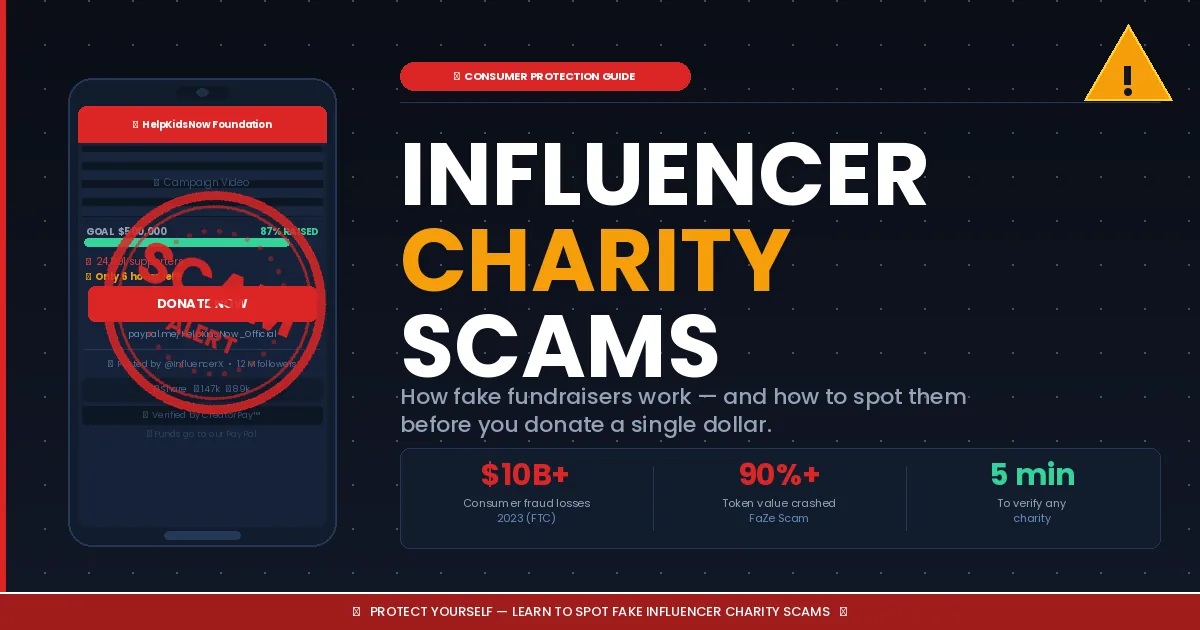
The Federal Trade Commission reported that consumers lost more than $10 billion to fraud in 2023 — a record. Charity fraud is one of the fastest-growing subcategories, and influencer-driven campaigns are an increasingly significant part of the problem.
How Do These Scams Work? A 5-Stage Playbook
Most influencer charity scams follow a predictable pattern. Once you recognize the stages, they become much harder to miss.
Stage 1: Choose a High-Emotion Cause
The influencer identifies a cause with maximum emotional pull — sick children, disaster victims, rescued animals, families in poverty. The cause doesn’t need to be invented; it just needs to generate enough emotional response that critical thinking takes a back seat. Real suffering is frequently used as the backdrop for fraudulent fundraising.
Stage 2: Create Urgency
“This fundraiser closes in 24 hours.” “Every dollar we don’t raise is a child without food tonight.” Artificial time pressure is a deliberate tactic, not a logistical reality. It prevents donors from pausing to research the campaign, verify the organization, or ask basic questions. In my experience tracking these campaigns, the presence of a countdown timer on a donation drive is one of the most consistent early warning signs.
Stage 3: Direct Money to an Opaque Channel
Instead of linking to a registered, independently audited nonprofit, the influencer directs funds to:
- A personal PayPal, Venmo, or Cash App account
- A GoFundMe they control directly with no named beneficiary organization
- A newly created LLC or “foundation” with no registration history
- A cryptocurrency wallet or “charity token”
This structure gives the influencer total control over the funds and zero external accountability. There is no mandatory reporting, no audit, and no legal obligation to forward the money to any cause.
Stage 4: Gamify the Donation
Donating is made social and visible. Top donors get shoutouts. Screenshots are encouraged. “Who can help us hit the goal?” becomes a community challenge. This framing transforms a financial decision into an act of group belonging — which significantly suppresses the instinct to scrutinize where the money actually goes.
Stage 5: Disappear and Move On
After the campaign closes, the influencer posts a vague “thank you” video with no financial breakdown, never publishes donation receipts, and pivots to the next content cycle. Followers who ask for accountability are typically ignored, dismissed as cynics, or blocked. The cause they championed is rarely mentioned again.
Three Real Cases That Show How Damaging This Gets
The FaZe SaveTheKids Scandal (June 2021)
Several members of the gaming collective FaZe Clan — including FaZe Kay, FaZe Jarvis, FaZe Nikan, and FaZe Teeqo — co-promoted a cryptocurrency token called “SaveTheKids” ($KIDS). The token was marketed with explicit charitable messaging: buy in, and a portion of the proceeds would benefit children’s charities worldwide.
The structure was a textbook pump-and-dump scheme with a charitable facade. The influencers held significant quantities of the token before publicly promoting it to their combined audiences of tens of millions. Once the price spiked on the back of that promotion, they sold their holdings. The token’s value dropped more than 90% within days. Fans who had purchased it based on the charitable framing lost real money. No credible documentation ever emerged demonstrating that meaningful charitable donations were actually made.
FaZe Clan suspended Kay, Jarvis, Nikan, and Teeqo pending an investigation. The incident became one of the most widely documented cases of influencer charity fraud and sparked widespread discussion about the regulatory vacuum around influencer-promoted cryptocurrency products.
The Myka Stauffer Exploitation Case (May 2020)
Myka Stauffer, a lifestyle creator on YouTube and Instagram, built an audience of several million followers by documenting her family’s adoption of a boy named Huxley from China, who had been diagnosed with autism and other neurological conditions. For years, she generated advertising revenue and brand sponsorships directly tied to Huxley’s story — his challenges, his milestones, and her portrayal of herself as his dedicated advocate.
In May 2020, she and her husband announced in a video that they had “rehomed” Huxley — transferred him to another family. The backlash was swift and substantial. Critics pointed out that she had monetized his vulnerability systematically: the brand deals, the sponsorships, the follower growth — all built on documenting a child with special needs, who was then surrendered when his care became more demanding than convenient.
This case is the defining example of cause exploitation: generating income and audience growth through the appearance of charitable caregiving while the actual human being at the center of it is treated as content rather than a child.
COVID-Era Influencer Relief Fund Fraud (2020–2021)
During the COVID-19 pandemic, the FBI’s Internet Crime Complaint Center documented a dramatic spike in charity fraud across social media platforms. Multiple content creators — particularly on TikTok and Instagram — launched “community relief funds” and “mutual aid drives” directing donations to personal payment accounts with no auditing, no named beneficiary organizations, and no post-campaign financial reporting.
In April 2020, the FBI and FTC issued a joint advisory specifically warning about fake charity campaigns exploiting pandemic urgency on social media. The combination of a genuine global crisis, heightened emotional vulnerability, and the absence of regulated donation channels made these scams exceptionally effective and exceptionally hard to trace.
What These Cases Have in Common
| Warning Sign | FaZe SaveTheKids | Myka Stauffer | COVID Relief Scams |
|---|---|---|---|
| No named registered charity | ✓ | ✓ | ✓ |
| Money flows through influencer first | ✓ (crypto) | ✓ (ad revenue) | ✓ (PayPal/Venmo) |
| Urgency or emotional pressure used | ✓ | ✓ | ✓ |
| No post-campaign financial accounting | ✓ | N/A | ✓ |
| Influencer confirmed to profit | ✓ | ✓ | ✓ |
| Third-party charity verification absent | ✓ | ✓ | ✓ |
Common Myths That Keep People Vulnerable — and How to Actually Verify
Myth 1: “A famous influencer wouldn’t risk their reputation on a scam.”
This is consistently disproved. The FaZe Clan members involved in SaveTheKids had combined audiences exceeding 50 million followers. Fame does not correlate with honesty. If anything, a larger audience means a larger potential haul from a fraudulent campaign — which increases the incentive rather than the deterrent.
Myth 2: “Platforms would take it down if it were fake.”
Platforms are not regulatory bodies. They do not verify charitable claims before a campaign goes live. Most fraudulent fundraisers are removed only after they’ve already collected money — sometimes days or weeks after the campaign closes. Reporting to a platform is useful, but it is not a protection mechanism before you donate.
Myth 3: “They showed a receipt or photo, so it must be real.”
Receipts can be fabricated. Photos can be staged. A screenshot of a bank transfer proves nothing about how the total donated sum was managed or distributed. The only reliable proof is third-party documentation — from a registered charity regulator, a published nonprofit filing, or an independent auditor — not content the influencer controls.
Myth 4: “Crypto charity tokens are an innovative giving model.”
In practice, charity-branded tokens have produced no documented high-profile case of meaningful charitable impact. Virtually every well-known example — with SaveTheKids being the most prominent — ended with buyers losing money and no verifiable charitable distribution. The model is structurally incompatible with accountability because there is no mechanism that requires proceeds to reach a named organization.
Myth 5: “It’s only a small donation — it doesn’t matter either way.”
Small amounts aggregate into substantial sums. Across thousands of donors, a $5 or $10 contribution becomes part of a total that can reach hundreds of thousands of dollars. More practically: participating, even at small scale, validates the campaign’s apparent credibility and provides cover for the influencer to claim widespread community support.
How to Verify Any Influencer Charity Campaign in Under 5 Minutes
From tracking influencer fundraising campaigns over several years, I’ve found the verification process is almost always this fast — and the results are usually decisive.
- Find the named charity. The influencer should identify a specific, registered nonprofit by its full legal name — not a vague cause (“helping kids”) or a personal fund (“my fundraiser”). If no named charity is specified, that alone is a red flag.
- Check its registration. Every legitimate charity must be registered with a government authority. In the US: use the IRS Tax Exempt Organization Search at apps.irs.gov or Charity Navigator at charitynavigator.org. UK: Charity Commission register. Australia: ACNC Charity Register. Canada: CRA’s charities directory. If the “charity” doesn’t appear in any of these, it is not legally a charity.
- Look at published financials. Registered nonprofits above certain revenue thresholds are legally required to publish audited financial statements. If the campaign’s “charity” has no published financials and no operational track record, proceed with extreme caution.
- Confirm where the money actually goes. Donations should flow directly to the registered charity’s own accounts. If money passes through the influencer — their PayPal, their LLC, their crypto wallet — first, that is a structural warning sign, regardless of how sincere the presentation seems.
- Search for independent coverage. Legitimate large-scale fundraising campaigns get covered by news outlets and charity watchdog organizations that are completely independent of the influencer. Zero external validation is meaningful information.
- Ask directly — and note what happens. Comment or message the influencer asking for the charity’s registration number and a breakdown of how funds will be allocated. Legitimate campaigns answer this promptly and specifically. Fraudulent ones deflect, delete the comment, or become hostile.
What Platforms and Regulators Are — and Aren’t — Doing
The response from platforms and government bodies has been partial and inconsistent.
YouTube has integrated verified nonprofit donation tools into its Live streaming feature, requiring that donations go to registered organizations rather than to creators directly. TikTok has partnered with charity verification services for some campaign types. Instagram has added fundraising tools that connect to Facebook’s verified nonprofit database.
However, enforcement across all platforms is reactive, not proactive. Fraudulent campaigns are removed after reports accumulate — rarely before. Influencers who run scams on one platform can migrate to another with minimal consequence. International creators, particularly those operating from outside US jurisdiction, face even less accountability.
On the regulatory side, the FTC updated its Endorsement Guides in 2023 to include stricter rules around misleading charitable claims made by paid or financially interested promoters. The FTC has pursued enforcement actions against several influencers for deceptive advertising practices, and charitable fraud is increasingly covered by those actions.
State attorneys general have been more aggressive than federal regulators in some cases. Several states — New York and California in particular — have active charitable fraud statutes with criminal penalties, and have pursued cases against online fundraisers who collected donations without delivering on charitable claims.
The regulatory gap remains significant. In practice, the primary protection is audience due diligence — not platform policy or government enforcement.
Frequently Asked Questions
Can you get your money back after donating to an influencer charity scam?
Recovery depends on the payment method used. Credit card donations can often be reversed through a chargeback — file with your card issuer as quickly as possible, since most allow disputes within 60 to 120 days. PayPal donations can be disputed through PayPal’s Resolution Center within 180 days. Cryptocurrency donations are nearly impossible to recover. In all cases, report the fraud to the FTC at reportfraud.ftc.gov and to your state attorney general’s consumer protection office.
Is it legally fraud for an influencer to keep charity donation money?
In most jurisdictions, yes. Soliciting funds under false charitable pretenses can constitute wire fraud under US federal law, and equivalent statutes exist in most countries. The legal burden is proving intent to deceive — which is why many influencers deliberately use vague language like “supporting the community” rather than making an explicit promise to a named registered charity.
Are GoFundMe campaigns run by influencers automatically trustworthy?
No. GoFundMe does not pre-verify charitable claims or confirm that funds will be delivered to a specific organization. The platform offers a limited donation guarantee for certain campaign types, but this does not cover all influencer-run fundraisers. Apply the same five-step verification process above to any GoFundMe campaign, regardless of who is running it.
Do influencers face real legal consequences for charity fraud?
Increasingly, yes. The FTC has expanded its enforcement to cover misleading charitable promotions under its updated Endorsement Guides. Multiple state attorneys general have pursued fraud charges under charitable solicitation statutes. Wire fraud prosecutions are possible under federal law, carrying penalties up to 20 years in prison. Enforcement remains under-resourced relative to the scale of the problem, but legal exposure for influencers has grown substantially since 2020.
How do I tell a legitimate influencer fundraiser from a fraudulent one?
Legitimate campaigns name a specific registered charity, link directly to that charity’s own donation page, and never route money through the influencer’s personal accounts. Post-campaign financial reports are published. Third-party news or charity watchdog coverage exists independently of the influencer’s own content. Verification requests are welcomed, not deflected.
What should I do if I’ve already donated to what looks like a scam?
Document everything immediately — screenshots of the campaign page, donation confirmation, and any communications. File reports with the FTC at reportfraud.ftc.gov, with the platform hosting the content, and with your state attorney general. Contact your bank or payment provider about reversal options. If significant money is involved, consult a consumer protection attorney.
Are there legitimate influencer charity campaigns?
Yes. MrBeast (Jimmy Donaldson) operates Beast Philanthropy as a registered 501(c)(3) nonprofit with published annual financials, dedicated staff, and independently verifiable charitable projects. Many creators run fundraisers that link directly to established organizations like Red Cross chapters, Médecins Sans Frontières, or local registered nonprofits. The consistent differentiator is always the same: the money goes to a verifiable registered entity, and the financial accounting is transparent and post-campaign.
Conclusion
Influencer charity scams work because they exploit the most powerful dynamic in modern media: parasocial trust. When someone feels they know a creator — their personality, their values, their apparent sincerity — they extend a level of credibility that conventional advertising has never achieved. Fraudulent influencers understand this and deploy it deliberately.
The protection is not blanket cynicism about every charitable campaign. It is a five-minute verification habit: name the charity, check the registration, confirm where donations actually go, and look for third-party confirmation. If a campaign cannot survive those four checks, it should not survive your wallet.
If you encounter a campaign that looks fraudulent, report it — to the platform, to the FTC at reportfraud.ftc.gov, and to your national charity regulator. Every report contributes to the enforcement record that makes legal action possible.
The influencers running genuine charity campaigns are strengthened, not weakened, when their audiences demand transparency. The ones who resist that scrutiny have already given you their answer.
Deep knowledge, easy reading—our simplified expert guides do both perfectly.