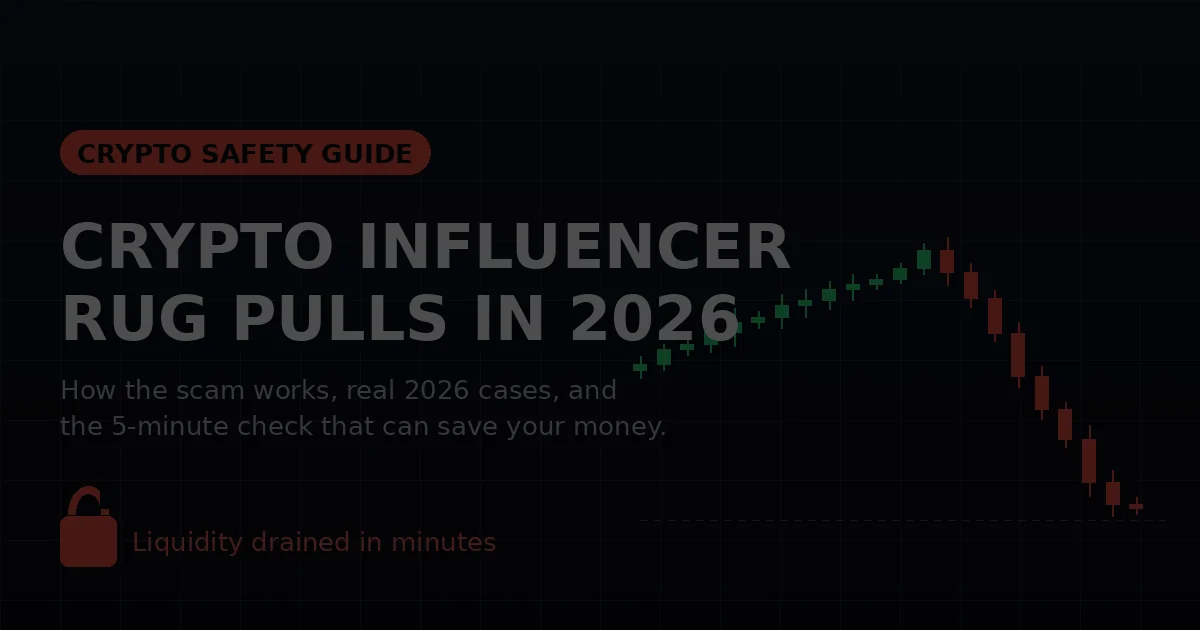
A crypto influencer rug pull happens when a content creator promotes a token they secretly control, then drains liquidity or dumps their holdings once followers buy in. In 2026, this remains one of the fastest-growing fraud categories in DeFi, with losses tracked in the billions and new cases surfacing almost weekly. Here’s how the scam actually works, real 2026 cases, and how to check before you buy.
In my own review of dozens of 2026 cases, the pattern rarely changes: an account with a large, trusting audience promotes a brand-new token, the price spikes on FOMO, then liquidity vanishes within minutes or hours. What changes is the disguise.
What Is a Crypto Influencer Rug Pull?
A crypto influencer rug pull is a scam where a social media personality promotes a token they have a financial stake in, then exits before followers can sell. The influencer either controls the liquidity pool directly, holds a large pre-mined allocation, or is paid by the real developers to generate buying pressure they know will collapse.
It differs from a generic rug pull mainly in the trust mechanism. A random anonymous token launch relies on hype bots and paid Telegram groups to build momentum. An influencer-driven rug pull skips that step entirely, because the audience already trusts the person posting. That trust is the product being sold.
Three structures show up again and again in 2026 cases. In the first, the influencer is the developer, quietly deploying the token from a wallet not publicly linked to their name. In the second, the influencer is paid a flat fee or a percentage of token supply to promote a project someone else built, often without disclosing the arrangement. In the third — the one South Korean prosecutors describe in a case brought this June — the “influencer” is entirely fabricated, an AI-generated or impersonated persona built specifically to run one scam and disappear.
How Do Crypto Influencer Rug Pulls Actually Work?
Most influencer rug pulls follow a five-stage sequence: build an audience, launch or promote a token, generate artificial urgency, let retail buyers pile in, then drain liquidity or dump the pre-allocated supply within hours. The entire cycle often takes less than three days from launch to collapse.
Step 1: Audience-building. The influencer spends months or years posting legitimate trading content, market analysis, or lifestyle content to earn follower trust. This groundwork is what makes the eventual scam effective — it’s also what makes these cases so damaging, since real relationships get exploited.
Step 2: The token launch. A new token appears, usually on a low-cost chain like Solana or BNB Chain where deployment takes minutes and costs almost nothing. The influencer either announces they’ve “found” a promising new project or reveals they’re “finally launching my own coin.”
Step 3: Manufactured urgency. Posts emphasize a tiny market cap, a “few spots left,” or a countdown. Screenshots of supposed early gains circulate, often from wallets the promoter controls. This mirrors classic pump-and-dump tactics, just filtered through a trusted face instead of an anonymous Telegram admin.
Step 4: The pump. Retail buyers rush in during a narrow window, frequently the first 15–60 minutes after launch. Chart tools later show one-sided buying with almost no sell pressure — a pattern experienced traders recognize as a red flag in real time, but new buyers rarely check.
Step 5: The exit. Liquidity gets pulled, or the influencer’s wallet dumps its allocation, and price collapses toward zero within minutes. On decentralized exchanges, this is instant and irreversible; there’s no customer support line to call and no transaction to undo.
Real Crypto Influencer Rug Pull Cases from 2026
Several documented 2026 cases show how this plays out across different regions and levels of sophistication.
The WORLD token case. In late May 2026, blockchain analytics platform Lookonchain linked wallets connected to trader James Wynn to a token called WORLD, which lost its liquidity shortly after launch. Wynn claimed his account had been compromised, a defense many in the crypto community publicly doubted. Wynn had already built a controversial reputation from earlier high-leverage trading losses that wiped out much of his visible holdings.
South Korea’s first criminal rug pull prosecution. In June 2026, prosecutors indicted five people over a meme coin called CATFI, allegedly promoted through a fabricated online persona nicknamed “Eth Father.” Investigators say the account was actually run by the case’s suspected ringleader, and that the group accumulated the token before hyping it to unsuspecting buyers. This marked the country’s first criminal case built specifically around a rug pull scheme.
The NYC token controversy. In January 2026, a former New York City mayor launched a Solana-based token that fell more than 80% within its first hour of trading, prompting public accusations of a rug pull. The politician denied moving or profiting from the funds, but the episode illustrated how quickly a public figure’s endorsement — political or otherwise — can trigger the same collapse pattern seen in anonymous scams.
Binance Alpha listings under scrutiny. Two tokens featured on Binance’s Alpha platform, PIGGY and Bedrock, suffered violent crashes in early 2026 after sudden minting events and large liquidity withdrawals, raising questions about how much vetting even exchange-endorsed listings actually receive before influencers start promoting them.
These cases share a common thread: audience trust, a fast launch, and an exit measured in minutes.
How to Spot an Influencer Rug Pull Before You Buy
You can catch most influencer rug pulls before losing money by checking five things: wallet history, liquidity lock status, token distribution, disclosure language, and timing pressure. None of these checks take more than a few minutes.
| Red Flag | What to Check | Free Tool |
|---|---|---|
| Undisclosed promotion | Look for “#ad” or paid partnership language; assume payment if absent and price movement is unusually fast | Manual review of post history |
| Unlocked liquidity | Confirm the LP tokens are locked for 6+ months on the actual trading pair, not a decoy token | Team Finance, PinkLock |
| Concentrated supply | Check if the top 10 wallets hold more than 20–30% of total supply | Bubblemaps, Solscan/Etherscan |
| No sell activity | If every visible trade is a buy with no sells, it may be a honeypot | Honeypot.is, GoPlus |
| New or reused wallet | Search whether the promoting wallet has any history beyond this one token | DEXTools, Solscan |
Step-by-step check before buying anything promoted online:
- Pull the contract address, never trust a link pasted in a comment or DM.
- Run it through a honeypot checker to confirm you can actually sell.
- Check liquidity lock duration and the unlock recipient address.
- Look at holder concentration for wallets funded from the same source.
- Search the promoter’s wallet history for prior token launches and their outcomes.
- Wait at least one hour before buying anything marketed with urgency language.
That sixth step alone filters out a large share of these scams, since the entire model depends on buyers acting before they think.
Common Mistakes and Myths About Influencer Rug Pulls
Myth: “A big following means the project is safe.” A large audience only proves the person is good at building trust, not that the token is legitimate. Some of the most damaging 2026 cases involved creators with years of credible content behind them.
Myth: “Locked liquidity means it can’t be rugged.” Short lock periods of one to two weeks, or upgradeable contracts that let developers rewrite the rules after launch, both defeat a liquidity lock. The lock has to cover the actual trading pair, run at least six months, and sit on a non-upgradeable contract to mean anything.
Mistake: Treating a verified badge or exchange listing as full vetting. Even tokens featured on major exchange launch platforms have crashed from sudden minting or liquidity withdrawal this year, showing that a listing reduces risk but doesn’t eliminate it.
Mistake: Buying because “everyone else is.” Coordinated hype — multiple accounts posting the same token within the same hour, bot-filled group chats with thousands of members but almost no real conversation — is a manufactured signal, not organic demand.
Comparison: Rug pull vs. pump-and-dump. A rug pull typically involves direct control over liquidity or contract permissions, so the exit is instant and total. A pump-and-dump relies on coordinated selling pressure from insiders holding a large token share, so the collapse can take hours instead of minutes. Influencer scams frequently blend both, using promotion to pump and either a dump or a liquidity pull to finish the job.
Frequently Asked Questions
Is promoting a crypto token illegal if the influencer doesn’t disclose payment? In most jurisdictions, undisclosed paid promotion can violate securities or consumer protection rules, and regulators have increasingly pursued these cases. Whether it’s prosecuted depends on local law, whether the token is classified as a security, and provable intent to deceive.
Can I get my money back after an influencer rug pull? Blockchain transactions are irreversible, so recovery is rare. Some victims have worked with chain analytics firms to trace stolen funds and filed reports with law enforcement, which occasionally leads to frozen exchange accounts or, as in South Korea’s June 2026 case, criminal prosecution.
How do I know if an influencer actually holds the token they’re promoting? Ask for the wallet address and check it independently on a block explorer. A legitimate promoter will share this without hesitation; reluctance or vague answers about “the team handling that” is itself a warning sign.
Are influencer rug pulls more common on certain blockchains? Yes. Low-cost, high-speed chains like Solana and BNB Chain see the highest volume because deploying a new token takes minutes and costs almost nothing, making rapid hit-and-run launches far more practical than on more expensive networks.
What’s the difference between a rug pull and an exit scam? The terms overlap heavily, but an exit scam more often describes a longer-running project — sometimes months of legitimate-looking activity — before the team disappears with funds, while a rug pull is typically faster, sometimes collapsing within hours of launch.
Do celebrity or political endorsements make a token safer? No. Several 2026 cases, including a token launched by a former big-city mayor, show that a public figure’s involvement doesn’t reduce contract risk or guarantee locked liquidity. It only adds another layer of trust for scammers to exploit if the endorsement itself is the vehicle for the scam.
Should I trust a token just because it’s listed on a major exchange’s launch platform? Treat a listing as one data point, not full vetting. Tokens featured on exchange launch platforms have still suffered sudden crashes from minting exploits and liquidity withdrawals in 2026, so independent checks remain necessary.
Conclusion
Crypto influencer rug pulls succeed because they borrow trust that took years to build and spend it in minutes. The technical patterns — unlocked liquidity, concentrated holdings, manufactured urgency — are consistent enough that a five-minute check catches most of them before money changes hands. Before you buy anything promoted online, run the contract through a honeypot checker, verify the liquidity lock, and give yourself at least an hour to think it over. If a promoter won’t share their wallet address or gets defensive when asked, that’s your answer.
This article is for informational purposes only and does not constitute financial advice. Cryptocurrency investments carry significant risk of loss.
The information you need, delivered right—dive into our premium content picks.