The creator economy is worth over $250 billion — and most businesses built inside it fail. Not quietly. Publicly, expensively, and in ways that damage audience trust for years.
Between 2020 and 2025, thousands of creator-led products, apps, food brands, and agencies launched with massive fanfare. A fraction survived. The rest left behind refund requests, lawsuits, collapsed valuations, and audiences who felt burned by people they thought they knew.
From MrBeast Burger’s shutdown to Ninja’s $30 million Mixer disaster and Logan Paul’s CryptoZoo collapse, the failure patterns are consistent, predictable, and largely avoidable.
This analysis breaks down exactly why creator businesses fail, what the data reveals, and what the survivors did differently.
What Is a Creator Business — and Why Is It Structurally Different?
A creator business is any commercial venture — merchandise line, app, food product, online course, or agency — that uses a creator’s personal brand as its primary growth engine. Unlike traditional businesses, the founder’s identity and the product are deeply fused. That’s the core advantage. It’s also the central structural flaw.
Traditional businesses fail when they run out of cash, lose product-market fit, or face stronger competition. Creator businesses face all of that — plus one additional failure mode that no business school teaches: the creator themselves becomes the liability.
When a creator’s reputation shifts, the business collapses immediately. No traditional CEO faces this problem. When Johnson & Johnson faces a PR crisis, the brand survives because the brand isn’t the CEO. When a creator faces a reputation event, the business often doesn’t survive because the brand is the creator.
This changes the entire risk architecture. Creator businesses are fundamentally reputation-dependent. Revenue flows from trust. Lose the trust — whether through a scandal, a public failure, or a broken product promise — and the business loses its primary fuel overnight.
This distinction is critical to understand before analyzing any specific failure. Every case study in this piece traces back to this structural reality in one form or another.
Why Do Most Creator Businesses Fail? The Core Reasons
Most creator businesses fail due to four core patterns: audience-product mismatch, over-reliance on a single platform, operational scaling failure, and the creator’s inability to maintain content while running a business. Each pattern compounds the others.
1. Audience-Product Mismatch
This is the leading cause of failure. A creator attracts followers through a specific type of content — entertainment, humor, lifestyle documentation, technical education — then attempts to sell them something unrelated to why they subscribed.
A gaming creator launching a skincare line. A commentary channel selling nutrition supplements. A vlog-based creator launching a B2B software tool. The audience doesn’t transfer, because the audience followed the content persona, not the brand identity.
After reviewing dozens of documented creator product launches, the clearest pattern is this: the products that die fastest require the audience to reimagine who the creator is. The products that survive feel like an obvious next step.
Emma Chamberlain’s Chamberlain Coffee is the clearest modern example of alignment done right. Coffee is embedded in her content — she’s been filming herself making coffee for years. When she launched the brand, she didn’t ask her audience to believe something new about her. She simply offered them what they already associated with her. The business followed naturally from the content identity.
Most failed creator product launches do the opposite.
2. Platform Dependency — The Single Point of Failure
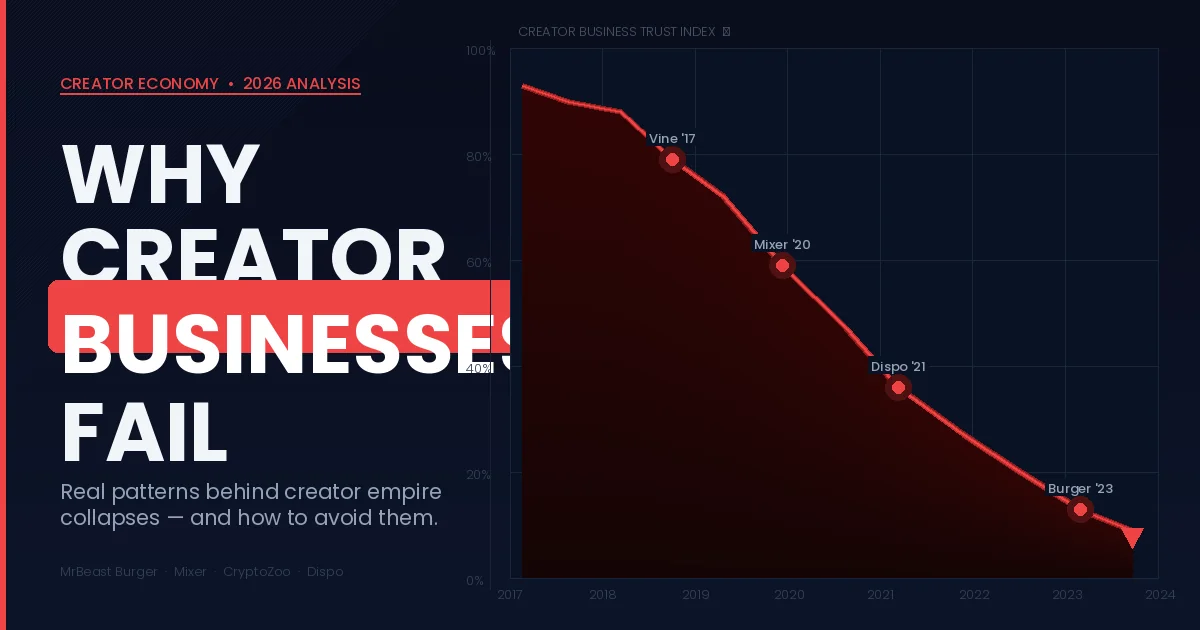
In 2019, Tyler “Ninja” Blevins — the most-followed streamer in the world at the time, with over 14 million Twitch followers — signed an exclusive streaming deal with Microsoft’s Mixer platform. The deal was reportedly worth between $20 and $30 million. In July 2020, after just 14 months, Microsoft shut Mixer down entirely.
Ninja’s audience on Mixer hadn’t organically transferred from Twitch — it was a partially cultivated, partially new audience tied to a single platform. When the platform died, the distribution infrastructure died with it. He returned to Twitch, but the moment had passed.
The business lesson is stark: a creator’s platform is their distribution channel. Abandon the platform, lose the audience. Lose the audience, lose the business.
When Vine shut down in January 2017, this lesson became industry-defining. Creators like King Bach, who had over 16 million Vine followers, discovered that follower counts on a shuttered platform convert to nothing. The creators who survived — like Lele Pons, who treated Vine as a traffic source and aggressively built YouTube audiences simultaneously — had diversified before the collapse forced them to.
The creators who failed treated the platform as the business. It never is. The audience is the business.
3. Operational Failure: The Gap Between Brand and Execution
Most creators are world-class at content and genuinely under-skilled in operations. This isn’t a character flaw — it’s a skills gap that most creators don’t discover until they’re already mid-launch.
Running supply chains, managing fulfillment centers, leading customer service teams, tracking unit economics, negotiating with manufacturers, and handling inventory forecasting are entirely different disciplines than editing video or building an audience. The skills don’t transfer.
MrBeast Burger launched in November 2020 as a virtual restaurant chain delivered through ghost kitchens — commercial restaurant kitchens that prepare food for delivery-only brands. At its peak, the operation ran in over 1,700 locations across the United States. The model was designed for speed, not quality control.
Customers received wrong orders. Food quality was inconsistent across locations. Online reviews showed massive variance between markets. By August 2023, Jimmy Donaldson (MrBeast) filed a lawsuit against Virtual Dining Concepts, the company that operated the restaurant network, arguing the brand had caused “irreparable harm” to his reputation. The burger chain effectively shut down.
The brand, the content marketing, and the initial product-market fit were all legitimate. The execution wasn’t — because execution requires operational expertise that a content creator doesn’t automatically possess. VDC’s business model depended on ghost kitchen partners who had no skin in the MrBeast brand’s long-term reputation.
This is a recurring structure in failed creator businesses: the creator supplies brand equity, and a third-party operator supplies execution — with misaligned incentives on quality control.
4. The Content-Business Attention Divide
Content is what maintains the audience. Business is what monetizes the audience. When creators prioritize the business over content, they gradually lose the audience that makes the business viable. When they prioritize content over the business, the business collapses from operational neglect.
There’s no easy resolution to this tension — but there is a workable strategy. Creators who successfully launched businesses typically maintained their content output within 20% of their baseline posting frequency during the business launch period. Those who allowed content to drop 50% or more during a major business push saw measurable audience disengagement in the same window.
The audience doesn’t wait. And the algorithm doesn’t wait. Both continue moving, whether the creator is focused on their business or not.
Real Creator Business Failures: The Case Studies
Case Study 1: Dispo — Brand Collapse Before Launch
David Dobrik co-founded Dispo, a photo-sharing app built around the nostalgic concept of disposable cameras, in 2021. The app attracted significant venture funding and was generating early cultural buzz. Then, in March 2021, a sexual assault allegation involving a member of Dobrik’s friend group triggered a wide-scale advertiser and investor withdrawal.
Spark Capital, one of Dispo’s prominent investors, publicly announced its exit. Dobrik stepped down from the company’s board. Without the creator-founder at the center of the identity, Dispo lost the only differentiator that made it interesting to investors and users. The app went through multiple pivots, never recaptured early momentum, and faded from cultural relevance.
This case illustrates one of the most underappreciated risks in creator businesses: the founder is the product. A reputational event doesn’t just damage the creator’s personal brand. It simultaneously compromises the business’s funding relationships, partnership pipeline, and user acquisition thesis — all at once, with no separation between the personal and the commercial.
Case Study 2: Logan Paul’s CryptoZoo — Leveraging Trust as Capital
In late 2021, Logan Paul promoted CryptoZoo, an NFT-based game where participants could purchase digital eggs, hatch creatures, and breed animals on a blockchain. The project raised millions through NFT sales, largely from Paul’s audience of tens of millions of followers.
The game was never fully built. Promised features were delayed indefinitely. The ecosystem of NFT-based animals that buyers purchased became worthless as development stalled. Investigative journalist Stephen “Coffeezilla” Browder published a three-part series in December 2022 detailing how the project had failed its buyers and exposing the gap between what was promised and what was delivered. Lawsuits followed. Paul eventually proposed a refund plan, but the project’s credibility was irreparably damaged.
The specific failure pattern here is what makes this case instructive beyond the drama: treating audience trust as startup capital. When a creator uses their followers’ goodwill to raise money for an unproven, incomplete product, they’re borrowing against a non-renewable resource. Trust, once converted into financial transactions that don’t deliver, doesn’t regenerate to its prior level.
Case Study 3: The 2021–2023 Creator NFT Collapse
Between mid-2021 and early 2022, hundreds of creators across music, art, comedy, fitness, and gaming launched NFT collections. Some were genuine creative projects. Many were poorly conceptualized attempts to monetize audience loyalty through speculative digital assets.
When the NFT market began its steep decline in 2022 — average NFT sale prices fell by over 90% during that cycle — most of these collections became near-worthless. Creators who had attached business promises to their NFTs — exclusive content, merchandise access, live events, Discord communities — found themselves unable or unwilling to deliver.
The financial loss was borne by the fans. Unlike a poor-quality merch drop, where a buyer receives a substandard product, a collapsed NFT project leaves buyers holding a digital file worth a fraction of its purchase price, with no recourse and no product at all. This made the audience damage uniquely lasting in the creator NFT failures — not just a business failure, but a financial harm that fans experienced directly.
What Do Successful Creator Businesses Do Differently?
The contrast between failed creator businesses and successful ones comes down to five consistent differences — not talent, not audience size, not even luck.
| Dimension | Failed Creator Businesses | Successful Creator Businesses |
|---|---|---|
| Product-audience fit | Low — product unrelated to content identity | High — natural extension of what the creator represents |
| Platform dependency | Single platform, no owned audience | Multi-platform + email list + community platform |
| Operational structure | Creator-operated solo or with a misaligned partner | Dedicated ops team hired early with domain expertise |
| Content output | Dropped significantly during business launch | Maintained consistently throughout build and launch |
| Revenue model | Single product, single launch | Tiered products, recurring revenue, multiple streams |
| Audience trust usage | Leveraged as startup capital for unproven products | Protected; validated before any financial ask |
Mythical Entertainment, built by Rhett McLaughlin and Link Neal (of Good Mythical Morning), represents what this looks like in practice. They built operations infrastructure — a full production company, merchandise operation, and branded content studio — while maintaining one of the most consistent upload schedules in YouTube history. The business grew around the content rather than competing with it for their attention.
The Chamberlain Coffee example, similarly, succeeded in part because Emma Chamberlain brought in an experienced consumer brand operator (Matthew Smith, with prior CPG experience) rather than running the business herself. She remained the brand. Someone else ran the business.
That division of responsibility is the structural insight most creator business failures miss.
Common Myths That Drive Creators Into Failed Businesses
Myth 1: “My Audience Will Buy Anything I Make”
This is the most expensive myth in the creator economy. Audience size creates reach, not unconditional purchasing power. Parasocial connection produces loyalty to the creator — not loyalty to any product the creator endorses or launches.
A viewer who watches daily vlogs may love the creator and still refuse to spend money on a product that doesn’t fit their own life. The gap between engagement and purchase intent is always larger than creators expect — and it shows up at the worst possible moment, which is after a product is already manufactured.
Myth 2: “Speed Is the Competitive Advantage”
Creators are rewarded for speed in content. Frequent uploading, fast responses to trends, rapid iteration on formats — these behaviors are genuinely rewarded by algorithms and audiences. That lesson does not transfer to physical product businesses.
MrBeast Burger’s decision to scale to 1,700 ghost kitchen locations at speed produced unmanageable quality variance. The speed that built the audience became the liability that damaged the business. Operational businesses — food, physical merchandise, apps — have quality floors that speed cannot replace.
Myth 3: “Viral Reach Equals Business Demand”
Viewership and purchase intent are different things. A creator who achieves 50 million views on a single video cannot reliably assume that 1% — 500,000 people — will buy a related product. Viewership measures entertainment value. Purchase intent measures whether someone wants to solve a problem badly enough to spend money.
Most failed creator merchandise launches misread viral engagement as purchase validation. The actual validation is a waitlist with a deposit, a pre-order campaign, or a small-batch test at limited scale.
Myth 4: “The Audience Will Forgive a Business Failure”
For a brief period, some audiences do show loyalty when a business stumbles. But the creator economy runs on parasocial contracts — implicit agreements between creator and viewer about authenticity, reliability, and trustworthiness. When a creator launches a product that fails to deliver, misrepresents quality, or financially harms fans directly, that contract breaks.
Rebuilding after a significant business failure typically takes 18–36 months of consistent, non-commercial content output before audience trust returns to pre-failure levels — if it returns at all.
FAQ: Failed Creator Businesses
Why do so many creator businesses fail?
Most creator businesses fail because creators treat audience size as market validation. A large following provides reach but not guaranteed purchase intent. Without product-market fit, operational expertise, and maintained content output, even well-funded creator businesses typically collapse within 24 months of launch. The core issue is a skills mismatch: content creation and business operations require fundamentally different competencies.
What percentage of creator businesses fail?
Precise industry-wide data is limited. However, Linktree’s 2023 Creator Economy Report found that only 12% of full-time creators earn over $50,000 annually — suggesting the overall business sustainability rate is low. Creator businesses face failure rates similar to or higher than traditional small businesses, which the U.S. Bureau of Labor Statistics estimates fail at approximately 45% within the first five years.
What was the biggest creator business failure?
In financial terms, the Ninja/Mixer situation ranks among the largest — a reported $20–30 million exclusive streaming deal that produced no lasting business infrastructure when Microsoft shut Mixer down in 2020. By brand scale and public impact, MrBeast Burger’s collapse stands out, given it operated in over 1,700 locations before shutting down and resulted in a lawsuit between Jimmy Donaldson and his operating partner.
Can a creator business recover after a major failure?
Yes, but recovery requires a specific sequence: return to consistent content creation first, address the failure transparently with the audience second, and delay any new commercial venture until audience trust signals recover. Creators who attempt to re-monetize immediately after a business failure typically accelerate their audience decline rather than reversing it.
Which types of creator businesses have the highest failure rate?
NFT-based projects, virtual restaurant chains built on ghost kitchen networks, creator-launched apps without a technical co-founder, and merchandise lines launched without pre-order validation all show particularly high failure rates. The common thread across all of them: high capital requirements, high operational complexity, and a creator who has expertise in brand but not in the underlying business domain.
How should a creator validate demand before launching a business?
The most reliable methods are pre-order campaigns (with payment collected upfront), waitlist sign-ups with email capture, and small-batch limited drops tested at real price points. Each of these methods measures actual purchase intent rather than engagement metrics. A video getting 5 million views generates audience data; 500 pre-orders at $49 each generates business data. These are different signals, and only one of them predicts whether a business will survive.
What role does team-building play in creator business success?
It’s decisive. Successful creator businesses — Chamberlain Coffee, Mythical Entertainment, MKBHD’s media operation — brought in operators with domain-specific expertise early. Failed creator businesses typically had the creator at the center of both content and operations simultaneously, which creates unsustainable cognitive load and eliminates the specialization that competent businesses require.
Is the creator business model fundamentally viable?
Yes — but only when the creator brand is treated as infrastructure rather than a marketing shortcut. Creators who build operational teams, protect audience trust as their primary asset, validate products before scaling, and maintain content output have demonstrated that the model works. The business model is sound. The execution disciplines required to make it work are the gap most creators never close.
Conclusion
Failed creator businesses don’t fail randomly. They fail along predictable lines — audience-product mismatch, platform dependency, operational under-investment, and the misuse of audience trust as startup capital. Every major collapse in the past five years maps directly onto one or more of these patterns.
The creators who build lasting businesses share one foundational mindset: the audience is a relationship to protect, not a resource to extract. They maintain content output when the business gets hard. They hire operators for functions outside their expertise. They validate demand before committing capital. And they treat transparency — especially about failures — as an asset rather than a liability.
The business skills required in the creator economy are learnable. The operational infrastructure required is buildable. But neither of those things happens automatically. Creator talent is the starting point. It’s never the whole business.
If you’re a creator planning a product launch in 2026, the most important question isn’t what to sell. It’s whether you have the operational capacity to deliver what you’re about to promise — and whether you’re willing to test that at small scale before staking your audience’s trust on it.
That discipline is what separates creator businesses that last from the ones that become cautionary case studies.
Ready to take the next step? Our expert posts are here to guide your journey.