Federal prosecutors charged influencer Tai Lopez with running a $112 million fraud in September 2025. Months later, Columbus podcaster Tyler Bossetti was sentenced to six years for a $20 million real estate Ponzi scheme he sold through Facebook and YouTube. These aren’t isolated incidents.
In my review of federal court filings and SEC enforcement data, social media has become one of the most effective distribution channels for Ponzi schemes in history. This guide breaks down how these frauds actually work, walks through the highest-profile cases of the past two years, and gives you a practical checklist to protect your money.
What Is a Ponzi Scheme Influencer Case, Exactly?
A Ponzi scheme influencer case is a fraud in which a social media personality uses their audience and perceived credibility to solicit investments, then pays early “returns” using money from new investors rather than actual profits. The influencer’s follower count and lifestyle branding replace the due diligence investors would normally demand from a licensed advisor.
The mechanics are the same as any classic Ponzi scheme first identified with Charles Ponzi in 1920. What’s different is the recruitment engine. Instead of door-to-door sales pitches or cold calls, the pitch arrives as a YouTube testimonial, an Instagram story showing a rented Lamborghini, or a TikTok claiming “guaranteed” returns of 20% or more per month.
I’ve found three features that distinguish influencer-driven schemes from traditional ones:
- Parasocial trust. Followers feel like they “know” the influencer, which lowers their guard.
- Manufactured proof. Screenshots of account balances, unboxing videos, and “verified” payout stories create social proof that’s easy to fake.
- Speed of scale. A single viral post can pull in thousands of investors in days, something a traditional fraudster could never achieve through personal networks alone.
How Do These Schemes Actually Work? A Step-By-Step Breakdown
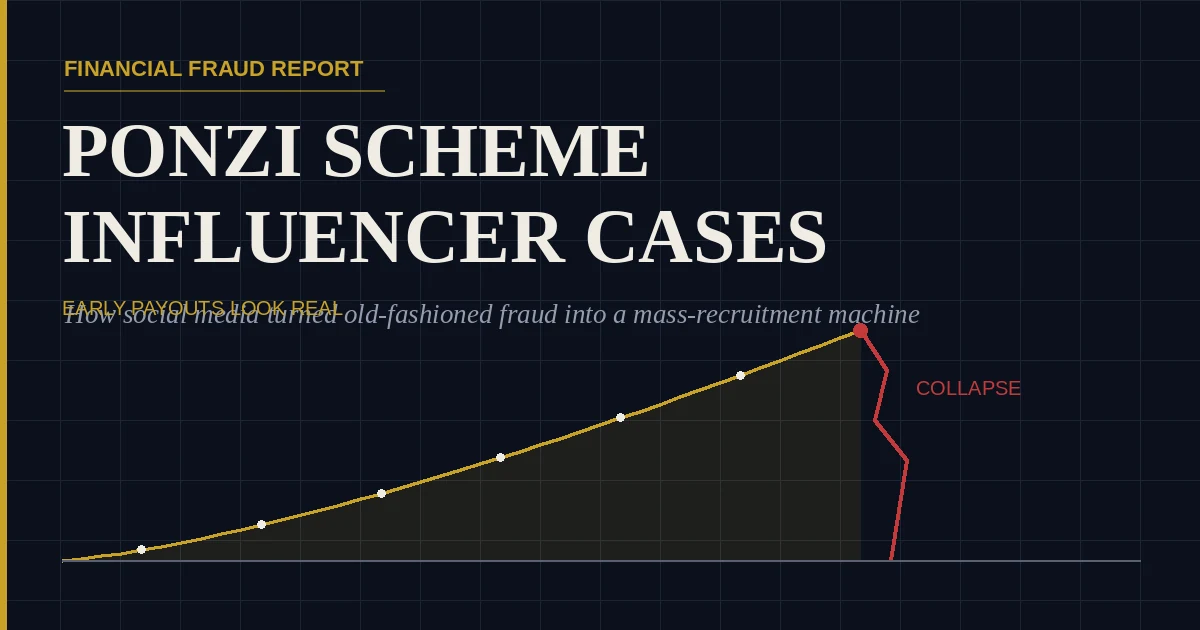
Most influencer Ponzi schemes follow a five-stage pattern: build an audience, pitch an exclusive opportunity, pay early investors from new deposits, use those payouts as marketing proof, then collapse once withdrawals outpace new deposits. Understanding each stage helps you recognize the pattern before you’re the one funding it.
- Audience building. The influencer spends months or years establishing credibility through unrelated content — fitness, motivation, business tips, crypto commentary — before pivoting to an investment pitch.
- The pitch. An “exclusive” opportunity is framed as too good to advertise publicly: real estate flips, crypto arbitrage, forex trading bots, or e-commerce brand acquisitions.
- Early payouts. The first cohort of investors gets paid on time, sometimes even early, funded entirely by cash from the next wave of depositors.
- Proof-of-concept marketing. Those early payouts become testimonials. Investors post their own “look, it worked!” content, which the influencer amplifies, creating a feedback loop of apparent legitimacy.
- Collapse. Once new deposits slow — often triggered by a market downturn, a whistleblower, or simple saturation — the operator can’t cover withdrawal requests, and the scheme unravels.
<br>
| Stage | What Investors See | What’s Actually Happening |
|---|---|---|
| Recruitment | Polished videos, lifestyle content, “insider” access | Building a pipeline of new capital |
| Early returns | Consistent, sometimes high payouts | New investor money funding old investor “profits” |
| Growth phase | Testimonials, referral bonuses, urgency | Classic pyramid-style expansion |
| Collapse | Delayed withdrawals, excuses, silence | Cash inflow can no longer cover outflow |
Real Ponzi Scheme Influencer Cases From 2025–2026
Regulators brought several major influencer-linked Ponzi cases in the past 18 months, spanning real estate, retail e-commerce, and cryptocurrency, with combined investor losses well into the hundreds of millions of dollars. Here are the cases that best illustrate the pattern.
Tai Lopez and Retail Ecommerce Ventures ($112 Million)
In September 2025, the SEC filed a complaint in the Southern District of Florida alleging that social media influencer Tai Lopez and technology entrepreneur Alex Mehr, co-founders of Retail Ecommerce Ventures (REV), raised money from hundreds of investors between April 2020 and November 2022 through fraudulent securities offerings tied to distressed retail brands the company had acquired, including RadioShack, Dressbarn, and Pier 1 Imports. Related reporting put the total raised at over $230 million from 660 investors nationwide.
According to the SEC, none of REV’s portfolio companies were actually profitable, and the defendants allegedly kept up appearances by paying existing investors using new investor funds, merchant cash advances, outside loans, and intercompany transfers. The complaint states at least $5.9 million in investor returns were funded in this Ponzi-like fashion, while Lopez and Mehr allegedly misappropriated roughly $16 million for personal use.
What makes this case a textbook example: internal documents allegedly showed Dressbarn losing $13.7 million in 2020 and Stein Mart posting net losses in the same period, even as Lopez told investors the brands were thriving. This is a recurring pattern — the gap between internal financials and public messaging is often where fraud investigators find their strongest evidence.
Tyler Bossetti and Boss Lifestyle ($20 Million)
Columbus-based podcaster Tyler Bossetti built an audience of nearly 100,000 followers before pivoting to investment promotion. From 2019 until 2023, Bossetti widely publicized a real estate investment program through his company, Boss Lifestyle LLC, guaranteeing large rates of return for short-term investments and advertising them through Facebook and YouTube, often promising thirty percent or more.
He received more than $23 million in investments from victim investors throughout the United States and abroad, and dozens of investors ultimately lost more than $11 million. Bossetti was charged in spring 2025, pleaded guilty in June of the same year, and was sentenced in April 2026 to 72 months in federal prison.
Court records show he used investor funds for rental payments on a downtown condo, frequent travel, a $150,000 Mercedes SUV, and various cryptocurrency investments — a personal-enrichment pattern investigators see in nearly every case of this kind.
The IcomTech Crypto Ponzi Network
Not every case involves a single headline name. IcomTech was a purported cryptocurrency mining and trading company that launched in mid-2018 and promised investors profits in exchange for crypto-related investment products, but was in reality a multi-level-marketing Ponzi scheme. Federal prosecutors have secured multiple convictions against its network of senior promoters, one of whom was sentenced to nearly six years in prison for helping prey on Spanish-speaking victims who lacked investment experience, according to the U.S. Attorney’s Office for the Southern District of New York.
This case matters because it shows how “influencer” doesn’t always mean a celebrity with millions of followers. Multi-level promotion structures create dozens of micro-influencers, each recruiting within their own trusted community.
Impersonation Schemes: When Fraudsters Fake the Influencer
A newer variant skips real influencers entirely. In one case, a New York man was sentenced to 15 months in prison after creating fake Telegram handles to imitate popular crypto influencers, collecting more than $1.4 million from victims by falsely claiming he could generate returns through cryptocurrency staking. Thousands of people joined the impersonator’s channel before the fraud was uncovered.
This tells you that even real influencers can’t fully protect their followers — bad actors will clone their identity if the audience is valuable enough.
Why Are These Schemes So Common Right Now? Data and Trends
Ponzi scheme prosecutions tied to social media promotion have risen sharply because enforcement priorities shifted, crypto lowered the barrier to launching a fake investment product, and platforms make audience-building nearly free. The numbers back this up.
The SEC’s enforcement report for fiscal year 2025 shows the agency filed 456 enforcement actions and secured orders for monetary relief totaling approximately $17.6 billion, including $10.8 billion in disgorgement and prejudgment interest and $7.2 billion in civil penalties. Among the highlighted cases, the SEC charged an individual and his companies with operating a large-scale Ponzi scheme that raised over $770 million from approximately 2,700 investors — one of the largest of the year.
In my experience tracking these filings, three forces are converging:
- Crypto’s low barrier to entry. Anyone can launch a token or “staking” product with no licensing, no audit, and minimal technical skill, then promote it as a can’t-miss opportunity.
- Post-pandemic financial anxiety. Rising living costs pushed more people toward “passive income” pitches promising fast, guaranteed returns.
- Platform incentives. Algorithms reward high engagement and lifestyle content, which is exactly the aesthetic Ponzi promoters rely on to build perceived credibility.
The Department of Justice’s crypto-related sentencings alone in the past year — including cases in Oklahoma, New York, and Maryland — show this isn’t confined to one platform, one country, or one asset class.
There’s also a structural reason these schemes last as long as they do. Traditional Ponzi schemes relied on word of mouth within a limited social circle, which naturally capped how fast they could grow and how long they could survive before someone asked too many questions. Influencer-driven schemes replace that slow, self-limiting network with a one-to-many broadcast channel. A single video can reach more potential victims in a week than a traditional fraudster could reach in years, which means the scheme can raise enormous new capital right up until the moment it can’t.
That speed cuts both ways, though. It’s also why regulators have gotten faster at spotting these cases — a viral pitch draws viral scrutiny, and the same public visibility that fuels the fraud often produces the tip that ends it.
Common Mistakes Investors Make (And the Myths That Enable Them)
The biggest mistake investors make with influencer-promoted opportunities is treating follower count as a substitute for regulatory verification. A large audience proves marketing skill, not investment competence or legal compliance.
Here are the recurring errors I see across nearly every case file:
- Mistaking charisma for expertise. A confident presenter with a large following isn’t automatically qualified to manage other people’s money.
- Ignoring the “guaranteed return” red flag. Legitimate investments carry risk. Any pitch promising fixed, high, guaranteed returns — Bossetti promised 30%+ — should be treated as a warning sign, not a selling point.
- Trusting screenshots as proof. Account balances and payout confirmations are trivially easy to fabricate or cherry-pick.
- Skipping the registration check. Securities offerings, in most jurisdictions, must be registered or qualify for a specific exemption. Almost none of the schemes above were properly registered.
- Believing “everyone is doing it” signals safety. Early participants getting paid is a feature of the fraud’s design, not evidence the opportunity is sound.
Myth vs. Reality Table
| Myth | Reality |
|---|---|
| “If it were a scam, people would be talking about it” | Positive testimonials are often the reward mechanism, not independent verification |
| “They have too many followers to risk their reputation” | Reputational risk didn’t stop Lopez, Bossetti, or REV’s leadership |
| “Crypto is too new for regulators to catch fraud” | The SEC and DOJ secured multiple crypto Ponzi convictions and sentences in 2025 alone |
| “I got paid once, so it’s legitimate” | Early payouts are typically funded by newer investors’ deposits |
Frequently Asked Questions
What is the difference between a Ponzi scheme and a pyramid scheme? A Ponzi scheme pays returns from new investor deposits while claiming a legitimate underlying investment exists. A pyramid scheme explicitly requires recruiting new members for income, with little or no real product involved. Influencer cases often blend both structures.
How can I check if an investment influencer is legitimate? Search regulatory databases such as the SEC’s EDGAR system or your country’s financial regulator for registration status. Legitimate investment advisors and broker-dealers must be registered, and that registration is publicly searchable.
Are crypto influencers held to the same legal standard as traditional finance influencers? Yes. U.S. regulators, including the SEC and DOJ, have prosecuted crypto-related Ponzi schemes using the same wire fraud and securities fraud statutes applied to traditional finance cases, as seen in the IcomTech and Oklahoma cryptocurrency cases.
What should I do if I think I’ve invested in a Ponzi scheme? Stop making further payments immediately, document all communications and transactions, and report it to your national securities regulator (the SEC in the U.S.) or local law enforcement. Early reporting improves the odds of asset recovery.
Can influencers be held personally liable even if a company committed the fraud? Yes. In the REV case, both Tai Lopez and Alex Mehr were charged individually alongside the company, and Tyler Bossetti was prosecuted as an individual through his company Boss Lifestyle LLC. Corporate structure does not shield individuals from personal liability for fraud.
Why do these schemes often collapse during market downturns? Ponzi schemes depend on a steady stream of new deposits to pay existing investors. A downturn slows new investment and increases withdrawal requests simultaneously, which is often the exact combination that exposes the fraud.
Is it illegal for an influencer to promote a legitimate investment for a fee? No, paid promotion itself isn’t illegal, but it typically must be disclosed under advertising and securities regulations. The illegality in these cases comes from the underlying fraud and misrepresentation, not the act of promotion itself.
Conclusion
Ponzi scheme influencer cases share a consistent blueprint: build trust through unrelated content, pitch an “exclusive” opportunity, pay early investors with new deposits, and use those payouts as proof the whole thing is real. Tai Lopez, Tyler Bossetti, and the IcomTech network all followed this pattern, and regulators are prosecuting these cases at a record pace, with the SEC alone recovering billions in FY 2025.
Before you invest based on a social media recommendation, verify the person’s regulatory status, question any guaranteed return, and remember that a large following is a marketing achievement, not a financial credential. If something feels engineered to create urgency and social proof rather than answer hard questions, that’s usually the clearest signal of all.
Unlock hidden potential with our strategy-packed blog posts today.