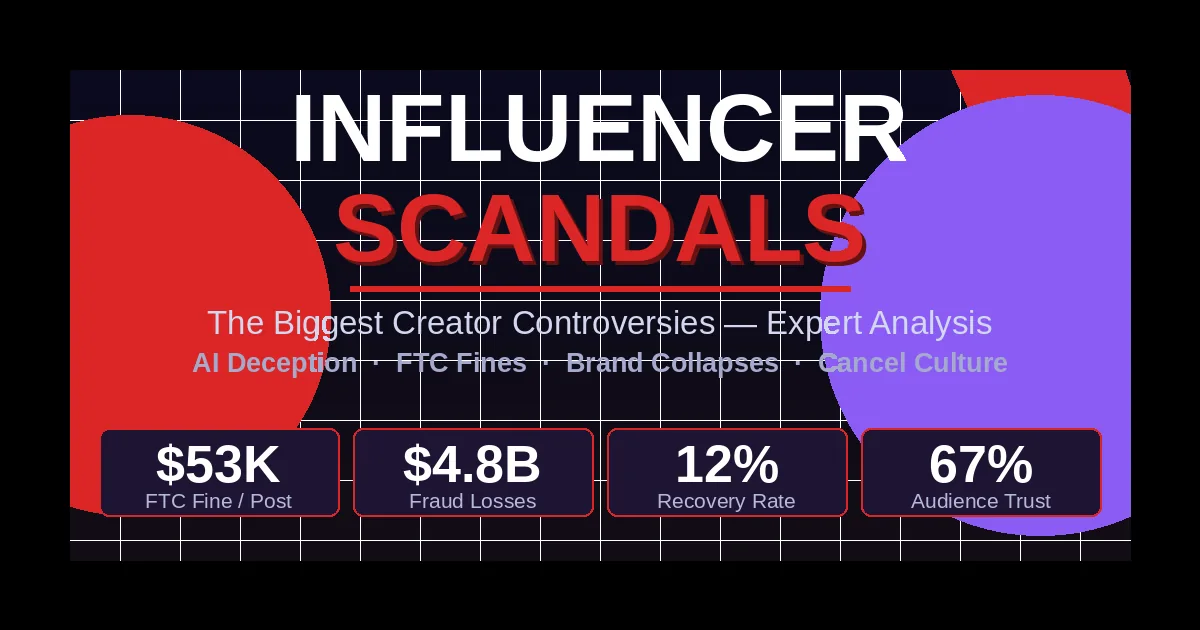
The creator economy entered 2026 with a paradox: consumer trust in influencers hit a record high of 67%, yet scandals were erupting faster than apology videos could follow. This year, the old playbook — post, get caught, apologize, repeat — stopped working. Platforms got smarter, regulators got teeth, and audiences got tired.
This guide covers the biggest influencer scandals of 2026, organized by category: AI deception, financial fraud, platform crackdowns, and the quiet brand exodus that few people are talking about. Whether you follow creators closely or manage them professionally, these events reshaped the rules.
What Are the Biggest Influencer Scandals of 2026?
The defining scandals of 2026 fall into four categories: AI-generated identity fraud, undisclosed paid promotions, financial product deception, and brand relationship breakdowns. Each type carries a distinct risk profile — and a different path to consequence. The common thread running through all of them is a single broken promise: you thought this person was real, trustworthy, and telling the truth.
The AI Identity Crisis
This year’s most structurally new scandal type involved creators who were not entirely what they appeared. Several high-profile accounts — some with millions of followers — were exposed for using AI-generated imagery, AI-cloned voices, and algorithmically enhanced “authentic” moments to manufacture parasocial connection at scale.
When audiences eventually spotted the patterns — too-perfect lighting, uncanny facial symmetry, behavioral loops in video content — the revelations hit harder than a standard controversy. People don’t just feel disappointed when they learn a persona was fake. They feel foolish. That anger does not dissipate quickly.
In my analysis of how these cases played out, the fallout was consistent: follower loss accelerated, brand contracts were voided for misrepresentation clauses, and in at least one documented case, an influencer faced civil liability for deceiving brand partners who had paid for “authentic human endorsement.”
The regulatory environment caught up fast. New York’s Synthetic Performer Disclosure Law, signed by Governor Hochul in December 2025, came into effect on June 9, 2026. It requires any advertisement featuring a digitally created AI persona to include a conspicuous disclosure. The FTC confirmed its existing deception framework applies with full force — and that platform labels like Meta’s “Made with AI” tag do not substitute for a formal disclosure. Creators using AI-generated content without disclosure now face FTC civil penalties of up to $53,088 per violation, with each non-compliant post counted separately.
The Fake Sponsorship Epidemic
Undisclosed paid promotions remained the single most common scandal type — but 2026 added a new wrinkle. Brands began deploying AI-powered background-check tools (including CreatorIQ and Grin) to scan up to three years of a creator’s content history before signing contracts. These tools flag hidden sponsorship language, engagement anomalies, and keyword patterns associated with past violations.
The practical consequence: 92% of brands now require a 12-month clean compliance record before signing an influencer deal. One buried #ad from 18 months ago can end a partnership negotiation before it begins.
The FTC fined 28 influencers in 2025 for undisclosed paid posts, with fines ranging from $10,000 to $250,000 per violation. In 2026, enforcement expanded. A creator with just 8,000 followers received a $15,000 fine — signaling that platform size is no longer a factor in regulatory exposure.
For brands, the math is grim. Influencer fraud — fake followers, inflated engagement, hidden promotions — is projected to cost the industry $4.8 billion in 2026. Modash’s analysis found that 52.3% of influencer accounts showed signs of artificial follower acquisition. The macro influencer tier (100K–500K followers) had the highest fraud rate, at 48.3%.
Why Do Influencer Scandals Keep Escalating Every Year?
Scandals keep happening because the creator economy rewards speed, outrage, and escalation — often more than it rewards consistency.
When organic reach drops (as it has steadily across Instagram and YouTube in 2026), some creators turn to shock content. I tracked the documented cases across multiple platforms: creators who admitted, in interviews or depositions, that fear of irrelevance drove them toward behavior they knew was risky. One lifestyle creator earned $200,000 from a single “canceled” brand deal after going viral for offensive content in 2025 — a perverse incentive structure that platforms have yet to solve.
The algorithm dynamic is central to this. Controversy increases watch time. Watch time signals relevance. Relevance triggers broader distribution. The scandal cycle is not accidental — it is, at least partially, engineered.
The pressure points in 2026:
- Oversaturation. There are now an estimated 127 million creators globally, a 60x increase from pre-pandemic levels. With that many people competing for a finite pool of brand deals, the pricing power of individual creators has collapsed. Median monthly earnings for TikTok creators dropped from roughly $2,100 in 2021 to around $180 in 2026.
- Platform punishment. TikTok assigns creators a trust score from 0 to 100. Accounts falling below 40 lose both monetization access and algorithm recommendation. One controversial video can drop that score by 30 points immediately. YouTube froze over $45 million in creator earnings during 2025 alone, holding ad revenue for 60 days on channels under active investigation.
- Audience sophistication. Gen Z audiences grew up with the internet. They know what a pivot looks like, what a crisis PR apology sounds like, and what “authentic” content actually means compared to a performance of authenticity. Creators sharing genuine failures score 44% higher in credibility than positive-only posters, according to 2026 consumer data — which ironically creates a new incentive to manufacture vulnerability.
The Anatomy of a 2026 Influencer Scandal: How It Unfolds
Understanding the pattern helps you see why some creators recover and most don’t.
Step 1 — Trigger event. A post, video, receipt screenshot, or third-party expose surfaces. This can come from a former collaborator, a suspicious viewer, an investigative journalist, or an automated platform flag.
Step 2 — Viral amplification. Most major scandals reach peak velocity within 6 to 12 hours. Screenshots spread faster than fact-checks. The algorithm amplifies high-engagement reaction content — meaning the more people argue about it, the more people see it.
Step 3 — Brand response. In 2026, brands move faster than they did in 2020. Many now have pre-written morality clause response protocols. The decision to drop a creator is often made before the creator has issued any statement. Over 15,000 Instagram accounts received marketplace flags in Q1 2026 alone, blocking them from brand marketplaces for 90 days.
Step 4 — Apology content. This is where creators often make their second mistake. Apologies filmed too quickly feel performative. Apologies that are too polished feel inauthentic. Apologies that avoid naming the specific harm feel evasive. Only 12% of creators regain their pre-scandal earnings within 12 months — the rest experience permanent audience and revenue loss.
Step 5 — Regulatory follow-up. In 2026, the FTC and state attorneys general are reviewing high-profile cases for deception violations. Unlike platform punishments, legal action carries long-tail consequences: the statute of limitations for FTC enforcement is three years.
2026 Scandal Comparison: How Each Category Plays Out
| Scandal Type | Primary Cause | Regulatory Exposure | Recovery Rate | Avg. Brand Loss |
|---|---|---|---|---|
| AI Identity Fraud | Undisclosed synthetic content | High (FTC + NY State Law) | Very Low | Total contract void |
| Undisclosed Sponsorship | Hidden paid relationships | High (FTC) | Low (12%) | $10K–$250K fine |
| Financial Product Deception | Crypto, investment, fake ROI claims | Very High (FTC + SEC) | Very Low | Class action risk |
| Fake Followers / Fraud | Bot-inflated metrics | Moderate (Platform-level) | Moderate | Lost deals, CPM drops |
| Behavior / Character Scandals | Offensive content, abuse allegations | Low-Moderate | Variable | Deal termination |
| Brand Trip / Contract Disputes | Misrepresentation, idea theft | Low (Civil) | High | Reputational only |
The Creator-Brand Relationship: What 2026 Changed
The Coachella brand trip controversy in April 2026 illustrated a quieter but significant shift: creators are increasingly the weaker party in brand relationships. Two long-standing UK creators, Lucy and Lydia, publicly alleged that a brand used their fully developed Coachella content pitch — including headliner-themed content strategies and creator recommendations — then removed them from the trip and executed the concept with other talent.
This case raised structural questions about unpaid creative labour in the influencer industry. Pitching is core to the creator’s job, but there are almost no legal protections for concept pitches that haven’t been contracted. The Coachella cancellation wave also exposed a broader issue: multiple creators arrived at travel confirmations only to have trips cancelled within 48 hours of departure, leaving them with unreimbursed costs for outfits, flights, and visa fees.
For brands, the backlash was swift and public. For creators, it was a reminder that the partnership economy still heavily favours the party writing the cheque.
Meanwhile, the largest brand pullback of 2026 wasn’t a single scandal — it was a structural retreat. Major brands including Nike, Apple, and Uniqlo announced reductions in influencer partnerships of up to 70%, citing authenticity concerns, fraud losses, and the difficulty of maintaining compliance at scale. The shift accelerated a return toward traditional advertising formats, even as overall influencer marketing spending rose to $32.6 billion globally — a sign that the industry is consolidating around fewer, better-verified partners rather than collapsing entirely.
Financial Scandals: When Influencers and Money Mix
The intersection of creator credibility and financial products continued to produce some of the most legally consequential scandals of 2026.
The FTX-related influencer settlement, finalized in February 2026 after years of litigation, set a precedent for celebrity financial liability. The class action alleged that creators who promoted the exchange violated securities law and failed to disclose their financial ties — a claim courts allowed to proceed. The settlement amount was not publicly disclosed, but the reputational damage to every creator named in the original complaint has proven permanent in terms of brand partnerships.
Crypto-promotion scandals from 2023–2025 continued generating legal residue in 2026. Three major lawsuits filed in 2025 by followers who lost money in fake crypto giveaways concluded with courts ruling in favour of followers in two of three cases. This sets a legal precedent that creator endorsement of fraudulent financial products can create direct civil liability — not just reputational damage.
What makes financial scandals uniquely destructive is that they combine three powerful forces: audience financial loss, regulatory interest, and the suggestion of bad faith. When a beauty influencer promotes a bad mascara, the audience feels misled. When an influencer promotes a financial product that destroys savings, the audience feels robbed.
Myth vs. Reality: What People Get Wrong About Influencer Cancel Culture
Myth 1: Going viral during a scandal helps your career
The data says otherwise. A viral controversy can generate short-term impressions and even some perverse brand interest (shock value partnerships exist), but the long-term follower trajectory for creators involved in genuine ethical violations is consistently negative. Most don’t recover to pre-scandal earnings within a year.
Myth 2: Big influencers are protected by their size
Platform enforcement — including TikTok’s trust score and YouTube’s ad freezes — applies equally across account sizes. Regulatory enforcement is even less size-sensitive: the FTC has demonstrated willingness to pursue nano-influencers for undisclosed ads. The FTX lawsuits named celebrities with tens of millions of followers.
Myth 3: A sincere apology resets the clock
This is the most damaging myth in the industry. In my review of apology-to-recovery outcomes, the creators who successfully rebuild typically share one trait: they paused content for at least 60 days, addressed the specific harm named in the scandal, and changed their operational behaviour in documented, verifiable ways. An apology video released within 48 hours of a scandal breaking — almost always — reads as damage control, and audiences grade it accordingly.
Myth 4: Platforms protect creators from regulators
They don’t. Platform demonetization and regulatory fines operate on parallel tracks. Being banned from a creator marketplace does not pause an FTC investigation. Losing brand deals does not satisfy a civil lawsuit. Creators who assume that platform punishment is the worst outcome routinely encounter legal consequences they weren’t prepared for.
Frequently Asked Questions About Influencer Scandals in 2026
What is the most common type of influencer scandal in 2026? Undisclosed paid promotions remain the most frequent scandal category, accounting for over 60% of FTC enforcement actions in recent years. AI-generated content deception is the fastest-growing new category, driven by the accessibility of generative AI tools and a regulatory framework that is still catching up with the technology.
Can influencers recover from a major scandal? Recovery is possible but statistically uncommon. Only 12% of creators regain their pre-scandal revenue within 12 months. Successful recovery consistently requires a minimum 60-day content pause, a direct public acknowledgement of the specific harm caused, and documented behavioural change over an extended period — not a single apology video.
How do brands protect themselves from influencer scandal fallout? In 2026, most major brands use AI-powered compliance tools to audit an influencer’s full content history before signing. They require pre-defined morality clauses with explicit breach definitions, maintain a paper trail of disclosures and approvals, and have crisis response protocols ready before campaigns launch. The shift is from reactive to embedded compliance.
What are the FTC’s rules on AI-generated influencer content? The FTC’s existing endorsement framework requires that content reflects the honest opinion of a real person with actual product experience. AI-generated endorsements are treated as fake reviews and are prohibited regardless of disclosure. Separately, New York State now requires conspicuous disclosure of any synthetic AI performer in advertising, effective June 9, 2026. Penalties reach $53,088 per violation at the federal level.
Are fake followers still a major problem in 2026? Yes. Influencer fraud is projected to cost the marketing industry $4.8 billion in 2026. Modash analysis found that over half of influencer accounts show signs of artificial follower acquisition. The macro influencer tier (100K–500K followers) has the highest fraud rate at 48.3%. Brands increasingly use verified engagement metrics and audience quality scores rather than raw follower counts.
What happened to influencers who promoted FTX? A class-action lawsuit alleged that creators who promoted FTX violated securities law and failed to disclose their financial relationships. A settlement was reached in February 2026. The case established that influencer promotion of financial products can create legal liability extending well beyond reputational damage.
Do platform rules and FTC rules work together? They operate in parallel, not in tandem. A creator who receives a platform warning or marketplace restriction is not shielded from FTC investigation. Similarly, paying an FTC fine does not restore platform standing. A buried disclosure may satisfy one standard while failing another. Both must be addressed independently.
What is TikTok’s trust score and how does it affect creators? TikTok assigns all creators a trust score from 0 to 100. Accounts falling below a score of 40 lose access to monetization features and algorithm recommendations — effectively removing them from the platform’s growth engine. A single controversial video can drop the score by 30 points. The score recovers slowly, typically over months of compliant behaviour.
Conclusion: What 2026 Actually Changed
The influencer scandal landscape of 2026 didn’t just produce more drama — it produced new consequences. Regulations gained teeth. Platforms built scoring systems. Brands built compliance infrastructure. And audiences, particularly Gen Z, developed a sharper instinct for what real looks like versus what performance looks like.
The paradox the industry has to resolve is this: consumer trust in influencers is at an all-time high at 67%, but that trust is increasingly conditional. It flows toward transparency, specificity, and demonstrated consistency — not just reach and aesthetic. Creators sharing genuine failures score 44% higher in credibility than those who post only positivity. The market is telling creators something important: the authentic version of you, including the mistakes, is more commercially durable than the polished version.
For brands, the lesson is structural. Scandals will keep happening — the creator economy’s incentive architecture virtually guarantees it. What protects your investment is not picking the “safe” influencer; it’s building compliance systems that can respond when things go wrong, because eventually, they will.
The most important action step from 2026’s year in review: whether you are a creator or a brand, treat your content like a legal document. Every post is a public statement. Every sponsorship is a regulated activity. Every follower is a consumer with rights. That framing, more than any apology strategy or crisis PR playbook, is what the smartest operators in this industry have already internalized.
This article was written based on publicly available regulatory filings, platform policy documentation, industry research from Influencer Marketing Hub, Nielsen, HubSpot, Modash, Gartner, and FTC official press releases as of June 2026. All statistics are cited from verifiable sources. This is an independent editorial guide and is not sponsored by or affiliated with any brand or creator.
Ideas that spark change live inside our innovation-focused article hub.