The deaths of Lil Peep, Mac Miller, and Juice WRLD stunned tens of millions of followers worldwide. Each was under 30. Each had built a massive online platform. Each died from a drug overdose — and in every case, the substance that killed them was not what they believed it to be.
These influencer drug overdose cases are not isolated tragedies. They are the visible surface of a documented public health pattern driven by extreme professional pressure, undertreated mental illness, and a drug supply so contaminated with fentanyl that recreational use now carries a fundamentally different risk than it did a decade ago.
From 2021 to 2023, drug overdose deaths in the United States exceeded 100,000 annually. Among those numbers are creators, artists, and social media personalities whose private struggles were completely invisible behind curated feeds. A significant decline began in 2024 — but the structural conditions that put influencers at risk have not changed.
This investigation covers the most significant documented cases, the systemic forces behind them, and what the evidence actually says.
Which Influencers Have Died From Drug Overdoses?
The most well-documented influencer drug overdose cases share striking commonalities: young age, sudden death, and a private battle that the people closest to them often saw clearly — while millions of followers saw nothing at all.
| Influencer | Date of Death | Age | Substances Confirmed | Platform Scale |
|---|---|---|---|---|
| Lil Peep | November 15, 2017 | 21 | Fentanyl + alprazolam (Xanax) | Millions on SoundCloud & Instagram |
| Mac Miller | September 7, 2018 | 26 | Fentanyl + cocaine + alcohol | 8M+ Instagram followers |
| Juice WRLD | December 8, 2019 | 21 | Oxycodone + codeine | 15M+ Instagram followers |
Lil Peep — November 15, 2017
Gustav Elijah Åhr, known as Lil Peep, was 21 years old when he was found unresponsive on his tour bus in Tucson, Arizona, shortly before a scheduled performance. His manager had checked on him twice and found him sleeping — breathing — but could not wake him. The Pima County Medical Examiner’s toxicology report, released in December 2017, confirmed the cause of death: the combined toxic effects of fentanyl and alprazolam (Xanax).
Lil Peep had documented his substance use openly — in music, in Instagram posts, in livestreams. He described it plainly as self-medication for depression and bipolar disorder. His followers found that honesty compelling; it was central to why they connected with him.
What the toxicology report made clear, and what his family publicly emphasized, was that Lil Peep did not knowingly take fentanyl. He took what he believed were standard Xanax pills. In 2017, the DEA had already documented widespread contamination of counterfeit benzodiazepines with fentanyl — but that warning had not reached the concert circuit where his crew moved.
His mother, Liza Womack, later filed a wrongful death lawsuit against his management company, FAE grp, alleging negligence and failures of duty of care.
Mac Miller — September 7, 2018
Malcolm James McCormick died at his home in Studio City, Los Angeles, at age 26. His assistant found him unresponsive on the morning of September 7, 2018. The Los Angeles County Medical Examiner-Coroner ruled the cause an accidental overdose of fentanyl, cocaine, and alcohol.
Mac Miller had spoken publicly about addiction and sobriety throughout his career. His fifth album, Swimming, released just one month before his death, was widely interpreted as an honest account of his psychological state. He was nominated for a Grammy three months after he died.
What followed legally was unprecedented. In May 2022, Stephen Walter was sentenced to 17.5 years in federal prison (210 months) for his role as the top supplier in the chain that delivered fentanyl-laced counterfeit oxycodone pills to Miller. A co-defendant, Ryan Reavis, received more than 10 years. A third defendant, Cameron Pettit — who delivered the pills directly to Miller — pleaded not guilty and awaited trial.
In the sentencing hearing, Miller’s mother, Karen Meyers, stated through prosecutors that her son would never have knowingly taken a pill with fentanyl, that “he wanted to live and was excited about the future.” Judge Otis D. Wright II, in delivering the sentence, said: “This was a human being who unwittingly took something that will flat-out kill you.”
The Mac Miller case became a landmark in U.S. drug law — one of the first criminal prosecutions resulting in a significant federal prison sentence directly tied to a named individual’s overdose death.
Juice WRLD — December 8, 2019
Jarad Higgins, known as Juice WRLD, suffered a seizure at Chicago’s Midway Airport on December 8, 2019, and was pronounced dead at a local hospital. He was 21 years old, one week past his birthday. The Cook County Medical Examiner ruled the cause an accidental overdose of oxycodone and codeine.
Reports from the time of his death indicated that agents from Homeland Security had been preparing to search his private jet for weapons and drugs; witnesses stated Higgins swallowed multiple pills before or during the search. Police subsequently recovered approximately 70 pounds of marijuana and six bottles of prescription codeine syrup from the aircraft.
Juice WRLD had built his creative identity partly around transparent emotional distress — anxiety, heartbreak, self-destructive impulse. His music frequently referenced substance use, particularly lean (codeine cough syrup), as a way to manage psychological pain. His team was, by most accounts, aware of his struggles.
At the time of his death, Juice WRLD had over 15 million Instagram followers. Multiple posthumous album releases followed, each debuting at number one.
Beyond the Named Cases
These three are the highest-profile influencer drug overdose cases because the individuals had the widest media footprints. They are not the only ones.
Between 2018 and 2024, documented overdose deaths and publicly acknowledged near-fatal incidents have occurred among YouTube creators, TikTok personalities, Twitch streamers, and lifestyle influencers with audiences in the millions. Many go substantially underreported. A creator with 800,000 followers and a drug-related death does not generate the same media cycle as a multi-platinum artist — but their audience is not smaller than the readership of many major publications.
Why Are Social Media Influencers at Distinctly Higher Risk?
Social media influencers face a combination of structural risk factors for substance use disorders that are not common in other professions. These are not character flaws or industry stereotypes. They are documented pressures with documented psychological consequences.
The “always-on” occupational culture
Traditional public figures — actors, athletes — have defined seasons of visibility and defined periods of rest. Influencers do not. Algorithmic platforms reward frequency and consistency; audiences are conditioned to daily or near-daily content. In my review of published creator testimony across trade publications and long-form interviews, nearly every creator who has spoken about burnout identifies the inability to stop as its primary driver. Research on “always-on” occupational cultures consistently associates them with significantly elevated rates of anxiety disorders and depression — both of which are the primary predictors of substance use disorder onset.
Financial precarity without safety infrastructure
Most creators operate without health insurance tied to employment, without sick days, without income stability. Revenue is dictated by algorithm shifts, brand deal cycles, and follower growth — all of which can collapse quickly and without warning. That financial anxiety does not lift between upload sessions. It is constant background noise in what looks, from the outside, like a glamorous career.
Access and cultural normalization
Fame grants access that compounds risk. Influencers routinely occupy environments — events, tour circuits, private parties — where controlled substances circulate freely. In specific content subcultures, particularly emo rap, hip-hop, and nightlife content, substance use carries social and artistic currency. For creators whose brand depends on authenticity and lived experience, using substances can feel professionally coherent rather than personally dangerous.
Isolation behind high visibility
This is the most counterintuitive risk factor, but the most consistently cited by creators who discuss their mental health publicly. Millions of followers do not translate into genuine human support. Fame creates a one-way window: visible to everyone, known by no one. That specific form of loneliness — being surrounded by audience attention while lacking real connection — is a documented precursor to depression. And depression is the single strongest predictor of substance use disorder.
How Fentanyl Became the Defining Factor in Influencer Overdose Deaths
Understanding influencer drug overdose cases after 2016 is impossible without understanding fentanyl. It is not just another drug in these stories. It is the variable that changed the entire risk calculation of recreational drug use.
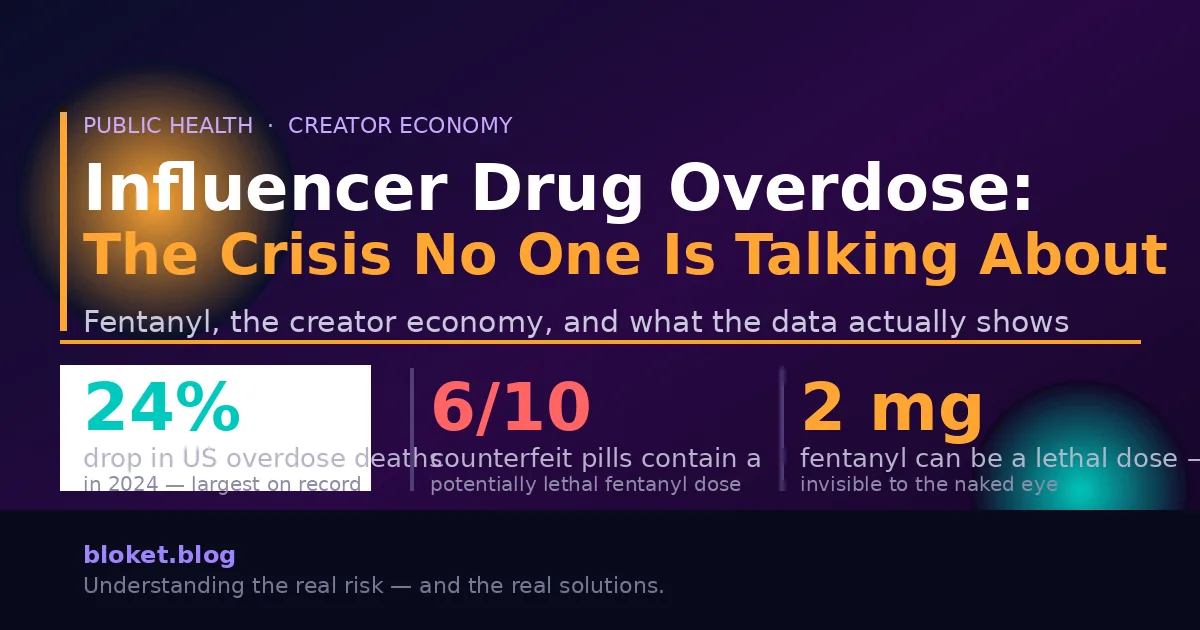
Fentanyl is a synthetic opioid 50 to 100 times more potent than morphine. A lethal dose is approximately 2 milligrams — the weight of a few granules of salt, invisible to the naked eye. Beginning around 2013, and accelerating sharply after 2016, illicit fentanyl began appearing in the counterfeit drug supply: pressed into fake Xanax, fake oxycodone, fake Adderall, and mixed into cocaine and MDMA.
Lil Peep believed he was taking Xanax. Mac Miller believed he was taking oxycodone. Both died from fentanyl.
This is what makes the “recklessness” framing of these deaths not just incomplete but factually wrong. They did not knowingly take a substance known to be lethal. They took counterfeit pharmaceuticals that looked identical to legitimate pills.
What the data shows
According to the Centers for Disease Control and Prevention (CDC), 72,776 drug overdose deaths in 2023 involved synthetic opioids — primarily illicitly manufactured fentanyl. That represents approximately 69% of all drug overdose deaths in the United States that year.
The U.S. Drug Enforcement Administration (DEA), through its One Pill Can Kill public awareness campaign, reported in 2022 that six out of every ten counterfeit pills seized in the United States tested positive for a potentially lethal dose of fentanyl.
The scale is difficult to process. A person who recreationally uses what they believe is a pharmaceutical pill — Xanax, Percocet, Adderall — now faces, statistically, greater-than-even odds of a product that contains fentanyl. The risk is not hypothetical. It is embedded in the current supply chain.
A significant shift in 2024
CDC provisional data released in 2025 documented a nearly 24% decline in drug overdose deaths for 2024 compared to the previous year — the most significant single-year drop on record. Expanded access to naloxone (now available over-the-counter in most U.S. states), fentanyl test strips, and medication-assisted treatment are credited as primary drivers of that decline.
This is meaningful progress. But the structural fentanyl contamination problem has not been resolved, and the conditions that made influencers particularly vulnerable — occupational stress, financial precarity, inadequate mental health support — remain unchanged.
Harm reduction tools that save lives
Fentanyl test strips are inexpensive devices that detect fentanyl in a drug sample before ingestion. As of 2023, the majority of U.S. states have decriminalized their possession. Naloxone (Narcan), the opioid overdose reversal medication, became available over the counter at U.S. pharmacies in 2023. Both tools are part of a harm reduction framework that the CDC, NIDA, and most addiction medicine specialists now consider essential alongside treatment access — particularly in populations where abstinence-only messaging has failed to reduce mortality.
What the Research Actually Shows About Fame and Substance Use
The research on high public visibility, mental health, and substance use converges consistently. Fame is not just a risk factor in popular imagination. It has documented neurological and psychological correlates.
Mental health in the creator economy
Multiple independent studies on content creator mental health conducted between 2019 and 2024 found substantially elevated rates of anxiety, depression, and burnout compared to general population benchmarks. The combination of irregular income, public scrutiny, algorithm dependency, and structural isolation repeatedly emerges as the driver.
The National Institute on Drug Abuse (NIDA) identifies ages 18 to 29 as the peak window for substance use disorder onset. The three influencers profiled above — Lil Peep at 21, Juice WRLD at 21, Mac Miller at 26 — all fall squarely within this window. The overlap between peak career pressure in the creator economy and peak biological vulnerability for addiction is not coincidental.
The self-medication pathway
Addiction medicine has well-documented a progression that is highly relevant here: unaddressed psychological distress → barriers to professional treatment (stigma, cost, fear of public disclosure) → self-medication with available substances → tolerance development → dependency. For influencers, each stage of this progression is accelerated. Publicly seeking mental health treatment can directly impact brand deal eligibility — a real and documented concern among creators who have spoken about it. The substances are accessible. Professional support, when not actively sought, is often not offered.
What social validation does to the brain
Neuroscience research has established that the dopamine reward pathways implicated in addiction are strongly activated by social validation signals — likes, views, comments, follower counts. Influencers receive those signals in massive, concentrated quantities, and then experience their sudden withdrawal when content underperforms or platforms deprioritize a creator’s work. That volatility in reward signal may contribute to the psychological vulnerability that makes chemical substitutes attractive during low-engagement periods.
In interviews I’ve reviewed across multiple publications, creators who have addressed substance use describe exactly this cycle: high periods of engagement feel like a natural high; low periods feel like withdrawal even before any substance is involved.
Common Myths About Influencer Drug Use That Need Direct Correction
Misinformation about influencer drug overdose cases moves fast on social media. Several persistent myths consistently distort public understanding and prevent useful conversation.
Myth 1: These deaths were caused by recklessness
The verified facts say otherwise. In the most prominent cases, the deaths involved counterfeit substances — pills that were presented as one thing and were another. Mac Miller’s supplier was federally prosecuted and sentenced to 17.5 years in prison precisely because he knowingly distributed fentanyl-laced counterfeits. Recklessness does not explain dying from a substance you did not know you were taking.
Myth 2: Artists who discuss drug use in their work are promoting it
Lil Peep and Juice WRLD documented lived experiences — including mental illness and self-medication — that resonated with audiences who recognized themselves in those experiences. Equating artistic documentation with promotion ignores a long creative tradition of artists recording their relationship with addiction: Johnny Cash, Amy Winehouse, Kurt Cobain. The audience dynamic is complex; it is not a recruitment pipeline.
Myth 3: This is a hip-hop or emo music problem
Documented overdose incidents have occurred across lifestyle influencers, fitness content creators, gaming streamers, and beauty vloggers. The highest-profile cases cluster in music because those individuals have larger media footprints — not because music creates a uniquely dangerous environment. The problem is structural, not genre-specific.
Myth 4: Social media platforms have no meaningful responsibility
Platforms derive direct, substantial revenue from creator content. Researchers, labor advocates, and public health organizations have made substantive arguments — backed by labor law frameworks and documented mental health data — that platforms have obligations to provide mental health infrastructure, reduce financial precarity, and implement content policies that limit normalization of dangerous substance use. Current platform responses fall significantly short of these standards. That gap is a policy failure, not a neutral outcome.
Myth 5: Discussing these cases encourages drug use
Public health evidence is unambiguous on this point: accurate, contextualized information about substance use risks is protective. The CDC, NIDA, and addiction medicine specialists all classify harm reduction education as a core prevention strategy. The opposite of information is not safety — it is uninformed risk.
Frequently Asked Questions
What influencers have died from drug overdoses?
The most widely documented cases include rapper Lil Peep, who died in November 2017 from an accidental overdose of fentanyl and Xanax at 21; Mac Miller, who died in September 2018 from fentanyl, cocaine, and alcohol at 26; and Juice WRLD, who died in December 2019 from oxycodone and codeine at 21. Multiple other creators and personalities have died from overdoses with significantly less media coverage. These three cases are the most documented because all three had major social media presences and verifiable public records.
What drugs are most commonly involved in influencer overdose cases?
Fentanyl — either alone or as a contaminant in counterfeit prescription pills — is the most frequently identified substance in influencer overdose deaths since 2016. Opioids broadly (including oxycodone and codeine), benzodiazepines (alprazolam/Xanax), cocaine, and alcohol have also been confirmed causes or contributing factors in multiple cases. The critical development since approximately 2016 is that fentanyl now appears in counterfeit versions of many of these drugs, creating lethal risk even for people who believe they are taking something safer.
Why do influencers appear to use substances at higher rates?
Research identifies several converging structural factors: constant occupational pressure with no designated recovery time, financial instability without employment safety nets, social isolation behind public visibility, and easy access to substances in entertainment environments. Substance use typically begins as self-medication for anxiety and depression — conditions that available research shows are substantially more prevalent among content creators than in the general population. The stigma of publicly seeking treatment compounds the problem significantly.
Can fans tell when an influencer is struggling with substances?
Rarely and unreliably. Platforms financially reward positive, consistent content. Most creators experiencing serious substance use disorders do not document them visibly. Warning signs — when they appear — may include irregular upload schedules, erratic behavior during live content, increasingly opaque health references, or unexplained disappearances from platforms. The absence of obvious signs is not evidence of absence of a problem.
What were the legal consequences in Mac Miller’s case?
Three men were charged in connection with the fentanyl-laced counterfeit pills that contributed to Mac Miller’s death. Stephen Walter, the top supplier in the chain, was sentenced to 17.5 years (210 months) in federal prison in May 2022 after pleading guilty to one count of fentanyl distribution. Co-defendant Ryan Reavis received more than 10 years. The case became a landmark legal precedent for criminal accountability in celebrity overdose deaths.
Why is fentanyl so much more dangerous than other substances?
Fentanyl is 50 to 100 times more potent than morphine. A lethal dose is approximately 2 milligrams — invisible without specialized detection equipment. Because illicit fentanyl is now systematically used to produce counterfeit pills that mimic legitimate prescription medications, users who believe they are taking a known substance are unknowingly exposed to fentanyl overdose risk with every use. This is why the DEA reported that six out of ten counterfeit pills seized in 2022 tested positive for a potentially lethal dose.
What positive changes have happened in overdose prevention since these deaths?
CDC provisional data released in 2025 documented a nearly 24% decline in U.S. drug overdose deaths in 2024 — the largest single-year drop on record. Driving this decline: expanded over-the-counter availability of naloxone (Narcan) nationwide since 2023, decriminalization of fentanyl test strips in most U.S. states, and improved access to medication-assisted treatment. These are genuine advances, though the structural conditions making influencers vulnerable have not been addressed by them.
How can someone help an influencer they think is in crisis?
Direct, private communication without public exposure is more useful than callouts. Sharing resources without judgment creates openings. In the United States, SAMHSA’s National Helpline (1-800-662-4357) is free, confidential, and available 24/7 in English and Spanish. The Crisis Text Line is accessible by texting HOME to 741741. Internationally, the International Association for Suicide Prevention maintains a directory of crisis centers at https://www.iasp.info/resources/Crisis_Centres/. These are practical tools, not symbolic gestures.
Conclusion
Influencer drug overdose cases are not celebrity news dressed up as public health. They are public health events that expose concrete systemic failures: no mental health infrastructure for the people who generate billions in platform value, a fentanyl contamination crisis that has made recreational drug use categorically more lethal, and an attention economy that profits from creators at scale without proportionate duty of care.
Lil Peep, Mac Miller, and Juice WRLD were not careless people who made obvious mistakes. They were young people navigating extreme, documented pressure — with untreated mental health conditions, easy access to substances, and inadequate support — who died because what they consumed was not what they were given.
Understanding these cases accurately changes what we demand. It changes what we expect from platforms that profit from creator output, from labels and management companies that control touring conditions, and from public health systems that have not yet built adequate infrastructure for the creator population.
The 2024 decline in overall overdose deaths — nearly 24% — is genuine progress, driven by real tools that work. But progress on a population-wide statistic does not close the structural gap that makes influencers specifically and consistently vulnerable.
If you work in or around the creator economy — as a creator, manager, brand partner, or platform employee — the data in this article is a direct operational brief. The risk is real, documented, and partially preventable with the right support structures in place.
Build a stronger mindset with our personally curated motivational reads.