The influencer economy crossed $21 billion in 2023. A measurable portion of that money went directly to fraudsters.
Fake followers are not a niche problem buried in obscure corners of the internet. They sit at the center of a billion-dollar deception that has burned household brands, destroyed influencer careers, and triggered federal enforcement action in the United States. In 2018, one New York Times investigation alone exposed a single company selling fake followers to over 200,000 clients — including celebrities, athletes, and political consultants.
This article covers the biggest fake follower scandals on record, the detection methods investigators and brands now use, and the exact steps you should take before committing any marketing budget to an influencer campaign. No hypotheticals. No filler. Just what actually happened and what it means for you.
What Are Fake Followers — and Why Do They Damage Brands?
Fake followers are bot accounts, purchased profiles, or inactive users that inflate a creator’s follower count without contributing any real engagement, purchase intent, or audience value. They matter because brands pay for access to real audiences — and a fake audience delivers a zero percent return on investment.
The mechanics are straightforward. Services like the now-defunct Devumi sold Twitter followers starting at around $17 per 1,000 accounts. Many of those accounts were constructed using stolen identities — real profile photos scraped from legitimate users, recycled biographies, and scripted activity calibrated to mimic human behavior patterns.
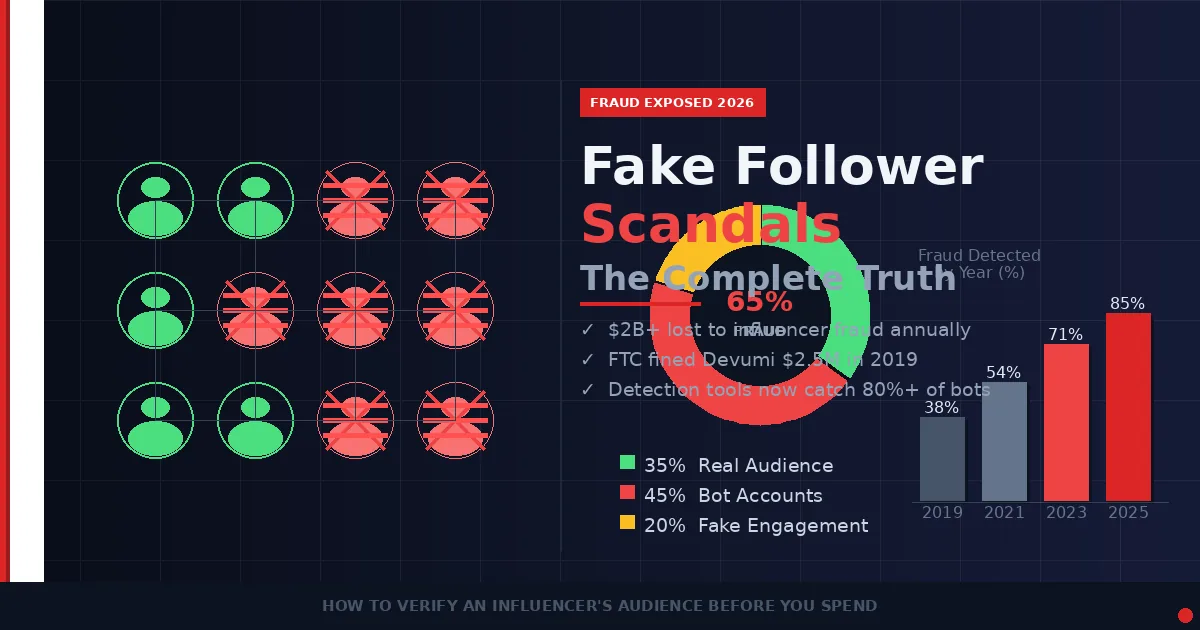
The financial damage is well-documented. A 2019 study by Cheq and the University of Baltimore estimated that influencer fraud cost advertisers approximately $1.3 billion annually. By 2023, with the creator economy significantly expanded, updated estimates from cybersecurity firms placed that figure closer to $2 billion per year.
Three core metrics that brands rely on are directly distorted by fake followers:
- Follower count — the most obvious and most frequently gamed number
- Engagement rate — likes, comments, and shares can also be purchased separately
- Audience demographics — bots misrepresent age, location, language, and interests, meaning the audience a brand thinks it is reaching often does not exist at all
Understanding fake followers is the first step. Understanding the scandals that proved how serious the problem became is what actually changes behavior.
The Biggest Fake Follower Scandals Ever Exposed
The history of influencer fraud is not a collection of rumors. Several cases produced court filings, federal enforcement actions, and documented financial losses — leaving a clear paper trail.
The Devumi Scandal — The One That Changed Everything (2018)
On January 27, 2018, the New York Times published an investigation titled “The Follower Factory.” The report exposed Devumi, a Florida-based company that had been selling fake social media followers, likes, retweets, and views on an industrial scale. Investigators identified the company’s database of over 200,000 customers and traced more than 55,000 fake accounts built using stolen identities — real photographs and personal details scraped from legitimate users without their knowledge or consent.
The client list was striking. It included a co-founder of YouTube, a cast member from a Real Housewives franchise, professional athletes, and consultants working for political campaigns. Many clients later claimed their agencies or managers had purchased the followers on their behalf without direct authorization.
The New York Attorney General opened an immediate investigation. The Federal Trade Commission followed. In September 2019, the FTC settled with Devumi and its owner, German Calas Jr., for $2.5 million — the first FTC action specifically targeting the sale of fake social media metrics. The consent order permanently prohibited Calas from selling fake indicators of social media influence.
This was the case that forced the industry to confront what it had long preferred to ignore.
The Mediakix Fake Influencer Experiment (2017)
One year before Devumi broke into public consciousness, an influencer marketing agency named Mediakix ran a controlled experiment that proved just how easy the deception was to execute. Their team created two Instagram accounts from scratch — one built around a lifestyle aesthetic, the other around travel photography.
Neither account represented a real person. Mediakix purchased followers in bulk and bought bot-generated likes to manufacture an engagement rate that appeared credible on the surface. Within approximately two months, both accounts received genuine, paid brand partnership offers — one for $150 and another for $250. Small amounts, but real money paid by real brands for access to a completely fabricated audience.
The experiment was not about the money. It was a proof-of-concept that exposed the industry’s vetting processes as fundamentally inadequate. Brands were paying based on numbers without ever verifying what those numbers represented.
Italy’s Formal Influencer Fraud Investigations (2019–2021)
While US enforcement focused on Devumi, Italian consumer protection authorities opened formal investigations into several high-profile influencers after brands reported that campaign performance was consistently failing to match the audience reach that had been promised at the point of sale.
Investigators used engagement rate analysis, demographic auditing, and platform data to build cases showing that follower bases had been artificially inflated. The cases highlighted a meaningful difference between the Italian and American legal contexts: under European consumer protection regulations, misrepresenting your commercial reach to a brand partner created more direct legal exposure than comparable conduct in the US at the time.
Instagram’s Mass Account Purges — Collateral Damage and Exposed Fraud (2018–2020)
Beginning in 2018, Instagram launched a series of large-scale fake account removal operations targeting bot networks and coordinated inauthentic behavior. The purges were not targeted at specific influencers — they swept across the platform — but the overnight follower-count crashes they produced revealed just how many accounts had inflated numbers.
Justin Bieber’s account reportedly lost more than 3.5 million followers across a single purge cycle. Ariana Grande, Kim Kardashian, and Cristiano Ronaldo all recorded significant drops. For accounts at that scale, bot infiltration without deliberate purchase is common — large follower counts attract automated follows. But for mid-tier influencers who lost 20 to 40 percent of their audience in 48 hours with no corresponding change in their content, the drops told a different story.
The purges functioned as an unintentional audit — making visible what brands’ due diligence had missed.
The Engagement Pod Problem — A Gray Area Still Being Abused
Not every fake follower scandal involves bots or purchased accounts. Instagram “pods” — private groups of creators who agree to like and comment on each other’s posts immediately after publishing — artificially inflate engagement rates without technically purchasing fake followers.
Pod activity is harder to detect than raw bot attacks, but it creates the same core problem: brands paying for what looks like organic audience enthusiasm when it is actually coordinated reciprocal behavior between a small group of insiders. Some pods in 2024 shifted to Telegram, organizing thousands of creators into structured engagement networks that operate at scale.
How Investigators and Brands Actually Detect Fake Followers
Detection methodology has matured significantly since the Devumi era. In reviewing multiple fraud cases and audit reports, the most reliable detection signals are not found in the follower count itself — they live in the patterns behind engagement, growth, and audience composition.
Step 1: Benchmark the engagement rate against industry standards
A genuine micro-influencer with 10,000 to 100,000 followers typically achieves 3–6% engagement on Instagram. Macro-influencers at 100,000 to 1 million followers typically see 1.5–3%. Mega-influencers above 1 million typically see 1–2%. An account showing 0.2% engagement on a 400,000-follower count is a fundamental mismatch. It does not automatically mean fraud, but it requires explanation.
Step 2: Run a follower quality audit with a third-party tool
Tools like HypeAuditor, Modash, and Traackr pull account-level follower data and flag suspicious patterns: accounts with no profile photo, no posts, created in bulk on the same date, following thousands of accounts while having zero followers of their own. These are structural signals of bot accounts.
Step 3: Map the follower geographic distribution
If an influencer markets themselves as a US lifestyle creator but 55 percent of their audience is located in Brazil, India, or Bangladesh — regions with well-known bot traffic economies — that geographic mismatch requires explanation. I have reviewed audit reports where the influencer’s stated core audience and their verified demographic data differed by more than 50 percentage points.
Step 4: Read the comment quality
“Nice post! 🔥” and “Love this ❤️” appearing at high volume from accounts with no followers and no posts are pod or bot signals. Real community members argue, ask specific questions, share personal context, and tag friends with a reason. Bot comments do none of those things. The comment section of any account is the fastest manual signal — though it should not replace a systematic audit.
Step 5: Pull the full follower growth history
Legitimate accounts grow steadily, with occasional spikes tied to verifiable events: press features, viral posts, or cross-platform mentions. Fake follower purchases appear as sudden vertical jumps — 15,000 followers added in 36 hours with no corresponding content event. Tools like Social Blade make this growth history visible and exportable.
Step 6: Cross-check across multiple platforms
A creator with 900,000 Instagram followers but 5,000 YouTube subscribers and 6,000 TikTok followers has an inconsistent digital footprint. Real influence follows a person across platforms — even unevenly. A single-platform concentration at large scale with minimal presence elsewhere is a red flag worth investigating.
Fake Follower Detection Tools: A Direct Comparison
| Tool | Best For | Key Detection Feature | Price Range |
|---|---|---|---|
| HypeAuditor | Brands and agencies | AI-powered audience quality scoring across Instagram, TikTok, YouTube | From $399/month |
| Modash | Campaign managers | Full demographic audit + lookalike creator discovery | From $299/month |
| Traackr | Enterprise marketing teams | Fraud scoring at scale with CRM integration | Custom pricing |
| Social Blade | Quick pre-screening | Public follower growth history charts | Free / $3.99/month |
| Upfluence | E-commerce brands | Shopify-native integration with fraud flagging built in | Custom pricing |
| Followerwonk | Twitter/X focus | Follower authenticity scoring and account analysis | Free / From $29/month |
For initial screening, Social Blade is free and takes two minutes. For any influencer campaign where spend exceeds $5,000, a paid audit through HypeAuditor or Modash is a standard cost of doing business, not an optional extra.
What Brands Got Wrong — and What the Industry Fixed
The core mistake brands made throughout the mid-2010s was treating follower count as a direct proxy for influence. It is not. Follower count is a vanity metric that measures how many accounts exist in a database attached to a profile. The number that actually matters is the size of an influencer’s engaged, real, and purchasable audience.
Mistake 1: Flat-rate pricing based on follower count
Many early influencer deals were structured like billboard advertising — more eyeballs meant a higher price, automatically. This model collapses when the eyeballs are bots. Post-Devumi, sophisticated brands moved toward performance-based compensation models that include guaranteed engagement thresholds and clawback clauses if performance metrics fall below agreed benchmarks.
Mistake 2: No pre-campaign audience audit
Investing $75,000 in an influencer campaign without a $300 audience audit is not confidence — it is negligence. Marketing managers have admitted, in post-mortem campaign reviews, to signing influencer contracts based solely on a screenshot of a follower count provided by the influencer themselves. That practice created the conditions Devumi’s clients exploited.
Mistake 3: Confusing reach with influence
An influencer with 40,000 genuinely engaged followers in a specific niche — specialty coffee, competitive cycling, early childhood education — can consistently outperform an influencer with 400,000 passive followers in a vague lifestyle category. Conversion comes from trust and specificity, not raw numbers.
What changed after 2018:
Unilever’s then-CMO Keith Weed delivered a widely covered speech at the 2018 Cannes Lions festival, publicly committing the company to refusing paid partnerships with any influencer who had purchased followers. That statement from one of the world’s largest advertisers had an immediate effect on industry norms.
The Association of National Advertisers published formal influencer fraud guidelines. The Interactive Advertising Bureau developed influencer marketing standards. Instagram, TikTok, and YouTube all built native analytics dashboards that made some audience health data visible to brand partners for the first time.
The baseline standard of care rose. It is not perfect — fraud methods continue to evolve — but the industry that let Devumi’s clients operate invisibly for years no longer exists in the same form.
Common Myths About Fake Followers That Keep Brands Vulnerable
Myth: Only small or struggling influencers buy fake followers.
False. The Devumi client list included major verified accounts with millions of legitimate followers who still purchased additional fake ones. HypeAuditor’s 2023 annual state-of-influencer-marketing report found that mega-influencers — those above 1 million followers — frequently show higher percentages of suspicious or low-quality followers than micro-influencers, a combination of deliberate purchase and organic bot infiltration from their larger visibility.
Myth: You can spot fake followers just by looking.
You cannot — not reliably. Professional bot operations build convincing accounts with profile photographs stolen from real users, plausible biographies, and scripted commenting behavior calibrated to pass surface-level review. Manual inspection catches only the most basic fraud. Systematic algorithmic analysis across thousands of data points is required for confident detection.
Myth: Platforms always catch and remove fake followers automatically.
Platforms try hard, and the major ones have invested heavily in detection. But it is a continuous arms race. Sophisticated bot operators rotate accounts, mimic human behavioral patterns, and update their methods in response to platform algorithm changes. Instagram’s purges removed tens of millions of accounts across 2018–2020, but bot infrastructure repopulates rapidly. Platform action reduces the problem; it does not solve it.
Myth: Low engagement rate always signals fake followers.
Not necessarily. An account can hold a large following of real people who simply do not engage — common for news accounts, celebrity accounts that grew through mass-media exposure, or accounts that went viral once but never sustained a consistent posting strategy. Context matters. Engagement decay over time may indicate algorithm reach reduction or audience fatigue rather than fraud. Investigate the signal; do not automatically convict on it.
Myth: Buying followers is illegal.
In most jurisdictions, purchasing followers is not directly illegal. Selling them using stolen identities — as Devumi did — is. Misrepresenting your audience size to a brand in a commercial transaction in exchange for payment can constitute fraud under existing consumer protection law. The FTC’s action against Devumi established the clearest US legal precedent: selling fake metrics at commercial scale attracts federal enforcement.
FAQ: Fake Follower Scandals Answered Directly
How do I quickly check if an influencer has fake followers? Use HypeAuditor or Social Blade. HypeAuditor gives a full audience quality score; Social Blade shows the follower growth history for free. Look for sudden vertical growth spikes in the history, an engagement rate well below industry benchmarks, and geographic audience data that does not match the influencer’s stated target market. A thorough check takes under 15 minutes.
Can an influencer get fake followers without buying them? Yes, absolutely. Bot accounts autonomously follow large and growing accounts to appear more legitimate. After viral content or press coverage, an account can attract thousands of bot follows with no action by the influencer. This is why audience audits assess overall health rather than making character judgments about individual creators. Context — rate of growth, platform history, content events — matters in interpreting the data.
What happened to Devumi and its founder after the FTC case? The FTC settled with Devumi and its owner German Calas Jr. in 2019 for a $2.5 million fine. A federal court order permanently banned Calas from selling fake social media metrics. The company effectively ceased operating. The case established the legal precedent in the United States for treating the sale of fake engagement as consumer fraud subject to FTC enforcement.
What engagement rate should I expect from a legitimate influencer? Industry benchmarks by tier on Instagram: nano-influencers (1K–10K followers) typically average 5–10%; micro-influencers (10K–100K) average 3–6%; macro-influencers (100K–1M) average 1.5–3%; mega-influencers (1M+) average 1–2%. Rates meaningfully below these benchmarks for the relevant tier warrant investigation. Rates significantly above benchmark on large accounts can also signal purchased engagement.
Are fake follower scandals still active in 2026? Yes. The methods have evolved. Rather than straightforward follower purchases, current fraud increasingly involves AI-generated bot accounts with realistic behavioral patterns, coordinated engagement pods operating through encrypted messaging apps, and manipulation of short-form video view counts — which are cheaper to inflate than follower counts. Detection tools have kept pace, but the fraud has not disappeared; it has professionalized.
Do platforms ban influencers caught with fake followers? Platform responses vary and are rarely severe for established accounts. Fake followers are typically removed in cleanup sweeps, which reduces reach and credibility. Full account removal is reserved for egregious or repeated violations. In practice, the more damaging consequence is not the platform response — it is the brand relationships that collapse when an audit reveals the discrepancy between promised and actual audience quality.
What should a brand require in an influencer contract to protect against fraud? Three clauses matter: First, an audience authenticity warranty — the influencer represents that they have not purchased followers, likes, or comments, and consents to a third-party audience quality audit at any point during the campaign. Second, a performance guarantee — a minimum engagement rate threshold, with a compensation clawback if actual performance falls materially below that guarantee. Third, a disclosure compliance clause — confirming that all content will meet FTC and applicable local disclosure requirements for paid partnerships.
Conclusion: The Excuses Have Run Out
Fake followers have functioned as an open industry secret for over a decade. The Devumi scandal, the Mediakix experiment, the Italian fraud investigations, and the platform purges collectively removed any remaining justification for ignorance.
The tools to detect fake audiences exist, cost far less than a single mid-sized campaign, and take minutes to run. The legal framework to pursue fraud is established. The contractual protections to defend brand investments are well-understood and easy to implement.
If you manage brand partnerships or allocate influencer marketing budget, the single highest-leverage action you can take today is to implement a mandatory pre-campaign audience audit as a non-negotiable step in your workflow. A $300 tool subscription routinely protects $50,000+ campaign budgets.
For creators: the audience you build through genuine content and real relationships is the only audience worth having. Numbers that do not represent real people do not produce real careers — they produce audit results that end them.
Your breakthrough moment is waiting inside our featured knowledge posts.