If you’ve built an audience but your only income is brand deals, you’re leaving a significant amount of money on the table — and accepting more risk than you need to. A single sponsorship pays once. Affiliate marketing can pay for years from the same piece of content.
The challenge isn’t that affiliate marketing is complicated. It’s that most influencers either pick the wrong programs, promote products their audience doesn’t trust, or don’t know which platforms actually convert. This guide covers all of it — how the model works, which networks pay the most in your niche, how to promote without damaging your credibility, and the quiet mistakes that kill most creators’ revenue. Whether you have 5,000 followers or 500,000, the strategy here applies.
What Is Affiliate Marketing and How Does It Work for Influencers?
Affiliate marketing is a performance-based revenue model where you earn a commission every time someone purchases through your unique tracking link or discount code. When your follower clicks your link and buys within the program’s cookie window, you get paid — typically 5–30% of the sale.
The three-party model looks like this:
- The brand (merchant): Provides the product, tracking links, and commission structure.
- You (the affiliate): Promote the product to your audience through content.
- Your audience (the customer): Completes a purchase, triggering your commission.
Affiliate networks often sit between you and the brand, handling tracking, payments, and reporting. Some brands run their own in-house programs without a network middleman.
How affiliate income compares to brand deals
| Factor | Sponsored Post | Affiliate Marketing |
|---|---|---|
| Payment model | Fixed upfront fee | Commission per sale |
| Income ceiling | Fixed | Unlimited |
| Brand approval required | Yes | Usually no |
| Passive income potential | None | High |
| Income duration | One-time | Months to years |
| Risk | Low (paid regardless) | Performance-based |
Sponsored deals pay once. A well-placed affiliate link in an evergreen YouTube video can earn commissions for three to five years from the same upload. In reviewing influencer income case studies, the pattern is consistent: creators who combine affiliate links with long-form, searchable content consistently outperform those who rely solely on one-off sponsorships over a 12-month horizon.
<cite index=”1-1″>In 2026, the overlap between affiliate and influencer marketing has grown significantly — TikTok Shop affiliates can add shoppable links directly into their videos, earning instant commissions on purchases, and influencer storefronts on platforms like Amazon, Instagram, and YouTube give creators dedicated sales pages where every purchase counts toward their commission.</cite>
How Do You Choose the Right Affiliate Programs as an Influencer?
The right program depends on four factors: niche alignment, commission rate, cookie duration, and brand trust. Choose a program that doesn’t match your content and your conversion rate will suffer regardless of follower count.
Step 1 — Match the product to your content niche
If your content covers fitness, promoting project management software will feel jarring to your audience. Your followers follow you for a specific reason. Products you recommend should feel like natural extensions of your content, not detours. A finance creator promoting an investing app is seamless. The same creator promoting skincare is confusing.
Step 2 — Evaluate cookie duration carefully
Cookie duration is the window in which you earn a commission after someone clicks your link. Amazon Associates offers 24 hours — one of the shortest in the industry. ShareASale merchants average 30–90 days. Programs with longer cookies earn more from followers who need time to consider a purchase before committing.
Step 3 — Compare commission structures
- One-time commissions work for physical products and standalone software purchases.
- Recurring commissions apply to SaaS subscriptions — every time your referred customer renews, you earn again. This is where compounding passive income comes from. Promote one SaaS tool to 50 paying customers and you’re earning every month without creating new content.
Step 4 — Check payment thresholds and schedules
Some programs hold payments for 30–60 days to account for returns. Always verify the minimum payout threshold before committing time to a program. Earning $40/month on a program that requires $200 minimum payout creates a cashflow problem that can last months.
Step 5 — Test the product before promoting it
This is non-negotiable. One poor recommendation — for a product you’ve never used — can erode audience trust that took years to build. Buy it, use it, and form a real opinion. The authenticity that follows is not just ethical; it converts better.
How to Promote Affiliate Products Without Losing Your Audience’s Trust
Trust is the only real asset an influencer owns. Followers who trust you convert. Audiences who feel sold to unsubscribe.
Always disclose — it’s required by law
The FTC (Federal Trade Commission) requires clear disclosure whenever you have a material connection to a brand, including affiliate relationships. This applies in the US, and similar regulations exist in the EU, UK, Canada, and Australia. <cite index=”4-1″>The UK requires “#ad” like the US, the EU has stricter GDPR rules around data, Canada uses similar FTC standards, and Australia requires clear affiliate disclosure. Non-compliance carries real consequences — the FTC fined influencers over $100,000 in 2025 for failing to disclose properly.</cite>
Use “#ad,” “#affiliate,” or “contains affiliate links” at the start of your content — not buried three paragraphs down or in the seventh hashtag.
Beyond legal compliance, proper disclosure actually improves conversions. <cite index=”5-1″>According to the 2023 Edelman Trust Barometer, 71% of consumers believe it’s more important than ever to trust brands, and 79% of Gen Zers say trust in the brands they buy from matters more today than before.</cite> Audiences who know you’re being transparent are more likely to buy through your recommendation, not less.
Match your content format to the product type
Not every platform or format converts equally. The channel matters as much as the product:
- YouTube reviews and tutorials consistently deliver the highest affiliate conversion rates. A 10-minute honest product walkthrough with a link in the description outperforms a 30-second story for almost every product category. The viewer is already in research mode.
- Blog posts with SEO traffic generate passive clicks continuously. A “best laptops for students” post with affiliate links ranks in search results and earns commissions every time someone searches that phrase — at 2 a.m. on a Tuesday, with no effort from you.
- Instagram Stories and Reels work best for fashion, beauty, and lifestyle — visually driven categories with strong impulse-purchase behavior. The swipe-up or link-in-bio path needs to be frictionless.
- TikTok Shop allows affiliate links embedded directly inside videos, making it one of the fastest-growing affiliate channels for product-focused creators in 2025–2026.
- Email newsletters remain underutilized by most influencers, but subscribers who opted in to receive your recommendations are your highest-converting audience. Email click-through rates for affiliate links consistently outperform social media.
Promote one product at a time
Promoting five products in one post or video dilutes all of them. Influencers with the highest conversion rates typically promote one product per piece of content, with specific personal context attached — “I’ve used this for six months,” “this is what I switched to after my old one broke,” “here’s what I noticed after 30 days.” Specificity is what converts browsers into buyers.
What Are the Best Affiliate Networks for Influencers?
The network you join determines which brands you can access, how tracking works, and how reliably you get paid. Below is a side-by-side comparison of the major platforms based on reliability, commission potential, and creator-friendliness.
| Network | Best For | Avg. Commission | Cookie Duration | Key Feature |
|---|---|---|---|---|
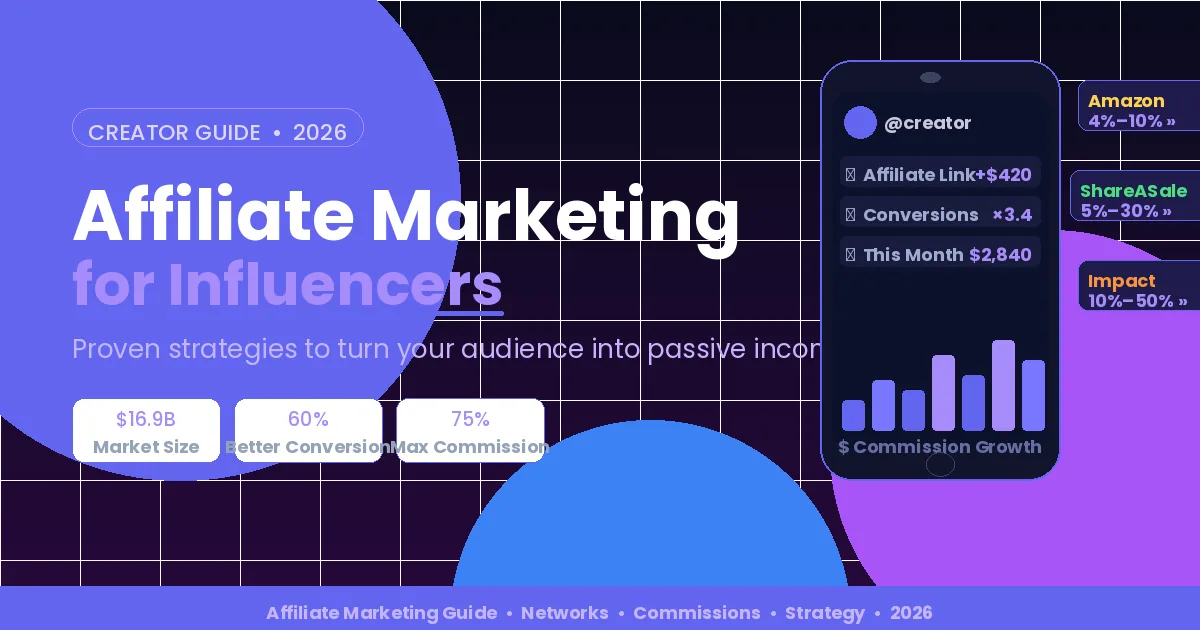
| Amazon Associates | General / all niches | 1–10% | 24 hours | Massive product range, lowest barrier to entry |
| ShareASale | Fashion, health, home | 5–30% | 30–90 days | 4,500+ merchants, creator-friendly onboarding |
| Impact | SaaS, tech, finance | 10–50% | 30–90 days | Used by Airbnb, Shopify, major tech brands |
| CJ Affiliate | Retail, travel, finance | 5–25% | 7–90 days | Established network, strong brand roster |
| LTK (LikeToKnow.it) | Fashion, beauty, lifestyle | 10–20% | 7–30 days | Built specifically for influencers, shoppable app |
| ClickBank | Digital products, health | 25–75% | 60 days | Very high commissions, quality varies by product |
| Rakuten Advertising | Retail, luxury goods | 5–15% | 30–60 days | Premium brand relationships, reputable |
| TikTok Shop | Lifestyle, fashion, tech | 5–20% | In-session | Native in-video affiliate integration |
Which network fits your niche?
- Lifestyle, fashion, beauty: LTK + ShareASale is the standard combination. LTK’s app-based shopping experience removes friction for followers who want to buy immediately.
- Tech, SaaS, productivity, finance: Impact or CJ Affiliate. These networks host high-commission programs with recurring revenue structures that compound over time.
- General or broad content audiences: Amazon Associates as a foundation — low commissions, but the brand recognition reduces purchase hesitation. Pair with one niche-specific network for higher-margin products.
- Digital products, online courses, software: ClickBank or direct affiliate programs from course creators. Commission rates of 40–75% are common in this category.
Most successful creators run 2–3 programs simultaneously, matching network to content type rather than defaulting to one platform across everything.
How Much Can Influencers Actually Earn from Affiliate Marketing?
Earnings vary widely, but they come down to four variables: niche purchase intent, engagement rate, content format, and affiliate link placement strategy. Follower count is the least important of the four.
Micro-influencers often outperform on conversions
<cite index=”3-1″>According to Influencer Marketing Hub’s 2025 research, micro-influencers deliver 60% better engagement rates than accounts with over 100,000 followers — their audiences are highly engaged, niche-focused, and trust their recommendations. A fitness creator with 50,000 devoted followers will drive more qualified affiliate sales than a celebrity with 2 million disengaged followers.</cite>
<cite index=”5-1″>HubSpot’s 2025 State of Marketing & Trends Report found that 44% of B2C marketers achieved the most success with micro-influencers (10,000 to 99,999 followers), while only 25% had the most success with macro-influencers, and just 7% with mega-influencers.</cite>
Realistic earnings benchmarks by tier
| Influencer Tier | Follower Range | Realistic Monthly Affiliate Income | Conditions |
|---|---|---|---|
| Nano | 1K–10K | $100–$500 | Niche content, strong engagement |
| Micro | 10K–100K | $500–$5,000 | Targeted niche, SEO + social content |
| Mid-tier | 100K–500K | $3,000–$20,000 | Diversified platforms, email list |
| Macro | 500K–1M | $10,000–$50,000+ | Multi-network strategy, evergreen content |
| Mega | 1M+ | $50,000–$200,000+ | Usually combined with brand deals |
These figures assume active, strategic affiliate promotion — not a bio link that sits untouched.
The highest-earning niches for affiliate income
- Personal finance (credit cards, investing apps, insurance) — highest cost-per-action rates in the industry, often $50–$200 per referred customer
- SaaS and software — recurring commissions, high lifetime customer value, compounding income
- Health and wellness — high consumer spending, emotionally driven purchase decisions, strong repeat-buy behavior
- Home improvement and home goods — high average order values, strong seasonal demand
- Travel — hotel and flight affiliate commissions recovered strongly, with commission rates reaching 4–8% on high-ticket bookings
<cite index=”4-1″>Commission rates range widely: Amazon Associates pays 2–10%, SaaS products pay 20–40%, and physical products typically pay 8–15%. Your niche determines your rate — tech and finance pay significantly more than fashion or entertainment.</cite>
What Mistakes Are Quietly Killing Your Affiliate Revenue?
Even creators who understand the model make avoidable errors that compound over time into lost income.
Promoting products you don’t personally use
Audiences pick up inauthenticity faster than most creators realize. When promotional copy lacks genuine personal detail — the kind that only comes from real experience — conversion rates drop and long-term trust erodes. A single inauthentic recommendation can produce more unsubscribes than months of organic growth can recover.
Ignoring SEO and evergreen content
The majority of influencers focus entirely on social media posts with a 24–48 hour visibility window. A single blog post or YouTube video with solid SEO can drive affiliate clicks for three to five years. Evergreen content is the only category of affiliate work that earns while you sleep, travel, or produce other content. It’s also the category most influencers skip entirely.
Depending on a single platform
Algorithms change, platforms get acquired or restricted, and creators who diversify across a blog, email list, and at least two social channels have dramatically more stable affiliate income. An email list is an audience you own — no algorithm stands between you and your subscribers. Building one, even slowly, is one of the highest-leverage moves available to any creator.
Not tracking performance
If you don’t know which links convert and which don’t, you can’t improve. Every major affiliate network provides analytics dashboards with click, conversion, and earnings data. Use UTM parameters — unique tracking codes added to your links — to identify which specific posts, videos, or story frames drive the most sales. Then do more of those and stop doing what doesn’t move numbers.
Evaluating programs by commission percentage alone
A 50% commission on a $15 product earns $7.50. A 10% commission on a $400 product earns $40. Always evaluate commission rate multiplied by average order value — not percentage in isolation. High-commission programs on low-ticket items often underperform lower-commission programs on premium products.
Skipping the disclosure
Non-disclosure isn’t just legally risky — it damages trust with the segment of followers paying attention. When audiences discover undisclosed affiliate relationships (and they do, often via comments or other platforms), the credibility cost is disproportionate to the short-term gain. Proper disclosure doesn’t reduce conversions. It signals confidence in what you’re recommending.
Frequently Asked Questions
How many followers do you need to start affiliate marketing as an influencer?
There is no minimum. Amazon Associates accepts anyone with a website or social presence. Most major networks follow suit. <cite index=”4-1″>You can start with as few as 1,000 followers on most platforms — Amazon Associates has no minimum, TikTok Shop accepts creators with 5,000 or more followers, and some premium programs require 50,000 or more.</cite> Start where you are; niche engagement matters more than raw follower count at every level.
What’s the difference between an affiliate link and a discount code?
An affiliate link is a URL with tracking embedded in it. When someone clicks and purchases, the commission is recorded automatically. A discount code gives the buyer a price reduction and is tracked manually by the brand. Many programs offer both. Discount codes typically perform better on social media where links can’t be clicked directly; affiliate links perform better in YouTube descriptions, blogs, and email newsletters where clicking is natural.
How long does it take to start earning money from affiliate marketing?
Most creators see their first commissions within 30–90 days of actively promoting products. Building meaningful passive income typically takes 6–18 months of consistent content creation with strategic affiliate integration. The timeline shortens significantly for creators who invest in SEO-optimized blog content or long-form YouTube videos, where search-driven traffic begins compounding quickly.
Do you need a website to do affiliate marketing as an influencer?
No, but having one significantly increases earning potential. A website lets you create evergreen SEO content that drives affiliate traffic continuously through search engines. Without one, you’re dependent on platform algorithms and posts with 24–72 hour lifespans. At minimum, an email list combined with one or two social platforms provides a more stable foundation than social media alone.
Are affiliate commissions taxable income?
Yes. Affiliate commissions are taxable as self-employment income in most countries, including the United States, United Kingdom, Australia, and EU member states. Track earnings across all programs throughout the year. Most networks issue 1099 forms (in the US) or equivalent documentation once you exceed reporting thresholds. Keep records of all commission deposits and consult a tax professional if you’re earning significant affiliate income, as deductions for content creation expenses are often available.
What’s the best platform for affiliate marketing as an influencer right now?
YouTube remains the highest-converting platform for affiliate marketing because links in video descriptions have long lifespans and viewers are typically in research or consideration mode — meaning they’re actively looking for information before a purchase decision. Blogs with SEO traffic rank second for evergreen passive income. <cite index=”3-1″>TikTok Shop’s in-video affiliate integration has emerged as one of the fastest-growing affiliate channels, while Instagram and TikTok work best for fashion, beauty, and lifestyle categories with high visual appeal.</cite>
Can you do affiliate marketing alongside brand deals?
Yes, and this is the most sustainable income model. Brand deals provide a reliable upfront income floor; affiliate commissions provide performance-based upside with no ceiling. Many creators negotiate hybrid arrangements — a reduced flat fee for content creation combined with ongoing affiliate commissions — which aligns the brand’s and creator’s incentives over a longer period. <cite index=”1-1″>Hybrid models are increasingly common, with brands combining a flat fee for content creation with ongoing affiliate commissions to ensure both immediate visibility and long-term sales incentives.</cite>
How do I disclose affiliate links correctly?
Place your disclosure at the beginning of the content where it’s clearly visible — not buried in hashtags, folded behind “more,” or appearing after the affiliate link itself. The FTC guidance is clear: the disclosure must be “hard to miss.” On YouTube, state it verbally in the first 30 seconds and include it in the description. On Instagram, use “#ad” or “#affiliate” at the start of the caption. On a blog, add a disclosure block above your first affiliate link or in a banner at the top of the post.
Conclusion
Affiliate marketing works for influencers at every level — but results depend almost entirely on strategy, not follower count. The model rewards niche alignment, genuine product experience, and content with a long shelf life. A micro-influencer with a focused audience and an SEO blog can outperform a macro-influencer relying solely on Instagram Stories.
The principles are clear: choose programs that match your content, disclose every partnership, build content that lasts beyond 48 hours, track what converts, and be honest about what you actually use. These aren’t complex ideas — they’re the difference between affiliate marketing as a side experiment and affiliate marketing as a reliable income stream.
Your next step: Pick one network from the comparison table above that fits your niche. Sign up, choose one product you genuinely use, and create one piece of content around it with proper disclosure. That’s the entire starting point. Everything else scales from there.
Explore the topics that matter to you—our curated content will keep you informed and engaged.