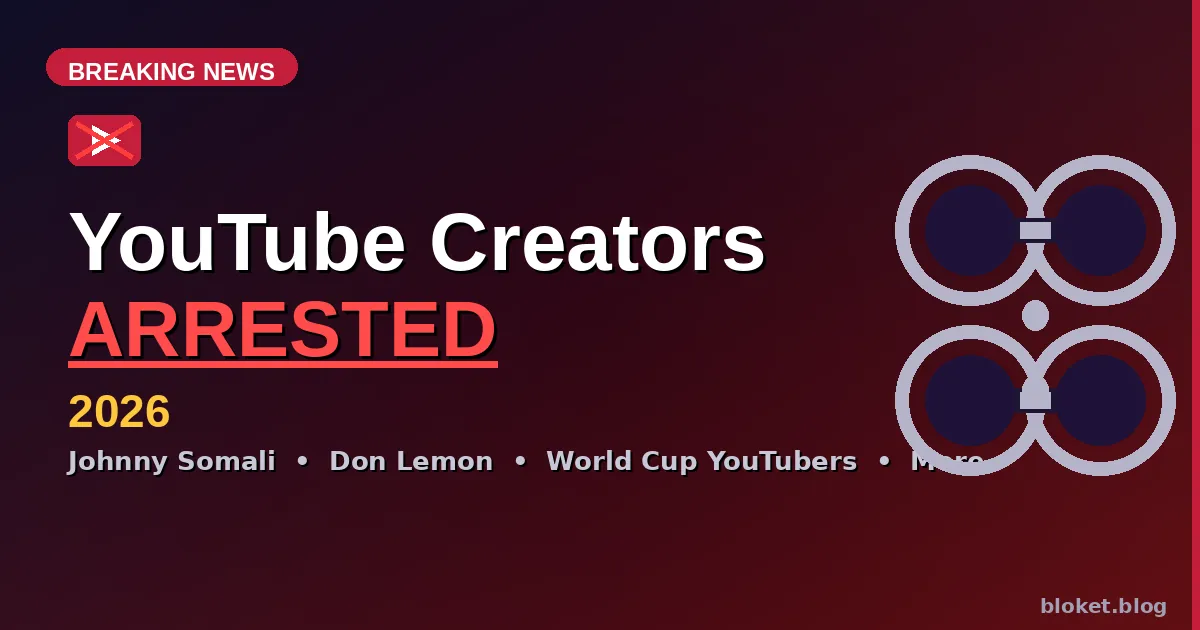
In 2026, YouTube creators getting arrested stopped being a once-a-year curiosity. It became a recurring headline. A former CNN anchor was charged with federal civil rights crimes for livestreaming a protest. A self-described internet troll went to a South Korean prison. Two Argentine YouTubers with a combined 770,000 subscribers were arrested at a World Cup stadium. A group of residential streamers were handcuffed on camera in Tucson.
These cases look different on the surface. But they share a common thread: content creators pushing boundaries — whether for journalism, shock value, or access — and running into laws that don’t care how many subscribers you have.
This article covers every major case, the charges behind each one, and what all of this tells us about where the law stands on creator content in 2026.
Which YouTube Creators Were Arrested in 2026?
In 2026, at least seven YouTube creators or streamers faced arrest or criminal charges worldwide, spanning press freedom disputes, nuisance streaming, security fraud, and international legal battles.
Here’s a quick reference of the confirmed major cases:
| Creator / Channel | When | Where | Charge |
|---|---|---|---|
| Don Lemon (The Don Lemon Show) | January 29, 2026 | Los Angeles, USA | Federal civil rights conspiracy |
| Johnny Somali (Ramsey Khalid Ismael) | Sentenced April 15, 2026 | Seoul, South Korea | Obstruction of business, deepfake distribution |
| Pato Perrotta | June 27, 2026 | Miami, USA | Felony interference with a sporting event |
| Beni Marmol | June 27, 2026 | Miami, USA | Felony interference with a sporting event |
| Alexander Zabel Jr. (CriminalNetwork) | June 2026 | Tucson, USA | Obstruction of highway, public nuisance |
| Troy Lewis Bradshaw (DAA JUICE) | June 2026 | Tucson, USA | Public nuisance |
| Damian Todd Enderle (857 Tucson) | June 2026 | Tucson, USA | Public nuisance (cited and released) |
Each of these cases unfolded differently. Some involve clear law-breaking. Others raise serious questions about press freedom in the current political climate. Let’s go through them one by one.
Don Lemon: When Covering a Protest Gets You Federal Charges
The arrest of Don Lemon on January 29, 2026 is the year’s most politically charged creator case — and the one with the furthest-reaching consequences for journalism.
Lemon, who left CNN in 2023 and built a substantial independent media operation on YouTube, was arrested overnight in Beverly Hills by more than two dozen FBI and Homeland Security agents. <cite index=”9-3″>Federal agents seized his phone at the time of arrest</cite>, and <cite index=”8-1″>he was charged with conspiracy against the rights of religious freedom at a place of worship, as well as injuring, intimidating, and interfering with the exercise of the right of religious freedom at a place of worship.</cite>
The charges stem from a protest on January 18. Demonstrators entered Cities Church in St. Paul, Minnesota, interrupting a church service. Lemon was there covering the story. <cite index=”10-1″>Lemon repeatedly said on his YouTube stream that he was present as a journalist, not as an activist, and was heard on video saying “I’m just here photographing, I’m not part of the group — I’m a journalist.”</cite>
The government saw it differently. The indictment alleged Lemon took steps to keep pre-protest communications discreet and was therefore part of a conspiracy.
The legal problems with that theory are significant. <cite index=”12-1″>A magistrate judge initially refused to sign the arrest warrant for Lemon, citing lack of probable cause.</cite> After the Justice Department appealed and a federal appellate court declined to override the magistrate, the government went to a grand jury — which returned an indictment on January 29.
<cite index=”8-1″>Lemon was released on a personal recognizance bond the same day and appeared outside a downtown federal courthouse, saying he would not stop reporting.</cite>
The response from legal experts and press freedom organizations was swift and largely critical. <cite index=”10-1″>Seth Stern of the Freedom of the Press Foundation said the arrests relied on “bogus legal theories” and were “clear warning shots aimed at other journalists.”</cite> The ACLU described the prosecution as “extremely concerning,” noting that a magistrate judge had refused to sign the original warrant and that career prosecutors reportedly objected to the case.
<cite index=”9-1,9-2″>In May 2026, a federal judge ordered the unsealing of search warrants aimed at obtaining Lemon’s YouTube channel data from Google as evidence in the ongoing prosecution.</cite>
As of July 2026, charges remain active. Lemon pleaded not guilty at his February 13 arraignment.
What makes this case significant for creators specifically: it’s the first time a working journalist using YouTube as their primary broadcast platform faced federal charges for field reporting. The legal outcome will affect how independent news creators assess risk when covering protests.
Johnny Somali: Six Months in a South Korean Prison
If Don Lemon’s case is complicated and contested, Johnny Somali’s is far less ambiguous.
<cite index=”29-1″>Ramsey Khalid Ismael, known online as Johnny Somali, was convicted by the Seoul Western District Court of obstruction of business and distributing fabricated sexually explicit content.</cite> On April 15, 2026, he received a six-month prison sentence, with immediate detention ordered because the court viewed him as a flight risk.
<cite index=”27-1″>In addition to the prison term, Ismael was sentenced to 20 additional days in detention and barred from working with children or people with disabilities for five years.</cite>
The charges covered a range of behavior during his time in Seoul. <cite index=”30-1″>Formal charges included causing disturbances at a convenience store — blasting loud music and spilling cup noodle broth on a table — as well as repeatedly disrupting buses, subways, and public spaces, and creating and distributing nonconsensual deepfake videos combining male and female faces.</cite>
The case drew international attention in October 2024, when <cite index=”29-1″>Ismael posted a clip of himself kissing and performing a lap dance on a statue commemorating Korean women who were forced into sexual slavery by Japanese forces during World War II. He later apologized, claiming he was unaware of the monument’s significance.</cite>
The court was direct in its reasoning. <cite index=”16-1″>The court found that Ismael “repeatedly committed crimes against unspecified members of the public to generate profit via YouTube and distributed the content in disregard of Korean law.”</cite>
Prosecutors had pushed for three years. The reduced sentence reflected what the court called an “absence of severe harm to victims.”
Both sides appealed. <cite index=”30-1″>In a June 26, 2026 ruling, a Seoul appeals court upheld the six-month sentence, rejecting both the prosecution’s push for a harsher term and Ismael’s bid for leniency.</cite> Ismael had testified at the appeal that he was diagnosed with bipolar disorder and had stopped taking medication upon entering Korea.
For the broader creator community, this case illustrates something that was already clear from similar incidents in Japan and Israel: the “I’m just trolling for content” defense does not travel well. South Korea prosecuted the behavior as a series of deliberate crimes, not an edgy aesthetic.
Argentine YouTubers Arrested at the 2026 FIFA World Cup
This one is the most recent — and the most straightforwardly avoidable.
<cite index=”21-1″>On June 27, 2026, Argentine YouTubers Pato Perrotta, 26, and Beni Marmol, 20, were arrested at Hard Rock Stadium in Miami after allegedly making it through multiple layers of security to attend the Colombia vs. Portugal group-stage match at the 2026 FIFA World Cup.</cite>
<cite index=”20-1″>In an arrest affidavit, a Miami-Dade County Sheriff’s deputy wrote that Perrotta claimed he was “hired by a media company to review the event and has credentials” — but those credentials were from a previous event and were not valid for Saturday’s match. Marmol stated he was a “media influencer trying to get in to stream the game.”</cite>
Both were arrested on felony charges of interfering with a sporting event. Under Florida law — which was tightened following incidents at the 2024 Copa America final — <cite index=”25-1″>entering a ticketed event of more than 5,000 people without authorization is a third-degree felony carrying up to five years in prison.</cite>
<cite index=”19-1″>Perrotta and Marmol were held on a $2,500 bond.</cite> Their manager, Walter Costabel, told Argentine media both men were fine and not facing deportation, but would remain in the U.S. until the case was resolved.
<cite index=”21-1″>Perrotta has more than 500,000 YouTube subscribers, Marmol more than 270,000. Their content typically covers lavish shopping experiences and 24-hour challenges.</cite>
Context matters here: <cite index=”21-1″>tickets to the Colombia vs. Portugal match reportedly cost as much as $1,000, with five million ticket requests for a stadium holding 64,478.</cite> Getting in to stream the match without paying would have been a significant commercial advantage. Whether the court views it as opportunistic fraud or an honest mistake about credential validity will determine how serious the consequences become.
As of publication, no trial date has been set.
Tucson Streamers and the Rise of “Audit” Content Arrests
The Tucson cases in June 2026 sit in a different category than the others — and they’re worth understanding because they reflect a pattern growing quietly across the U.S.
<cite index=”1-1″>Three YouTubers who had been streaming in Nancy Guthrie’s Tucson neighborhood were arrested or cited by the Pima County Sheriff’s Department. Alexander Zabel Jr., 54, who runs the channel CriminalNetwork, was arrested on suspicion of obstruction of a highway or thoroughfare and public nuisance. Troy Lewis Bradshaw, 34, who runs the channel DAA JUICE, was arrested on suspicion of public nuisance. Damian Todd Enderle, 46, who runs the channel 857 Tucson, was cited and released for public nuisance.</cite>
<cite index=”1-1″>Bradshaw’s arrest was documented live on Enderle’s stream. “They have officially arrested DAA JUICE,” Enderle told viewers as he drove away from the scene.</cite>
The arrests triggered online pushback from the streamers’ followers, and the cases drew commentary from other creators in the “public audit” space — a niche where creators film public officials or controversial locations, often claiming First Amendment protections.
The Tucson situation reflects a specific tension: creators livestreaming in residential areas, often in connection with ongoing local news events, who argue their presence is protected journalism. Local authorities tend to view persistent presence in the same location differently, especially when complaints pile up.
These cases are still active as of this writing.
What Do These Cases Have in Common?
These arrests look scattered. A journalist in LA, a troll in Seoul, two influencers in Miami, and a group of streamers in Tucson. But look at the pattern underneath:
Content was the motive, not incidental. In every single case, the creator’s goal was to generate footage — for views, subscribers, or revenue. That context matters legally. South Korea’s court explicitly said Ismael committed crimes “to generate profit via YouTube.” The Tucson streamers were running active channels when they were arrested. The Argentine creators were there to stream a World Cup match. Lemon was livestreaming the protest he was covering.
The platform provides no protection. Being a YouTuber, streamer, or independent journalist does not grant special legal access or immunity. In some jurisdictions, it may actually draw more scrutiny — courts notice when the alleged motive is content monetization.
International standards differ widely. What’s legal to film and publish in the U.S. may constitute a criminal offense in South Korea or the Philippines. Creators who travel and stream in foreign countries are subject to those countries’ laws. This is not theoretical — Vitaly Zdorovetskiy spent nine months in Philippine immigration detention before being deported to Russia in January 2026, following a separate series of local law violations. Johnny Somali was convicted. The trend toward enforcement is real.
“I’m a journalist” is not a universal shield — but it matters. Don Lemon’s case is the exception that shows how complicated this gets. His defense rests on First Amendment protections for journalists. The government’s case relies on the theory that attending a pre-protest meeting made him a co-conspirator. That line has never been tested quite this way before. The outcome will matter for every creator doing field reporting.
Frequently Asked Questions
Why are so many YouTubers getting arrested in 2026?
Several factors are converging. Livestreaming technology makes it easier to document and broadcast behavior in real time, which increases both the reach of creator content and the evidence available to prosecutors. Governments worldwide are also showing less tolerance for disruptive content creators, particularly after high-profile incidents involving “nuisance” streamers in Asia. In the U.S., a political climate focused on enforcement is producing cases like Don Lemon’s that would have been unthinkable a few years ago.
What happened to Don Lemon’s YouTube channel after his arrest?
<cite index=”3-1″>Prominent creators, influencers, and media figures kept Lemon’s YouTube channel active on the day of his arrest, with rolling coverage featuring figures including DL Hughley, Joy Reid, Jim Acosta, and others rallying viewer support.</cite> Lemon has continued operating his independent media operation and has made clear he does not plan to stop.
What was Johnny Somali convicted of specifically?
<cite index=”28-1″>Ismael was convicted of obstruction of business and distributing deepfake content.</cite> The obstruction charges covered a pattern of disrupting public and commercial spaces in Seoul. The deepfake charges involved creating and sharing nonconsensual explicit videos. Both the original six-month sentence and the five-year employment ban involving minors and disabled individuals were upheld on appeal in June 2026.
Can YouTubers be arrested for covering protests?
In the U.S., journalists generally have strong First Amendment protections when covering protests from public spaces. Don Lemon’s case is unusual because prosecutors allege he was present at a pre-protest meeting and therefore participated in a conspiracy — not just reporting from the outside. As of mid-2026, he has pleaded not guilty and the case is ongoing. Most legal experts following the case are skeptical that the government’s theory will hold up in court.
What charges do the Argentine World Cup YouTubers face?
<cite index=”20-1″>Pato Perrotta and Beni Marmol were each charged with felony interference with a sports or entertainment event under Florida law.</cite> The charge carries a maximum sentence of five years in prison. They were released on a $2,500 bond and remained in the United States while the case proceeded.
Did VitalyzdTv get arrested in 2026?
Not in the conventional sense. <cite index=”2-1″>Vitaly Zdorovetskiy, who had been held in Philippine immigration detention since April 2025, had his cases resolved and was deported to Russia on January 17, 2026.</cite> He was subsequently barred from re-entering the Philippines. In April 2026, he drew criticism for falsely accusing a man during a “Catching Child Predators” livestream, an incident he later acknowledged as a serious mistake that caused the man significant reputational harm.
What legal risks do content creators face when filming in public?
The risks vary significantly by country. In the U.S., filming in genuinely public spaces is broadly protected, though private property rules apply and law enforcement interactions can become physical. In South Korea and Japan, intentionally disruptive behavior — even in public — can constitute criminal interference. At major events like the FIFA World Cup, special-event security laws carry felony-level penalties. The bottom line: your country of origin’s legal traditions may not apply where you’re filming.
Conclusion
The wave of creator arrests in 2026 doesn’t fit one neat narrative. Some cases are clearly about people breaking the law for content. Others raise serious questions about government overreach and press freedom.
What they share is this: being a YouTuber is not a legal category that changes the rules. Courts in South Korea, the U.S., and beyond are treating creator content as evidence of intent, motive, and conduct — not as a shield from accountability.
If you’re a creator, the practical takeaways are straightforward. Know the laws in any country where you plan to film. Understand that livestreaming creates real-time evidence. If you’re covering protests or controversial events as a journalist, document your role clearly and consult a lawyer before you go.
The cases above aren’t warnings. They’re precedents. And in 2026, the legal system is clearly paying attention to what creators do with a camera.
Better choices start with better information—explore our decision-making reads.