YouTube changed more about creator payments in the past 18 months than in the four years before that. The platform now runs a two-tier Partner Program, rewrote its policies on AI-generated content, and started enforcing “inauthentic content” rules that reject channels even when the subscriber count looks fine on paper.
Understanding the YouTube monetization rules 2026 edition means going beyond the subscriber-and-watch-hours checklist. This guide covers the current eligibility thresholds, how the two tiers actually differ, what YouTube’s reviewers check when they assess your channel, and the specific mistakes keeping creators stuck in review limbo. If you’ve already read the standard “1,000 subscribers and 4,000 hours” summary elsewhere, this goes well beyond that.
What Are the YouTube Partner Program Requirements in 2026?
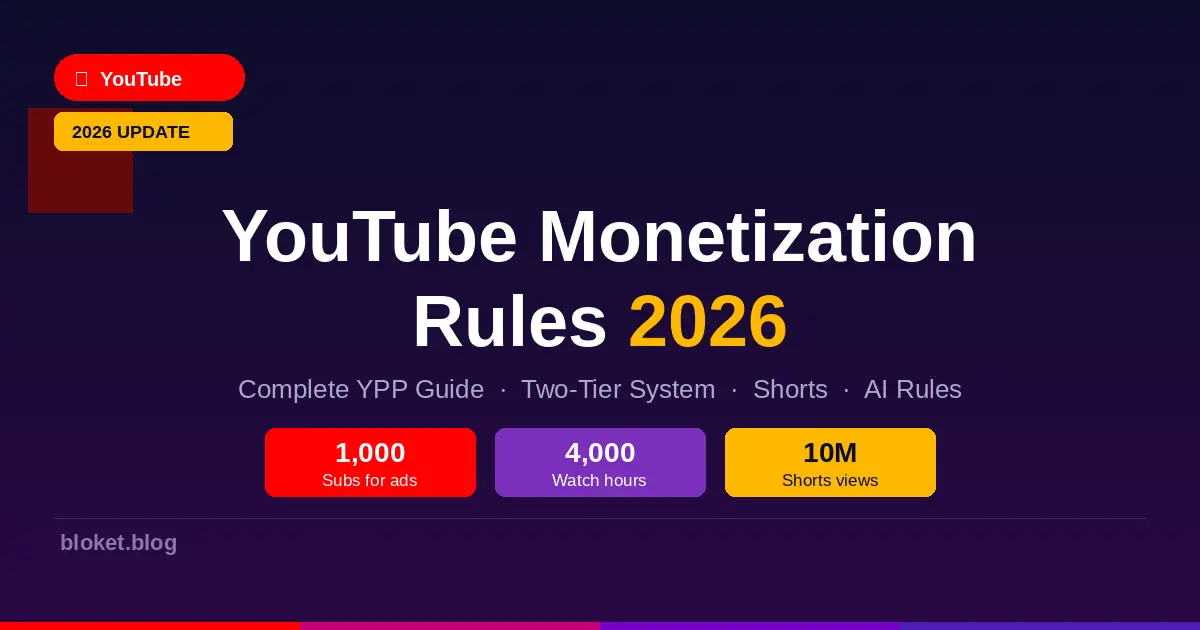
To qualify for full YouTube monetization in 2026, you need 1,000 subscribers plus either 4,000 valid public watch hours in the past 12 months or 10 million public Shorts views in any 90-day window. You also need an active AdSense account, two-factor authentication enabled on your Google account, and a channel with no active Community Guidelines strikes.
That covers the full ad-revenue tier. But there’s now a second entry point most guides underexplain.
The Two-Tier YPP Structure
YouTube split the Partner Program into two distinct tracks in 2023 and has kept this structure through 2026:
Tier 1 — Early Access (Fan Funding)
| Requirement | Threshold |
|---|---|
| Subscribers | 500 |
| Public videos (last 90 days) | 3 or more |
| Watch hours (last 12 months) | 3,000 |
| OR Shorts views (last 90 days) | 3 million |
This tier unlocks Super Thanks, Super Chat, Channel Memberships, and YouTube Shopping for your own products. You cannot earn ad revenue at this level.
Tier 2 — Full Monetization (Ad Revenue)
| Requirement | Threshold |
|---|---|
| Subscribers | 1,000 |
| Watch hours (last 12 months) | 4,000 valid public hours |
| OR Shorts views (last 90 days) | 10 million |
This is where ad revenue sharing starts.
One thing that trips up a lot of creators: watch time from Shorts does not count toward the 4,000-hour threshold. Shorts have their own separate view path. If you primarily make Shorts, you need 10 million views in a 90-day window to reach the full ad tier — the long-form watch hours won’t accumulate from Shorts, no matter how many you post.
How Do You Actually Get Approved for YPP?
Hitting the subscriber and watch hour numbers unlocks the Apply button. It does not guarantee approval. YouTube manually reviews every application and examines things your Studio dashboard won’t show you upfront.
Here’s what the process looks like after you submit:
- Meet the baseline metrics. Check eligibility in YouTube Studio → Monetization tab. The progress bar updates in real time.
- Verify your AdSense account first. An unverified or incomplete AdSense setup will stall your monetization even after YouTube approves your channel. Handle this before you apply — not after you’re approved.
- Enable 2-factor authentication. No 2FA on your Google account means no YPP application. It’s a hard block, not a suggestion.
- Submit your application. YouTube Studio → Earn → Apply to YPP. Standard review takes about 30 days. Channels in sensitive content categories or with complicated histories take longer — sometimes significantly longer.
- Wait for the human review. YouTube reviewers look at your entire channel, not just recent uploads. They’re checking for reused content, misleading thumbnails, engagement quality, and policy violations going back years.
What Reviewers Actually Look At
In tracking publicly reported rejection patterns, a few things stand out consistently. Channels built on stock footage plus AI voiceover — with no meaningful human contribution — get flagged at a high rate under the “inauthentic content” policy (more on that below). Channels with clickbait thumbnails that don’t match the video’s actual content also get rejected at an unusually high rate, even when the content itself is clean.
A note on channel history: a Community Guidelines strike from two years ago still matters during review. Reviewers assess the full arc of your channel, not just your last 10 uploads. If you have any unresolved strikes or warnings in your channel’s past, address them before you apply.
What Content Gets Monetized — and What Gets Cut?
YouTube’s advertiser-friendly content guidelines define what earns money. Most creators know the obvious limits. The rules that catch people off guard are more specific.
Content that qualifies for full ads:
- Original tutorials, commentary, reviews, and educational content
- News reporting with clear journalistic framing and source attribution
- Entertainment that doesn’t target protected groups or glorify harmful behavior
- Lifestyle, travel, cooking, and similar non-sensitive niches
Content with limited or no ads:
- Videos discussing self-harm, suicide, or eating disorders — even if genuinely educational
- Drug-related content including alcohol unless clearly framed as a health or documentary topic
- Heavy profanity throughout (limits premium ad categories)
- Controversial political content with extreme viewpoints
Content that risks rejection entirely:
- AI-generated scripts read by synthetic voices over stock footage, with no original contribution
- Channels built around scraping and reposting other creators’ content
- Misleading thumbnails or video titles that don’t reflect actual content
- Mass-produced “ambient” or compilation content that follows a template with no variation
The most significant enforcement change came in July 2025, when YouTube renamed its “repetitious content” rule to “inauthentic content” and deployed new detection systems. The practical effect: channels producing high volumes of near-identical templated videos are now flagged for manual review, even if each individual video is technically original. Pattern matters as much as individual quality.
How Do Shorts Monetization Rules Differ?
Shorts have their own mechanics, and they’re meaningfully different from long-form rules. This is the most misunderstood section of YouTube’s current monetization framework.
| Feature | Long-Form Video | Shorts |
|---|---|---|
| Watch hours count toward YPP | Yes (4,000 hrs threshold) | No |
| Views needed for full YPP | N/A | 10M in 90 days |
| Ad revenue share | 55% to creator | 45% to creator |
| Revenue structure | Per-video CPM | Shared pool model |
| Long-form hours from Shorts | No | — |
The 45% Shorts revenue share comes from a pooled fund, not direct per-video ad placement. YouTube aggregates Shorts ad revenue across the whole platform, subtracts music licensing costs, and distributes the remainder to eligible creators based on their proportional share of total views. Your effective RPM for Shorts will almost always be lower than your long-form RPM.
The 90-day window for Shorts views is a rolling count updated daily — not a fixed quarter. A Shorts video posted today starts accumulating views toward your running 90-day total, but those views drop off the count exactly 91 days later. Creators building toward the 10 million threshold need to track this carefully rather than relying on cumulative lifetime totals.
Based on patterns from channels that have cleared the Shorts threshold: hitting 10 million views typically requires either one viral video or consistent output of 20–30 Shorts per month sustained over several months. The Shorts path is not inherently faster than the long-form path — it’s just different, and tends to generate lower ad revenue once you’re in.
What Are YouTube’s AI Content Disclosure Rules in 2026?
Most articles on this topic either overcomplicate it or bury the practical details. Here’s what the policy actually requires, based on YouTube’s May 2025 update.
You must disclose AI content when:
- Your video contains a synthetic voice that could be mistaken for a real, identifiable person
- It shows AI-generated footage of real people or events that could look like genuine recordings
- It depicts realistic AI recreations of real-world locations in ways that might mislead viewers
- It covers sensitive topics — health, news, elections, personal finances — using AI-generated material
You do NOT need to disclose when:
- Your content uses clearly stylized AI art, animation, or obviously non-realistic visuals
- You use AI for editing assistance, background removal, subtitle generation, or script drafting
- You create content with YouTube’s own native AI tools (Dream Screen, Dream Track) — these apply labels automatically with no action needed from you
The disclosure label appears in your video description and, for sensitive topics, directly on the video player. According to YouTube’s confirmed policy, the label has no effect on your video’s ranking, recommendations, or monetization eligibility. The only consequence comes from failing to disclose qualifying content — which can trigger content removal, revenue loss, or suspension from YPP.
Enforcement has become noticeably stricter since early 2025. YouTube now uses both automated detection and manual review to identify undisclosed synthetic content. If your channel operates in a high-scrutiny category (health, financial advice, news), assume reviewers will examine your disclosure habits before approving or renewing YPP status.
How Much Can You Actually Earn?
Ad RPM — revenue per 1,000 views — varies by niche, audience location, and content type. Here’s a realistic range based on creator-reported figures from 2025–2026:
| Niche | Typical RPM Range |
|---|---|
| Finance / Investing | $8–$25 |
| Tech / Software | $5–$15 |
| Business / Marketing | $5–$12 |
| Lifestyle / Vlogging | $2–$6 |
| Gaming | $1–$4 |
| Shorts (all niches) | $0.03–$0.08 per 1,000 views |
To make this concrete: a gaming channel with 200,000 views per month at a $2 RPM earns roughly $400 from ads. A finance channel with the same views at $15 RPM earns $3,000. Niche selection affects income more than view count for most creators.
Beyond ads, monetized channels have access to additional revenue streams at different thresholds:
- Channel Memberships (Tier 1, 500 subs): recurring monthly payments from subscribers, typically $1.99–$9.99/month per member
- Super Chat and Super Thanks: one-off payments during livestreams and on regular videos
- YouTube Shopping affiliate (requires 10,000 subscribers): commission on products from external brands
- YouTube Premium revenue: a proportional share based on how long Premium subscribers watch your content
Creators who build three or more of these streams alongside ad revenue consistently report 2–3x higher monthly income than those relying on ads alone — particularly in lower-CPM niches like gaming or general entertainment where ad rates are thin.
One shift worth noting in 2026: YouTube has been pushing harder on non-skippable mid-roll ads, shoppable ad formats, and integrated Shopping placements. For creators in product-adjacent niches — tech reviews, beauty, cooking — this creates a real opportunity to earn on views that previously generated minimal ad revenue. It’s worth setting up your Shopping shelf even if you don’t have merchandise yet, simply to be eligible when YouTube tests new placements on your content type.
Common Mistakes That Kill YPP Applications
Most rejection stories trace back to one of five root causes.
1. Reused content without real transformation Assembling clips from other creators, news broadcasts, or movies without original commentary, significant editing, or clear added value is the fastest rejection trigger. YouTube’s reviewers are specifically trained to identify this pattern — and the detection systems have improved substantially since 2024.
2. Hitting thresholds with fake engagement Purchased subscribers and view count inflation from click farms get caught during the review process. YouTube cross-references engagement quality — a channel where 80% of subscribers have never liked, commented, or watched anything beyond the first click will stand out immediately.
3. Ignoring channel history A Community Guidelines strike from 18 months ago still matters. Reviewers assess the full channel, not just the last three months. An old strike you’ve forgotten about can delay or kill your application.
4. AdSense setup errors The two most common: duplicate AdSense accounts linked to the same identity (causes automatic holds), and mailing addresses that don’t match what Google has on file (fails identity verification). Set up AdSense carefully — it’s slower to fix after the fact than to do correctly the first time.
5. Assuming Shorts income will be sustainable Shorts can qualify you for YPP through the views threshold. They rarely generate reliable income on their own. Creators who build to monetization through Shorts, then rely on Shorts alone for revenue, consistently find the income too variable to depend on. Treat Shorts as a growth tool, not an income strategy.
FAQ: YouTube Monetization Rules 2026
How many subscribers do you need to get monetized on YouTube in 2026? You need a minimum of 500 subscribers for Tier 1 fan-funding features (Super Chat, Memberships). Full ad revenue requires 1,000 subscribers plus either 4,000 valid watch hours or 10 million Shorts views. Both tiers require a channel in good standing with no active policy violations.
Does Shorts watch time count toward the 4,000-hour requirement? No. Shorts watch time is tracked separately and does not contribute to the long-form threshold. Shorts creators qualify for ad revenue through a parallel path: 10 million valid public Shorts views within any rolling 90-day window.
How long does YouTube take to review a monetization application? Standard review takes about 30 days. Channels with limited posting history, content in sensitive categories, or a record of previous policy violations take longer — sometimes well beyond 30 days. There’s no way to accelerate the review queue.
Can AI-generated content be monetized on YouTube? Yes, AI-generated content is monetizable provided it meets YouTube’s originality standards and carries the correct disclosure label when required. Content must be “significantly original and authentic” — AI scripts over stock footage with no human creative input does not clear that bar and risks rejection.
What happens to your monetization if you stop uploading? YouTube can disable monetization on channels that go six or more months without publishing new content. Consistent uploads — even once or twice a month — maintain your standing. The policy is meant to prevent “zombie channels” from holding YPP status indefinitely.
What is the Shorts ad revenue share in 2026? Shorts creators receive 45% of eligible ad revenue from the Shorts revenue pool, compared to 55% for long-form content. The pool model also means Shorts RPM in absolute terms is much lower than long-form CPM — typically $0.03–$0.08 per 1,000 views versus $1–$25 depending on niche for long-form.
Why would a channel with 1,000 subscribers be rejected for YPP? The most common reasons are reused or low-value content, inactive posting history, misleading thumbnails, unresolved policy violations, and engagement patterns consistent with artificial growth. Meeting the subscriber threshold opens the application — it doesn’t guarantee approval.
Do you need a separate AdSense account for YouTube? No, but you need one AdSense account linked to your YouTube channel. You can use an existing AdSense account if you have one from another Google product. The critical rule: only one AdSense account per person. Multiple accounts linked to the same identity trigger an automatic hold.
Conclusion
The YouTube monetization rules 2026 update rewards channels with real audiences, original content, and clean account histories. The two-tier YPP system gives smaller creators earlier access to fan-funding tools, while the full ad revenue tier still requires 1,000 subscribers and verified watch time. The AI disclosure rules are specific and enforced — not something you can dismiss as vague guidance.
Three things matter most right now: produce content that passes the inauthentic content test, get your AdSense account verified and clean before you apply, and don’t build your income strategy around Shorts alone.
Open YouTube Studio → Earn tab and check where your channel actually stands. If you’re near the threshold, clear any old policy violations from your channel history before you apply. That single step prevents most of the avoidable rejections.
Cut through the noise—our curated reads deliver only what matters.