Twitch has banned thousands of channels since 2011, but only a handful of cases actually changed how the platform operates. In my years covering creator platforms, I’ve watched Twitch swing from an all-or-nothing ban hammer to a more graduated system that separates streaming suspensions from chat suspensions. This guide breaks down exactly who got banned, why, and what the current rules mean if you stream.
You’ll get a plain-English explanation of Twitch’s enforcement system, a table of the platform’s most notable bans, the real reasons behind them, and answers to the questions people ask most about getting banned or unbanned.
What Does It Mean to Be Banned From Twitch?
A Twitch ban is an enforcement action that removes a user’s ability to stream, chat, or both, after a violation of the Community Guidelines. Bans range from a 24-hour suspension to an indefinite suspension that can last years. Since February 2025, Twitch no longer issues permanent bans in the strict sense — even indefinite suspensions can be appealed after six months.
Twitch splits violations into two broad categories: on-platform conduct and off-platform conduct. On-platform violations happen during a stream, in chat, or in channel content like panels. Off-platform violations cover behavior elsewhere — including other social platforms — that Twitch’s Off-Service Investigations Team determines poses a safety risk, such as ties to extremist groups or sexual exploitation of minors.
The severity of a violation determines the punishment. Twitch defines harm broadly, covering physical, emotional, social, or financial damage to a person, to Twitch, or to the wider community. Low-severity violations expire from a user’s record after 90 days; higher-severity ones stay on file for one to two years.
It’s worth separating a Twitch ban from a channel ban. A Twitch ban comes from Twitch’s own Trust & Safety team and affects a user’s entire account across the platform. A channel ban, by contrast, is issued by an individual streamer or their moderators and only blocks a viewer from that one channel’s chat — it has nothing to do with platform-wide enforcement.
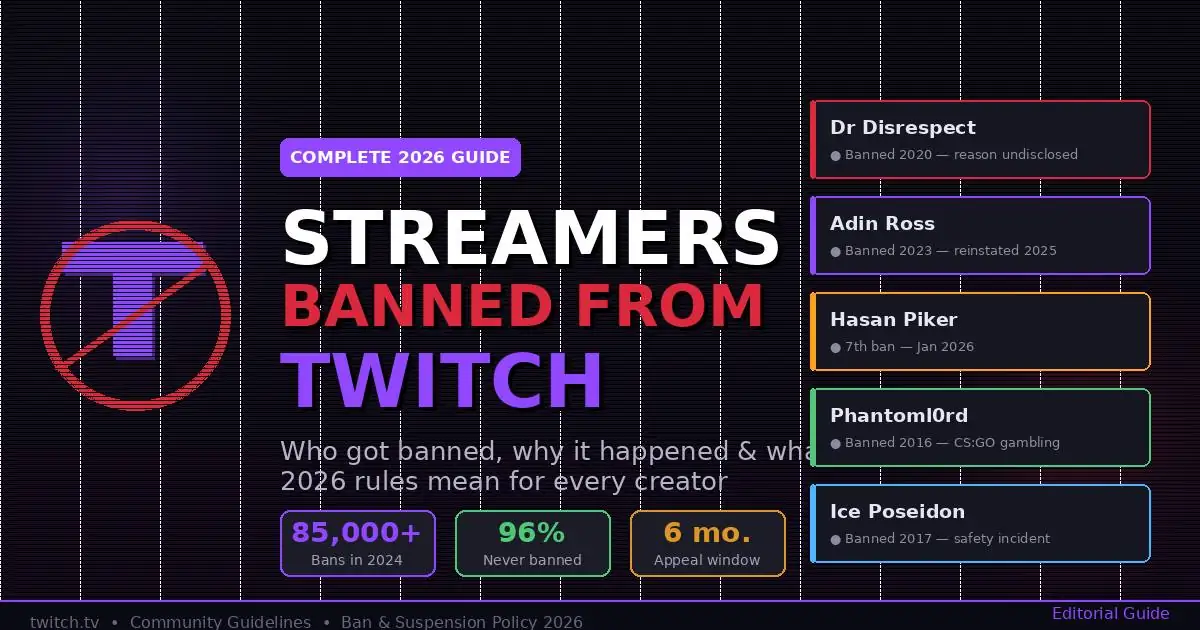
Twitch’s Transparency Report gives a sense of scale here. Twitch issued more than 85,000 enforcement actions in 2024 alone, and that number has climbed every year as the platform’s user base grows. The overwhelming majority of these are smaller channels dealing with spam, harassment, or automated bot accounts rather than the high-profile cases that make headlines.
DMCA copyright claims sit in a separate lane entirely. Twitch’s Trust & Safety team doesn’t handle music or video copyright strikes — those come through a different process tied to rights holders, and they’re tracked independently from Community Guidelines violations. A streamer can rack up DMCA strikes without ever touching the enforcement system described here.
How Does Twitch Decide Who Gets Banned?
Twitch scores every violation by harm level, then applies an enforcement type that matches the offense rather than shutting down the whole account. This changed dramatically on February 24, 2026, when Twitch split its old single suspension type into two distinct actions: streaming suspensions and chatting suspensions.
Here’s how the current system actually works, step by step:
- Detection. Twitch flags a possible violation through user reports, moderator escalation, or automated tools that scan chat and stream content.
- Severity review. Twitch’s safety team scores the incident against its internal harm framework, checking whether it’s a first offense or a repeat violation in the same policy category.
- Suspension type assigned. Low-severity, stream-based violations trigger a streaming suspension only. Chat-only violations trigger a chatting suspension only. High-severity violations trigger both at once.
- Escalation check. If the user violated the same policy category before, within that violation’s expiration window, the new suspension length increases automatically — even if this specific incident isn’t worse than the last one.
- Notification and evidence. Twitch now shares the specific chat message or stream clip that triggered the enforcement, sent through the Appeals Portal and via email.
- Appeal window. The streamer can contest the decision through the Appeals Portal. First-time appeals tend to have the best odds of a reduced penalty.
- Reinstatement path. For indefinite suspensions, the user can request reinstatement after six months has passed, a policy introduced when Twitch retired true permanent bans in early 2025.
A streaming suspension blocks someone from going live but still lets them watch other channels, chat elsewhere, and manage their dashboard. A chatting suspension does the opposite: it blocks someone from chatting in other people’s channels, but they can still stream and chat in their own community. Twitch made this split specifically because a full lockout for a minor chat infraction felt disproportionate to both creators and the community.
Before 2026, a single mistake in someone else’s chat could shut down a creator’s entire channel for days, wiping out ad revenue and subscription momentum in the process. That “all-or-nothing” model is what Twitch’s engineering and safety teams pointed to when they announced the overhaul. Under the new structure, the punishment is supposed to fit the specific feature that was misused, not the creator’s entire livelihood.
Twitch’s own data suggests most creators never see this system up close. Roughly 96% of active streamers have never received a suspension of any kind, and among the small percentage who do, the large majority never reoffend. That statistic matters for context: the high-profile bans covered in this guide are outliers, not the norm for the average person streaming on the platform.
In my conversations with creators who manage moderation teams, the biggest complaint about the old system wasn’t the punishment itself — it was the ambiguity. A streamer could get suspended after an eight-hour broadcast with no idea which moment triggered it. The new evidence-sharing requirement, where Twitch points to the specific chat message or clip, directly answers that complaint.
Which Streamers Have Been Banned From Twitch?
The most notable Twitch bans share a pattern: repeated policy violations, off-platform controversy, or a single incident severe enough to warrant an immediate indefinite suspension. Some of these streamers eventually returned; others never did.
| Streamer | Year Banned | Reason | Current Status |
|---|---|---|---|
| Dr Disrespect | 2020 | Never officially disclosed by Twitch | Remains banned; now streams independently |
| Ice Poseidon | 2017 | Shared his flight gate live, leading to a bomb-threat swatting incident | Remains banned; streams on Kick |
| Phantoml0rd | 2016 | Undisclosed ownership of a CS:GO skin-gambling site he promoted on stream | Remains banned; sued Twitch and won partial damages |
| Adin Ross | 2023 (eighth ban) | Hateful conduct after displaying an unmoderated chat feed on stream | Reinstated in March 2025 after Twitch’s policy overhaul |
| Destiny (Steven Bonnell) | 2024 | Repeated policy violations tied to on-stream debates and off-platform statements | Remains banned; streams on YouTube |
| indiefoxx | 2022 | Repeated dress-code violations, including an on-stream wardrobe incident | Reinstated in 2023 |
| JiDion | 2021 | Organized a harassment raid against another streamer’s channel | Remains banned |
| Asmongold | 2026 | Suspended twice for comments Twitch deemed hateful conduct during Just Chatting broadcasts | Currently serving a temporary suspension |
| Hasan Piker | January 2026 (seventh ban) | Community guidelines violation during an on-stream political discussion | Reinstated after his suspension expired |
A few patterns stand out from these cases. First, escalation is real: nearly every streamer on this list had multiple prior violations before the ban that made headlines. Second, off-platform behavior increasingly counts against a creator, a shift Twitch formalized through its Off-Service Investigations process starting in 2024. Third, even a platform’s biggest names aren’t exempt — Hasan Piker and Adin Ross both rank among Twitch’s most-watched creators, and both have been suspended multiple times.
Amouranth offers a useful data point on a different kind of enforcement: repeated temporary suspensions tied to sexual content policy rather than a single dramatic incident. That pattern shows Twitch applying graduated discipline consistently, not just reserving it for political or safety-related cases.
Adin Ross’s case is probably the clearest illustration of how much Twitch’s approach has changed. He picked up eight separate violations between 2020 and 2023, several tied to slurs and unmoderated content, before receiving what was then called an indefinite suspension. When Twitch eliminated permanent bans in February 2025 and introduced a six-month reinstatement window, Ross became one of the first major test cases — and his return in March 2025 came with his follower count reset to zero, a detail that surprised even long-time viewers who expected a seamless comeback.
Hasan Piker’s situation shows the other side of the escalation model in action. His January 2026 suspension was his seventh, and each prior violation in the same policy category shortened the runway before the next one triggered a longer penalty. Twitch’s public messaging around this case emphasized that follower count and platform value don’t buy exemptions — the escalation math applies the same way whether a channel has 500 viewers or 500,000.
Not every case ends in reinstatement. Destiny’s 2024 ban followed a broadcast that featured a controversial guest, and Twitch never issued detailed public reasoning for the final decision. He has continued streaming on YouTube since, illustrating a broader trend: banned creators rarely disappear from content creation entirely, they simply migrate their audience to a competing platform like Kick or YouTube.
Ice Poseidon’s ban remains one of the starkest examples of real-world consequence colliding with livestreaming. Sharing his flight gate on a live broadcast led directly to a bomb-threat call and a police response, and Twitch’s decision to ban him permanently reflected the physical safety risk rather than any speech-related violation. That distinction matters — physical safety violations sit at the top of Twitch’s harm framework and rarely get reversed.
Common Mistakes and Myths About Twitch Bans
Myth: a ban always means permanent removal. In reality, Twitch eliminated true permanent bans in February 2025. Even indefinite suspensions now include a formal reinstatement path after six months, which is exactly how Adin Ross returned after two years away.
Myth: only political streamers get banned. Streamers get banned for gambling non-disclosure, harassment campaigns, dress-code violations, DMCA issues, and safety incidents just as often as for political commentary. Phantoml0rd and Ice Poseidon are proof the earliest major bans had nothing to do with politics.
Myth: Twitch reveals the reason for every ban. Twitch has stayed silent on several high-profile cases, most famously Dr Disrespect’s 2020 suspension. Streamers sometimes get more clarity through the Appeals Portal than the public ever does.
Mistake: assuming off-platform behavior doesn’t matter. Twitch’s Off-Service Investigations Team can open a case based on conduct on another social platform if it poses a safety risk, even if nothing happened on Twitch itself. This is a genuine shift from the platform’s earlier, narrower enforcement scope.
Mistake: ignoring escalation windows. A minor violation from over a year ago might not matter anymore, but the same violation type committed again within 90 days to two years will trigger a longer suspension automatically. Streamers who track their violation history in the Appeals Portal avoid nasty surprises here.
Myth: getting unbanned means a clean slate in every sense. Reinstated streamers often lose their follower count, as Adin Ross discovered when his account reset from roughly 7 million followers to under 2,000 upon his return. Twitch typically restores clip and VOD history, but the social proof of a large follower count doesn’t always come back quickly.
Mistake: assuming content warning labels are optional for sensitive topics. Twitch requires a Content Classification Label for streams that focus on gender, race, sexuality, or religion in a polarizing or inflammatory way, though the platform clarified in 2024 that discussing one’s own lived experience doesn’t automatically require the label. Getting this distinction wrong has tripped up streamers who assumed any political topic needed a warning, or conversely, that no political topic did.
Myth: gambling content is banned outright on Twitch. Twitch restricted unlicensed gambling streams and sites without consumer protections back in 2022, but the platform didn’t ban gambling content as a whole category. Streamers can still feature licensed gambling operators that meet Twitch’s requirements, which is a nuance that trips up a lot of newer creators researching the rules.
Frequently Asked Questions
Can a streamer come back after being permanently banned from Twitch? Yes, in most cases now. Twitch retired true permanent bans in February 2025, replacing them with indefinite suspensions that allow a reinstatement request after six months, which is how Adin Ross and indiefoxx both returned to the platform.
Why was Dr Disrespect banned from Twitch? Twitch never officially disclosed the reason for Dr Disrespect’s June 2020 ban, making it one of the most speculated-about moments in streaming history. He has since built an independent streaming career outside Twitch.
Does off-platform behavior count toward a Twitch ban? Yes. Twitch’s Off-Service Investigations process, expanded in 2024 and 2025, can open a case against a user for behavior on other platforms if it poses a safety risk to the Twitch community, including extremist affiliations or sexual exploitation of minors.
What’s the difference between a streaming suspension and a chatting suspension? A streaming suspension stops someone from going live but allows chatting elsewhere; a chatting suspension blocks chatting in other channels but allows the person to keep streaming their own content. Twitch introduced this split enforcement model on February 24, 2026.
How long does a Twitch ban usually last? Temporary suspensions range from 24 hours to 30 days depending on severity, while indefinite suspensions have no fixed end date but can be appealed after six months under current policy.
Can I appeal a Twitch ban? Yes, through the official Appeals Portal, where Twitch now shares the specific chat message or clip that caused the violation. First-time appeals generally have the highest success rate.
Does streaming a banned game get you suspended? It can. Twitch prohibits any game rated Adults Only by the ESRB, along with specific titles flagged for violating community guidelines regardless of rating, and streaming one can trigger an immediate suspension.
Do bigger streamers get treated differently than smaller ones? No — enforcement applies at every follower tier, though bigger bans simply attract more public attention. Hasan Piker and Adin Ross, two of Twitch’s most-watched creators, have each been suspended multiple times.
Key Takeaway
Twitch’s ban system has moved away from blunt, all-or-nothing punishment toward a graduated model that separates streaming suspensions, chat suspensions, and escalating penalties for repeat offenses. The biggest names in streaming — from Dr Disrespect to Adin Ross to Hasan Piker — prove that no follower count guarantees immunity from enforcement.
If you stream on Twitch, the practical move is simple: read the current Community Guidelines, check your violation history in the Appeals Portal if you have one, and remember that off-platform behavior can now factor into on-platform consequences. Bookmark Twitch’s Safety Center and revisit it quarterly, since these policies keep evolving.
Stop scrolling, start learning—our curated reading list is worth your time.