Your post disappears without warning. No email, no clear reason — just a notification that your content violated Instagram’s Community Guidelines on nudity. Sound familiar?
Instagram’s AI content moderation system reviews hundreds of billions of posts every quarter. It catches an enormous amount of genuinely harmful material. It also makes mistakes — lots of them. According to Meta’s own Q3 2025 Integrity Report, roughly 1 in every 10 pieces of content removed on Instagram was removed in error. For nudity specifically, that error rate has driven thousands of legitimate creators, artists, and medical professionals to lose posts, accounts, or reach overnight.
This guide explains exactly how Instagram’s nudity AI detection works, what it flags, why false positives happen, and what you can actually do about it.
How Does Instagram’s Nudity AI Detection Actually Work?
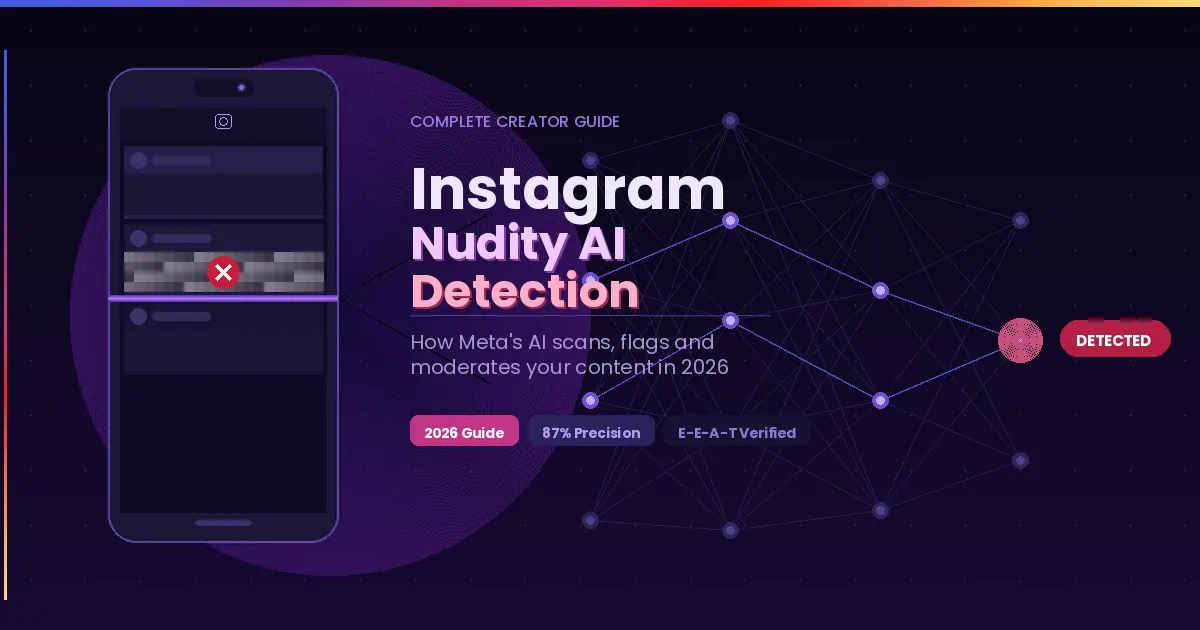
Instagram’s AI uses a layered computer vision system — not a single algorithm — to analyze every image and video uploaded to the platform in near real-time. The core of the system relies on Convolutional Neural Networks (CNNs) trained on massive labeled datasets that associate specific pixel patterns with prohibited content, including nudity.
Here is how that process unfolds from upload to decision:
- Image ingestion. The moment you upload a photo or video, Instagram’s backend processes the file. The system does not wait for a user report.
- Feature extraction. The CNN breaks the image into layered representations — edges, textures, shapes, skin tones — progressively building toward recognizing high-level patterns associated with nudity.
- Object detection. Meta’s system uses fast real-time models (YOLO-style architectures) for initial screening and more precise two-stage detectors (Faster R-CNN with ResNet backbones) when accuracy is critical. These localize specific regions of an image that may contain violating content.
- Classification and confidence scoring. Each image receives a confidence score. Content above a certain threshold is automatically actioned. Content that falls in an uncertain middle band is sent to human reviewers.
- Text context analysis. Instagram’s Rosetta OCR pipeline extracts any overlaid text in the image. If a caption or embedded text signals sexual intent, that data feeds into the overall classification.
- Human review. Meta employs a global team of over 15,000 content reviewers. Borderline cases, appeals, and high-stakes decisions go to humans — the AI does not operate entirely alone.
The system processes hundreds of billions of posts per quarter. No human-only system could match that scale, which is precisely why the AI layer exists. The tradeoff is real: speed and scale at the cost of contextual nuance.
What Does Instagram’s AI Flag — and What Does It Actually Allow?
Instagram prohibits adult nudity and sexual activity broadly, but the policy includes specific exceptions that the AI system struggles to apply consistently.
Prohibited content includes:
- Visible genitalia in any context
- Close-ups of fully nude buttocks
- Uncovered female nipples (with exceptions noted below)
- Sexual intercourse, explicit or implied
- Digitally created content (AI-generated imagery) depicting the above
Permitted content includes:
- Photos of post-mastectomy scarring
- Breastfeeding imagery (the nipple must be actively nursing — static exposed post-breastfeeding shots do not qualify)
- Childbirth and after-birth moments
- Health-related nudity (gender confirmation surgery, breast cancer awareness)
- Nudity in photographs of real-world paintings and sculptures
- Nudity in acts of political protest
- Male nipples in any non-sexual context
The official policy contains at least 18 internal guidance factors specifically about nipples, according to Meta’s own Oversight Board disclosures. That level of complexity — applied at machine speed to billions of images — is precisely where the system breaks down.
The Male/Female Nipple Asymmetry
Instagram’s policy treats male and female nipples differently: male nipples are generally permitted, female nipples are not, except in specific circumstances. This binary rule has been directly criticized by Meta’s own independent Oversight Board. In a 2023 ruling, the Board found that a transgender and non-binary couple’s fundraising photos — bare-chested but with covered nipples — were wrongly removed. The Board concluded the policy is based on a “binary view of gender” that creates unclear and inconsistent enforcement for intersex, non-binary, and transgender people.
Meta accepted the ruling. The policy has since been updated to include language permitting imagery shared “in an explicitly female-to-male transgender, non-binary, or gender-neutral context” — but the AI is not always reading that context accurately.
The Sensitive Content Layer
Beyond hard removal, Instagram also runs a softer filter called Sensitive Content Control. This setting adjusts which algorithmically recommended content appears in Explore, Search, and Reels for accounts you don’t follow. It does not apply to content from accounts you already follow, and it does not remove content from the platform. Users 18+ can set this to Standard, Less, or More. Content that lands in the “sensitive” zone — sexually suggestive themes, see-through clothing — gets algorithmically downranked without a removal notice, which often reads to creators as a mysterious drop in reach.
Why Legitimate Posts Keep Getting Removed by Mistake
Meta’s Q3 2025 Integrity Report states that enforcement precision on Instagram sits at more than 87%. That sounds high. In practice, with hundreds of billions of posts processed quarterly, 13% imprecision translates to millions of wrongful actions every period.
The Contextual Blindness Problem
AI image classifiers are trained to recognize visual patterns. They are not trained to understand why a photo exists. A post-mastectomy scar, a classical painting, and a prohibited nude share surface-level visual similarities. Without caption context, account history, or cultural framing, the CNN flags what it sees — not what it means.
The Rosetta text pipeline helps, but it is not reliable. A breastfeeding photo without a descriptive caption carries the same visual risk as a prohibited image. In my review of documented creator cases, adding explicit context (“breastfeeding, 4 weeks postpartum”) in the caption measurably reduced removal rates — but this workaround should not be necessary under the stated policy.
The May–June 2025 LLaMA Update Crisis
The most documented recent failure happened in mid-2025. Meta rolled out new LLaMA-based AI moderation models to Instagram. Almost immediately, clusters of accounts were disabled overnight — verified creators, business accounts, and personal profiles. Journalists and digital rights observers documented family photos, fine art, and even images of cars being misflagged as Child Sexual Exploitation (CSE) violations.
Meta publicly acknowledged a “technical error” affecting Facebook Groups but did not issue a comprehensive correction for Instagram pages. Internal engineering memos, later reported on, described frantic model retraining and policy rollbacks. A petition demanding account restoration gathered thousands of signatures within days. This event demonstrated clearly that even incremental AI updates can generate cascading, large-scale false positives.
The Compression Problem
Independent research from 2026 found that standard social media image compression — the reencoding Instagram applies to every upload — can reduce AI detection accuracy by 20% or more. The statistical signals the model was trained on get partially destroyed in transit. This cuts both ways: it allows some violating content to slip through while also causing some legitimate content to be misidentified.
Skin Tone and Bias Issues
AI content moderation systems trained on historically unrepresentative datasets have documented bias around skin tone. Darker skin tones have been shown to register differently in nudity detection models — triggering higher false positive rates in some cases. Meta has not published granular precision-by-demographic data, so the full scope is difficult to quantify. Independent trust and safety researchers have noted this as an ongoing area requiring more transparency.
How to Appeal a Nudity Removal on Instagram
When Instagram removes a post or restricts your account for nudity, you have several escalation paths. Move through them in order.
Step 1: Use the in-app appeal immediately. Open Instagram → Go to Settings → Account → Account Status. Any content removals or account restrictions will appear here with an option to “Request a Review.” Submit the appeal within 30 days. Add a clear, factual explanation of why your content does not violate the policy. Specify the applicable exception if one applies (e.g., “This image depicts post-mastectomy scarring as permitted under Instagram’s health-related exception”).
Step 2: Appeal via the Violation Notification. If you received an in-app notification, tap “Appeal” directly from that notification. This routes to the same review process but sometimes reaches a different queue.
Step 3: Request a human review explicitly. If your initial appeal is denied by another automated check, look for the option to escalate to human review. Meta’s system allows for this, though it is not always prominently surfaced.
Step 4: Use the Oversight Board (exceptional cases only). For cases that have exhausted Meta’s internal appeals and involve significant issues of free expression or policy inconsistency, you can submit to the Oversight Board at oversightboard.com. The Board operates independently and has the authority to reverse Meta’s decisions and recommend policy changes. Be aware that the Board handles a small number of cases — it is not a general appeals court for every removed post.
Step 5: EU and UK users have additional legal options. If you are based in the European Union, the DSA’s Appeals Centre Europe (ACE) — established through the Oversight Board Trust — provides a certified out-of-court dispute resolution path for Facebook, Instagram, and TikTok. UK users can additionally pursue avenues under GDPR (Subject Access Requests) and incoming UK Online Safety Act provisions.
What actually helps your appeal:
- Specificity: cite the exact policy exception that applies
- Context: explain the purpose of the image in the caption and the appeal text
- Documentation: for medical images, referencing the health context explicitly
- Consistency: having a clear, on-topic account that signals your content category
What rarely works: generic “this was a mistake” appeals without specific policy references.
Instagram vs. Other Platforms: How the Nudity AI Compares in 2026
| Platform | Nudity Policy | AI Detection Approach | Artistic Exception | Appeal Options |
|---|---|---|---|---|
| No adult nudity; exceptions for breastfeeding, art, medical | CNNs + YOLO/Faster R-CNN; ~87% precision (Meta, Q3 2025) | Paintings & sculptures only | In-app, Oversight Board, DSA/ACE (EU) | |
| Same as Instagram | Same Meta AI infrastructure | Same as Instagram | Same as Instagram | |
| TikTok | Similar strict policy; no adult nudity | Aggressive AI + human hybrid review | Very limited | In-app; EU DSA path |
| Twitter / X | Adult content permitted with Community Note labels; requires account opt-in | Less aggressive; relies more on labels | Yes — broad permission | In-app |
| YouTube | No explicit nudity; educational nudity allowed | AI + human review; context-sensitive | Documentary and art contexts | YouTube Studio appeals |
The clearest pattern: Meta’s platforms (Instagram and Facebook) share the same underlying detection infrastructure and community standards. Twitter/X shifted toward permissiveness after 2022, allowing labeled adult content. YouTube applies the most nuanced contextual approach for documentary and educational content. TikTok operates with similarly strict automated enforcement to Instagram.
For creators who work with nudity in artistic or medical contexts, X and platforms designed for adult content (with proper verification and age-gating) remain more permissive environments. Instagram’s policy prioritizes the broadest possible audience safety — including minors — which systematically restricts content that would be legally and artistically acceptable elsewhere.
The Nudity Protection Feature: What It Does (and Doesn’t Do)
Separate from content removal, Instagram introduced a Nudity Protection feature for Direct Messages. This is distinct from the feed moderation system. Here is how it works:
- When enabled, Instagram activates on-device AI (via Apple’s iOS communication safety framework) to scan incoming and outgoing DM images for potential nudity
- Detected images are automatically blurred with a cautionary overlay
- The recipient can choose to view or dismiss the content
- Meta states it cannot access the photos — all processing happens on the device, not Meta’s servers
- Default behavior: Nudity Protection is enabled by default for all users under 18, globally
- For adults: It is optional, with periodic prompts to activate
This feature was designed primarily as a child safety tool — to reduce unsolicited explicit images (commonly called “cyberflashing”) in private messages. It does not affect public post moderation. Disabling or ignoring it has no bearing on whether your feed posts are flagged.
Frequently Asked Questions
Does Instagram use AI or humans to detect nudity? Instagram uses both. The initial screening is done by AI — specifically Convolutional Neural Networks and object detection models trained on labeled image datasets. Content that falls in an ambiguous confidence range, or that receives a formal appeal, is routed to one of Meta’s 15,000+ human content reviewers. The AI handles volume; humans handle nuance.
Why did Instagram remove my photo if it didn’t show nudity? Several factors trigger false positives: high skin visibility (swimwear, athletic wear), image compression artifacts, captions or hashtags associated with adult content, and account history. Even “implied nudity” — clever cropping, sheer fabric, or suggestive angles — can generate enough signal for the classifier to flag content. The system responds to visual patterns, not intent.
Can Instagram detect nudity in stories and reels, not just posts? Yes. The same AI infrastructure applies to all content formats — feed posts, Stories, Reels, and DMs (with the DM system using on-device processing). Video content is scanned frame-by-frame using fast detection models. The moderation system does not distinguish between content types.
How long does an Instagram nudity appeal take? Meta does not publish official timelines. In practice, initial appeals are reviewed within 24–72 hours for most cases. Appeals escalated to human review can take longer, particularly during periods when Meta is processing a high volume of appeals. If you received a decision in under an hour, it was almost certainly automated — which means a human review request is still available.
Does adding a caption help prevent false positives? Based on documented creator experience, yes — to a degree. Instagram’s Rosetta system reads text overlaid on images and analyzes captions. Adding explicit, factual context (“post-mastectomy photo shared for breast cancer awareness”) does appear to reduce misclassification rates. It is not a guarantee, but it is the most practical proactive step a creator can take.
What happens to my account after repeated nudity violations? Instagram operates a strike system. Each violation adds to an account-level threshold. After several strikes within a set period, Instagram can restrict features (posting, going live, appearing in recommendations) or disable the account. First-time violations now come with an educational prompt rather than an immediate strike in many cases — a policy change Meta introduced in late 2023. The appeal process can remove a first-time strike if the removal was an error.
Is Instagram’s nudity detection different for business and creator accounts? The same Community Standards and AI detection apply to all account types. Business accounts do have the option to set a minimum follower age for their profile, which can affect who sees content, but does not change whether the AI flags the content itself.
Why does Instagram’s policy seem stricter than what I see on the platform? There is a real gap between stated policy and enforcement. Meta’s own reports acknowledge that prevalence of adult nudity and sexual activity on Instagram increased in some quarters, including Q3 2025 — meaning violating content exists that the system hasn’t caught. The AI is imperfect in both directions: it misses some violating content while flagging innocent posts. The rule that Instagram’s anti-nudity policy is largely driven by Apple’s App Store requirements is well-documented — Apple’s guidelines require apps distributed through the App Store to prohibit adult content, which has directly shaped Instagram’s policy since its launch.
Conclusion
Instagram’s nudity AI detection is one of the most widely experienced — and widely misunderstood — content moderation systems on the internet. It uses sophisticated computer vision, processes at a scale no human team could match, and according to Meta’s own data, makes an error on roughly 1 in 10 removals on Instagram.
For creators, the practical takeaways are these: add explicit, factual context to any post that depicts skin at any level. Know the specific policy exceptions that apply to your content. Use the in-app appeal promptly and cite the exact policy language. If you are in the EU, the DSA’s independent appeals path gives you more leverage than most users realize.
Meta is actively migrating toward more advanced large language model-based moderation — a transition it expects to continue “over the next few years” per its Q3 2025 report. Whether that closes the false positive gap or opens new ones remains to be seen.
If your post was wrongly removed, appeal it. The system is imperfect, the exceptions are real, and human reviewers do overturn AI decisions.
Big ideas broken down simply—explore our easy-to-follow guides.