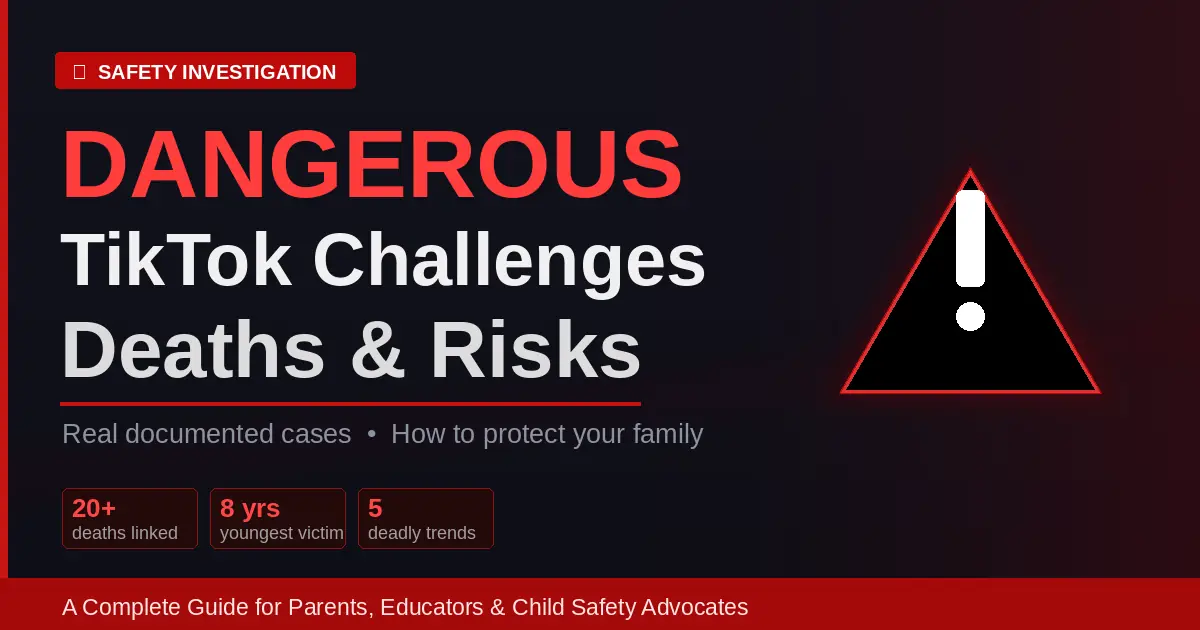
Since 2020, more than a dozen children have died attempting challenges they first encountered on TikTok. Not teenagers daring each other privately — children as young as 8, alone in their bedrooms, copying exactly what the algorithm served them for free.
This is not a scare-tactic article. It is a factual guide: which specific challenges caused deaths, the real documented cases behind the headlines, why TikTok’s system keeps amplifying dangerous content, and concrete steps parents and educators can take right now. If a child in your life uses TikTok, the next 3,000 words are worth your full attention.
What Makes a TikTok Challenge Deadly — and Different from Harmless Fun?
Most TikTok challenges are completely harmless — dance routines, cooking experiments, comedy skits. The ones that kill share a specific set of characteristics that set them apart from ordinary viral content.
A challenge crosses into genuinely dangerous territory when it involves breath restriction or oxygen deprivation, requires ingesting substances in amounts well beyond normal safety thresholds, encourages physical stunts with high fall or collision risk, and — critically — spreads fastest among children aged 8 to 14, before the brain’s risk-assessment systems are fully developed.
The common thread across every deadly challenge documented in the past five years is not cruelty or negligence — it is speed. TikTok’s recommendation algorithm does not distinguish between a harmless dance trend and a lethal dare. Both receive the same amplification mechanism if engagement metrics are high enough.
Research published in JAMA Network Open has consistently shown that adolescent brains, particularly those under 16, process reward signals differently from adult brains. The prospect of social validation — likes, comments, shares — activates the same dopamine pathways that make risk-taking feel rational in the moment, even when it clearly isn’t. This is not a character flaw in young people. It is neuroscience. Understanding this is the foundation of any meaningful protection strategy.
Which TikTok Challenges Have Caused Deaths? Verified Cases and Evidence
The following cases are documented in legal filings, government agency communications, official investigations, and mainstream reporting. These are not rumors.
The Blackout Challenge (2021–Present): The Deadliest Trend on Record
The Blackout Challenge — also called the Pass-Out Challenge — instructs participants to restrict blood flow or oxygen to the brain until they lose consciousness, then film the moment of blacking out. The challenge predates TikTok; it circulated on YouTube as the “Choking Game” around 2008–2010. TikTok’s algorithm gave it a second, far deadlier life beginning in 2021.
Documented deaths include:
- Lalani Walton, 8, Temple, Texas (July 2021): Found unresponsive in her bedroom. Her family confirmed the Blackout Challenge was the direct cause and later joined litigation against TikTok.
- Arriani Arroyo, 9, Milwaukee, Wisconsin (February 2021): Died in a nearly identical manner. Her family also brought legal action against the platform.
- Nylah Anderson, 10, Philadelphia, Pennsylvania (December 2021): Her mother, Tawainna Anderson, became one of the most prominent public advocates for platform accountability. The case drew direct congressional attention.
- A 10-year-old girl, Palermo, Italy (January 2021): One of the earliest documented TikTok-linked Blackout Challenge deaths outside the United States. The case triggered a formal national investigation by Italian prosecutors into TikTok’s platform practices.
Italian authorities responded by ordering TikTok to immediately block all users who could not verify their age — an emergency regulatory action that few other countries matched at the time. Attorneys involved in U.S. class-action litigation have cited more than 20 deaths globally linked to this single challenge through 2022.
The mechanism of harm is both simple and irreversible: brain cells begin dying within four minutes of oxygen deprivation. There is no safe way to attempt this challenge. Children who lose consciousness before they can remove a ligature or recover their breathing have no opportunity to reverse the outcome.
The Benadryl Challenge (2020): When a Drug Aisle Became a Danger Zone
This challenge encouraged users to take excessive doses of diphenhydramine — the active antihistamine in Benadryl — to induce hallucinations, then film the effects. The problem is that diphenhydramine toxicity causes dangerous cardiac arrhythmias and seizures. The “hallucinations” the challenge promises are a direct symptom of poisoning the body, not a safe recreational state.
In May 2020, three teenagers in the Tulsa, Oklahoma area were hospitalized after attempting the challenge. A 15-year-old in Oklahoma City died from diphenhydramine overdose — one of the first confirmed deaths directly linked to a TikTok-spread challenge.
The U.S. Food and Drug Administration (FDA) issued a formal public safety communication in September 2020, explicitly warning that taking higher-than-recommended doses of Benadryl is dangerous and potentially fatal. That step — a federal agency issuing a safety warning in direct response to a social media challenge — was extraordinary. Johnson & Johnson, Benadryl’s manufacturer, simultaneously urged TikTok to remove the content.
The One Chip Challenge (2023): A Product Recall and a Preventable Death
Paqui marketed an extremely spicy tortilla chip — coated in Carolina Reaper and Naga Viper peppers, two of the hottest peppers on Earth — as a “challenge” product. Participants filmed themselves eating the chip and recording their distress reaction.
On September 1, 2023, Harris Wolobah, 14, of Woburn, Massachusetts, ate the chip at school after classmates pressured him. He collapsed and died later that day. The Middlesex County Medical Examiner confirmed that the extreme capsaicin content was a contributing factor in his death.
Paqui recalled the entire product line within weeks. His mother, Lois Wolobah, stated publicly that she had no idea the chip was in her son’s backpack. The Massachusetts state legislature subsequently initiated proceedings to restrict the marketing of extreme-heat food products to minors. Harris’s death remains one of the most widely reported cases of a social media challenge directly driving product liability and legislative response.
The Skull Breaker Challenge (2020): Designed to Cause Falls
Three people stand side by side and jump in unison. What the person in the middle doesn’t know: the two on the outside have coordinated to kick out the middle person’s legs at the peak of their jump. The victim falls without any chance to brace for impact — head and spine take the full force of the fall on hard surfaces.
The challenge spread rapidly across TikTok in early 2020, with documented cases in the United States, Spain, and Latin American countries. Injuries ranged from severe concussions to skull fractures requiring surgery. Schools across the U.S. and Spain issued emergency notifications. Multiple deaths were reported internationally, though some families declined to have their children’s cases identified publicly. New Jersey state legislators introduced platform accountability bills partly in direct response to this trend.
The NyQuil Chicken Challenge (2022): When Cooking Became a Health Warning
Users were cooking raw chicken in NyQuil — a liquid cold medicine containing dextromethorphan, acetaminophen, and doxylamine — and filming the result. The challenge began with satirical intent, but the FDA issued a formal warning in September 2022 regardless.
The specific risk: cooking concentrates the active drug compounds. Inhaling the medicated vapors during cooking introduces those compounds directly into the bloodstream through the lungs, bypassing the digestive system’s normal absorption and metabolic regulation. No deaths were directly attributed to this challenge. But the FDA’s formal response to it — two years after their Benadryl warning — illustrated how the regulatory framework was shifting to treat TikTok challenges as a genuine public health category.
Why Does TikTok’s Algorithm Keep Amplifying Dangerous Content?
TikTok does not intentionally promote deadly challenges. Its recommendation system — the For You Page (FYP) — is optimized for a single metric above all others: engagement. Watch time, shares, and replays. Dangerous content generates all three — not because viewers want to see children get hurt, but because shock, concern, and disbelief are among the most powerful drivers of watch time. The algorithm cannot distinguish between a person watching because they’re entertained and a person watching because they’re horrified.
Three structural problems compound the core issue:
Speed of spread outpaces moderation. A challenge can reach tens of millions of views — and be attempted by thousands of children — in under 48 hours. By the time content is flagged, reviewed by a human moderator, and removed, the behavioral pattern has already spread. The Blackout Challenge videos that reached Nylah Anderson and Lalani Walton were not caught before they caused harm.
The algorithm targets by interest signals, not by developmental maturity. A child who watches sports content, prank videos, or any challenge content gets served more of the same category — including progressively risky variations. An 8-year-old who watches one challenge video is served more challenge content. There is no filter that distinguishes “appropriate for a 10-year-old” from “appropriate for a 17-year-old” in TikTok’s FYP logic.
Duets, Stitches, and Shares extend a challenge’s reach exponentially. TikTok’s built-in sharing features allow dangerous content to survive and spread even after the original is removed. A child doesn’t need to find the original Blackout Challenge video — they find 400 reaction videos that describe, re-enact, and discuss it in full detail.
In 2023, TikTok introduced enhanced Family Pairing controls, default screen time limits for users under 18, and additional age-appropriate content filtering. Independent evaluations by Common Sense Media found these measures represent genuine improvements — while also noting they are incomplete, particularly for children who access the platform with falsified ages or through adult-registered accounts.
Common Myths That Are Putting Children at Greater Risk Right Now
Knowing what is false is as important as knowing what is true.
Myth 1: “My child knows better than to try dangerous things.” In reviewing documented child safety cases, this is the most common parental assumption — and the most dangerous one. Every family whose child died in the cases above described their child as sensible, careful, and well-raised. Peer dynamics and algorithmic exposure override rational knowledge in adolescent decision-making. Knowing a risk exists does not reliably prevent the behavior in children under 16.
Myth 2: “TikTok removes dangerous content fast enough.” TikTok’s own transparency reports document millions of videos removed every quarter. The problem is that removal happens after content has already circulated widely. The fatal exposures in the cases above happened within the first wave of a challenge’s spread — not after it became a known controversy.
Myth 3: “This only happens to older teenagers.” Every case in this article involves a child aged 8 to 15. The youngest documented death linked to a TikTok challenge was 8 years old. Children this young access TikTok in significant numbers because its age verification system — which relies entirely on a self-entered birthdate — is trivially easy to bypass.
Myth 4: “Banning my child’s phone solves it.” Restriction without explanation creates curiosity. Children who understand specifically why a challenge is dangerous — who know the biological mechanism of harm in age-appropriate terms — make safer decisions than children who are simply told “no.” Education is not a soft alternative to restriction. It is the more effective long-term intervention, according to research from the American Academy of Pediatrics.
Myth 5: “Platform liability is someone else’s problem.” The lawsuits filed by families of Blackout Challenge victims are directly challenging the legal frameworks that have historically shielded platforms from responsibility. Cases like Anderson v. TikTok argue that Section 230 immunity — which protects platforms from liability for user-generated content — should not extend to algorithmic amplification decisions made by the platform itself. Several courts have allowed these cases to proceed. This represents a meaningful shift in how product liability law is being applied to recommendation systems.
How to Protect Your Child from Dangerous TikTok Challenges: 7 Steps
Protection requires action across three areas: platform-level controls, direct household conversation, and school-level coordination.
Step 1: Enable TikTok Family Pairing. Family Pairing links a parent’s TikTok account to a child’s. From your account, you can restrict direct messages, control search functionality, set daily screen time limits, and filter content categories. Access it via: Profile → Settings → Family Pairing.
Step 2: Set the child’s account to private. A private account limits who can Duet or Stitch with your child’s content and significantly reduces exposure to challenge trends propagating through the platform. Access via: Profile → Settings → Privacy → Private Account.
Step 3: Turn on Restricted Mode. Restricted Mode filters content TikTok’s system categorizes as inappropriate for younger audiences. Independent testing confirms it is imperfect — but it reduces exposure in measurable ways. Access via: Profile → Settings → Content Preferences → Restricted Mode.
Step 4: Have a specific conversation, not a generic warning. Research from the American Academy of Pediatrics shows that specific warnings (“the Blackout Challenge involves cutting off oxygen to your brain and can kill within minutes”) are significantly more effective than generic ones (“be careful online”). Name the actual challenges. Describe exactly what they involve. Explain the specific biological harm mechanism. Specificity builds accurate risk perception.
Step 5: Build a non-punitive reporting environment. Children are far more likely to report dangerous content they encounter — or peer pressure they experience — if they believe reporting it will not result in losing their device. Make it explicit: “If you see something that looks dangerous, I want to know immediately. You will not be in trouble. Nothing about your access changes. I just need to know.”
Step 6: Review watch history together — openly, not covertly. Periodic, transparent review of recent TikTok activity — framed as curiosity about what’s trending, not surveillance — normalizes the habit and keeps communication channels open. Covert monitoring, when discovered, damages exactly the trust you need for Step 5 to function.
Step 7: Alert your child’s school. Schools are frequently the environment where challenge trends spread between children, and school staff are often the first to observe warning signs. Share what you know — not to generate alarm, but to ensure that teachers and administrators have accurate, current information and know how to respond if a student mentions a specific challenge.
Dangerous TikTok Challenges: Quick-Reference Comparison
| Challenge | Mechanism of Harm | Age Range Most Affected | Deaths Documented | Official Response |
|---|---|---|---|---|
| Blackout Challenge | Oxygen deprivation to brain | 8–16 | 20+ globally (est.) | Italy emergency age-block; U.S. lawsuits proceeding |
| Benadryl Challenge | Diphenhydramine overdose | 13–17 | At least 1 confirmed | FDA Safety Communication, Sept. 2020 |
| One Chip Challenge | Capsaicin cardiac toxicity | 12–17 | 1 confirmed (Harris Wolobah) | Full product recall; Massachusetts legislative action |
| Skull Breaker Challenge | Traumatic head/spinal injury | 10–17 | Multiple internationally | School emergency alerts; NJ legislative response |
| NyQuil Chicken | Inhaled drug compound overdose | 14–20 | 0 confirmed | FDA Safety Communication, Sept. 2022 |
Frequently Asked Questions
What is the most dangerous TikTok challenge ever recorded? The Blackout Challenge is the deadliest TikTok-spread challenge on record. It involves intentionally restricting blood flow and oxygen to the brain until losing consciousness. More than 20 deaths have been linked to it globally, with victims as young as 8 years old. Because oxygen deprivation causes irreversible brain cell death within four minutes, there is no safely recoverable version of this challenge.
How do dangerous TikTok challenges reach children so quickly? TikTok’s For You Page optimizes for engagement — watch time, shares, replays — not safety. Dangerous content scores extremely high on engagement metrics because it triggers shock and strong emotional reactions. The algorithm pushes it to millions of users within hours, far faster than human moderators can review and remove it. Duet and Stitch features then allow the trend to survive original video removal by spreading across thousands of reaction accounts.
Can TikTok be held legally responsible for deaths caused by its challenges? Several U.S. lawsuits are pursuing exactly this argument. The core legal theory is that TikTok’s recommendation algorithm — not the user who created the original video — is the proximate cause of harm, and that this algorithmic decision falls outside Section 230’s traditional immunity protections. Multiple federal courts have allowed these cases to proceed rather than dismissing them outright, which represents a significant development in platform liability law.
What should I do if my child shows me a dangerous challenge they’ve seen? Stay calm and avoid a punitive response, which discourages future reporting. Thank them for coming to you. Explain specifically why the challenge is dangerous — describe the physical harm mechanism clearly. Report the specific video in-app: long-press the video → Report → Safety. Then notify your child’s school so staff are aware the trend is circulating in the relevant age group.
What age group faces the highest risk from dangerous TikTok challenges? Children aged 8 to 15 are the highest-risk group across every documented case. This is the developmental stage where social validation is the most powerful behavioral driver and where neurological development makes peer influence most difficult for children to consciously override. It is also the age group most likely to use TikTok without consistent adult co-viewing.
Are dangerous TikTok challenges getting more or less common? The most severe peak in documented deaths occurred in 2021–2022. Increased parental awareness, regulatory pressure, and platform moderation improvements have reduced the worst incidents since. However, the structural conditions that allowed the Blackout Challenge to kill eight children remain largely unchanged: a powerful engagement algorithm, bypassed age verification, and social pressure dynamics. New dangerous challenges continue to emerge on a regular cycle.
Does TikTok enforce its minimum age of 13? In practice, enforcement is weak. TikTok’s age verification relies entirely on user-entered birthdates. Children routinely enter false ages to create accounts. The UK’s Information Commissioner’s Office (ICO) fined TikTok £12.7 million in 2023 specifically for allowing children under 13 to use the platform without parental consent — a finding that reflects how systemic the verification failure is, not just anecdotal.
What permanent changes has TikTok made to address this problem? Since 2021, TikTok has introduced Family Pairing controls, default 60-minute daily screen time limits for users under 18, enhanced age-appropriate content filtering, and expanded human review teams. These are genuine improvements. Independent evaluations by Common Sense Media and digital safety researchers find them meaningful but insufficient — particularly for children accessing the platform through falsified ages or adults’ accounts.
Conclusion: What This Means — and What to Do Today
Dangerous TikTok challenges have killed children as young as 8. That is not an exaggeration — it is a documented fact attached to real names, real lawsuits, and real regulatory actions.
TikTok’s algorithm is not malicious. It is indifferent. It cannot distinguish between a dance trend and a dare that cuts off oxygen to a child’s brain. That indifference, scaled to more than 1.5 billion monthly active users, is the actual problem — and it is a structural one that individual families cannot fully solve on their own.
What parents and educators can do right now is concrete: activate Family Pairing controls this evening, have a specific and named conversation about the challenges in this article before the week is out, and build the kind of household environment where a child feels safe coming to you when something online looks dangerous.
The families of Nylah Anderson, Lalani Walton, Harris Wolobah, and others brought their cases into public record not primarily to recover damages — but to force a reckoning with algorithmic amplification as a genuine product liability issue. Their efforts are slowly reshaping the legal and regulatory landscape. Courts are taking these arguments seriously. Legislatures are responding.
In the meantime, protection starts at home and at school. Do the seven steps in the section above. Have the specific conversation today — before the algorithm has it for your child first.
One click is all it takes—explore our life-changing blog content now.