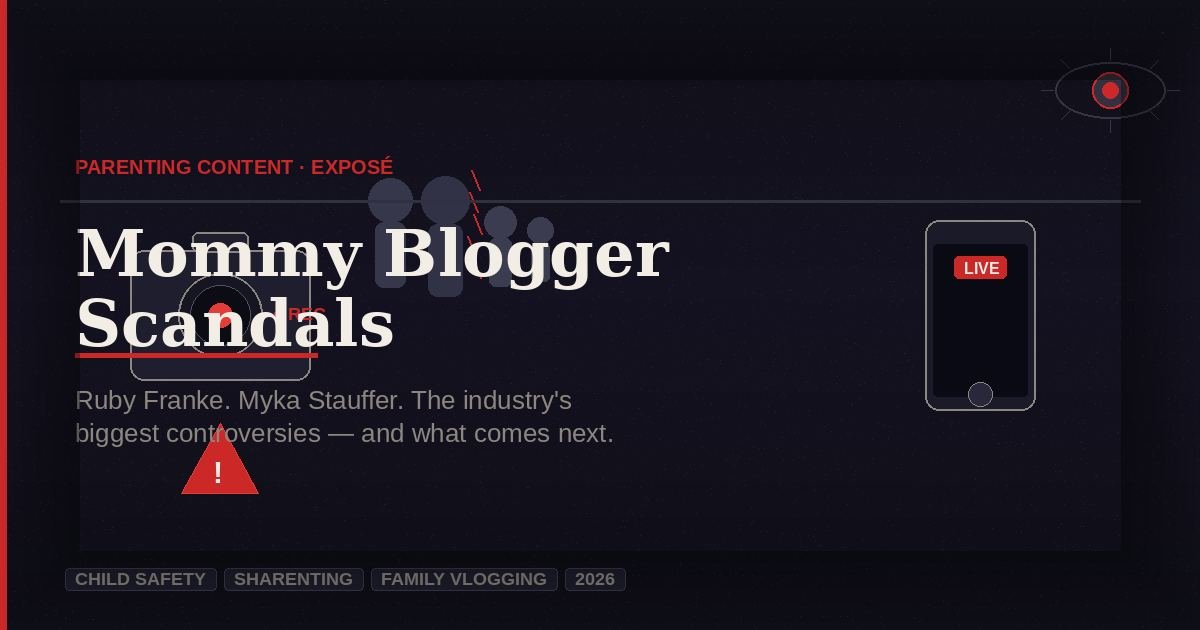
Ruby Franke posted parenting advice to millions of followers. In 2023, she pleaded guilty to child abuse. Myka Stauffer documented her son’s adoption for 700,000 subscribers, then quietly gave him to another family. These aren’t isolated incidents — they’re the visible edge of a pattern researchers now call “sharenting” gone wrong. This guide breaks down the major mommy blogger scandals, why they keep happening, and what’s changing in 2026.
What Counts as a “Mommy Blogger Scandal”?
A mommy blogger scandal is any public controversy where a parenting content creator’s online behavior toward their children — or their audience — crosses an ethical, legal, or safety line. The common thread is exploitation: kids used as unpaid labor, private moments turned into content, or family struggles staged for engagement.
These scandals generally fall into four buckets: child abuse or neglect documented or enabled by content creation, exploitative content that sexualizes or humiliates children for views, financial exploitation where kids get zero compensation for work that built a business, and deception scandals involving faked stories, undisclosed ads, or manipulated narratives. Understanding which bucket a case falls into helps explain why the consequences — criminal charges versus platform bans versus new legislation — differ so widely from one story to the next.
The “mommy blogger” label itself has evolved. It started with early-2010s written blogs about parenting life and has since folded into “family vlogging,” a term covering YouTube channels, TikTok accounts, and Instagram pages built around a household’s daily life, often with children as the main draw.
How Did We Get Here? The Rise of Family Vlogging as a Business
Family vlogging scandals escalated because the format’s biggest financial incentive — child-centered content — is also its biggest ethical risk. Platforms reward engagement, and content researchers have found that videos showing children in distress, sickness, or high emotion consistently outperform calmer footage, creating a direct incentive to manufacture or prolong those moments.
Step 1: The blog-to-vlog shift. Early mommy bloggers wrote personal essays and product reviews. As YouTube and Instagram grew, video replaced text, and children moved from being mentioned to being filmed constantly.
Step 2: Brand deals scaled the incentive. Companies like Pampers, Walmart, and Fabletics began paying family channels directly, tying a creator’s income to how much of their children’s daily life they were willing to broadcast.
Step 3: Algorithms rewarded intensity. In her reporting on the industry, journalist Fortesa Latifi found that multiple parent-influencers told her their best-performing content featured a sick, sad, or injured child — a dynamic that pushes some creators toward filming private, painful moments rather than protecting them.
Step 4: Scale outpaced oversight. Unlike child actors on a TV set, kids in family vlogs aren’t covered by entertainment labor law in most U.S. states, so there was no legal backstop as the format grew into a multibillion-dollar industry.
Step 5: The backlash cycle began. As individual scandals broke — often starting with fan speculation on Reddit “snark” forums — the pattern repeated: viral suspicion, creator denial, investigative reporting, and sometimes, years later, legal consequences.
The Biggest Mommy Blogger Scandals, Explained
Each of these cases represents a different failure mode, and together they map out most of the ways family vlogging can go wrong.
Ruby Franke and “8 Passengers.” Franke ran a Utah-based family channel that grew to roughly 2.5 million subscribers documenting her six children. In August 2023, she was arrested; she and business partner Jodi Hildebrandt later pleaded guilty to child abuse charges after prosecutors said two of Franke’s children, then aged nine and eleven, had been held in what one prosecutor described as severe, prolonged mistreatment. Franke was sentenced to a minimum of four years in prison. Her story is now the subject of Hulu’s documentary series Devil in the Family.
Myka and James Stauffer’s adoption reversal. The Ohio couple built a following of nearly 700,000 subscribers partly by documenting their 2017 adoption of Huxley, a two-year-old boy with special needs from China. In 2020, after Huxley quietly disappeared from their videos for months, the Stauffers confirmed they had placed him with a new family, citing needs they said they couldn’t meet. The backlash was swift and largely ended their online careers; the story is now examined in the HBO docuseries An Update on Our Family.
Jordan Cheyenne and the “fake crying” video. In 2021, YouTuber Jordan Cheyenne accidentally posted unedited footage in which she coached her eight-year-old son to perform sadness for the camera after learning their dog was seriously ill. The clip, in which the boy protests that he’s genuinely crying, went viral for the wrong reasons and became a widely cited example of manufactured emotional content.
Wren Eleanor and content that crossed a line. In 2022, critics accused the mother behind a toddler TikTok account with 17 million followers of posting clips that adult viewers were sexualizing in the comments, including ordinary footage recontextualized in troubling ways. The controversy led many parents to reassess what they post about young children and prompted broader conversations about predatory engagement with kids’ content.
Michelle Hackney and “Fantastic Adventures.” The creator behind this family channel was arrested on charges including child abuse and kidnapping, with prosecutors alleging she starved, restrained, and hit her seven children, in part to compel their participation in videos — one of the clearest documented links between the demands of a content schedule and physical abuse.
Everyday deception scandals. Not every controversy involves abuse. Many mommy bloggers have faced smaller-scale backlash for undisclosed sponsorships, staged “candid” moments, plagiarized content, or manufactured drama with other creators — violations of trust rather than law, but damaging to a following built on the premise of authenticity.
| Scandal type | Example | Primary harm | Typical consequence |
|---|---|---|---|
| Physical abuse | Ruby Franke / 8 Passengers | Child safety | Criminal prosecution |
| Adoption/family exploitation | Myka & James Stauffer | Child welfare, privacy | Career collapse, public backlash |
| Manufactured emotional content | Jordan Cheyenne | Emotional exploitation | Viral backlash, brand loss |
| Sexualized engagement by audience | Wren Eleanor | Child safety, predation risk | Account removal, parental reassessment |
| Abuse tied to content demands | Michelle Hackney / Fantastic Adventures | Child safety | Criminal prosecution |
| Undisclosed ads / staged content | Various creators | Audience trust | FTC scrutiny, follower loss |
Red Flags, Common Mistakes, and Why the Backlash Often Comes Too Late
The biggest mistake audiences make is assuming a scandal is sudden. In nearly every major case, warning signs circulated online — often on dedicated “snark” forums — long before mainstream media or law enforcement got involved. In the Stauffer case, fans noticed Huxley’s absence from videos months before the family addressed it publicly.
A second common mistake is confusing “wholesome” branding with actual safety. Michelle Hackney’s channel name, “Fantastic Adventures,” and Franke’s “8 Passengers” both projected cheerful, faith-based family values right up until criminal charges surfaced — a reminder that tone and production quality say nothing about what happens off-camera.
A third mistake, made by creators rather than viewers, is treating children’s discomfort as content rather than a boundary. Researchers who study “sharenting” note that kids in these channels are rarely able to meaningfully consent, and parents sometimes discover the cost of that only once the children are older and object publicly.
Some myths are worth clearing up directly:
Myth: Only fringe or unknown creators are involved in these scandals. In reality, several of the largest cases involved creators with hundreds of thousands to millions of followers and brand partnerships with major national companies.
Myth: Blurring kids’ faces or going semi-private fixes the underlying problem. It reduces identifiability but doesn’t address the core issues of consent, compensation, or the pressure to keep producing content about a child’s private life.
Myth: This is only a YouTube problem. Family content controversies have surfaced across YouTube, TikTok, Instagram, and Facebook alike; the platform changes but the incentive structure doesn’t.
What’s Changing: Laws, Platform Policy, and What Comes Next
Illinois became the first U.S. state to legally protect child influencers, requiring creators to set aside a share of earnings tied to a child’s likeness into a trust the child can access as an adult, and the law took effect on July 1, 2024. A minor is covered if they appear in at least 30% of a creator’s content within a 30-day window and that content meets a compensation threshold.
Minnesota followed with its own law, effective July 1, 2025, which goes further by barring children under 14 from “engaging in the work of content creation” altogether and requiring creators to delete footage if a child (including one now grown) asks for its removal. As of 2026, several more states — including Arizona, California, Georgia, Maryland, Missouri, Ohio, Pennsylvania, and Washington — have introduced similar bills, following a model that echoes California’s 1939 Coogan Act for child actors.
Advocacy for these laws has often come from unexpected places: Illinois’s legislation was driven in part by a teenager’s independent research project after she noticed how little legal protection existed for kids in this exact situation.
Documentaries have also accelerated public pressure. Hulu’s Devil in the Family: The Fall of Ruby Franke and Netflix’s Bad Influence: The Dark Side of Kidfluencing brought courtroom details and behind-the-scenes accounts to mainstream audiences well beyond the parenting-content niche, turning what had been internet-forum knowledge into cultural conversation.
Some creators have adjusted proactively. TikTok creator Maia Knight, who built a following around her twin daughters, began blurring their faces in late 2022 after fans repeatedly overstepped boundaries, opting to keep sharing her life while limiting her children’s public identifiability.
Frequently Asked Questions
What is “sharenting”? Sharenting is the practice of parents regularly sharing photos, videos, or details about their children online, often for engagement or income. The term highlights the tension between a parent’s choice to post and a child’s inability to consent to that exposure.
Are family vloggers legally required to pay their kids? Only in a small but growing number of U.S. states. Illinois and Minnesota currently require creators to set aside earnings tied to a child’s appearances; most states and countries still have no such requirement.
What happened to Ruby Franke’s children? Following her 2023 arrest and guilty plea to child abuse charges, Franke’s children were placed in the care of relatives, and she was sentenced to at least four years in prison alongside her former business partner.
Why did the Myka Stauffer scandal happen? Public backlash followed the Stauffers’ 2020 disclosure that they had placed their adopted son, Huxley, with a new family after documenting his adoption for years on their channel, raising questions about whether he was ever able to consent to that level of exposure.
Can I report a family vlogging channel I’m concerned about? Yes. Most major platforms allow users to report content that appears to endanger a minor, and in the U.S., suspected abuse can also be reported to local child protective services or the National Child Abuse Hotline.
Is family vlogging illegal? No, family vlogging itself isn’t illegal. What’s illegal is specific conduct within it, such as abuse, neglect, or in some states now, failing to compensate a child whose likeness generates income.
Will more states pass child influencer laws? It’s likely. Several states have bills under consideration as of 2026, and advocates expect more legislatures to follow Illinois and Minnesota’s lead as public awareness grows.
Final Takeaway
Mommy blogger scandals share a common root: children who can’t consent, incentives that reward exposing them anyway, and regulation that’s only starting to catch up. If you follow family content creators, watch for the warning signs covered here — manufactured emotion, disappearing children, and “wholesome” branding used as a shield — and consider supporting the growing push for stronger legal protections in your own state.
Something new awaits—our featured articles are brimming with insights you won’t want to miss.