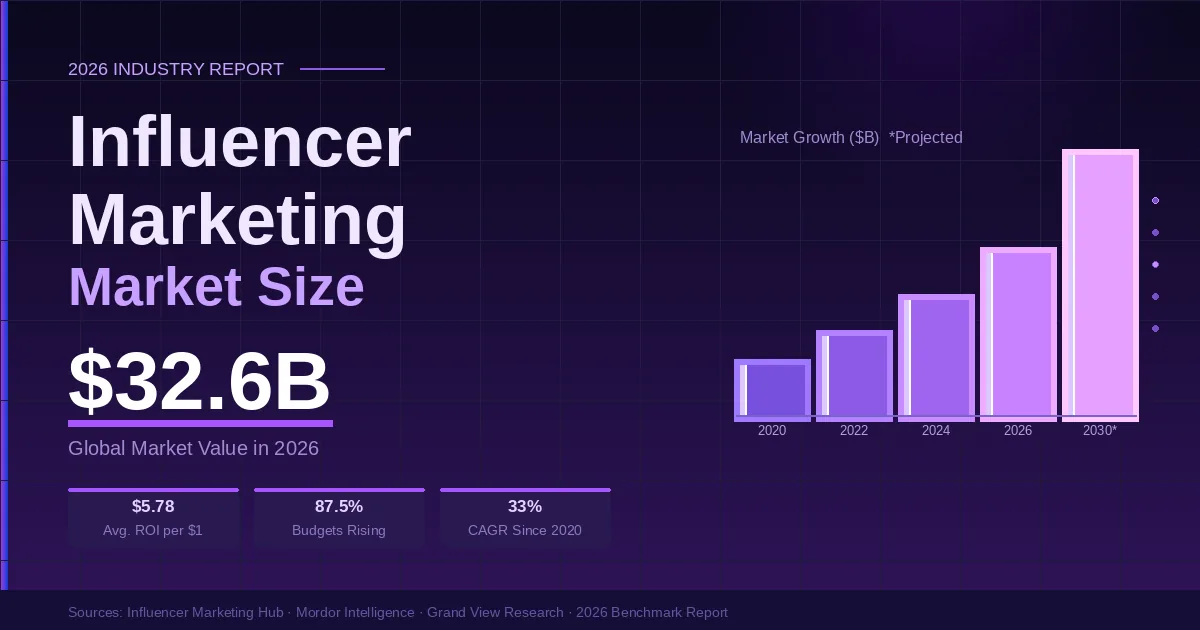
The influencer marketing industry has crossed $32.6 billion in 2026 — up from just $1.7 billion a decade ago. That’s 19x growth in ten years, a pace that outstrips almost every other digital marketing category.
But raw market size numbers only tell part of the story. Which platforms are delivering real ROI? Why are brands abandoning celebrity deals for nano-creators? And where is this market heading by 2030?
This report pulls together verified 2026 data from Influencer Marketing Hub, Grand View Research, Mordor Intelligence, Sprout Social, and the 2026 Influencer Marketing Benchmark Report to give you a complete, accurate picture — whether you’re a brand allocating budget, an agency pitching clients, or an investor tracking the creator economy.
What Is the Influencer Marketing Market Worth in 2026?
The global influencer marketing market reached approximately $32.6 billion in 2026, making it larger than the entire global outdoor advertising industry. Projections from Mordor Intelligence put the figure even higher — at $40.51 billion — depending on whether the measurement includes platform software and services or creator-earned revenue alone.
Both figures reflect the same underlying momentum: brands are shifting advertising dollars away from traditional media and toward creator-led content at an accelerating rate.
Here’s how market size estimates differ by scope:
| Source | Scope | 2026 Estimate |
|---|---|---|
| Influencer Marketing Hub | Broader creator economy | $32.6 billion |
| Mordor Intelligence | Total market incl. commerce | $40.51 billion |
| Grand View Research | Platform & software layer | $45.25 billion |
| MarketsandMarkets | SaaS platforms only | $1.15 billion |
The discrepancy is a methodology question, not a data conflict. Grand View Research counts the platforms, tools, and software infrastructure supporting influencer campaigns. Influencer Marketing Hub measures campaign spend directly. Both are tracking real money — just different slices of it.
What’s not in dispute is the direction: every reputable projection points toward $52 billion or more by 2030, representing a compound annual growth rate of roughly 33% since 2020. The market has tripled in five years and shows no structural reason to decelerate.
North America leads regionally with 31% of global revenue, but Asia Pacific is the fastest-growing region and is expected to close that gap significantly by 2030. Fashion and lifestyle remain the dominant verticals, accounting for 32% of platform market share in 2025.
What’s Driving the Influencer Marketing Boom in 2026?
The short answer: trust is now scarce, and creators have it. The longer answer involves five converging forces reshaping where brand budgets go.
1. Social media surpassed paid search as the world’s largest ad channel
In 2024, social media advertising crossed $247.3 billion globally — overtaking paid search for the first time. Influencer content sits directly inside that environment, making it the most native form of brand communication on the most used media platforms on earth. Brands aren’t choosing influencer marketing over paid social; they’re integrating both as a single system.
2. Consumer trust in traditional advertising has collapsed
<cite index=”15-1″>Around 94% of Gen Z trusts influencers more than traditional advertising.</cite> That figure is extraordinary when you hold it next to decades of brand-building logic built around TV spots and display ads. The shift isn’t generational sentiment — it’s measurable in purchase behavior. <cite index=”8-1″>Nearly seven in ten consumers (69%) trust recommendations from influencers they follow, rating them more credible than traditional advertising.</cite>
3. AI has made influencer marketing operationally scalable
Before AI-powered discovery tools, running campaigns with 50 micro-creators was a logistical nightmare of spreadsheets, email chains, and manual tracking. <cite index=”4-1″>AI adoption in influencer marketing is now operational — most commonly used for creator discovery — and only 10.56% of marketers report not using AI at all.</cite> That shift means brands can run distributed, data-driven campaigns at scale without proportional headcount increases.
4. B2B influencer marketing has arrived — quietly and fast
<cite index=”1-1″>B2B brands allocated $4.1 billion to influencer programs in 2026, a 47% increase from the prior year. LinkedIn-first influencer campaigns generate 3.2x more qualified leads than paid social for B2B companies, and 71% of B2B buyers report that industry thought leaders influence their purchasing decisions.</cite> B2B was the last holdout against influencer marketing. That holdout is over.
5. Social commerce has created a direct path from content to purchase
The gap between “I saw it on TikTok” and “I bought it” has compressed to seconds. <cite index=”13-1″>78% of TikTok users have purchased after seeing creator content</cite>, and <cite index=”14-1″>TikTok Shop accounts for 66.17% of social commerce platform selections among current adopters.</cite> That’s not an engagement story — it’s a conversion story.
6. Budget confidence is historically high
<cite index=”4-1″>87.49% of marketers expect their influencer marketing budget to increase in 2026, while only 5.55% expect a decrease.</cite> When nearly nine in ten practitioners are increasing spend, the market has cleared the “experimental” label permanently.
Which Platforms and Creator Tiers Are Winning Right Now?
Platform choice and creator tier are the two decisions that determine whether an influencer campaign succeeds or wastes money. The 2026 data is more definitive on both than in any prior year.
Platform Breakdown
TikTok is the single most important platform for investment intent in 2026. <cite index=”4-1″>TikTok is the most frequently selected platform for investment intent, with the market behaving like a “single primary platform bet” environment.</cite>
The engagement data backs that up: <cite index=”17-1″>the median engagement rate across all TikTok creator tiers in 2026 is approximately 8%, with nano creators averaging 9–15% and mega creators averaging 1–3%.</cite> Compare that to Instagram’s static post average of 1.2%, and you understand why budgets are moving.
For short-term ROI specifically, <cite index=”15-1″>TikTok reports a short-term ROI of 11.8% — higher than most other social platforms for influencer campaigns.</cite>
Instagram retains its position as the volume leader. <cite index=”13-1″>57.1% of brands choose Instagram for their campaigns</cite>, and it remains the benchmark for conversion-focused and ambassador-style programs. Instagram Reels generate engagement of 3.8% on average — significantly higher than static posts, and strong enough to justify ongoing investment even as TikTok leads on raw engagement.
YouTube plays a distinct role: depth over speed. <cite index=”15-1″>YouTube influencers achieve the longest-lasting impact — 62% of viewers recall brand mentions after 30 days.</cite> For high-consideration purchases (tech, software, financial products, fitness equipment), YouTube creators outperform every other platform on brand recall and purchase intent over time.
LinkedIn is the sleeper story. For B2B brands specifically, LinkedIn influencer campaigns are delivering results that paid social cannot match, and the creator pool is growing rapidly as more professionals build audiences.
The Creator Tier Shift: Why Smaller Is Winning
The data on creator tiers has been consistent for three years, and 2026 makes it definitive.
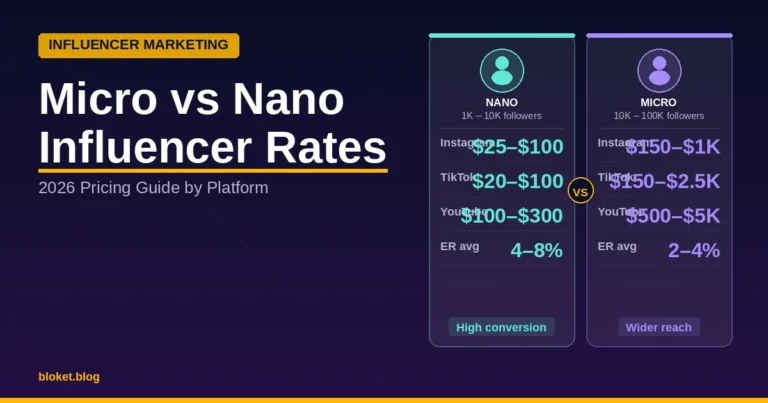
<cite index=”1-1″>Micro-influencers (10K-100K followers) generate an average engagement rate of 3.86% compared to 1.21% for mega-influencers (1M+), while costing 60% less per post.</cite>
<cite index=”16-1″>Nano-influencers with 1,000-10,000 followers now represent 75.9% of Instagram’s influencer base and 87.68% of TikTok’s, fundamentally reshaping partnership strategies from celebrity endorsement toward authentic community engagement.</cite>
The cost math makes this even clearer. <cite index=”20-1″>Micro creators cost $0.20 per engagement compared to $0.33 for macro — a 40% efficiency gap — with median engagement rates of 3–8% vs. 1–3% for macro-tier creators. A 50-creator micro program at $500 per creator typically outperforms a single $25K macro deal on both engagement and attributed sales.</cite>
In practice, this is what brands have moved toward: <cite index=”13-1″>73% of brands now prefer working with micro and mid-tier creators who offer better cost efficiency and audience trust.</cite>
One nuance worth tracking: gifted collaborations are outperforming paid partnerships on authenticity metrics. <cite index=”16-1″>Gifted partnerships deliver 2.19% engagement rates — 12.9% higher than paid collaborations at 1.94% — particularly effective with nano and micro-influencers who achieve 2.76% engagement through product-based compensation models.</cite> When the creator genuinely uses the product, audiences notice.
What Do the ROI Numbers Actually Tell Us?
ROI is where influencer marketing conversations get honest — or evasive. Here’s what the verified 2026 data actually shows.
The average return is $5.78 per $1 spent. <cite index=”8-1″>Brands earn an average of $5.78 for every $1 they invest in influencer campaigns. Top-performing campaigns can return $18 to $20 per dollar, and a 5:1 ratio is considered the industry benchmark.</cite>
That average is meaningful — it consistently beats the ROI benchmark for most paid media channels — but it hides wide variance. Campaigns built around nano and micro-creators with strong audience alignment outperform campaigns built around reach alone.
Measurement methodology matters more than most brands acknowledge. <cite index=”11-1″>Brands using multi-touch attribution models report 34% higher measured ROI than those using last-click only.</cite> That gap isn’t campaign performance — it’s accounting. If you measure influencer marketing with last-click attribution and paid search with multi-touch, you’re comparing different things and drawing wrong conclusions.
Consumer purchase behavior validates the investment at scale. <cite index=”9-1″>86% of consumers make at least one purchase inspired by an influencer annually, and 49% make influencer-inspired purchases daily, weekly, or monthly.</cite> That’s not a niche behavior pattern — it describes how most consumers now discover and evaluate products.
Gen Z represents the highest-value segment by behavior. <cite index=”8-1″>Gen Z averages 3.2 influenced purchases per month and spends $127 more monthly than peers who don’t shop through social commerce.</cite> Brands targeting 18–28-year-olds without a creator-led strategy are operating at a structural disadvantage.
Fraud remains a significant drag on returns. <cite index=”15-1″>Influencer fraud burns $4.8 billion per year in wasted spend.</cite> Fake followers, engagement pods, and inflated metrics remain endemic, particularly among macro and mega-tier creators. Brands that don’t deploy fraud detection tools before scaling budgets are paying for audiences that don’t exist.
The practical takeaway: influencer marketing delivers strong ROI for brands that choose the right tier, measure correctly, and use fraud detection. It delivers mediocre results for brands chasing reach with celebrities and measuring with last-click attribution.
Common Myths About Influencer Marketing That Data Disproves
After years of working through influencer campaign data, a few persistent myths keep leading brands to bad decisions. Here’s what the 2026 numbers actually show.
Myth 1: “Bigger audiences mean better results.”
The data contradicts this completely. Mega-influencers (1M+ followers) generate 1.21% average engagement. Micro-influencers generate 3.86%. The “reach” a celebrity delivers is often passive scrolling from an audience with no specific interest in your category. A skincare brand partnering with a 25K-follower dermatologist who posts three times a week about skin health will typically outperform the same brand partnering with a general lifestyle influencer at 2 million followers.
Myth 2: “TikTok is too risky because of regulatory uncertainty.”
<cite index=”15-1″>56% of brands increased their TikTok influencer spending in 2026</cite>, despite ongoing regulatory discussions. The market has assessed the risk and continued investing — not recklessly, but with the recognition that TikTok’s engagement and commerce infrastructure is unmatched. Smart brands diversify rather than exit, maintaining presence on Instagram and YouTube as their operational baseline.
Myth 3: “Influencer marketing only works for B2C.”
<cite index=”1-1″>B2B influencer marketing grew 47% year-over-year and reached $4.1 billion in spend in 2026.</cite> SaaS companies, financial services firms, and professional tools brands have built entire go-to-market motions around LinkedIn creators, industry analysts, and technical YouTubers. The buyers are different; the mechanism — trust transferred from a credible voice — is identical.
Myth 4: “Paid partnerships outperform organic gifting.”
<cite index=”9-1″>Gifted partnerships deliver 12.9% higher engagement rates than paid collaborations.</cite> This appears counterintuitive until you consider the mechanism: a creator who is paid to post often treats it as a job. A creator who received a product they genuinely love and chose to post about it treats it as a recommendation. Audiences feel that difference.
Myth 5: “Virtual influencers are a gimmick.”
<cite index=”1-1″>AI-generated virtual influencers now account for $1.37 billion in annual brand spending and generate engagement rates averaging 5.67%, compared to 1.89% for human influencers of equivalent following size.</cite> Virtual influencers have zero controversy risk, are available 24/7, and never go off-brand. They’re not replacing human creators — but for specific campaign types (product launches, global markets, always-on content), they’re a legitimate strategic choice.
FAQ: Influencer Marketing Market Size 2026
How big is the influencer marketing industry in 2026? The influencer marketing market reached approximately $32.6 billion in 2026, according to Influencer Marketing Hub. Broader estimates that include platform software, SaaS tools, and social commerce infrastructure push the figure toward $40–45 billion. The industry has grown 19x since 2016 and is projected to reach $52.1 billion by 2030.
What is the ROI of influencer marketing in 2026? The industry average is $5.78 returned per $1 spent. Top-performing campaigns deliver $11–$20 per dollar, while underperforming campaigns — typically those relying on macro-influencers, poor measurement, or fake follower pools — fall below the 5:1 benchmark. Brands using multi-touch attribution report 34% higher measured ROI than those using last-click models.
Which platform delivers the best influencer marketing ROI in 2026? TikTok leads on short-term ROI (11.8% in a Dentsu study) and engagement rates (median 8% across all creator tiers). Instagram leads on campaign volume and conversion infrastructure. YouTube delivers the strongest long-term brand recall — 62% of viewers remember brand mentions after 30 days. The right platform depends on your goal: TikTok for discovery, Instagram for conversion, YouTube for consideration.
Are micro-influencers really better than celebrities for brand campaigns? For most campaign objectives, yes. Micro-influencers generate 3.2x higher engagement at 60% lower cost than mega-influencers. A 50-creator micro program typically outperforms a single macro deal on both engagement volume and attributed sales. Celebrity partnerships remain useful for broad awareness and brand positioning, not for conversion-focused or niche-audience campaigns.
What percentage of marketers are using influencer marketing in 2026? 86% of U.S. marketers plan to partner with influencers in 2026, and 87.49% of marketers globally expect to increase their influencer marketing budget this year. The channel has moved from experimental to standard practice across virtually every consumer-facing category.
What is the biggest challenge in influencer marketing right now? Influencer fraud — fake followers, engagement pods, and inflated metrics — costs brands $4.8 billion per year. The second most cited challenge is discovery: 48% of marketers say finding the right creators for niche audiences is their biggest operational pain point, even with AI-powered tools now available.
How fast is the influencer marketing market growing? The market has grown at approximately 33% CAGR since 2020, tripling from $10 billion to $32.6 billion in five years. Growth is driven by TikTok Shop adoption, B2B influencer programs, AI-powered campaign tooling, and the continued migration of ad budgets from traditional media to social platforms.
Is influencer marketing effective for B2B companies? Yes — and increasingly so. B2B influencer marketing grew 47% year-over-year in 2026, with $4.1 billion in total spend. LinkedIn-first campaigns generate 3.2x more qualified leads than paid social for B2B companies. 71% of B2B buyers say industry thought leaders influence their purchasing decisions, making creator partnerships one of the most efficient demand generation channels in the B2B stack.
Conclusion
The influencer marketing market in 2026 isn’t growing — it’s maturing. The numbers are large ($32.6 billion), the direction is clear (toward $52 billion by 2030), and the winners are well-defined: brands that choose micro over macro, prioritize measurement over reach, and build always-on creator programs rather than one-off campaign spikes.
The single most important shift in 2026 is performance accountability. Budgets are rising (87.49% of marketers increasing spend), but measurement expectations are rising faster. The brands extracting $10–$20 per dollar from influencer programs are those treating it like a performance channel — with attribution models, fraud detection, and defined conversion goals — not a brand awareness line item.
Your next step: Audit your current influencer strategy against the 2026 benchmarks in this report. If you’re spending more than 40% of your creator budget on macro or celebrity-tier influencers without a reach-specific rationale, the data suggests reallocating toward a diversified micro-creator program. If you’re measuring with last-click attribution, fix that before drawing any conclusions about what’s working.
The creator economy is not a trend. It’s the new infrastructure of brand trust.
Follow the topics you care about—our curated content keeps you informed, engaged, and inspired.