Influencer burnout is no longer a fringe complaint — it is a documented industry crisis. Research from 2025 shows that 62% of content creators experience burnout, and nearly 9 in 10 lack access to mental health support. Behind a $33 billion global influencer market, the people powering it are quietly hitting a wall. This article breaks down the latest influencer burnout statistics, what is driving the crisis, and what creators and brands can realistically do about it.
What Do the Numbers Say About Influencer Burnout?
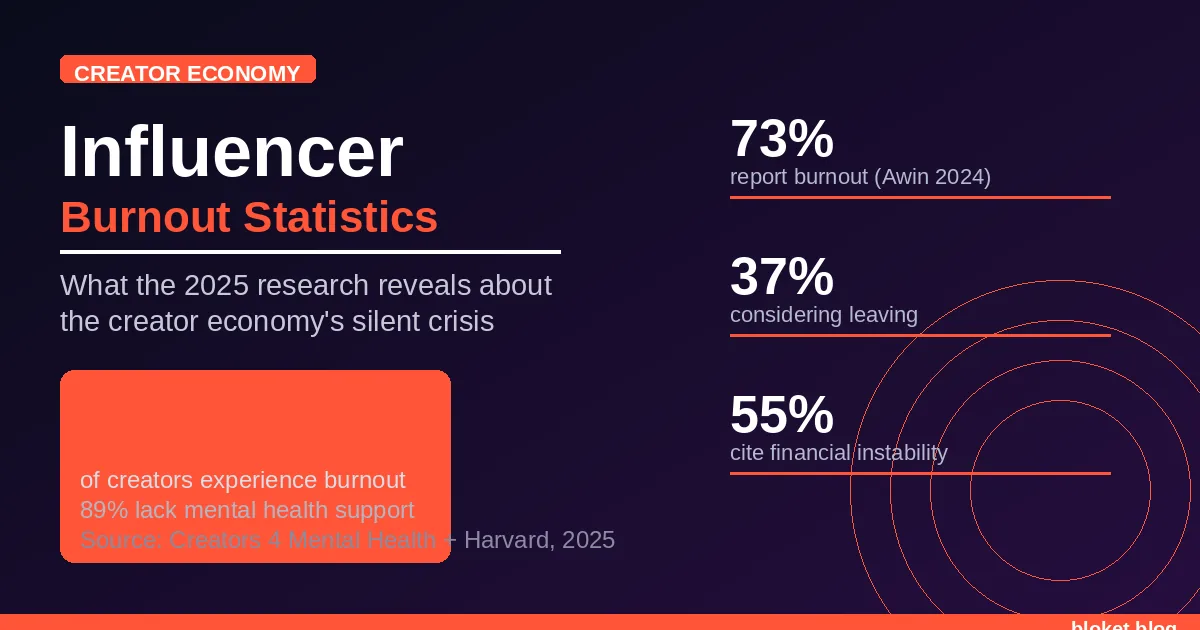
Influencer burnout affects the majority of content creators worldwide, with rates ranging from 52% to 73% depending on the study. The most comprehensive 2025 data from Creators 4 Mental Health, Billion Dollar Boy, and Awin Group independently confirm this is a systemic issue, not an individual failing.
The numbers are striking — and consistent across sources:
| Study / Source | Year | Burnout Rate | Key Finding |
|---|---|---|---|
| Creators 4 Mental Health (C4MH) + Harvard | 2025 | 62% | 89% lack mental health resources |
| Billion Dollar Boy (Censuswide survey) | 2025 | 52% | 37% considering leaving the industry |
| Awin / ShareASale (creator survey) | 2024 | 73% | Down from 87% in 2022 |
| Awin / ShareASale (creator survey) | 2022 | 87% | Highest reported rate on record |
| Market.biz Creator Economy Report | 2024 | 41% | Among independent creators specifically |
Looking at these figures together, a clear picture forms: burnout is not an edge case. Even the most optimistic reading — that rates have fallen from 87% to 73% since 2022 — still means roughly three out of every four working creators experience burnout with some regularity.
A 2025 study published in partnership with Harvard T.H. Chan School of Public Health added an especially alarming data point: 10% of creators report suicidal thoughts connected to their work — nearly double the rate of the broader U.S. population. These are not lifestyle complaints. This is a public health concern embedded inside a booming industry.
What Is Actually Causing Influencer Burnout?
The primary causes of influencer burnout are creative fatigue, financial instability, and constant algorithmic pressure — not simply working too many hours. When 1,000 creators were surveyed by Billion Dollar Boy in July 2025, three causes dominated, though creators ranked them differently by frequency versus severity:
By how often they occur:
- Creative fatigue — cited by 40% of burned-out creators as the most frequent cause. Producing original, engaging content daily or weekly without a clear creative fuel source is genuinely exhausting.
- Demanding workloads — cited by 31%. Creators are effectively running one-person production studios: scripting, filming, editing, managing brand deals, and responding to audiences, all without traditional workplace support structures.
- Constant screen time — cited by 27%. When your phone is both your office and your personal space, there is no natural clocking out.
By how severe they feel:
When asked to rank these by severity rather than frequency, the rankings shift significantly. Financial instability jumped to the number one stressor, cited by 55% of burned-out creators. This makes sense: a missed posting week or an algorithm change can directly wipe out income for someone with no employment safety net.
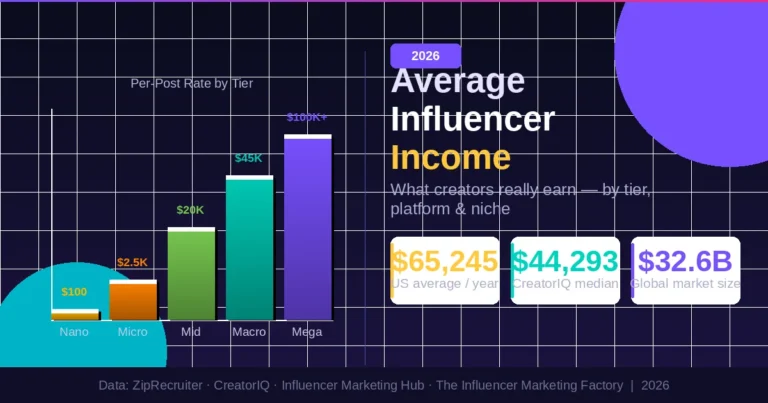
According to a NeoReach analysis, 50.71% of influencers earn under $15,000 annually. Only 15.41% earn over $100,000. In a field where income is tied entirely to visibility and consistency, burnout is not just emotionally damaging — it is financially terrifying.
Platform pressure adds another layer. In the Awin 2024 survey, 88% of creators named Instagram as the leading platform driving burnout, followed by TikTok (81%) and Facebook (67%). Constant platform changes ranked as the top driver of creator anxiety at 70%, ahead of a lack of creative quality (55%) and the inability to switch off (43%).
I have spent time reviewing the research across these studies, and one thing stands out clearly: the typical burnout conversation focuses on volume of content. The data tells a different story. It is not how much creators produce — it is the absence of financial stability, predictable rules, and recovery time that breaks people down.
How Burnout Affects Creator Health and Career Outcomes
Burnout among influencers carries real professional and physical consequences — it is not just mental fatigue that passes with a weekend off. Understanding the full cost helps explain why so many creators are reaching breaking point despite loving what they do.
The career impact
The Billion Dollar Boy research found that 59% of creators say burnout has negatively impacted their careers, and 58% report it has damaged their overall well-being. Nearly 37% are actively considering leaving the creator industry entirely.
For brands investing in influencer marketing, this is not a wellness footnote. Creator dropout, inconsistent delivery, and declining creative quality are direct business risks in campaigns that depend on sustained human output.
According to Viral Nation’s analysis of the burnout crisis, burnout leads to “declining output, shrinking opportunities, and doubts about whether their careers are sustainable.” Brands that ignore this risk end up with derailed campaigns and last-minute creator dropouts.
The mental health impact
The 2025 C4MH study found that 69% of creators admit to obsessing over content performance — a habit that increases in severity the longer someone works as a creator. Creators active for five or more years show measurably worse mental health indicators than newer creators. The longer you stay in the industry, the higher the cumulative toll.
A 2024 study from the journal examining influencer mental health — Beyond the Filter: Impact of Popularity on the Mental Health of Social Media Influencers — tracked 161 creators between November 2022 and March 2023. It found that influencers who spent more than five hours daily on social media felt significantly worse than those who spent less time. Paradoxically, larger follower counts did not protect creators — they reported more negative emotions, likely due to greater public scrutiny and the pressure to maintain a prominent persona.
The study also found that higher earners were not immune: greater income correlated with more anxiety and relationship strain, particularly with close family members. Being “always on” carries an emotional cost that money does not automatically offset.
The physical health impact
Burnout is classified by the World Health Organization as an occupational phenomenon, and its physical consequences are real. Research consistently links prolonged burnout to insomnia, elevated cholesterol, increased risk of type 2 diabetes, and cardiovascular stress. Creators living with chronic burnout are not just unproductive — they are at risk of longer-term health problems.
Common Myths About Influencer Burnout — and What the Data Actually Shows
The public narrative around creator burnout contains several myths that the research directly contradicts. Getting these wrong means both creators and the brands working with them approach the problem with ineffective solutions.
Myth 1: “Burnout only hits creators who don’t enjoy their work.”
This is false. Creative fatigue — the top cited cause — is specifically the experience of loving your craft and still finding it depleted by constant demand. Many burned-out creators started with deep passion for content. A 2024 Awin survey found that 53% of creators admitted their passion for content creation had decreased in the past year — not because the passion was never there, but because the system wore it down.
Myth 2: “More followers means less financial stress, so burnout decreases.”
The data says the opposite. Creators with larger audiences report more negative emotions, not fewer. Bigger followings bring bigger expectations, more trolling, more brand management, and more public judgment. Financial stress at this level also takes a different form: the fear of losing significant income if you take a break.
Myth 3: “Platforms are helping creators manage burnout.”
Over half of creators — 54% in the Awin survey — said resources available from platforms to cope with burnout have been no help at all. Meanwhile, 89% of creators in the C4MH study lack access to specialized mental health support. The industry spends billions attracting and retaining creators, but almost nothing on sustaining them.
Myth 4: “AI tools will solve the workload problem.”
AI is a meaningful but partial answer. The 2024 Awin study found 71% of creators said AI had little to no impact on burnout levels. Among those who did find AI helpful, it assisted primarily with content creation (78%), enhancing creativity (57%), and editing (53%). AI reduces certain task burdens, but it does not address financial instability, algorithm anxiety, or the emotional weight of public performance.
Myth 5: “Burnout is a personal resilience issue.”
This framing places the burden entirely on the individual and ignores structural causes. In the Billion Dollar Boy research, 71% of creators said brands and platforms have a responsibility to protect their welfare, and 68% said the same of agencies. Burnout is an industry design problem, not a willpower problem.
Frequently Asked Questions About Influencer Burnout Statistics
What percentage of influencers experience burnout? Studies consistently show between 52% and 73% of influencers experience burnout to some degree. The 2025 Creators 4 Mental Health study places it at 62%, while a 2024 Awin survey found 73% experience it at least some of the time. At its peak, an Awin 2022 study found the rate as high as 87%.
What is the number one cause of influencer burnout? By frequency, creative fatigue is the most cited cause, affecting 40% of burned-out creators. However, when ranked by severity, financial instability is the top factor — named by 55% of creators. Many influencers earn under $15,000 per year, making income loss from a single bad month genuinely destabilizing.
Which platform causes the most influencer burnout? Instagram is the primary driver of creator burnout, cited by 88% of creators in the Awin 2024 survey. TikTok follows at 81%, and Facebook at 67%. Constant algorithm changes are the top anxiety trigger, cited by 70% of surveyed creators across platforms.
How does influencer burnout affect mental health? The impact is serious. According to the C4MH and Harvard study, 62% of creators experience burnout, and 10% report suicidal thoughts linked to their work — nearly double the broader U.S. population rate. Burnout is also linked to anxiety, depression, insomnia, and over time, elevated risk of cardiovascular issues and type 2 diabetes.
Are high-earning influencers immune to burnout? No. Research shows that higher income correlates with greater anxiety and relationship strain, not reduced burnout. Larger followings bring more scrutiny, higher performance expectations, and the fear that any pause will accelerate income loss. Financial success does not insulate creators from creative or emotional exhaustion.
What do creators do to cope with burnout? The most common coping strategies include relying on alternative income streams (50%), scheduling dedicated posting times (49%), taking planned vacations or days off (36%), and using AI tools to reduce creative workload (20%). A growing number are also seeking creator-specific therapists who understand the unique pressures of public-facing digital work.
How can brands help reduce creator burnout? The data points toward three areas: longer-term partnership structures instead of one-off campaigns, realistic deadlines that account for creative bandwidth, and regular check-ins instead of disappearing after the deal is signed. Brands that invest in creator well-being see more consistent output, stronger engagement, and better long-term ROI.
Is influencer burnout getting better or worse? The trend shows a partial improvement — burnout rates dropped from 87% in 2022 to 73% in 2024 in Awin’s longitudinal research. However, the absolute numbers remain alarming, and the C4MH study suggests mental health challenges deepen the longer someone stays in the industry. Scale in the creator economy is growing faster than the support structures being built to sustain it.
What Creators and Brands Can Do Right Now
The research makes one thing clear: burnout at this scale is not solved by better productivity habits alone. It requires structural changes from both sides of the creator economy.
For creators:
- Audit your platform time. Creators spending more than five hours daily on social media show measurably worse mental health. Set defined off-times and treat them as non-negotiable.
- Batch content production. Grouping similar tasks — filming multiple videos in one session, writing captions in bulk — reduces the cognitive context-switching that depletes creative energy.
- Diversify income. The 50% of creators relying on alternative income streams report lower stress. Building revenue sources that do not depend entirely on consistent posting reduces the financial panic that drives overwork.
- Announce breaks transparently. Audiences respond positively to honest communication. Creators who communicated their burnout and need for rest retained audiences better than those who disappeared without explanation.
- Connect with peer support. Platforms like Billion Dollar Boy’s FiveTwoNine community (1,800+ creators across 18 countries) exist specifically to reduce the isolation that compounds burnout.
For brands and agencies:
- Prioritize long-term partnerships. Short-term campaigns create income instability for creators. Multi-month or annual partnerships reduce financial stress and improve content quality.
- Build in buffer time. Campaigns built with realistic timelines and no last-minute pivots produce better results and preserve the creative relationships brands depend on.
- Proactively check in. Regular contact after contracts are signed — not just at deliverable milestones — builds the kind of trust that keeps creators motivated and reduces silent dropout.
The Bottom Line
Influencer burnout is not a niche lifestyle problem — it is a documented crisis affecting the majority of the creator workforce. With 62% experiencing burnout, 89% lacking specialized mental health support, and 37% considering leaving the industry, the creator economy is expanding on a foundation that is showing serious stress fractures.
The global influencer market exceeded $33 billion in 2025. If that growth continues while creator welfare stagnates, the industry risks building a high-spend system with exhausted talent at its center.
The statistics already show what the cost looks like. The more useful question now is which brands, agencies, and platforms will act on the data before the breakdown becomes impossible to ignore.
Time to level up? Our expert posts are designed to guide you every step of the way.