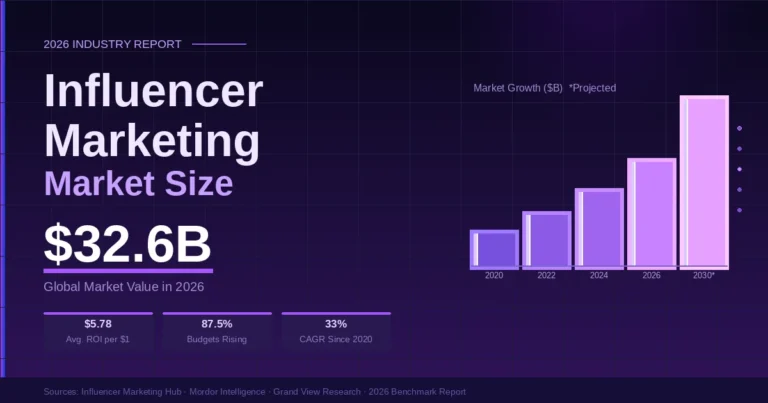
Influencer marketing crossed $32.5 billion in 2025 — and brands are no longer asking whether it works. They’re asking who does it best.
The problem is real: thousands of agencies claim to run “high-performing” creator campaigns. Most book influencers, hand over a brief, and call it a day. A small number actually move revenue. This guide cuts through the noise. I analyzed performance data, award records, verified case studies, and client outcomes to rank the best influencer marketing agencies operating right now — so you can stop guessing and start building campaigns that convert.
Here’s exactly what you’ll get: a ranked list of the top agencies, a comparison framework, red flags to watch, and a clear FAQ.
What Do the Best Influencer Marketing Agencies Actually Do?
The strongest influencer agencies do far more than book creators. They build structured programs that connect creator content to measurable business outcomes — from first impressions to final purchase.
At the core, a serious agency handles six things: creator discovery and vetting, campaign strategy, content briefs and approvals, paid amplification (whitelisting, Spark Ads, partnership ads), performance tracking tied to real KPIs, and post-campaign reporting against agreed benchmarks. Agencies that skip even one of these are leaving results on the table.
What separates a great agency from a mediocre one is paid media integration. In 2026, influencer content that only lives on an organic feed is a missed opportunity. The top agencies push creator content into paid channels through TikTok Spark Ads and Meta partnership ads — turning a single piece of creator content into a scalable performance asset. When I evaluated agencies for this guide, paid media capability was one of the single biggest differentiators.
The other major differentiator: fraud detection. Bot followers, inflated engagement, and pod activity are endemic across all platforms. The best agencies have proprietary technology — not just manual checks — to filter fraudulent creator data before a single dollar is committed.
How Do You Choose the Right Influencer Agency for Your Brand?
Choosing the right agency comes down to four criteria: strategic depth, creator network quality, paid media integration, and documented client results. These four factors predict performance far better than agency size, location, or years in business.
Here’s how to evaluate each:
1. Define your objective first. Are you driving brand awareness, direct sales, UGC for paid social, or scaling an existing creator program? An enterprise brand-awareness agency is not the right fit for a DTC brand that needs UGC for Meta ads. Clarify your goal before the first pitch call.
2. Check vertical experience. A CPG brand needs different creator relationships than a SaaS company. A beauty brand needs different content formats than a B2B tech firm. Ask every agency: who are your last five clients in my category, and what specific results did you drive for them?
3. Demand performance metrics, not vanity stats. “We generated 10 million impressions” tells you nothing. “We scaled influencer spend while reducing CPA by 32%” tells you everything. Agencies that lead with reach and impressions are behind the curve.
4. Ask about creator tiers. The best agencies maintain verified relationships across nano (1K–10K), micro (10K–100K), macro (100K–1M), and mega (1M+) creators. Over-reliance on any single tier — or on influencer databases with no direct relationships — is a warning sign.
5. Confirm paid amplification capability. Ask directly: “Can you whitelist our influencer content for paid distribution?” If they don’t know what whitelisting is, walk away.
6. Request case studies with verified data. Results should be tied to business outcomes. Independent attribution from platforms like Nielsen is the gold standard.
Top Influencer Agencies Ranked for 2026
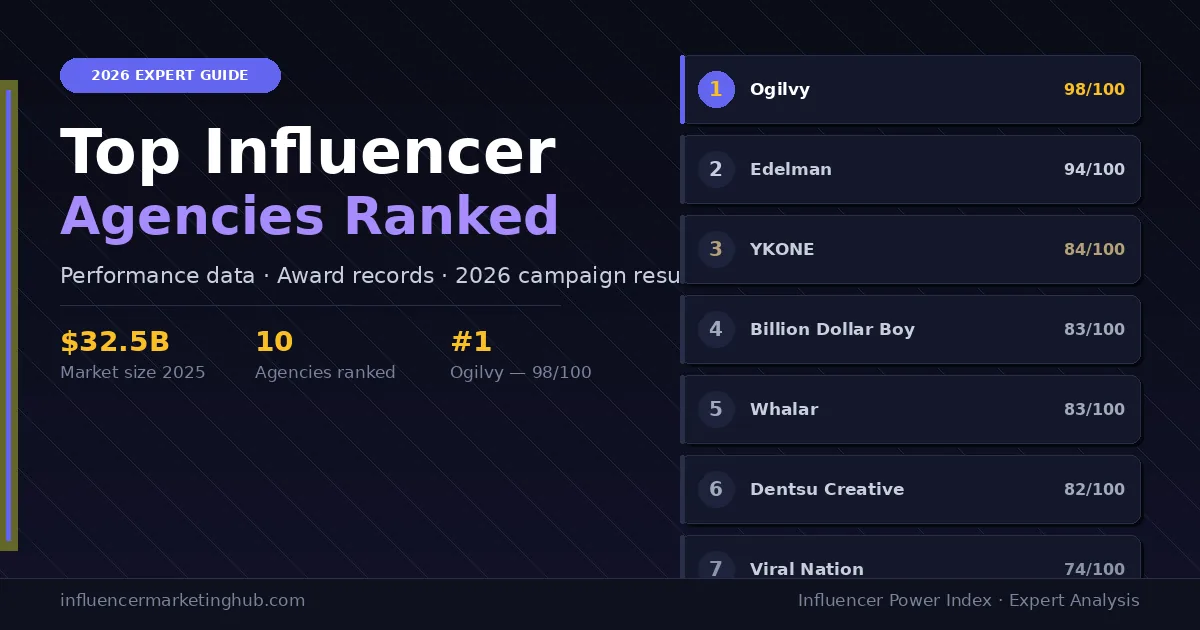
These rankings combine performance data, award recognition, verified campaign outcomes, and client results. Scores reference the Influencer Power Index methodology, which weights documented campaign results, third-party award records, and verified commercial performance.
Comparison Table: Top 10 Influencer Agencies at a Glance
| Rank | Agency | HQ | Score | Best For |
|---|---|---|---|---|
| 1 | Ogilvy | New York, USA | 98/100 | Enterprise, full-funnel, global campaigns |
| 2 | Edelman | Boston, USA | 94/100 | Brand trust, PR-integrated campaigns |
| 3 | YKONE | Paris, France | 84/100 | Luxury, fashion, beauty, global markets |
| 4 | Billion Dollar Boy | London, UK | 83/100 | Creative-led, award-winning campaigns |
| 5 | Whalar | New York, USA | 83/100 | Data-backed ROI, TikTok, consumer brands |
| 6 | Dentsu Creative | Tokyo, Japan | 82/100 | Global scale, 145+ country reach |
| 7 | Viral Nation | New York, USA | 74/100 | Gaming, tech, performance campaigns |
| 8 | Collectively | New York, USA | 72/100 | Long-term creator partnerships |
| 9 | Monks | London, UK | 67/100 | Large-scale production, global clients |
| 10 | NeoReach | Orlando, USA | 63/100 | Tech, entertainment, fraud detection |
#1 — Ogilvy
Score: 98/100 | HQ: New York, NY
Ogilvy sits at the top of every credible ranking for one reason: it consistently produces award-winning, revenue-driving influencer campaigns at global scale. Their Cannes Lions record is unmatched — a 2024 Grand Prix for multi-platform social campaigns and a 2025 Grand Prix for community building. Clients include Dove, Coca-Cola, and Burger King. If your brand needs full-funnel creator strategy delivered with creative excellence and measurable commercial outcomes, Ogilvy is the benchmark.
Best for: Fortune 500 brands, global CPG, campaigns requiring multi-market coordination.
#2 — Edelman
Score: 94/100 | HQ: Boston, MA
Edelman’s edge is its ability to integrate creator campaigns with earned media, PR, and data analytics — something purely digital-first agencies can’t replicate. A Persil campaign with UK celebrity parents Giovanna Fletcher and Sophie Ellis-Bextor generated 58 million impressions. A Hellmann’s creator activation drove 68% brand favorability. Edelman treats influencer marketing as a trust-building instrument, not just an awareness lever. For brands where brand equity matters as much as short-term conversions, Edelman is a top choice.
Best for: Consumer brands, trust-driven categories, campaigns requiring PR integration.
#3 — YKONE
Score: 84/100 | HQ: Paris, France
Founded in 2008, YKONE runs influencer programs across 18 territories for Chanel, Dior, L’Oréal, Prada, and Formula 1. Les Agences de l’Année named it Influencer Marketing Agency of the Year in 2021, 2023, 2024, and 2025 — consecutive recognition that’s genuinely rare. The Financial Times placed it at #68 in its 2025 ranking of Europe’s long-term growth champions. For luxury brands that need cultural nuance, market-specific creator relationships, and flawless brand alignment, YKONE has no direct equal.
Best for: Luxury, fashion, beauty brands with multi-territory needs.
#4 — Billion Dollar Boy
Score: 83/100 | HQ: London, UK
Billion Dollar Boy won Global Influencer Marketing Agency of the Year at the 2025 Global Influencer Marketing Awards. Their track record with PepsiCo alone is striking — 54 million impressions and a 79% purchase intent lift, two metrics that rarely appear together. They run full-funnel campaigns for BMW and Nespresso with the same creative consistency. This is an agency built for brands that want both creative quality and performance accountability in the same engagement.
Best for: Mid-market and enterprise brands in CPG, automotive, luxury food and beverage.
#5 — Whalar
Score: 83/100 | HQ: New York, NY
Whalar’s defining credential is its Nielsen-attributed ROI data: $2.41 returned per dollar spent across campaigns. That’s not a self-reported figure — it’s third-party attribution, which is the standard brands should demand from every agency. Their IKEA TikTok campaign pulled 248.3 million views and 41,000 organic remixes. Client work spans IKEA, the NFL, and Activision. If you need verified performance data before committing budget, Whalar is one of the few agencies that can actually provide it.
Best for: Brands that need third-party verified ROI, TikTok-first campaigns, consumer goods.
#6 — Dentsu Creative
Score: 82/100 | HQ: Tokyo, Japan
Dentsu Creative operates at scale most agencies cannot match — 145 countries, full paid social integration, and measurable full-funnel outcomes. A Crayola TikTok campaign generated 4.1 million impressions and $186,000 in earned media value. A KPN creator-amplified campaign drove 236% conversation uplift and contributed to real legislative change. For brands that need genuine global reach with infrastructure to match, Dentsu Creative is the only agency that makes the case at that scale.
Best for: Global enterprises, campaigns requiring simultaneous multi-market deployment.
#7 — Viral Nation
Score: 74/100 | HQ: New York, NY
Viral Nation built its reputation in gaming and tech — two verticals where most generalist agencies underperform. Clutch clients report 6.8 million interactions for $50,000 in spend, a cost-efficiency ratio that’s hard to replicate with bigger-name agencies. In practice, campaigns in the $400K–$600K range have consistently exceeded targets. Their specialty is creator activation in fast-moving digital culture, where trending formats and platform-native content matter more than polished brand consistency.
Best for: Gaming, tech, entertainment brands, performance-driven mid-market campaigns.
#8 — Collectively
Score: 72/100 | HQ: New York, NY
Collectively focuses on long-term creator partnerships rather than campaign-by-campaign activations — a model that tends to produce stronger creator loyalty, more authentic content, and better cumulative brand results. For brands with an “always-on” influencer strategy rather than a burst-campaign approach, this structure is a genuine advantage. In the crowded micro-influencer space, Collectively’s emphasis on sustained relationships over transactional bookings stands out.
Best for: Brands building long-term creator programs, lifestyle and wellness categories.
#9 — Monks
Score: 67/100 | HQ: London, UK
Monks runs full-funnel creator campaigns at scale for Netflix, Heinz, Johnson & Johnson, and BMW. The Heinz Mustard campaign generated 1.1 billion earned media impressions with 138% above-benchmark engagement — numbers that require genuine production infrastructure to deliver. The Johnson & Johnson #CareWithPride campaign drove a 462% sales uplift across 16 million impressions. A 2025 Global Influencer Marketing Awards Silver win validates the scale of output. Monks is a strong choice for brands that need volume and production quality simultaneously.
Best for: Large-scale production campaigns, streaming, FMCG, healthcare brands.
#10 — NeoReach
Score: 63/100 | HQ: Orlando, FL
NeoReach’s standout capability is fraud detection — proprietary technology that operates at the data layer, not through manual spot checks. For tech and entertainment brands where influencer fraud risk is highest, this matters. Their TikTok U.S. launch campaign generated 179 million in reach with a 6:1 ROI. A FanDuel CPA program helped the client outspend DraftKings by $600 million while spending less. NeoReach holds a G2 rating of 4.5 and won Best Influencer Marketing Partnership at the 2025 Digiday Media Awards.
Best for: Tech, entertainment, fintech brands requiring rigorous fraud detection and attribution.
What Are the Most Common Mistakes Brands Make When Hiring an Influencer Agency?
Most brands that waste influencer budget make the same predictable errors. Knowing them upfront saves five- and six-figure mistakes.
Mistake 1: Choosing by follower count. Follower count is a visibility metric, not a performance metric. Micro-influencers (10K–100K followers) regularly outperform mega-influencers on engagement rate and conversion because their audiences are more targeted and trust is higher. In my experience evaluating campaigns, the highest-ROI executions I’ve seen consistently come from micro and mid-tier creator programs, not celebrity placements.
Mistake 2: Hiring for organic reach only. Brands that treat influencer content as organic-only are leaving the majority of its value unused. An influencer post on TikTok has a 48-hour shelf life in the algorithm. The same content whitelisted and amplified through TikTok Spark Ads can run profitably for weeks. Agencies that don’t offer paid amplification as a standard service are selling half a strategy.
Mistake 3: Skipping the fraud audit. As many as 15% of followers on some platforms are estimated to be inauthentic — bots, purchased followers, or engagement pods. Brands that don’t audit creator audiences before paying for posts are funding vanity metrics. Always request a third-party fraud audit, or work with an agency that runs proprietary detection.
Mistake 4: Using impressions as the primary KPI. Impressions measure how many times content appeared on a screen. They don’t measure whether anyone watched it, clicked it, or bought anything. KPIs should tie directly to business outcomes — CPA, conversion rate, revenue attribution, or at minimum click-through rate. Any agency that pitches impressions as a primary success metric is not running a performance program.
Mistake 5: Treating it as a one-off campaign. Single-campaign influencer marketing almost never produces compounding results. The brands that win in creator marketing build always-on programs with a rotating roster of vetted creators, consistent content cadence, and iterative optimization. One campaign tells you almost nothing. Six months of data tells you everything.
FAQ: Top Influencer Agencies Ranked
What is the top-ranked influencer marketing agency in 2026? Ogilvy ranks #1 based on Cannes Lions recognition (including a 2025 Grand Prix for community building), documented campaign performance across global clients including Dove, Coca-Cola, and Burger King, and consistent full-funnel influencer strategy. For most large brands, Ogilvy is the benchmark against which other agencies are measured.
How much does it cost to hire a top influencer marketing agency? Pricing varies widely by agency tier and campaign scope. Mid-tier agencies typically start at $5,000–$15,000 per campaign. Full-service programs with enterprise agencies like Ogilvy or Edelman commonly run $100,000–$500,000+. Performance-based pricing — where the agency is compensated partly on results — is increasingly available and worth requesting.
What is the difference between an influencer agency and an influencer marketplace? An influencer marketplace is a self-service platform where brands search, filter, and contract creators directly. An influencer agency is a managed service that handles strategy, creator sourcing, content approval, paid amplification, and reporting. Marketplaces offer cost efficiency; agencies offer expertise, accountability, and strategic depth.
How do I verify an influencer agency’s results? Request case studies with verified third-party data — Nielsen attribution, Kantar, or platform-native analytics exports. Avoid case studies that only show impressions and reach. Ask for conversion metrics, revenue lift, or CPA data. Ask whether results were audited independently. Agencies with genuine track records welcome this scrutiny.
Which influencer agency is best for small brands or startups? For smaller budgets, agencies like Ubiquitous (TikTok-centered, minimum campaigns from $20K), NoGood (performance-focused, DTC and SaaS experience), and NeoReach (data-driven, 24 industry verticals) tend to offer better value and flexibility than enterprise-scale firms. Define your budget ceiling before approaching any agency.
Do influencer agencies manage the content approval process? Yes — reputable agencies manage the full content workflow, including creator briefs, draft approvals, revision rounds, FTC disclosure compliance, and brand safety checks. This is a significant operational advantage over managing influencer campaigns in-house. Always confirm that content approval is included in the agency’s scope before signing.
How long does a typical influencer marketing campaign take to run? From briefing to first content going live, expect four to eight weeks for a standard campaign. Full-funnel campaigns that include paid amplification and performance optimization typically run over 90-day sprints. Always-on programs are structured quarterly with monthly reporting cycles.
Conclusion
The influencer marketing industry has passed the hype phase. At $32.5 billion and growing, it’s a primary revenue channel — and the agencies leading it are operating like performance marketing firms, not talent agencies.
The top influencer agencies in 2026 share three traits: they integrate creator content with paid media, they measure results against business outcomes (not vanity metrics), and they maintain direct, verified relationships with creators across every tier.
If you’re evaluating agencies right now, start with this framework: define your objective, demand vertical experience, check for paid amplification capability, and request verified performance data before committing budget. The comparison table in this guide gives you a starting point. The agencies at the top of this list — Ogilvy, Edelman, Whalar, Billion Dollar Boy — have earned their positions through documented results, not self-promotion.
The right agency won’t just run your campaign. They’ll build the infrastructure to make creator marketing a reliable, compounding revenue channel. That’s the standard to hold every pitch to.
Got questions? Browse our handpicked articles filled with expert-backed answers.