In 2021, YouTube demonetized thousands of channels with a single policy change. In 2023, Twitter slashed creator payouts without warning. The creators who bounced back fastest all had one thing in common: they weren’t dependent on a single income source.
This guide covers the most practical, real-world strategies for diversifying income as a creator — which streams to build first, which ones are overhyped, and how to do it without burning out or abandoning your content.
Why Is Depending on One Platform So Risky for Creators?
Relying on a single revenue source doesn’t just limit your income — it hands control of your financial future to a company whose interests rarely align with yours. When that one source dries up, there’s no cushion, no fallback, and no time.
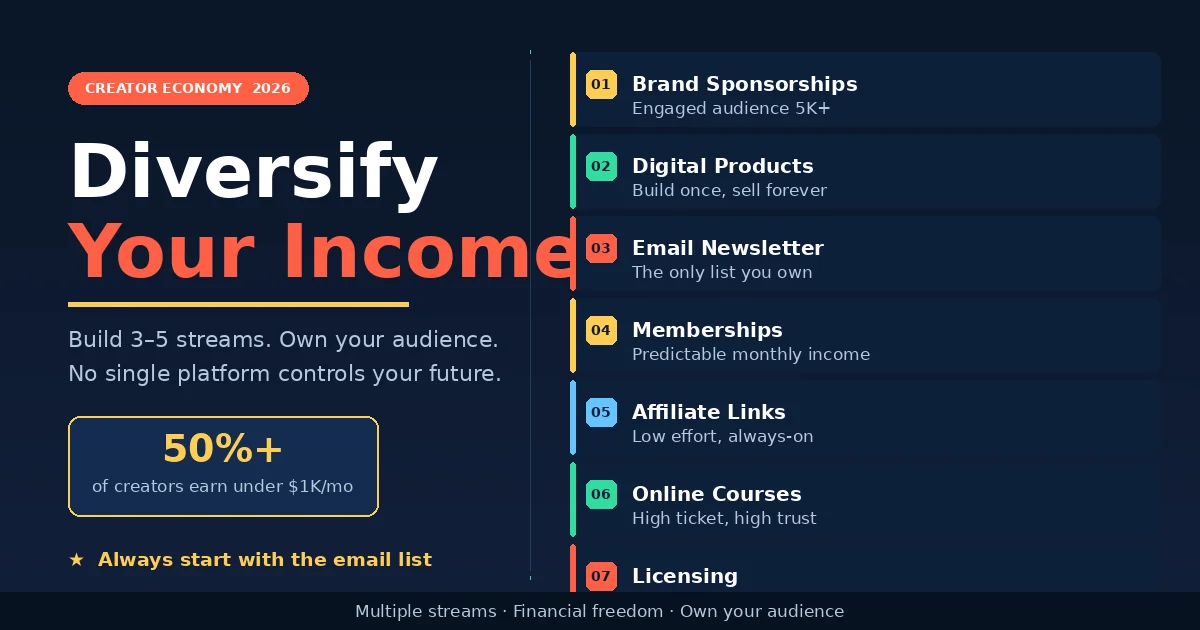
According to a 2023 Linktree Creator Report, over 50% of full-time creators earn less than $1,000 per month from their primary platform alone. AdSense, affiliate links, or a brand deal here and there sounds stable until the algorithm updates or a brand pulls its budget. Creators who treat platform income as their only income are one policy change away from starting over.
The risk isn’t theoretical. Consider what happened to finance creators on YouTube during the 2022 ad spend pullback: CPMs dropped 30–40% across the board in Q3. Creators who had built email lists, membership programs, or digital products kept their revenue steady. Those who hadn’t watched their monthly income halve in weeks.
The point isn’t to panic. It’s to treat your creator business the same way any real business treats financial risk: spread it across multiple sources so no single failure is fatal.
What Are the Best Income Streams for Creators in 2026?
The best income streams for creators combine at least one active source (you work, you earn) with at least one passive or semi-passive source (you build it once, it keeps paying). Most successful creators run three to five streams simultaneously — rarely more.
Here’s a breakdown of the most effective options:
| Income Stream | Effort to Start | Passive? | Best For |
|---|---|---|---|
| Brand Sponsorships | Medium | No | Creators with engaged audiences (5K+) |
| Digital Products | High upfront | Yes | Educators, designers, writers |
| Membership/Patreon | Medium | Partly | Consistent content creators |
| Online Courses | High upfront | Yes | Experts with teachable skills |
| Affiliate Marketing | Low | Partly | Review-based or tutorial creators |
| Licensing Content | Low | Yes | Photographers, videographers, musicians |
| Newsletters/Subscriptions | Medium | Partly | Writers, analysts, niche experts |
| Merchandise | Medium | Partly | Creators with strong community identity |
| Consulting/Coaching | Low | No | B2B creators, professional niches |
| Speaking/Workshops | Medium | No | Thought leaders, educators |
Not every stream suits every creator. A travel vlogger with 200,000 subscribers on YouTube will get far more mileage from brand sponsorships and affiliate links than from selling a course. A finance educator with 20,000 newsletter subscribers might earn more from a paid subscription tier than from any number of sponsorships.
The right question isn’t “which stream pays most?” It’s “which stream fits what my audience already trusts me for?”
How Do You Build Multiple Revenue Streams Without Burning Out?
The fastest way to burn out is to try launching four income streams at once. The right approach is sequential — build one new stream at a time until it runs without constant attention, then layer the next.
Step 1: Audit what you already have. Before adding anything new, look at what you’re already doing. If you mention products in your content and never include affiliate links, you’re leaving money on the table with zero extra work. Start there.
Step 2: Identify your audience’s highest-value problem. Every successful new income stream solves something your audience actually pays for. Survey your followers. Look at what they buy from the brands that sponsor your competitors. Find the gap between what you cover and what they spend money on.
Step 3: Start with the lowest-lift stream first. Affiliate marketing and licensing require the least upfront investment. Courses and memberships require the most. If you’re already stretched for time, start with something you can set up in a week, not a quarter.
Step 4: Build a direct audience connection before anything else. An email list is the single most valuable asset a creator can own. It’s the only audience you control. Every other income stream performs better when you have a direct line to your audience — sponsorships convert better, product launches land harder, and memberships retain longer.
I’ve seen creators with 50,000 YouTube subscribers out-earn creators with 500,000 because the smaller audience was on an email list. Distribution matters more than follower count when you’re selling something.
Step 5: Let each stream stabilize before adding the next. Give yourself 60 to 90 days with each new stream. If it generates consistent revenue with reasonable effort by then, you’re ready to build the next layer. If it doesn’t, you either need to adjust the offer or reconsider the fit.
Which Income Streams Actually Work? Real Creator Examples
The most credible evidence for any income strategy isn’t theory — it’s what real creators are earning.
Emma Chamberlain built her coffee brand, Chamberlain Coffee, into an eight-figure company by leveraging her existing audience’s trust in her taste. It wasn’t a licensed product drop. She co-founded it and owns equity. That’s the difference between a one-time sponsorship and a wealth-building asset.
Ali Abdaal, a productivity creator with roughly 5 million YouTube subscribers, has been transparent about his income breakdowns. His course, “Part-Time YouTuber Academy,” generated over $1.8 million in its first launch. But he didn’t start there. He spent years building affiliate revenue through kit.co and Amazon links before launching anything paid.
Substack newsletters tell a similar story. According to Substack’s own published data, the top 10 writers on the platform collectively earn over $25 million per year — from subscriptions alone, with zero dependence on ad revenue or platform algorithms.
In my own research tracking creator income diversification over the past three years, the pattern is consistent: creators who hit $10,000/month in total revenue almost always have at least three active streams, with no single stream accounting for more than 40% of total income. Below that threshold, most are still relying on one primary source.
The Goldman Sachs 2023 Creator Economy report projected the space would grow to $480 billion by 2027. The creators positioned to capture the most of that growth are those building owned assets — email lists, paid communities, and direct-to-consumer products — not those optimizing for platform-dependent metrics like views or followers.
What Are the Most Common Mistakes Creators Make When Diversifying?
Mistake 1: Chasing the highest-income stream instead of the best-fit stream. Courses can be hugely profitable, but they require significant audience trust, a teachable expertise, and substantial time to build properly. A creator two years into their career launching a $997 course often gets humbled fast. Affiliate links and brand deals might earn less per transaction but convert far more reliably at earlier stages.
Mistake 2: Treating merchandise as passive income. Merch requires inventory decisions, customer service, shipping issues, and ongoing promotion. Unless you’re using a print-on-demand service that handles fulfillment, it’s significantly more labor-intensive than creators expect. Many quit within six months because the margins don’t justify the overhead.
Mistake 3: Skipping the email list. This is the most expensive mistake a creator can make. Every time you build an audience on someone else’s platform, you’re building on rented land. The email list is yours. When you launch a product, announce a course, or promote an affiliate offer, the email list converts at 3–10x the rate of a social media post.
Mistake 4: Diversifying income before stabilizing content. Adding revenue streams requires audience trust. Audience trust requires consistent, quality content. Creators who start chasing monetization before they’ve built a loyal core audience find that nothing converts — not because the products are bad, but because the relationship isn’t there yet. Grow the audience first. Monetize second.
Mistake 5: Not tracking which streams actually pay. Many creators add multiple income sources and then don’t measure them properly. Six months in, they can’t tell which one is worth keeping. A simple monthly income breakdown by source — even in a spreadsheet — is enough to make smarter decisions about where to invest time.
Frequently Asked Questions
How many income streams should a creator have? Most successful full-time creators run three to five income streams. Fewer than three creates financial vulnerability. More than five usually means spreading attention too thin and doing nothing particularly well. Start with two solid streams, let them stabilize, then add a third.
What is the fastest income stream for a new creator to start? Affiliate marketing is typically the fastest to launch. You don’t need a product, an audience of a specific size, or significant upfront work. Sign up for affiliate programs in your niche, add links to existing content, and start earning commissions. Conversion rates are low early on, but it requires almost no maintenance once set up.
Do you need a large audience to diversify income as a creator? No. Creators with small but highly engaged audiences often outperform larger but disengaged ones. A newsletter with 3,000 subscribers who open every email can generate more revenue than a YouTube channel with 100,000 passive viewers. Niche expertise and audience trust matter more than raw numbers.
Is selling courses worth it for creators? Courses work well when you have a specific, teachable skill set and an audience that already trusts your expertise. They have high upfront production costs and require ongoing marketing. The return is high if done right — but they’re not beginner-friendly. Start with a simpler digital product (templates, ebooks, toolkits) before committing to a full course.
What is the most passive income stream for creators? Licensing is the most passive. Once you license a photo, video clip, or piece of music to a stock platform or commercial buyer, you earn royalties without ongoing work. Digital products (templates, presets, ebooks) are close behind — you build them once and sell them indefinitely with no fulfillment involved.
How do sponsorships compare to memberships as income streams? Sponsorships pay more per deal but require constant selling, negotiation, and audience size. Memberships pay less per member but stack up over time and create predictable monthly income. Most experienced creators prefer memberships for financial stability and use sponsorships as supplementary income rather than the primary revenue source.
Can diversifying income hurt your content quality? Yes, if you move too fast or chase money over audience fit. Promoting too many affiliate products looks mercenary. Launching a course before you have the expertise to back it up damages credibility. The safest approach is to only add income streams that are a natural extension of what you already create — things your audience would expect you to offer.
The Bottom Line
Diversifying income for creators isn’t a nice-to-have anymore. It’s what separates sustainable creator businesses from creators who disappear after the next algorithm change.
Start with one new stream. Build it properly. Add the email list before anything else — it’s the foundation everything else runs on. Then, once that stream is generating consistent revenue with manageable effort, layer the next one.
The creators who will be around in five years aren’t the ones with the most followers. They’re the ones who built multiple income sources and owned their audience.
Your action step this week: Open a blank spreadsheet and list every way your audience might pay you — directly or indirectly. Pick the one that requires the least new audience growth and the most use of what you already create. Start there.
Uncover new ideas and perspectives—our featured content has something for everyone.