In May 2025, a 14-year-old Texas girl became the law’s most cited catalyst. Her classmate used AI to generate fake nude images of her and posted them on Snapchat. Snapchat refused to act for nearly a year.
That story — and thousands like it — pushed Congress to act. On May 19, 2025, President Trump signed the TAKE IT DOWN Act into law, making the United States the first country with a federal statute that directly targets both real and AI-generated non-consensual intimate images.
This guide explains exactly what the law does, what it requires from platforms, who it protects, what penalties apply, and where its real weaknesses lie — so you can understand it clearly, whether you’re a victim, a platform operator, a parent, or a policy observer.
What Is the TAKE IT DOWN Act?
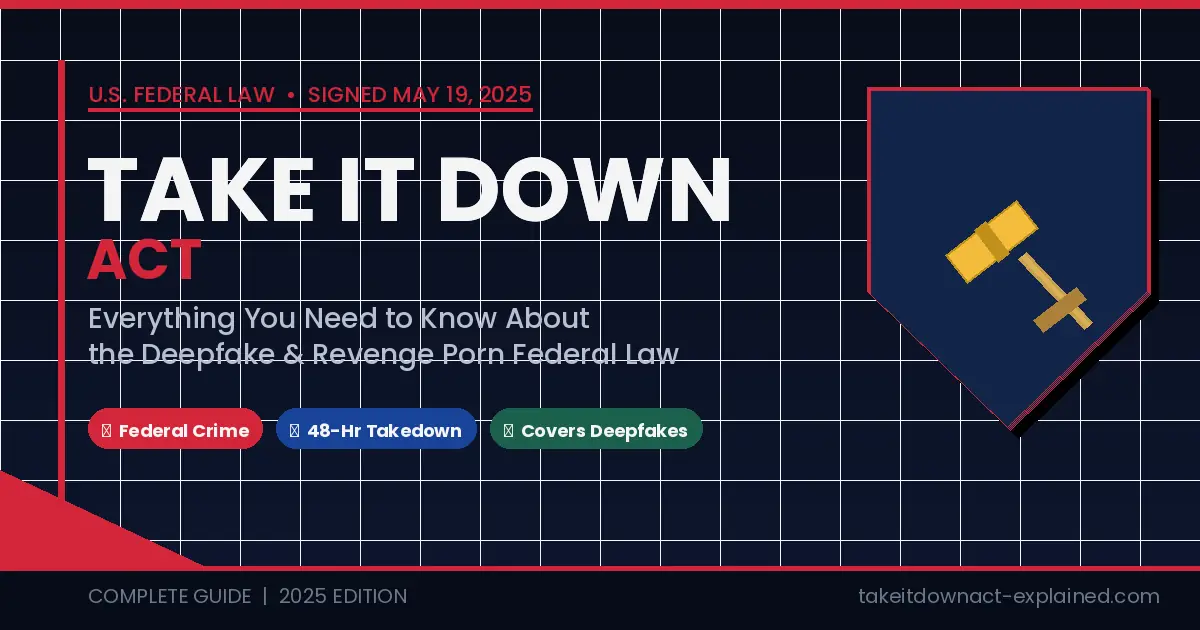
The TAKE IT DOWN Act is the first federal United States law that criminalizes the knowing publication of non-consensual intimate images (NCII), including AI-generated deepfakes of real people. It passed the House 409–2 and cleared the Senate with unanimous consent. It became Public Law No. 119–12 on May 19, 2025.
The full name is the Tools to Address Known Exploitation by Immobilizing Technological Deepfakes on Websites and Networks Act — a name constructed specifically to produce the acronym TAKE IT DOWN.
Where Did This Law Come From?
Before 2025, the United States had no single federal law covering non-consensual intimate imagery at the national level. Victims were left navigating a patchwork of state laws, and those laws varied enormously. Some states covered deepfakes; many did not. Some had criminal penalties; others only civil remedies. A person abused in one state might have strong recourse while someone in the next state had almost none.
That inconsistency, combined with a surge in AI-generated deepfake content that made the problem exponentially worse, created the conditions for federal action.
The law was originally introduced by Senator Ted Cruz (R-TX) after the Texas deepfake case and co-sponsored by Senator Amy Klobuchar (D-MN). First Lady Melania Trump publicly championed it as part of her anti-cyberbullying platform, which helped accelerate its passage. More than 100 organizations endorsed it, including Microsoft, the NCAA, Meta, Google, and TikTok.
Quick-Reference Summary
| Element | Detail |
|---|---|
| Law Name | TAKE IT DOWN Act |
| Signed | May 19, 2025 |
| Public Law No. | 119-12 |
| House Vote | 409–2 |
| Senate Vote | Unanimous |
| Criminal prohibition | In effect immediately |
| Platform compliance deadline | May 19, 2026 |
| Enforcement agency | Federal Trade Commission (FTC) |
| Max prison term (adults) | 2 years |
| Max prison term (minors) | 3 years |
| Platform fine per violation | Up to $53,088 |
What Does the TAKE IT DOWN Act Actually Criminalize?
The law makes it a federal crime for any person to knowingly publish — or threaten to publish — non-consensual intimate images, whether those images are real photographs or AI-generated deepfakes. Understanding the exact scope matters because the law contains important distinctions.
Two Categories of Prohibited Content
1. Authentic Intimate Images (Real Photos or Videos)
The law prohibits publishing real intimate visual depictions of an identifiable individual without that person’s consent. This applies when the person had a reasonable expectation of privacy at the time the image was created — meaning images taken in private settings, not images someone voluntarily shared in a public or commercial context.
A critical point built into the law: consenting to the creation of an intimate image does not mean consenting to its publication. If someone photographs a partner consensually, sharing that image publicly without consent is still a federal crime.
2. Digital Forgeries (AI-Generated Deepfakes)
The law also covers realistic, computer-generated intimate images that depict identifiable real people without their consent — even if those people never appeared in any such image in real life. This is the element that made the law historically significant: it is the first federal statute in the US to directly regulate the harmful use of AI against individuals.
To qualify as a “digital forgery” under the law’s definitions, the image must be realistic enough to be indistinguishable from an authentic depiction. That “indistinguishable” standard has drawn criticism from legal scholars who argue it creates a loophole for lower-quality AI content — a point worth watching as courts interpret the statute.
Who Can Be Criminally Charged?
Any individual who knowingly publishes either category of content faces federal criminal penalties:
- Crimes against adult victims: Up to 2 years in federal prison, plus fines and mandatory restitution.
- Crimes against minor victims: Up to 3 years in federal prison, plus fines and mandatory restitution.
- Threatening to publish non-consensual intimate images is also criminalized, even if no image is actually shared.
The law also mandates criminal forfeiture — any property or proceeds derived from the offense can be seized by the federal government.
What the Law Does Not Cover
The statute carves out specific exceptions where sharing intimate images is permitted:
- Disclosures to law enforcement or intelligence agencies during investigations.
- Disclosures made in good faith for legal proceedings.
- Medical treatment or education contexts.
- Reporting of unlawful conduct.
- Content voluntarily exposed by the identifiable individual in a public or commercial setting (for adult victims only).
- Content related to a legitimate matter of public concern (for adult victims only).
Note: These exceptions for “public concern” and “voluntarily exposed” content do not apply to minors. A minor’s intimate imagery is protected regardless of those circumstances.
What Must Platforms Do Under the TAKE IT DOWN Act?
The law’s second major component places obligations on “covered platforms” — essentially any website, app, or online service that primarily hosts user-generated content. This includes social media platforms, video sharing sites, image hosts, forums, and messaging applications that operate in the course of trade or business.
Platforms had one year from the law’s signing — until May 19, 2026 — to establish compliant removal processes. As of that deadline, the FTC began active enforcement.
The 48-Hour Takedown Requirement
Once a platform receives a valid removal notice, it must:
- Remove the reported intimate visual depiction within 48 hours of receiving the notice.
- Make reasonable efforts to identify and remove identical copies — not just the single reported instance, but known duplicates across the platform.
- Provide a plain-language explanation of its removal process, publicly accessible on the platform.
The notice itself must include a physical or electronic signature from the affected person (or an authorized representative), identification of the content with enough detail for the platform to locate it, and information confirming the content was published without consent.
Platform Liability and the Good Faith Safe Harbor
The law protects platforms from civil liability when they act in good faith to remove content based on a valid-appearing notice — even if the content turns out to have been lawful. This safe harbor is designed to encourage rapid removal rather than lengthy content review.
The flip side: platforms that fail to establish or follow the 48-hour process face FTC enforcement. Non-compliance is treated as a violation of the Federal Trade Commission Act’s provisions on unfair or deceptive practices, carrying civil penalties of up to $53,088 per violation.
The FTC launched a dedicated reporting portal — TakeItDown.ftc.gov — where people can report platforms that fail to comply with removal requests.
Does This Override Section 230?
Section 230 of the Communications Decency Act generally shields platforms from liability for user-generated content. The TAKE IT DOWN Act creates a notable tension with this protection. Legal analysts note that it remains unclear whether Section 230 can serve as a defense in FTC enforcement actions under the Act, or whether the Act effectively overrides Section 230 for these purposes. Courts will likely need to resolve this question.
How Does the TAKE IT DOWN Act Affect Victims, Survivors, and Individuals?
For victims of non-consensual intimate imagery, the law creates a concrete federal pathway that previously did not exist. Before May 2025, someone whose images were shared without consent in a state with weak NCII laws had few practical options: civil lawsuits were expensive, state law enforcement often lacked jurisdiction over out-of-state platforms, and platforms had no federal obligation to act.
The TAKE IT DOWN Act changes that structure in several meaningful ways.
Faster Platform Response
The 48-hour requirement represents a dramatic shift. Platforms can no longer take months or years to respond to removal requests — the gap that defined Elliston Berry’s experience in Texas. Federal law now mandates action within two days of a valid notice, with FTC oversight and penalties for non-compliance.
Federal Criminal Recourse
Victims can now report cases to federal law enforcement. The Department of Justice can prosecute offenders under the TAKE IT DOWN Act, and courts must order restitution for victims upon conviction.
No Private Right of Action
One important limitation: the TAKE IT DOWN Act does not include an express private right of action. Victims cannot sue under this specific law directly. The existing federal civil right of action for NCII (established under the Violence Against Women Act reauthorization in 2022) remains the primary path for civil lawsuits, though its application to AI-generated deepfakes is still unsettled by courts.
The DEFIANCE Act — a companion bill from Representative Alexandria Ocasio-Cortez that would explicitly guarantee civil rights of action for deepfake victims — was reintroduced in the Senate after the TAKE IT DOWN Act’s passage. As of mid-2026, it had not been signed into law.
The Law Does Not Address State Law
The TAKE IT DOWN Act does not preempt state NCII laws. All 50 states and the District of Columbia have some form of NCII protection, and 30 states specifically address deepfake imagery. Victims retain the ability to pursue cases under state law in parallel with federal options.
What Are the Law’s Key Criticisms and Controversies?
The TAKE IT DOWN Act passed with near-unanimous congressional support, but that political consensus does not mean the law is without real problems. Several civil liberties organizations, legal scholars, and even some NCII victim advocacy groups raised substantive concerns.
1. The Notice-and-Takedown System Can Be Abused
The law creates a notice-and-takedown mechanism similar to the one in the Digital Millennium Copyright Act (DMCA) for copyright complaints. That system has a well-documented abuse problem: bad actors file false or bad-faith removal requests to silence competitors, critics, or journalists.
The TAKE IT DOWN Act’s version of this system includes even fewer safeguards than the DMCA. Because platforms face FTC penalties for failing to meet the 48-hour deadline, the incentive structure pushes them toward removing first and verifying later — or not at all.
The Electronic Frontier Foundation (EFF) stated plainly that the law “gives powerful people a new legal tool to force online platforms to remove lawful speech that they simply don’t like.” Specifically, the EFF flagged that the takedown provision’s language is broader than the law’s definitions of NCII elsewhere in the text, potentially sweeping in content that is not actually non-consensual.
The Cyber Civil Rights Initiative — an organization that spent a decade advocating for exactly these kinds of laws — called the takedown provision “unconstitutionally vague, unconstitutionally overbroad, and lacking adequate safeguards against misuse.” Examples the group raised: a journalist’s photographs of a topless protest, law enforcement images of a flasher distributed to identify a suspect, or consensual content falsely reported as non-consensual.
2. Encryption Risks
The EFF and other digital rights groups raised a specific technical concern: the requirement to remove content “stored on servers” and to address “identical copies” creates pressure on platforms to monitor communications — including communications that may be end-to-end encrypted. If complying with the law requires breaking encryption to identify prohibited content, the consequences for user privacy would be severe and far-reaching.
3. The “Indistinguishable” Standard for Deepfakes
The law criminalizes AI-generated images only when they are “indistinguishable from an authentic visual depiction.” Critics argue this wording creates an implicit loophole: lower-quality deepfakes — which are still harmful and still clearly identify real people — may fall outside the law’s criminal scope. As AI image generation improves, this distinction may matter less, but the ambiguity creates uncertainty for prosecutors.
4. No Proactive Detection Required
The TAKE IT DOWN Act is entirely reactive. Platforms must act when notified, but they have no obligation to proactively scan for prohibited content. AI tools that generate the images are not addressed by the law at all. Creating the underlying technology remains entirely legal. The law treats the symptom — distribution — without touching the disease — generation.
5. No Statute of Limitations
Legal analysts note that the Act specifies no statute of limitations for the platform removal obligations. Platforms may therefore face removal requests for content uploaded years before the law’s passage, with no clear limit on how far back liability extends.
Frequently Asked Questions About the TAKE IT DOWN Act
What does TAKE IT DOWN stand for?
TAKE IT DOWN is an acronym for “Tools to Address Known Exploitation by Immobilizing Technological Deepfakes on Websites and Networks.” The law makes it a federal crime to knowingly publish non-consensual intimate images of real people — whether authentic photographs or AI-generated deepfakes — and requires platforms to remove reported content within 48 hours.
When did the TAKE IT DOWN Act become law?
President Donald Trump signed the TAKE IT DOWN Act into law on May 19, 2025. The criminal prohibitions took effect immediately on that date. Covered platforms had one year — until May 19, 2026 — to establish their notice-and-removal processes. FTC enforcement of those platform requirements began on May 19, 2026.
Does the TAKE IT DOWN Act apply to AI-generated deepfakes?
Yes. The law specifically covers “digital forgeries,” defined as realistic computer-generated images depicting identifiable real individuals in intimate contexts without their consent. This is what makes the law historically significant — it is the first federal US statute to directly regulate the harmful application of AI-generated imagery against real people.
What happens if a platform ignores a removal request?
Non-compliance with the 48-hour removal requirement constitutes a violation of the Federal Trade Commission Act’s provisions on unfair or deceptive practices. The FTC can pursue enforcement action, with civil penalties of up to $53,088 per violation. Victims can report non-compliant platforms at TakeItDown.ftc.gov.
Can I sue someone directly under the TAKE IT DOWN Act?
No. The law does not include a private right of action, meaning you cannot personally file a lawsuit under this specific statute. Criminal prosecutions are brought by the Department of Justice. For civil lawsuits, you may have recourse through the existing VAWA federal civil right of action or applicable state laws. The DEFIANCE Act, if passed, would add explicit federal civil remedies for deepfake victims.
Does the law apply to content outside the United States?
The law applies to platforms that host content accessible in the United States, regardless of where they are based. However, cross-border enforcement remains a genuine practical challenge. The FTC’s jurisdictional reach is broader than that of individual states, but platforms hosted in jurisdictions that do not cooperate with US enforcement requests represent an ongoing gap.
Does the TAKE IT DOWN Act replace state NCII laws?
No. The Act explicitly does not preempt state law. All 50 states and Washington D.C. have some form of NCII protection, and those state laws continue to operate alongside the federal statute. Victims in states with strong NCII laws retain access to those state remedies in addition to federal options.
Who enforces the TAKE IT DOWN Act?
The Federal Trade Commission enforces the platform requirements. The Department of Justice handles criminal prosecutions of individuals who publish prohibited content. The FTC also maintains TakeItDown.ftc.gov as a reporting tool for people whose removal requests are ignored by platforms.
Conclusion
The TAKE IT DOWN Act is genuinely landmark legislation. It closed a gap that left millions of people — especially teenagers — without meaningful federal protection against one of the fastest-growing forms of digital abuse. The 48-hour removal requirement, the criminalization of AI-generated deepfakes, and FTC oversight of platform compliance are all real and significant advances.
At the same time, the law has real weaknesses that will matter in practice. The absence of safeguards against bad-faith removal requests creates censorship risk. The pressure on platforms to remove without verification may produce over-removal of lawful content. And the law does nothing about the AI tools that generate the images in the first place.
Whether this law actually protects victims depends heavily on how aggressively the FTC enforces the platform requirements, how courts interpret ambiguous provisions like the “indistinguishable” standard for deepfakes, and whether complementary legislation — particularly the DEFIANCE Act — eventually fills the civil remedy gap.
What to do now:
- If your intimate images have been published without consent, you can submit a removal request directly to the relevant platform and report non-compliance to the FTC at TakeItDown.ftc.gov.
- If you are a platform operator, compliance with the notice-and-removal requirements is now mandatory under federal law, and the FTC is actively monitoring.
- If you are a parent or educator, this law provides both a legal framework and a conversation tool for talking with young people about digital privacy and the real-world consequences of image-based abuse.
Your journey to success begins with our goal-oriented content.