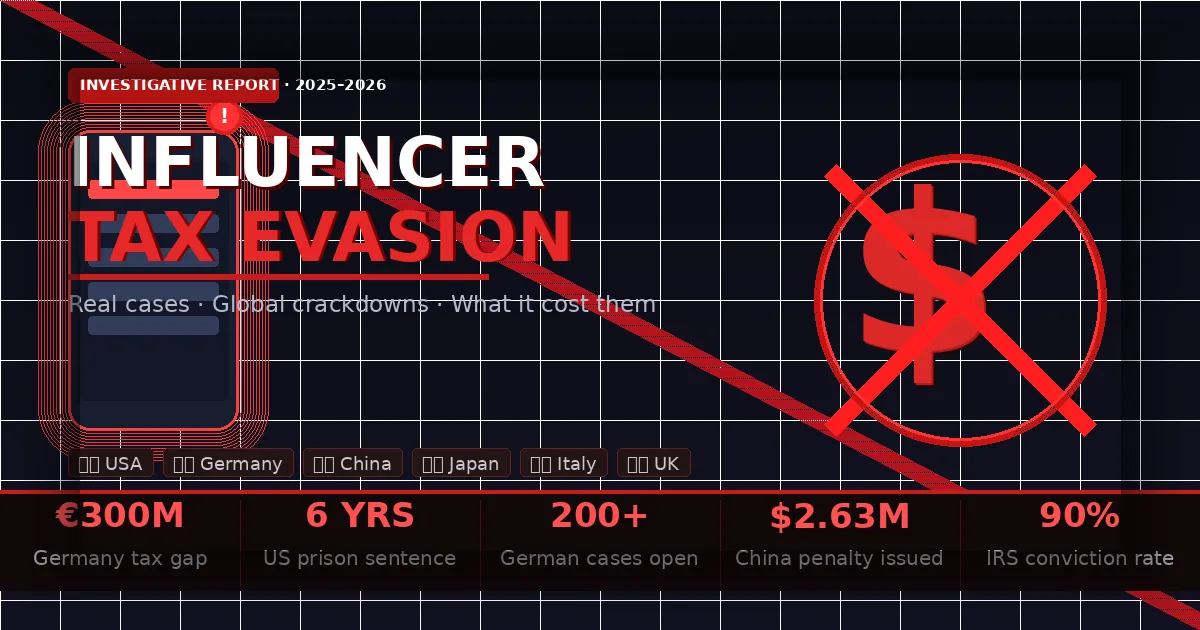
In November 2025, a Tennessee grand jury indicted WhistlinDiesel — a YouTuber with over 10 million subscribers — for evading state sales tax on a $400,000 Ferrari. That same month, German tax authorities announced criminal proceedings against approximately 200 influencers, estimating a cumulative tax gap of €300 million. These aren’t isolated stories.
From China to California, tax agencies have built specialist units to target high-earning content creators. The tools are new. The law is not. This article covers the biggest documented influencer tax evasion cases, the schemes authorities keep catching, the real penalties creators face, and why it’s becoming much harder to hide.
Why Are Tax Authorities Targeting Influencers Now?
Tax agencies are targeting influencers because the creator economy has grown large enough to justify the investment, and platform data now makes enforcement practical. Germany’s North Rhine-Westphalia analyzed 6,000 social media data records to identify creators whose disclosed income didn’t match the lifestyle they posted. The EU’s DAC7 directive now requires platforms to report creator earnings directly to tax authorities each year.
The creator economy is no longer niche. According to the German Association for the Digital Economy, company spending on influencer marketing in Germany alone rose from €223 million in 2019 to €477 million in 2022. Multiply that globally and the income flowing to creators runs into the tens of billions annually — much of it historically under-reported and difficult for traditional audit methods to catch.
That changed in several ways simultaneously. The EU’s DAC7 directive, effective from 2023, requires digital platforms including YouTube, Patreon, and Twitch to report user earnings automatically to national tax authorities. Any influencer who earned income and didn’t register for VAT can now be flagged without a single tip or audit trigger. Ireland’s Revenue Commissioners released detailed influencer tax guidelines in mid-2025. Spain issued binding rulings confirming that YouTube and Twitch income is subject to VAT with no threshold exemption.
In the US, IRS Criminal Investigation — the agency’s law enforcement arm — reports a 90% federal conviction rate. Once an influencer is referred to that division rather than just flagged for an audit, prosecution is the statistically overwhelming outcome. The DOJ created a new National Fraud Enforcement Division in April 2026, with an explicit mandate to prosecute fraud against American taxpayers.
Stephanie Thien, head of the state office for combating financial crime in North Rhine-Westphalia, told AFP in October 2025: “We know that there is a lot of money circulating right now. And we also know that not all of it is being taxed properly.” Her unit isn’t looking at small creators. It is “truly targeting serious financial crime, the big cases.”
How Do Influencers Actually Hide Their Income?
Influencers typically hide income through five methods: underreporting direct earnings, registering assets in low-tax jurisdictions, routing payments through shell companies, using cryptocurrency accounts, or falsely claiming foreign residency. Most caught influencers used a combination of these — rarely just one.
Going through the public court filings and indictments from 2024 to 2026, a clear pattern emerges. These aren’t sophisticated offshore schemes in most cases. They’re straightforward concealment, caught because platform reporting and lifestyle analysis made the gaps obvious.
1. Underreporting direct income from brand deals and content
Charles Lewis Davis — a social media personality on YouTube, Facebook, and Instagram operating under Forever Investments LLC — was indicted in April 2026 for allegedly withholding information from his tax preparer about $807,142 in 2020 income and $390,566 in 2021. He allegedly stored the unreported funds across personal bank accounts, brokerage accounts, and cryptocurrency wallets. This is the most basic version: not disclosing all your revenue.
2. Registering expensive assets in no-tax states
Montana has no state sales tax. By forming an LLC there and titling a vehicle under it, some buyers avoid paying sales tax in their actual home state. WhistlinDiesel registered his $400,000 Ferrari under a Montana entity rather than paying Tennessee’s 7% sales tax plus Williamson County’s additional 2.75% — potentially about $38,000 avoided. His attorneys later argued he was never given the chance to voluntarily pay before his arrest. The case is now a test of how aggressively states pursue this loophole.
3. Routing payments through shell companies
Japanese influencer Reika Kuroki — who posts as Reika Miyazaki with 500,000 Instagram followers — ran brand deal fees through her advertising company Solarie. Prosecutors allege she concealed ¥496 million in income across three tax years, evading ¥126 million in corporate taxes and a further ¥31 million in consumption taxes. The money was reportedly used for company operating costs.
4. Dual contracts
In China, some influencers sign two agreements for the same deal: one with a lower price declared to tax authorities, and a separate “actual contract” showing the real amount. China’s Supreme Court explicitly classified this as tax evasion in Judicial Interpretation [2024] No. 4. Chinese state media has documented multiple streamers and celebrities caught using this exact structure.
5. Fake relocation to low-tax countries
Germany’s investigators estimate this strategy alone accounts for approximately €300 million in avoided tax. Influencers formally deregister their German address and claim residency in the UAE, Dubai, or another low-tax jurisdiction — while continuing to create content aimed at German audiences and continuing to earn from German advertisers. Under Section 1 of Germany’s Income Tax Act, actual physical presence and habitual residence determine liability, not a registered address elsewhere.
Real Influencer Tax Evasion Cases From Around the World
These are documented cases from court filings, government press releases, and verified news reporting. They span five countries and every income level of the creator economy.
WhistlinDiesel — United States (2025–Ongoing)
Cody Detwiler, known as WhistlinDiesel, built a channel with over 10 million YouTube subscribers around buying, building, and destroying expensive vehicles. In November 2025, a Williamson County grand jury indicted him on two felony counts of tax evasion. The charge stems from a 2020 Ferrari F8 Tributo he purchased in January 2023 and registered under a Montana LLC rather than paying Tennessee sales tax — which would have come to roughly $38,000.
Detwiler posted about his arrest on Instagram with “Won so big they thought I was cheating.” In a subsequent video, he claimed Tennessee authorities had been aware of the issue for a year before arresting him in a publicly visible operation with body cameras rolling — suggesting the state wanted the footage. A judge issued a limited gag order after he began calling out investigators by name online. He announced plans to leave Tennessee and buy land in Montana. As of mid-2026, the case remained ongoing.
The case matters beyond Detwiler personally. It signals that states are willing to prosecute a loophole that thousands of vehicle owners have used for years, using a high-profile creator as the test case.
Charles Lewis Davis — United States (2026)
A federal grand jury in Phoenix indicted Davis on April 21, 2026, for making false statements on tax returns. Davis operates Forever Investments LLC, posting videos to YouTube, Facebook, and Instagram. The indictment alleges he hid $807,142 in 2020 and $390,566 in 2021 from his tax preparer, storing those amounts in bank, brokerage, and cryptocurrency accounts. He pleaded not guilty at his May 2026 appearance. A conviction for false statements on a tax return carries up to three years in prison and a $250,000 fine.
Scott Bossetti — United States (2025–2026)
This case combines fraud with tax crimes. Ohio-based finance influencer Bossetti promoted investment opportunities on Facebook and YouTube through Boss Lifestyle LLC, guaranteeing returns of 30% or higher on short-term investments. The scheme raised $20 million from victims. He filed approximately 14 fraudulent 1099-INT tax forms reporting fake interest income. He admitted to using investor funds to pay for a $150,000 Mercedes SUV, a downtown Columbus condo, and extensive travel. Bossetti was charged in April 2025, pleaded guilty to wire fraud and aiding a false tax filing in June 2025, and was sentenced to six years in federal prison in April 2026.
Reika Kuroki (Reika Miyazaki) — Japan (December 2025)
Tokyo prosecutors indicted Kuroki, her company Solarie, and two executives in December 2025. Kuroki — who has 500,000 Instagram followers promoting cosmetics and products — allegedly channeled her influencer fees through Solarie while concealing ¥496 million in income. The alleged tax evasion totaled ¥126 million in corporate taxes and ¥31 million in consumption taxes across three tax years ending January 2024. Kuroki posted an Instagram statement saying she was “reflecting deeply on her conduct and will swiftly make necessary corrections.”
Bai Bing — China (2025–2026)
Chinese food vlogger Bai Bing was investigated by the State Administration of Taxation for underreporting income between 2021 and 2024. She allegedly underreported personal income tax, value-added tax, and deed tax by converting the nature of the income and making false declarations — hiding approximately $1.26 million in total. In October 2025, authorities ordered her to pay $2.63 million in back taxes, late fees, and penalties. China’s State Administration of Taxation announced in April 2026 that celebrities and internet influencers would be an explicit focus of their annual joint enforcement campaign.
Germany’s National Crackdown (2025–Ongoing)
North Rhine-Westphalia isn’t pursuing one influencer — it’s pursuing approximately 200 simultaneously, with Hamburg and Thuringia running parallel investigations. The financial crimes unit analyzed roughly 6,000 data records from social media platforms to match lifestyle evidence against declared income. The total estimated tax loss from fake foreign relocation schemes alone is approximately €300 million. The investigations cover everything from undeclared brand payments to undeclared hotel stays and flights received as product placements.
Germany’s approach is notable because it treats non-cash income — gifts, travel, free products received in exchange for promotion — as taxable income requiring declaration. This is legally correct, but enforcement had been minimal before 2025.
Chiara Ferragni — Italy (2023–2026)
Italy’s Pandorogate case is the most high-profile creator accountability case of the decade, though technically fraud rather than pure tax evasion. Ferragni, who had over 29 million Instagram followers, partnered with cake manufacturer Balocco in 2022 on a branded pandoro priced at three times the standard retail cost, implying proceeds would go to a children’s hospital. The hospital received a single flat donation of €50,000 from Balocco before the campaign. Ferragni received approximately €1 million for the endorsement.
Italy’s anti-trust authority fined her €1 million in 2023. Criminal prosecutors indicted her for aggravated fraud in January 2025, with a potential five-year prison sentence. The trial began in September 2025. In January 2026, a Milan court acquitted Ferragni after she paid €3.4 million in total restitution to all affected parties. The Pandorogate case prompted Italy to pass the Ferragni Law, requiring influencers with over 1 million followers to register with communications regulators and comply with advertising transparency obligations. Italy subsequently expanded registration requirements to influencers with more than 500,000 followers.
What Penalties Do Influencers Face — and How Bad Does It Get?
The penalties for tax evasion break into three layers: back taxes plus interest, civil fraud penalties, and criminal prosecution. Most cases involve all three. The criminal layer is what separates evasion from a simple miscalculation.
| Country | Civil Penalty | Criminal Maximum |
|---|---|---|
| United States | 75% of unpaid tax (fraud penalty) + interest | 5 years prison (tax evasion); 3 years (false return) |
| Germany | Back taxes + late fees + surcharges | Up to 10 years for aggravated evasion |
| China | Back taxes + up to 5× penalty multiplier | Criminal prosecution for systematic concealment |
| Japan | Back taxes + consumption tax surcharges | Criminal indictment for corporate tax evasion |
| Italy | Regulatory fines up to €5 million | Up to 6 years for aggravated fraud |
| United Kingdom | Unpaid tax + 30–100% penalty + interest | Up to 7 years for deliberate evasion |
The US 75% fraud penalty is on top of the original tax owed — so a creator who hid $1 million in income might owe the original tax, then another 75% of that as a penalty, then interest going back years. The total bill often exceeds the original income hidden.
The IRS Criminal Investigation unit, once involved, carries a 90% federal conviction rate. Bossetti’s six-year sentence is the clearest recent example of where financial fraud plus tax crimes leads.
HMRC in the UK has been sending letters to tens of thousands of content creators since 2024. UK influencers earning over £1,000 in a tax year must file a Self Assessment return. Gifts from brands in exchange for promotional content count as taxable income at fair market value — a set of luxury cosmetics worth £500 received for promotion is £500 of taxable income.
Common Myths That Get Influencers Into Trouble
“I don’t have to report income until I hit a certain threshold.” Wrong, in every major jurisdiction. The US $600 threshold for 1099 forms is a reporting obligation on the payer, not a tax exemption for you. All self-employment income is taxable regardless of amount. UK creators must register if their trading income exceeds £1,000, but that’s a registration trigger — not a tax-free allowance.
“Gifted products aren’t income.” This is the mistake Germany is specifically hunting. The IRS is explicit: benefits received in connection with performing services — including products, flights, and hotel stays given in exchange for promotion — are taxable at fair market value. A creator who receives a €3,000 watch to review on YouTube has €3,000 of taxable income. Most influencers don’t track this at all.
“An LLC means lower taxes.” The entity structure redirects income; it doesn’t eliminate the tax. What investigators look for — and found in multiple cases above — is income being routed through companies in ways that conceal it from tax preparers or misrepresent its nature. Davis allegedly told his accountant about some income and withheld the rest. Kuroki ran fees through Solarie. The LLC was the vehicle for concealment, not the cause.
“Cryptocurrency is untraceable.” The blockchain is public. US prosecutors subpoena exchange records. Davis allegedly stored unreported income in cryptocurrency accounts — investigators found it. Norway’s tax agency estimated an 82% crypto tax noncompliance rate in 2024, which is why enforcement is now being prioritised. The IRS has sent warning letters to crypto holders it identified through exchange data and has escalated to audits and prosecutions.
“If I move abroad on paper, I’m no longer liable.” Germany is specifically, actively prosecuting this. Influencers who deregistered their German address and registered in Dubai while continuing to create for German audiences and earn from German advertisers remain liable under German income tax law. What matters under Section 1 of Germany’s Income Tax Act is your actual habitual residence and where your income is genuinely generated — not a formal registration.
Frequently Asked Questions
Are brand deal payments taxable income for influencers? Yes, in every major jurisdiction covered here. Payments from brands — whether in cash, bank transfer, or products — are self-employment income. US brands are required to file 1099 forms for payments over $600, but you must declare all brand income regardless of whether you receive a form. In the EU, DAC7 requires platforms to report creator earnings automatically.
How does the IRS actually find out about unreported influencer income? Several ways simultaneously. Brands file 1099s for payments over $600. Platforms report earnings under DAC7 equivalents. Crypto exchanges have been subpoenaed. Public social media posts are used as circumstantial evidence — posting about a $400,000 car while declaring minimal income creates an obvious discrepancy. The IRS also receives tips from former business partners and employees.
What is the Montana LLC loophole and is it legal? Forming a Montana LLC and registering a vehicle under it to avoid sales tax in a state where the vehicle is actually driven and stored is at best legally aggressive and at worst criminal evasion, as the WhistlinDiesel case demonstrates. Montana has no sales tax and relatively easy LLC formation. Thousands of car owners used this strategy. Several states are now treating it as tax fraud and pursuing prosecutions.
What is the difference between tax evasion and tax avoidance? Tax avoidance is legal — using legitimate deductions, business structures, timing strategies, or retirement contributions to reduce what you owe. Tax evasion is illegal — deliberately hiding income, filing false returns, or misrepresenting your situation to reduce your bill. The determining factor is honesty. Claiming every legitimate business deduction is avoidance. Hiding income from your own accountant, as allegedly occurred in the Davis case, is evasion.
Do influencers have to declare cryptocurrency payments? Yes. The IRS classifies crypto as property: receiving it as payment for services is taxable at fair market value on the date received. Later selling or exchanging it may also trigger capital gains. Storing earnings in crypto wallets doesn’t conceal them — exchange records, blockchain analytics, and court-ordered data disclosures have all been used successfully in prosecutions.
Can an influencer legally deduct a luxury car? Business use of a vehicle is deductible. Personal use is not. A creator who genuinely uses a car to drive to shoots and client meetings can deduct that portion. One who drives a Ferrari for personal enjoyment, then claims full business deduction, is committing fraud. The IRS expects detailed mileage logs and evidence of business purpose. Most lavish vehicle claims that appear in prosecutions were entirely personal.
What should an influencer do if they’ve been under-reporting income? Get specialist advice immediately, before any tax authority contact. In Germany, voluntary disclosure before an investigation formally opens can prevent criminal prosecution entirely — KPMG Law’s German team advises this explicitly. In the US, coming forward before the IRS initiates formal proceedings shifts the likely outcome from criminal to civil. Once investigators have made contact, the window narrows sharply.
Conclusion
The math on creator tax enforcement has fundamentally shifted. Platform data is now flowing directly to tax agencies in Europe. IRS Criminal Investigation has documented cases, a 90% conviction rate, and increasing resources. Germany has a dedicated influencer unit with 6,000 social media data records. China’s state tax authority named creators as a priority enforcement category for 2026.
The cases above range from a YouTuber who registered a Ferrari in Montana to a global fashion influencer who paid €3.4 million in restitution after a fraud scandal. What connects them is the assumption that income flowing through social media was somehow different — less visible, less traceable, subject to different rules. It isn’t.
If you’re a content creator: all income is taxable, gifted products count, cryptocurrency isn’t invisible, and your Instagram feed can be used as evidence. The DAC7 directive means European tax authorities now receive creator earnings reports directly from platforms. The IRS has a specialist unit and a 90% conviction rate.
The smartest move — before any of this becomes relevant — is a qualified accountant who understands creator income specifically, clean records of all brand deals and product receipts, and honest reporting. It costs far less than what the people in this article paid.
Power up your thinking with our brain-boosting articles picked by experts.