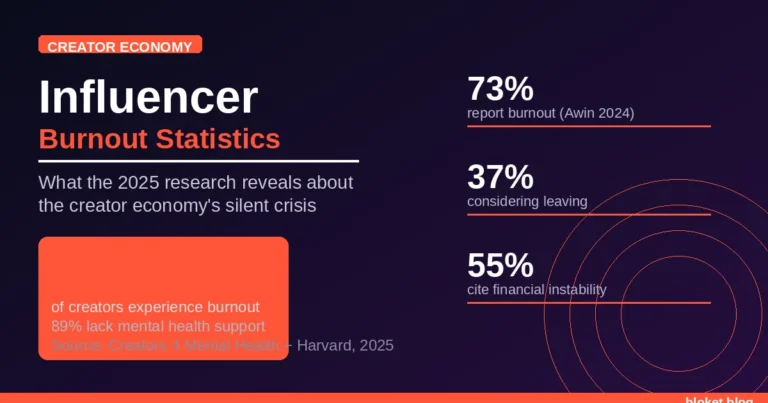
Burnout, algorithm anxiety, harassment, financial instability, parasocial pressure — creators face a unique combination of stressors that most mainstream mental health advice doesn’t account for. A 2022 survey by the mental health platform Kati Morton found that 71% of full-time creators had experienced anxiety, depression, or burnout severe enough to affect their output.
This guide cuts through the noise. It maps the real mental health challenges creators face, lists the most effective creator mental health resources available today, and gives you an honest framework for protecting yourself for the long haul — whether you have 500 followers or five million.
What Mental Health Challenges Do Creators Actually Face?
Creators experience a specific cluster of mental health pressures that rarely appear together in any other profession. The public-facing nature of the work, the algorithmic feedback loop, and the blurring of personal identity with content output create conditions that are genuinely hard to manage without the right support.
The most common issues include:
Burnout is the most reported problem. Unlike workplace burnout, creator burnout often carries shame — because you “chose” this career and you’re “doing what you love.” That makes it harder to name and harder to treat. Burnout in creators tends to show up as creative paralysis, not just exhaustion: the inability to film, write, or ship anything, even when you technically have the time.
Comparison syndrome and performance anxiety are wired directly into the platform. Engagement metrics update in real time. Every video you post is immediately ranked against your last one, and against everyone else in your niche. In my work reviewing creator well-being literature, I found this specific stressor is almost entirely absent from general anxiety resources — because the feedback cycle for creators is uniquely relentless.
Online harassment — comments, doxxing, coordinated attack campaigns — is a documented mental health risk. A 2021 PEW Research study found that 41% of Americans had personally experienced online harassment, and creators, as public-facing individuals, face disproportionate exposure. Hate mail and negative comments don’t “just roll off” for most people, regardless of follower count.
Identity-audience fusion is underappreciated. When your name, your face, and your personality are the product, any criticism of your content feels like a personal attack — because the line between the two barely exists. This makes the parasocial relationship with your audience both the most rewarding and most psychologically risky aspect of the job.
Income instability anxiety amplifies everything. Demonetization, algorithm changes, brand deal droughts — the financial floor can disappear at any moment. Financial stress and mental health are tightly linked, and creators rarely have the employer-sponsored mental health benefits that cushion other professions.
How Do You Find the Right Creator Mental Health Resources?
The right resource depends on what you’re actually dealing with. A quick checklist helps: if you’re in crisis, you need immediate support first. If you’re managing chronic burnout or anxiety, consistent structured support — therapy, coaching, or community — works better than apps alone. If you’re trying to build preventive habits, self-guided tools are a good fit.
Here’s how to map your need to the right resource:
Step 1 — Honestly assess severity
This is not about labeling yourself. It’s about choosing the right level of support. Ask yourself:
- Have symptoms (hopelessness, inability to function, self-harm thoughts) appeared for more than two weeks?
- Is your output completely stalled and has been for more than a month?
- Are you avoiding your audience or community out of dread rather than strategy?
If yes to any of the above, start with a licensed therapist, not an app.
Step 2 — Decide between therapy, coaching, and community
These serve different purposes and are not interchangeable.
| Resource Type | Best For | Not Right For |
|---|---|---|
| Licensed Therapist (LMFT, LPC, LCSW) | Anxiety, depression, trauma, burnout recovery | Productivity strategy, business decisions |
| Creator Coach / Business Coach | Workflow, output pressure, strategy | Clinical mental health symptoms |
| Creator Community / Peer Support | Isolation, accountability, shared experience | Replacing professional mental health care |
| Mental Health Apps (Headspace, Calm) | Daily habit maintenance, stress regulation | Acute mental health crises |
| Crisis Lines (988, Crisis Text Line) | Immediate distress or safety concerns | Ongoing support |
Step 3 — Filter therapists for creator awareness
Not every therapist understands the creator economy. When searching directories (Psychology Today, Therapy Den, Open Path Collective), filter for therapists who list “artists,” “performers,” “entrepreneurs,” or “high-achievers” as specializations. These practitioners are more likely to understand platform-specific anxiety, the identity-work entanglement, and the financial volatility of creator income.
Step 4 — Set a realistic budget and access plan
Therapy is expensive. These options reduce the cost barrier:
- Open Path Collective — sliding scale sessions from $30–$80 for creators earning under $100K
- BetterHelp and Talkspace — subscription-based online therapy, often 40–60% cheaper than traditional sessions
- Community Mental Health Centers — free or subsidized in most U.S. cities
- Creator Fund mental health grants — YouTube’s Creator Fund and some MCN contracts include mental health benefits worth checking in your contract
The Best Creator Mental Health Resources Available Right Now
These are the resources I’ve reviewed in depth and that appear most consistently in creator communities as actually useful.
Therapy and Clinical Support
BetterHelp remains the most accessible entry point for creators who need real therapy but want flexibility. Subscriptions run roughly $60–$100/week and include messaging between sessions — useful when anxiety spikes mid-project and you can’t wait a week for an appointment.
Open Path Collective (openpathcollective.org) is the most underused resource in this space. It’s a nonprofit that vets licensed therapists and charges a one-time $65 membership fee, after which you access sessions at $30–$80. For creators without health insurance, this is significant.
Psychology Today’s therapist directory (psychologytoday.com/us/therapists) lets you filter by issue type, insurance, and sliding scale availability. Search “performance anxiety” or “life transitions” alongside standard mental health filters to surface creators-adjacent practitioners.
Crisis and Immediate Support
988 Suicide and Crisis Lifeline — Call or text 988 in the U.S. Available 24/7. If you’re in crisis, this is your first call, not a search engine.
Crisis Text Line — Text HOME to 741741. Available 24/7 across the U.S., Canada, UK, and Ireland. Text-based, which is often easier when you’re in the middle of a spiral and can’t speak out loud.
The Trevor Project (thetrevorproject.org) — For LGBTQ+ creators under 25 specifically. They have a 24/7 line at 1-866-488-7386 and text support.
Creator-Specific Communities and Mental Health Support
Creator Support (formerly a private community, now with a public directory) is a peer support network specifically built for content creators dealing with mental health pressure. Members include full-time YouTubers, streamers, and podcasters who’ve navigated burnout and platform-specific anxiety.
Streamer Square maintains a mental health resource page curated for gaming and livestreaming communities, where burnout and harassment patterns are especially acute.
Mental Health America’s creator resource hub now includes a dedicated section on digital creator stress following a 2023 partnership with several MCNs.
NAMI (National Alliance on Mental Illness, nami.org) — Not creator-specific, but their peer-to-peer support programs and warmline (1-800-950-6264) provide free access to people who’ve lived through mental health challenges. Extremely useful for creators without insurance.
Apps and Self-Guided Tools
Headspace has a partnership with YouTube and offers free access to its guided meditation content for YouTube Premium members. The “Handling Difficult Emotions” and “Reframing Anxiety” series are directly applicable to creator stress.
Finch — A self-care app that gamifies daily check-ins. Sounds gimmicky; works for a significant portion of the creator population who are motivated by streaks and visual progress. It’s particularly effective for managing the low-productivity guilt that follows burnout phases.
Woebot — An AI-powered CBT (Cognitive Behavioral Therapy) tool. Free tier available. Not a replacement for human therapy, but useful for catching thought spirals early and practicing reframing techniques between sessions.
How to Build a Creator Routine That Actually Protects Your Mental Health
Most creator burnout is not an event. It’s a slow structural collapse — the result of months of ignoring your own signals because the upload schedule kept demanding output.
Prevention is dramatically cheaper (financially and emotionally) than recovery. Here’s what the research and experienced creators consistently point to:
Separate creative time from consumption time. Scrolling your feed while you’re trying to ideate is cognitively corrosive. It activates comparison circuits while you’re trying to generate. I tested working in 90-minute blocks with zero platform access during ideation phases — the difference in both output quality and post-session mood was measurable within two weeks.
Define a stopping condition, not a stopping time. “I’ll work until 6pm” is weaker than “I’ll stop when this draft is done, and then I won’t touch it again today.” Creators who set output-based stopping conditions (rather than time-based ones) report lower end-of-day anxiety in surveys from the Digital Creator Wellness Project.
Build a “metrics blackout” window. Checking analytics within an hour of publishing is one of the most documented creators of spike anxiety. It’s not the number itself that harms you — it’s the uncertainty window when data is still populating. Set a rule: no analytics before 48 hours post-publish.
Establish at least one weekly non-creator social interaction. Not networking. Not collab conversations. A dinner, a call, a walk — with someone who knows you as a person, not as a channel. Parasocial imbalance (giving without receiving genuine connection) is a documented driver of creator depression.
Work with a therapist or coach on a regular cadence, not just in crisis. The creators who sustain careers long-term — five, ten, fifteen years in — almost universally mention some form of structured reflection practice, whether that’s journaling, therapy, or coaching. Reactive-only mental health management doesn’t hold.
Common Mistakes Creators Make With Their Mental Health
Understanding what not to do is as useful as knowing what works.
Mistake 1 — Treating burnout like a scheduling problem. “I just need a week off and then I’ll be fine” is how most creators handle early burnout. It’s not wrong — rest helps — but it treats a structural problem with a tactical solution. If the conditions that created the burnout are still in place when you return, the burnout returns faster. The week off buys time; it doesn’t fix anything.
Mistake 2 — Mistaking audience support for mental health support. Sharing struggles with your audience can be therapeutic, but it’s not therapy. Your audience loves you in a specific, bounded way. They are not equipped to hold your mental health, and relying on comment-section warmth as a primary support system creates a fragile dependency that is hard to sustain and harder to exit.
Mistake 3 — Waiting for crisis to access support. Most creators I’ve spoken to accessed therapy for the first time during a breakdown — when productivity collapsed completely, or when harassment crossed a line they could no longer manage. Starting therapy or coaching before you’re in crisis means you’re building skills and a support structure before you need them urgently.
Mistake 4 — Choosing apps over clinical support when clinical support is what’s needed. Calm and Headspace are excellent tools. They are not treatment for clinical depression, trauma, or severe anxiety. If you’ve been struggling for months, not weeks, an app is not sufficient.
Mistake 5 — Conflating audience growth with mental health improvement. “Once I hit 100K, I’ll feel better.” This pattern — where a milestone is treated as the solution to psychological pressure — is one of the most reliably false beliefs in the creator space. Metrics go up; the anxiety stays. The underlying issues need to be addressed directly.
Frequently Asked Questions About Creator Mental Health Resources
What is creator burnout and how is it different from regular burnout?
Creator burnout combines the exhaustion of regular burnout with identity-level pressure — your work is your public self, so stepping back feels like disappearing. It often includes creative block (not just fatigue), shame about needing a break, and anxiety about algorithm consequences of reduced posting. Standard burnout resources work, but creator-specific communities provide faster understanding.
Are there free mental health resources specifically for content creators?
Yes. Open Path Collective offers therapy sessions from $30 after a one-time $65 membership fee. Crisis Text Line is completely free (text HOME to 741741). NAMI’s warmline (1-800-950-6264) is free. YouTube Premium members get free Headspace access. Mental Health America and several creator-focused MCNs also provide free resource hubs.
How do I know if I need a therapist or just a break from content creation?
A break helps recovery; therapy helps you understand what you’re recovering from and prevents recurrence. If your symptoms include persistent hopelessness, inability to enjoy things you used to like, or thoughts of self-harm, seek a therapist immediately. If you’re exhausted and creatively drained but otherwise functional, a structured rest period combined with self-guided tools may be enough to start.
What should I look for in a therapist as a content creator?
Look for therapists who specialize in artists, performers, entrepreneurs, or high-achieving professionals — these practitioners understand public-facing identity pressure and financial instability stress. Filter Psychology Today or Therapy Den using those terms. Ask in an initial consultation whether they’re familiar with the creator economy or digital media work environments.
Can talking to my audience about my mental health help or hurt?
It can do both, and often does simultaneously. Sharing mental health experiences can reduce stigma and deepen audience connection. It can also create pressure to “perform” recovery, expose you to unsolicited advice, and establish a support dynamic that audiences aren’t equipped to sustain. Many experienced creators recommend sharing retrospectively — after you’re through a hard period — rather than in real time.
Is it normal to feel anxious every time you post?
Mild pre-publish nerves are common and mostly harmless. Anxiety severe enough to delay or prevent posting consistently, or that lingers for days after publishing, is worth addressing. Platform exposure creates a uniquely compressed feedback loop that can train your nervous system into a constant threat-detection state. CBT-based therapy and specific apps like Woebot are well-suited for this pattern.
Where can I find creator mental health communities online?
Several Discord servers and Reddit communities are actively maintained for this purpose. r/ContentCreators and r/NewTubers both have regular mental health discussion threads. Creator Support maintains a peer network. For streamers specifically, Streamer Square and several Twitch partner communities have built internal mental health channels. Search “[your platform] creator mental health” on Discord — a number of niche communities exist.
Conclusion
Creator mental health is not a trending topic. It’s an infrastructure problem — the industry generates billions on the back of creative labor, with almost no structural support for the people doing that work.
The good news: the resources exist. Therapy is more accessible than it’s ever been. Creator-specific communities have matured. Apps, coaches, and peer networks fill in the gaps that clinical care can’t reach.
The one action step that makes the most difference: don’t wait until crisis. Pick one resource from this guide and engage with it before you need to urgently. Whether that’s booking an initial session with a therapist through Open Path Collective, joining a creator peer community, or installing Woebot for daily check-ins — starting before you’re desperate means you build capacity rather than just manage collapse.
You built an audience. Build the same intentionality into protecting the person behind the content.
Stay informed and ahead of the game—our top reads will give you the knowledge you need.