Most creators underprice their first ten brand deals by 40–60%. Not because they lack leverage — because they lack a formula.
A brand deal pricing calculator takes the guesswork out of sponsorship rates. It factors in your platform, follower count, engagement rate, deliverables, and usage rights to produce a defensible, market-aligned number you can put in any pitch.
This guide covers exactly how to build that number from scratch, what industry benchmarks look like in 2025–2026, which fees most creators miss, and the pricing mistakes that cost real money. Whether you’re a first-time creator or a talent manager negotiating on behalf of a roster, you’ll leave with a working rate sheet.
What Is a Brand Deal Pricing Calculator?
A brand deal pricing calculator is a structured formula — or a tool built on that formula — that converts your audience metrics and deliverable scope into a dollar figure for a sponsored content placement.
The core idea is simple: your rate should reflect your reach, the quality of that reach (engagement), the effort required to produce the content, and any extra rights the brand wants to own. When you price by gut feel, you almost always leave money on the table. When you price by formula, you can defend every line item in a negotiation.
Most professional calculators start with one anchor variable — your base rate per post — then apply multipliers for platform, format, usage rights, exclusivity windows, and contract complexity. The final number isn’t a ceiling; it’s your opening position with math behind it.
How Do You Calculate Your Brand Deal Rate?
Your base rate for any brand deal starts with this five-step formula. Work through each step before quoting any number to a brand or agency.
Step 1: Establish Your Base Post Rate
The most widely used starting point among creator economy professionals is the $100 per 10,000 followers rule for static posts on Instagram. This is not an industry law — it’s a floor. Experienced creators charge 2x–5x this figure once their engagement and niche authority are factored in.
- 50,000 followers → base rate: $500
- 250,000 followers → base rate: $2,500
- 1,000,000 followers → base rate: $10,000
For YouTube, the baseline shifts to a CPM model. A standard sponsored integration rate runs $20–$50 per 1,000 views on your average video. Pull your last 30 videos, average the views, and calculate from there.
Step 2: Apply Your Engagement Rate Multiplier
Engagement rate is the single most important signal brands actually care about. A 500K-follower account with 0.5% engagement is worth less to a brand than a 100K account with 7% engagement.
Calculate your engagement rate:
(Average Likes + Comments + Saves) ÷ Total Followers × 100
Apply these multipliers to your base rate:
| Engagement Rate | Multiplier |
|---|---|
| Below 1% | 0.7× (discount your base) |
| 1%–3% | 1.0× (standard base) |
| 3%–6% | 1.3× |
| 6%–10% | 1.6× |
| 10%+ | 2.0× or negotiate custom |
Step 3: Apply a Platform and Format Multiplier
Not all content types are created equal. A 60-second YouTube integration takes 8–20 hours to produce. An Instagram Story takes 30 minutes. Pricing must reflect that reality.
| Platform & Format | Multiplier vs. Base IG Post |
|---|---|
| Instagram Static Post | 1.0× |
| Instagram Carousel | 1.2× |
| Instagram Reel (30–60s) | 1.4× |
| TikTok Video (60s) | 1.3× |
| YouTube Integration (30–60s mid-roll) | 3.0–5.0× |
| YouTube Dedicated Video | 6.0–10.0× |
| Podcast Ad (host-read, 30s) | 2.0× per episode |
| Newsletter Placement | 1.5–2.5× |
| LinkedIn Post | 1.2–1.8× |
Step 4: Add Deliverable-Specific Fees
Each add-on changes the scope of your work. Itemize these separately so brands understand what they’re buying:
- Story sequence (3–5 slides): Add 25–40% to your Reel or post rate
- Link in bio for 30 days: Add $150–$500 depending on traffic
- Custom caption with tracked URL: Included unless heavy copywriting is required
- Rush delivery (under 7 days): Add 25–30% rush fee
- Revision rounds (beyond 1): Add $100–$300 per additional round
Step 5: Add Usage Rights and Exclusivity Fees
This is where most creators lose the most money. Usage rights determine what the brand can do with your content after you post it. Exclusivity restricts you from working with competitors.
Both have real monetary value and must be charged accordingly.
Usage Rights Fee:
| Usage Type | Fee (% of base post rate, per month) |
|---|---|
| Organic social repurposing only | 0% |
| Paid social ads (brand runs ads using your content) | 25–50% per month |
| Whitelisting / boosting from your handle | 30–60% per month |
| Website or email marketing use | 15–25% per month |
| TV, OOH, or broadcast | Negotiate separately — minimum 2× base |
Example: If your Instagram base rate is $2,000 and the brand wants to run paid ads with your content for 3 months, that’s $2,000 + (50% × $2,000 × 3 months) = $5,000 total.
Exclusivity Fee:
- 30-day category exclusivity: Add 15–25% to total deal value
- 60-day exclusivity: Add 25–40%
- 90-day exclusivity: Add 40–60%
- Full-year exclusivity: Typically 2–3× the base deal value; usually not worth it unless the retainer is substantial
Your Final Brand Deal Formula:
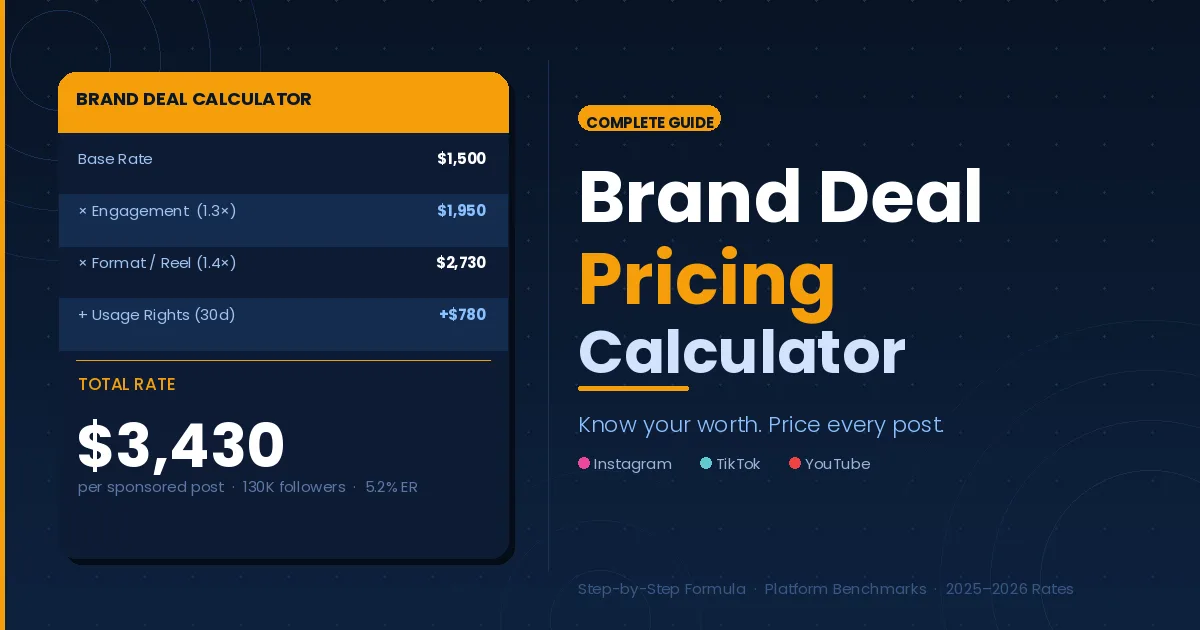
Total Rate = (Base Rate × Engagement Multiplier × Format Multiplier) + Deliverable Fees + (Usage Rights Fee × Months) + Exclusivity Fee
Brand Deal Rates by Platform and Creator Tier
Industry benchmarks help you sense-check your formula output. These figures are based on publicly available creator economy research, agency rate cards, and firsthand data reported by creators.
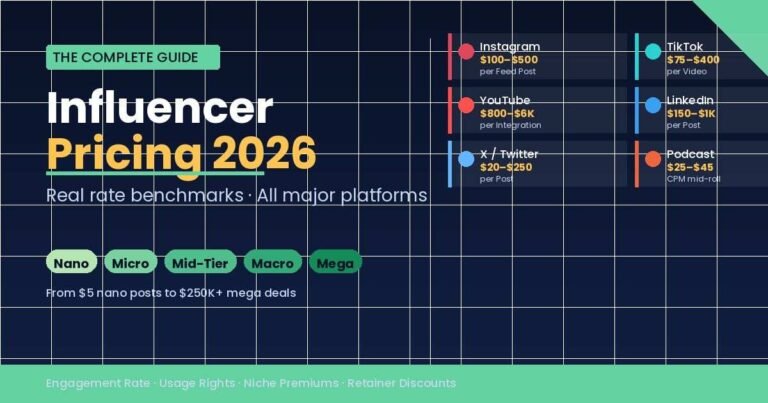
Instagram Rates (2025–2026)
| Tier | Followers | Avg. Rate per Post | Avg. Rate per Reel |
|---|---|---|---|
| Nano | 1K–10K | $50–$200 | $100–$400 |
| Micro | 10K–100K | $200–$1,500 | $400–$3,000 |
| Mid-Tier | 100K–500K | $1,500–$5,000 | $3,000–$10,000 |
| Macro | 500K–1M | $5,000–$15,000 | $10,000–$30,000 |
| Mega / Celebrity | 1M+ | $15,000–$100,000+ | $30,000–$200,000+ |
YouTube Rates (Sponsored Integration, 2025–2026)
| Channel Size (Subs) | Avg. Views Per Video | Rate Range (60s Integration) |
|---|---|---|
| Under 50K | Under 10K avg | $300–$1,000 |
| 50K–250K | 10K–50K avg | $1,000–$5,000 |
| 250K–1M | 50K–200K avg | $5,000–$20,000 |
| 1M–5M | 200K–1M avg | $20,000–$75,000 |
| 5M+ | 1M+ avg | $75,000–$500,000+ |
TikTok Rates (2025–2026)
TikTok pricing is uniquely tied to view performance, not follower count, because organic reach varies so dramatically.
| Creator Tier | Avg. Views per Video | Typical Rate |
|---|---|---|
| Micro (10K–100K followers) | 5K–30K | $150–$800 |
| Mid (100K–500K) | 30K–200K | $800–$4,000 |
| Macro (500K–2M) | 200K–1M | $4,000–$20,000 |
| Top Creator (2M+) | 1M+ | $20,000–$150,000+ |
Niche premium matters here. Finance, software, and B2B tech brands pay 2–3× the standard rate in any tier because their customer lifetime value is high. Beauty and fashion brands typically pay at or below standard because competition for those placements is intense.
Extra Fees That Most Creators Forget to Charge
The base rate and platform multipliers are well-documented. These five line items are where seasoned creator economy professionals consistently outperform beginners in deal value.
1. Concept and Creative Development Fee
If the brand sends you a script or detailed creative brief and expects you to execute their vision exactly, you’re a production house. That’s fine, but factor in less creative time.
If the brand says “here’s our product, you decide how to integrate it,” you’re doing strategy, copywriting, and production. Charge $200–$1,000 for this creative development work on top of the post rate. Few creators do. Brands expect it once you’re established.
2. Raw File and Footage Delivery
Some brands ask for raw footage, separate audio files, or unedited photos alongside the final deliverable. This adds export time, storage management, and IP transfer. Charge $100–$500 per deliverable asset package unless it was in the original scope.
3. First Comment Engagement
Pinning a brand comment and engaging in replies for 24–48 hours post-publish is legitimate promotional labor. Some talent agencies now itemize this as $50–$200 depending on audience size.
4. Performance Guarantee Clauses
Occasionally a brand contract includes a performance clause — “if the post doesn’t hit X views, you owe us a free repost.” Treat these clauses like an insurance premium. Add 20–30% to the deal to cover this risk or remove the clause entirely.
5. International Usage
If a brand wants to use your content in markets outside your home country, that’s a separate rights category. A straightforward multiplier: add 15–25% per additional major market (US, EU, APAC each counted separately).
The Biggest Brand Deal Pricing Mistakes Creators Make
Mistake 1: Quoting Based on Follower Count Alone
The most common error. In 2026, brands have become sophisticated enough to ignore follower count as a standalone metric. If you price based only on followers and ignore engagement, niche authority, and audience demographics, you’re operating on 2018 logic.
Fix it: Always lead with your average engagement rate and audience breakdown (age, gender, location, income if available) when pitching rates. It reframes the conversation from “reach” to “influence.”
Mistake 2: Forgetting the Tax Math
Brand deal income is typically gross pay, not net. Self-employment taxes, income taxes, and business expenses can consume 30–40% of a flat-rate deal.
When a brand offers you $5,000 for a video, think in terms of the $3,000–$3,500 you’ll actually keep. Build your pricing floor with this in mind, not the headline number.
Mistake 3: Accepting the First Offer Without Counter-Offering
Most brand initial offers are test quotes — deliberately low to see if the creator pushes back. In the creator economy, failing to counter-offer once is leaving money on the table. Industry professionals consistently report that a simple, professional counter of 1.3–2× the initial offer is accepted 40–60% of the time.
Fix it: Respond with a counter, a breakdown of your pricing logic, and an optional scope reduction (fewer deliverables) to match their budget if they push back.
Mistake 4: Skipping the Usage Rights Conversation
This is the most expensive mistake financially. A creator charges $1,500 for an Instagram post. The brand repurposes that content into a six-month paid Facebook and Google ad campaign generating $200,000 in revenue. The creator was paid a flat $1,500 with no usage rights fee because the contract didn’t address it.
Usage rights should be addressed in every contract, every time, regardless of deal size.
Mistake 5: Undervaluing Long-Form Content
YouTube creators routinely underprice their integrations because their follower counts look smaller than equivalent Instagram accounts. But 50,000 engaged YouTube subscribers with 40,000 average views produce significantly more purchase intent per dollar spent than 300,000 Instagram followers with 1,500 average Story views.
Anchor YouTube pricing to average view count and watch time, not subscribers.
Mistake 6: Not Accounting for Audience Quality
A 200K-follower account where 60% of the audience is US-based, age 25–44, with household income over $80K is worth 3–4× a 200K account with a similar engagement rate but fragmented international demographics. Brands know this. If you have a premium audience, document it and price it accordingly using your platform analytics.
FAQ: Brand Deal Pricing
How much should I charge for my first brand deal?
For a first deal, a reasonable starting point is $100 per 10,000 followers for a static post, adjusted for your engagement rate. Don’t undercut yourself to “get experience” — it sets a low anchor with that brand. Start at your calculated rate, be willing to negotiate, and always get it in writing.
What is a fair rate for a TikTok brand deal?
TikTok rates in 2026 average $250–$800 per video for micro-creators (10K–100K followers) and $2,000–$10,000 for mid-tier creators with 100K–500K followers. Rates vary heavily by niche — finance and software TikTok creators often command 2–3× standard lifestyle rates.
Do I charge more for Instagram Reels than static posts?
Yes. Reels require significantly more production time — scripting, filming, editing, captioning, music clearance. Industry standard is to charge 30–50% more for Reels than for a comparable static post. Some creators charge 2× for high-production Reels.
What is whitelisting and how much should I charge for it?
Whitelisting lets a brand run paid ads directly from your social handle, using your audience targeting. Because this gives the brand access to your account handle and bypasses your organic audience, it commands a premium — typically 30–60% of your standard post rate per month. Always set a firm end date in the contract.
Should I charge more for exclusive brand deals?
Exclusivity fees are non-negotiable for any deal longer than 30 days. A brand asking you not to work with competitors limits your income potential directly. Standard exclusivity fees range from 15% (30 days) to 50%+ (90 days) added to the total deal value.
What’s the difference between a flat-rate deal and a performance-based deal?
A flat-rate deal pays you a fixed amount regardless of results. A performance-based deal ties some or all payment to metrics like views, clicks, or conversions. Flat rates are preferable for most creators — they protect your income from algorithm volatility. Performance-based deals can pay more, but only accept them if you have strong, consistent conversion data to back you up.
How do I know if a brand’s offer is too low?
Run it through your formula. If their offer is less than your calculated base rate, it’s too low. Other warning signs: they refuse to share the campaign brief before signing, they don’t discuss usage rights, or they offer “exposure” as partial compensation. Established brands expect professional rates — walking away from undervalue offers signals market credibility.
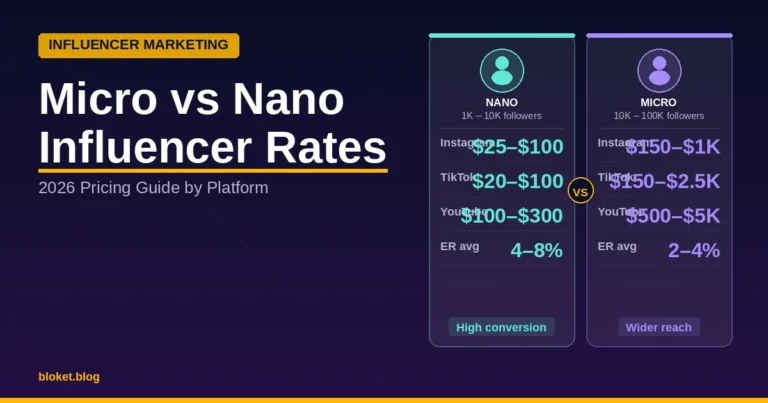
Can nano-influencers (under 10K followers) get paid brand deals?
Absolutely. Nano-influencers in specific niches — parenting, personal finance, hyper-local food, specific hobby communities — routinely command $50–$250 per post because their engagement and audience trust are high. Start building a media kit, tracking your analytics, and pitching to relevant brands even at 3,000–5,000 followers if your engagement is strong.
Conclusion
Brand deal pricing is a skill, not a guess. The formula is straightforward: anchor to a base rate, multiply for engagement and platform, itemize every deliverable, and protect yourself with usage rights and exclusivity fees.
Your immediate action step: Calculate your base rate right now using Step 1 and Step 2 from this guide. Run it against one past deal and see how close (or far) you were. Most creators discover they’ve been leaving 30–60% on the table.
From that number, build a one-page rate sheet you can send to any inbound brand inquiry within 60 seconds. Include your standard package, your à la carte add-ons, and a clear line item for usage rights. That single document will make more of a difference in your brand deal income than any negotiation tactic.
Price with data. Negotiate with confidence. Put everything in writing.
Need a spark? Our thought-provoking articles are packed with insights and tips you can act on right now.