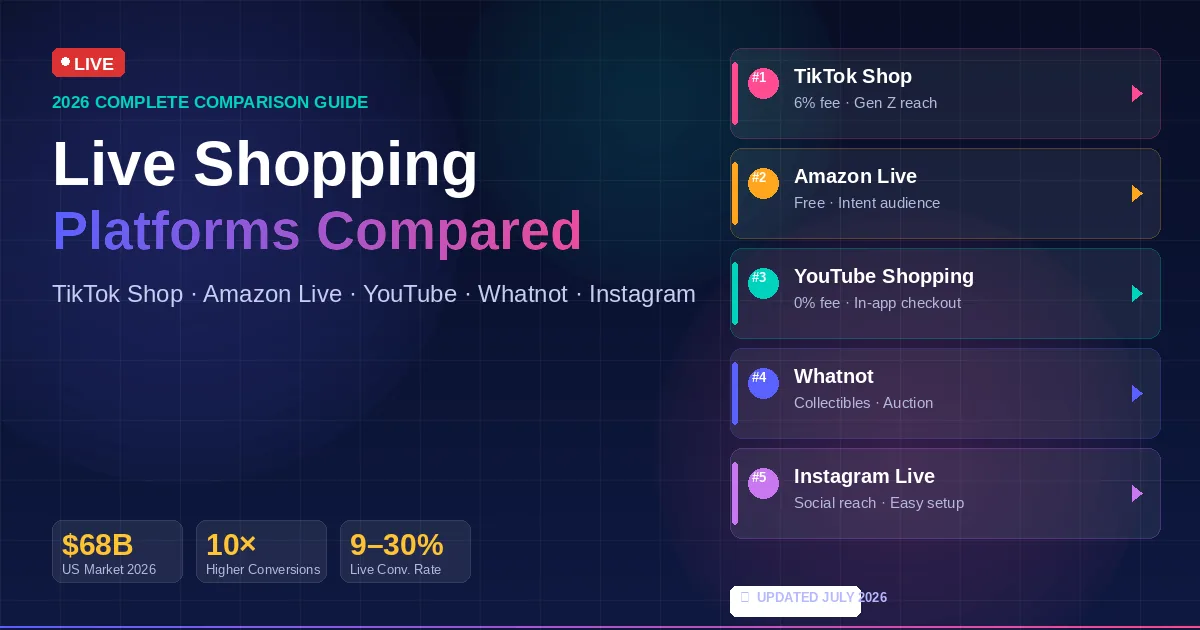
Live shopping converts at 9–30%, compared to 2–3% for a standard product page. That single statistic explains why every major platform — from TikTok to YouTube to Amazon — is now racing to own the live commerce space.
But not every platform is right for every seller. TikTok Shop rewards entertainment and impulse buying. Amazon Live suits established sellers who already live inside that ecosystem. Whatnot is built for collectors and resellers who thrive in auction energy. YouTube Shopping is maturing fast, with in-app checkout rolling out in 2026.
This guide cuts through the noise. You’ll get a side-by-side comparison of every major live shopping platform, real fee breakdowns, honest trade-offs, and a decision framework to help you choose correctly — the first time.
What Is Live Shopping and Why Does It Convert So Much Better Than Static Pages?
Live shopping is real-time video commerce: a host demonstrates a product, viewers ask questions in chat, and purchase without leaving the stream. It converts 5–10x better than traditional e-commerce because it collapses the three biggest friction points — doubt, distraction, and delay — into a single, urgent moment.
The format isn’t new. It’s QVC for the internet generation, but with bidirectional chat, instant checkout, and an algorithm that can surface your stream to millions of strangers in seconds.
The numbers now justify the hype. <cite index=”3-1″>China’s live commerce market crossed $1 trillion in 2025. The US market is projected to hit $68 billion in 2026.</cite> And <cite index=”5-1″>US livestream e-commerce sales grew nearly 50% in 2025 to reach $14.6 billion</cite> — momentum that was unimaginable just three years ago.
What drives those conversion rates? Three mechanics working together:
Social proof in real time. When other viewers are asking “does this come in XL?” or “I just ordered two,” hesitation collapses. Scarcity and peer behavior do more work than any banner ad.
Demonstration over description. A 90-second live demo answers questions a product description can’t. Texture, scale, real-world use — a live stream shows all of it simultaneously.
The FOMO loop. Flash discounts, countdown timers, and limited quantities create purchase pressure that a static cart never can. <cite index=”3-1″>Live commerce converts at 9–30%, compared to 2–3% for traditional e-commerce — up to a 10x difference.</cite>
Which Live Shopping Platforms Lead the Market in 2026?
The major platforms split into three clear categories: social platforms with built-in live commerce (TikTok Shop, Instagram, YouTube), marketplace-native solutions (Amazon Live, Whatnot), and white-label B2B tools (Bambuser, Channelize, CommentSold) that let brands host streams on their own sites.
Choosing between them is less about features and more about where your audience already is — and how much of your customer relationship you’re willing to hand over to a third-party platform.
<cite index=”4-1″>Many brands still run live shopping exclusively on TikTok, Instagram, or Amazon. These channels offer reach — but they come with serious limitations.</cite> Specifically: zero access to first-party customer data, total dependency on the platform’s algorithm, and the constant risk that a policy change or ban wipes out your entire audience overnight.
<cite index=”4-1″>This shift from rented social audiences to owned commerce infrastructure is one of the defining e-commerce trends of 2026.</cite>
TikTok Shop, Amazon Live, YouTube Shopping, and Whatnot: Full Platform Breakdown
Here’s a detailed look at each major platform — what it does best, who it’s for, what it costs, and where it falls short.
TikTok Shop
TikTok Shop is the fastest-growing live commerce platform in Western markets. <cite index=”9-1″>TikTok Shop enables brands and creators to sell products directly through live streams and in-feed videos on TikTok. Given TikTok’s massive reach among young consumers, it’s a goldmine for product discovery and impulse buys.</cite>
<cite index=”9-1″>Nearly half of TikTok’s users (48.9%) have made purchases via TikTok Shop</cite>, and the platform’s affiliate ecosystem — where creators promote your products for a share of each sale — is unlike anything else on the market. One viral video can drive thousands of orders in 24 hours.
Fees: <cite index=”24-1″>TikTok Shop charges sellers a 6% referral fee on most categories in 2026, plus a 1.02%–3.78% payment processing fee — bringing the true marketplace take-rate to approximately 7.02% before fulfillment and creator commissions.</cite> That headline number is deceptive, though. <cite index=”24-1″>Creator commissions add 10–30% variable cost depending on category (beauty 15–30%, fashion 10–15%, home 12–18%, tech 5–10%).</cite> Sellers who rely heavily on affiliates can see their true cost of sale reach 35–55% of revenue.
Best for: Brands targeting Gen Z and millennials, products that lend themselves to entertainment-first content (beauty, fashion, gadgets, food), and sellers willing to invest in creator partnerships.
Watch out for: Algorithm dependency, limited access to buyer data, and the operational challenge of managing sudden viral inventory spikes.
Amazon Live
Amazon Live is live commerce inside the world’s largest shopping intent engine. Sellers broadcast directly within Amazon’s ecosystem — product tags are tied to existing ASINs, and any Amazon shopper browsing that category can stumble onto your stream without following you first.
<cite index=”5-1″>Your live stream can attract any Amazon shopper browsing your category, not just your followers. It’s especially powerful for showcasing product features or answering FAQs live, which can then live on as a video FAQ on your listing.</cite>
The trade-off is total ecosystem lock-in. <cite index=”5-1″>The trade-off is you’re limited to Amazon’s ecosystem — you won’t get viewer emails or detailed analytics like on your own site.</cite>
Fees: Amazon Live itself is free for registered sellers and influencers. Your cost comes from Amazon’s existing seller fees (8–15% referral fee depending on category) plus your normal fulfillment costs. There’s no separate live streaming charge.
Best for: Established Amazon sellers who want to increase product visibility and conversion on existing listings, and influencers in the Amazon affiliate program looking to monetize streams.
Watch out for: No content portability, no customer email capture, and no cross-platform replay. What happens on Amazon, stays on Amazon.
YouTube Shopping
YouTube Shopping is the platform’s biggest commerce bet — and it’s maturing significantly in 2026. <cite index=”3-1″>YouTube is rolling out in-app checkout throughout 2026. It started with select creators and Shopify-connected stores. The feature lets viewers complete a purchase without leaving YouTube, which removes the biggest friction point in YouTube live shopping today (being redirected to an external site).</cite>
<cite index=”3-1″>AI-powered product tagging: YouTube automatically identifies products mentioned in voiceovers and shown in visuals, then links them to product listings. Sellers don’t need to manually tag every item.</cite> Combined with Shopify integration and the YouTube Partner Program’s existing infrastructure, this makes the barrier to entry genuinely low for established creators.
Fees: YouTube doesn’t take a commission on product sales made through Shopping integrations — it earns through its ad platform instead. Your cost is the underlying e-commerce platform fee (Shopify, WooCommerce, etc.) plus standard payment processing.
Best for: Creators and brands with existing YouTube audiences who want to monetize that audience directly, and businesses whose products benefit from longer demonstration formats.
Watch out for: In-app checkout is still rolling out — not universal yet. Discovery for new sellers without existing subscriber bases is significantly harder than on TikTok.
Whatnot
Whatnot is purpose-built for live selling in collectible and enthusiast categories. <cite index=”20-1″>Whatnot is a live shopping platform where sellers host real-time video streams to auction products to viewers. Think QVC meets Twitch, but for collectibles and resale items.</cite>
<cite index=”8-1″>On Whatnot in Europe, the number of active sellers grew by 600% year over year, streaming more than 20,000 hours each week.</cite> The auction mechanic creates real competitive bidding dynamics that routinely push prices 20–60% above what the same item would fetch on a static listing.
Fees: <cite index=”19-1″>Whatnot charges an 8% seller commission plus a 2.9% + $0.30 payment processing fee on every sale in 2026.</cite> The effective rate lands around 11–12% on most sales. There are no listing fees, monthly subscriptions, or insertion fees. <cite index=”18-1″>Top-performing sellers who qualify for the Premier Shop program receive a 10% commission reduction (e.g., the standard 8% commission becomes 7.2%).</cite>
Best for: Resellers and small business owners in trading cards, collectibles, vintage clothing, sneakers, comics, and sports memorabilia. Categories where auction energy and community drive bidding above market value.
Watch out for: Application-required seller approval, high time investment (live shows demand active hosting), and limited category diversity outside collector niches.
Instagram Live Shopping
<cite index=”7-1″>In 2026, Meta made improvements to its live shopping experiences, giving businesses a faster, simpler and more engaging way to turn livestreams into real-time sales. Brands can use live video ads on Instagram to help high-intent audiences who might not otherwise discover them.</cite>
Instagram works best for brands that have already built an organic following there and want to monetize existing audience relationships. The checkout experience is increasingly smooth, and product tagging within streams has improved.
Best for: Fashion, beauty, and lifestyle brands with strong Instagram audiences, particularly those running influencer-led campaigns.
Comparison Table: Live Shopping Platforms at a Glance
| Platform | Base Commission | Audience Ownership | Best Category | Audience Size | Entry Barrier |
|---|---|---|---|---|---|
| TikTok Shop | 6% + processing | ❌ Low | Beauty, Fashion, Gadgets | 150M+ US users | Low |
| Amazon Live | 0% (uses seller fees) | ❌ None | Any Amazon category | Massive (intent-based) | Medium |
| YouTube Shopping | 0% (ad-based) | ✅ Medium | Tutorials, Tech, Lifestyle | 2B+ global users | Medium |
| Whatnot | 8% + 2.9% + $0.30 | ✅ Medium | Collectibles, Resale | Niche, loyal | High (approval) |
| Instagram Live | 0%–5% | ❌ Low | Fashion, Beauty | 2B+ global users | Low |
| Bambuser / Channelize | SaaS fee ($) | ✅ Full | Any (own site) | Your own traffic | High (setup cost) |
How to Choose the Right Live Shopping Platform for Your Business
The answer depends on three variables: where your audience already is, how much you value customer data ownership, and your average order value.
Follow this decision tree:
- Do you sell collectibles, trading cards, or enthusiast goods? Start with Whatnot. The auction format and the built-in collector community will outperform every other platform in these categories.
- Are you an established Amazon seller? Add Amazon Live immediately — it costs nothing extra and boosts conversion on existing listings.
- Is your target audience under 35 and does your product photograph well in video? Test TikTok Shop. The discovery potential is unmatched, but model your full costs including creator commissions before committing to scale.
- Do you have a YouTube audience of 10,000+ subscribers? YouTube Shopping is now viable, especially as in-app checkout rolls out fully in 2026. Your audience is already warm.
- Is long-term customer ownership your priority? Invest in an on-site solution like Bambuser or Channelize. You’ll pay more upfront and drive your own traffic, but every buyer’s email address belongs to you.
<cite index=”4-1″>Brands seeking full control over their customer journey, first-party data, and long-term content ROI tend to choose on-site solutions such as Bambuser or Channelize. Brands focused on creator-driven reach lean toward TikTok Shop or CommentSold.</cite>
One approach that’s working well in 2026: use social platforms (TikTok, Instagram) for top-of-funnel discovery and impulse sales, then redirect high-value customers to an owned channel for repeat business. The live event generates the attention; the owned channel retains it.
Mistakes Brands Make When Starting Live Shopping
Most live selling failures aren’t about the product. They’re about setup, expectations, and platform mismatch.
Treating every platform the same. TikTok rewards entertainment first. Amazon rewards clarity and authority. YouTube rewards depth. A script that works brilliantly on TikTok will feel tedious on Amazon Live, and vice versa. Each platform has its own content grammar — study it before you go live.
Underestimating the real fee stack on TikTok Shop. The 6% referral fee is the beginning, not the end. <cite index=”25-1″>When you add transaction fees, shipping costs, affiliate commissions (5–20%), Shop Ads spend (15–25% of revenue), content production, returns, and chargebacks, the total cost of selling on TikTok Shop runs 35–55% of revenue depending on category and scale.</cite> Build a full P&L model before you price your products.
Going live without a show structure. The highest-converting live shopping streams are planned like TV segments: an opening hook, a product demonstration sequence, a limited-time offer, and a clear call to action. Improvising for 45 minutes is not a show — it’s footage.
Ignoring replay value. <cite index=”4-1″>The strongest platforms support both live events and evergreen shoppable videos. Evergreen videos continue generating revenue long after the live session ends — turning a one-time broadcast into a permanent sales asset.</cite> Film your streams knowing the replay will run indefinitely.
Starting on the wrong platform for your category. I’ve seen fashion brands launch on Whatnot (which has a collector-specific audience) and collectibles sellers start on YouTube (where the audience isn’t primed to bid). Platform-category fit matters as much as production quality.
Not stocking for a viral moment. On TikTok Shop especially, <cite index=”28-1″>a single creator video can generate thousands of orders overnight. This is both the opportunity and the risk. You need sufficient inventory and fulfillment capacity to handle viral spikes, or you’ll face cancellations that hurt your seller rating.</cite>
Frequently Asked Questions
What is the best live shopping platform for small businesses in 2026? For most small businesses, TikTok Shop offers the lowest barrier to entry and the strongest organic discovery. You need no existing audience to start generating sales — the algorithm can surface your stream to relevant buyers. However, small sellers with collector-category inventory will find Whatnot’s auction format and built-in community more profitable from day one.
How much commission does TikTok Shop take from sellers? TikTok Shop charges a 6% referral fee on most US product categories in 2026, plus roughly 1–2.5% in payment processing fees. The effective platform take-rate lands around 7–8.5% on a pure sale. When you add creator affiliate commissions (typically 10–20%) and Shop Ads spending, your total cost of sale frequently reaches 25–40% of revenue.
Do I need a large following to start live shopping? No. TikTok Shop and Amazon Live can surface your streams to new audiences based on category and content relevance — you don’t need followers to start. Whatnot also provides an existing buyer pool to new approved sellers. YouTube Shopping, by contrast, delivers significantly better results for sellers with an established subscriber base.
Is live shopping profitable for brands with high average order values? Yes — but the right platform matters. For luxury goods and high-ticket products, one-to-one video consultation platforms like Immerss report conversion rates of 40–70%, versus 5–15% for broadcast platforms. For AOVs above $500, the consultation model typically outperforms mass-audience live streaming by a wide margin.
What products sell best in live shopping streams? <cite index=”3-1″>Beauty, fashion, electronics, jewelry, and home goods consistently perform best.</cite> More broadly, the format rewards products that benefit from demonstration — anything where seeing it in use resolves buying hesitation. Static, low-differentiation commodities perform poorly; tactile, visual, or complex products perform exceptionally well.
Can I sell on multiple live shopping platforms simultaneously? Yes — and most serious sellers do. Cross-streaming tools like CommentSold allow simultaneous broadcasts to Facebook, Instagram, and TikTok. The risk is inventory management: selling the same item on two platforms at once without real-time sync leads to overselling and cancellations. Tools like cross-listing software with automatic inventory sync solve this.
How is live shopping different from shoppable video? <cite index=”7-1″>Live shopping has three elements: it takes place in video format, happens in real time, and links to products near the video screen.</cite> Shoppable video, by contrast, uses pre-recorded content that remains active and interactive indefinitely. Live shopping drives urgency and interaction; shoppable video drives passive, evergreen discovery. The most effective 2026 strategy combines both.
What is the live shopping market size in 2026? <cite index=”2-1″>The US has become the second-largest live commerce market behind China, accelerated by the launch of TikTok Shop and Amazon Live’s expansion. Coresight Research has projected the US live commerce market at around $68 billion by 2026.</cite> Globally, live commerce is on track to exceed $1 trillion, driven primarily by China’s Douyin and Taobao Live ecosystems.
Conclusion
Live shopping is not a trend that peaked — it’s a sales channel that’s still in early innings for Western markets. The US sits where China was in 2018: rapid adoption, platform consolidation, and massive first-mover advantages for brands that commit now.
The platform decision comes down to this: rent an audience or build one. TikTok Shop, Amazon Live, and Instagram offer speed and reach with no setup cost — but the customer relationship belongs to the platform. On-site solutions and YouTube give you more ownership, but demand more investment upfront.
For most brands in 2026, the winning answer is both. Use TikTok Shop or Instagram Live to generate discovery and trial. Feed converted customers into an owned channel — your email list, your website’s shoppable video, your Whatnot community — where the relationship compounds over time.
Your action step: Pick one platform from this guide that matches your category and audience. Run four live sessions in 30 days. Track conversion rate, average order value, and repeat purchase rate. Those three numbers will tell you more than any market report about whether live commerce belongs in your growth strategy.
Never fall behind—our most recommended content keeps you plugged into the latest trends.