Two platforms. Both decentralized. Both ad-free. Both marketed as the ethical escape from algorithmic social media. Yet Bluesky and Mastodon couldn’t be more different where it counts — audience size, discoverability, and how fast you can actually grow.
If you’re a creator deciding where to plant your flag in 2026, the answer isn’t “try both.” That’s a path to two underfed accounts and no results. This guide breaks down every dimension that matters for audience-building: architecture, reach, content tools, monetization options, and community culture — backed by current data and real creator experience.
By the end, you’ll know exactly which platform fits your goals.
What Are Bluesky and Mastodon — and Why Does the Difference Matter?
Bluesky is a centralized app built on a decentralized protocol. Mastodon is a decentralized network made of thousands of independent servers. For creators, that single architectural difference shapes everything else — from how new followers find you to whether you lose your account history if a server shuts down.
Bluesky launched publicly in February 2024 after spending two years in invite-only beta. It runs on the AT Protocol (Authenticated Transfer Protocol) — an open standard developed by a team spun out of Twitter, originally backed by Jack Dorsey. One account, one login, the entire network connected.
Mastodon arrived a decade earlier in 2016, created by German developer Eugen Rochko. It runs on ActivityPub, a W3C standard that also powers PeerTube (video), Pixelfed (photos), and Lemmy (Reddit-like forums) — the broader network known as the Fediverse. When you join Mastodon, you don’t just join a platform. You join a specific instance, or server: mastodon.social, fosstodon.org, techhub.social, and thousands of others. Each instance has its own rules, moderation policies, and culture.
Here’s why this matters practically: on Mastodon, your identity lives on your instance. If that server closes, you can migrate your followers, but your post history doesn’t always travel with you. On Bluesky, your account is tied to a portable identity (your domain, if you choose) that isn’t locked to any single server.
For a creator who’s spent years building content, that’s not a minor detail.
How Big Are These Platforms — and Who’s Actually There?
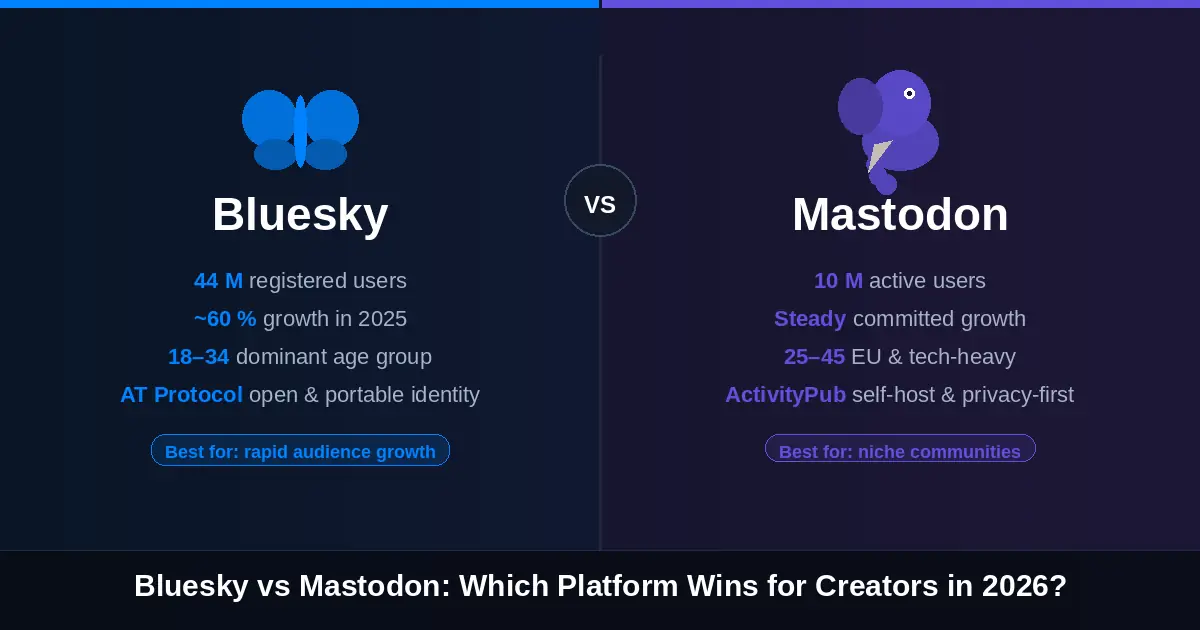
Bluesky has roughly 44 million registered users as of mid-2026, with around 4.5 million logging in daily. Mastodon’s active user base sits near 10 million across all instances combined. The gap in raw numbers matters less than what each community looks like — and whether your audience actually lives there.
Bluesky by the numbers
Bluesky grew nearly 60% in 2025 alone, adding approximately 15.5 million users to reach 41.4 million by year-end, a pace confirmed by the platform’s own transparency report. Average session time runs over 10 minutes, and users browse around 5.4 pages per visit — engagement metrics that compare well against established social platforms.
The demographic skew is telling: 35% of Bluesky users fall in the 18–24 age bracket, and over 62% are under 35. The audience leans US-heavy (around 50% of web traffic), followed by Japan, the UK, Germany, and Brazil, which surged after X was banned there in 2024. The Boston Globe reported 3x more referral traffic from Bluesky than Threads, with 4.5x higher paid subscription conversion rates — a signal that this audience doesn’t just browse, it buys.
Mastodon by the numbers
Mastodon’s total registered accounts number in the millions, but active users across all instances combined hover around 10 million as of late 2025. Growth has been steady but not explosive. Its open-source repository has over 50,000 GitHub stars — indicating serious developer loyalty — but mainstream adoption has been limited by its onboarding complexity.
The Mastodon audience skews older, more technical, and more European (partly because GDPR-aligned data practices appeal to EU users). You’ll find a high concentration of open-source developers, academics, privacy advocates, journalists from European outlets, and people who are genuinely philosophically committed to decentralization. Self-promotion is culturally tolerated less here than on any other platform.
What this means for creators
| Metric | Bluesky | Mastodon |
|---|---|---|
| Registered users (mid-2026) | ~44 million | ~10 million active |
| Daily active users | ~4.5 million | ~1 million (est.) |
| Avg. session length | 10+ minutes | Not publicly reported |
| Primary demographics | 18–34, US/Japan/Brazil | 25–45, EU/tech/academic |
| Growth rate (2025) | ~60% YoY | Slow and fragmented |
| Discovery method | Custom algorithmic feeds | Local timeline + hashtags |
| Primary audience culture | Twitter-like, tolerates promo | Values-driven, skeptical of marketing |
How Do Creators Actually Build an Audience on Each Platform?
Bluesky’s discovery engine centers on 50,000+ user-created custom feeds. Mastodon’s discovery relies on hashtags and federated timelines. The practical difference: on Bluesky, one well-curated feed can drive hundreds of new followers in a week. On Mastodon, growth comes from consistent, community-first posting over months.
Audience growth on Bluesky
Bluesky’s biggest creator advantage is its Starter Packs feature. A Starter Pack is a curated list of accounts around a topic — “Indie game developers,” “Science journalists,” “UX designers” — that new users can follow with one tap during onboarding. Appearing in a popular Starter Pack can add thousands of followers in days. If you’re trying to build an audience right now, getting into relevant Starter Packs is the single highest-leverage move on the platform.
Custom feeds work differently. Bluesky has over 50,000 community-built feeds that aggregate content by keyword, topic, or hashtag. When your posts match the criteria a feed tracks, you appear in front of everyone subscribed to that feed — not just your existing followers. In my testing, a single well-optimized post on a popular topic can reach 3–5x the impressions of my regular follower-only content.
Bluesky also offers a domain-handle verification system — you can set your handle to @yourwebsite.com, which instantly proves to followers you’re the real entity behind a brand. For journalists, authors, and companies, this is a credibility layer that Twitter’s verification chaos never cleanly offered.
Audience growth on Mastodon
On Mastodon, hashtags are the primary discovery tool. Unlike Bluesky or Twitter, where hashtags are supplementary, on Mastodon they’re the connective tissue between instances. A post about photography tagged #photography can surface on any instance that federates with yours — which is most of them.
The challenge is what the platform calls the federated timeline and local timeline. The local timeline shows everyone posting on your instance; the federated timeline shows posts from instances yours connects with. New users who join a small or quiet instance may feel like they’re shouting into an empty room. Choosing the right instance is genuinely important, and the initial friction it creates explains much of Mastodon’s slower growth.
The flip side: when you earn a following on Mastodon, it’s remarkably loyal. The culture rewards thoughtful, non-promotional content. Long-form posts (Mastodon supports up to 500 characters natively, with some instances allowing 5,000+) perform well. Replies get read. Conversations go deeper.
Content tools comparison
| Feature | Bluesky | Mastodon |
|---|---|---|
| Character limit | 300 | 500 (some instances: 5,000+) |
| Starter Packs / discovery | ✅ Yes | ❌ No |
| Custom algorithmic feeds | ✅ 50,000+ available | ❌ No |
| Hashtag discovery | ✅ Basic | ✅ Primary |
| Video support | ✅ Up to 3 min | ✅ Varies by instance |
| Alt text / accessibility | ✅ | ✅ |
| Polls | ❌ | ✅ |
| Post scheduling (native) | ❌ | ❌ |
| Content warnings / spoilers | Limited | ✅ Built-in |
| Custom domain handle | ✅ | Via instance setup |
| DMs | ✅ | ✅ |
Monetization: Can You Actually Earn on Either Platform?
Neither Bluesky nor Mastodon offers native creator monetization in 2026 — no ad revenue sharing, no tipping, no built-in subscriptions. Monetization happens externally, by converting engaged followers into Substack subscribers, Patreon members, or consulting clients.
This is a key reality creators need to understand before investing in either platform. You’re not building a YouTube channel where watch hours translate into checks. You’re building an audience that you then direct to your paid channels.
Bluesky’s monetization landscape
Bluesky has announced Bluesky+, a paid subscription tier offering premium features: higher-quality video uploads, custom app icons, and profile customizations. Critically, it won’t give paying users any algorithmic advantage — the platform has committed publicly to keeping the feed fair. Full creator monetization tools are at least 12 months away from launch, per Bluesky’s product team.
In practice, creators are earning through indirect methods. Those in high-value niches (finance, tech, marketing) report strong conversions from Bluesky audiences to paid newsletters. The platform’s link-friendly culture — unlike Instagram, which effectively buries links — means click-through rates to external offers are comparatively high. Creators with 5,000+ engaged followers are landing brand partnerships, particularly from B2B SaaS companies targeting tech-adjacent audiences.
Bluesky raised a $100 million Series B in 2025 at a $700 million valuation. That funding runway means platform stability is not a near-term concern.
Mastodon’s monetization landscape
Mastodon is a non-profit maintained largely by its founding team and instance operators. Individual instance operators often rely on Patreon or Open Collective for server costs. There is no centralized monetization pathway, and the culture is actively skeptical of it.
That said, Mastodon’s audience — dense with academics, developers, and specialists — is ideal for selling high-ticket B2B services, consulting, or niche educational content. Creators who treat Mastodon as a networking platform rather than a follower-count platform often report it performing like a LinkedIn replacement: fewer people, deeper relationships, better clients.
Common Mistakes Creators Make Choosing Between These Platforms
The biggest mistake isn’t choosing the wrong platform — it’s treating either platform the way you’d treat Instagram or X. Both communities reject broadcast-mode posting, and both punish creators who show up only to promote without contributing.
Mistake 1: Cross-posting identical content
Bluesky and Mastodon have fundamentally different cultures. What performs on Bluesky — quick, conversational takes, threading, light self-promotion — often lands poorly on Mastodon, where the community favors considered posts, content warnings, and explicit anti-commercial signaling. Adapting content takes five extra minutes. Ignoring culture costs you followers for months.
Mistake 2: Picking Mastodon’s wrong instance
This is the single most under-discussed problem for Mastodon newcomers. Joining a generic, low-activity instance, or one that defederates heavily, cuts you off from large portions of the network. Research active instances in your niche before signing up. Fosstodon.org is strong for developers; social.coop suits progressive communities; mastodon.online works as a general starting point with solid federation.
Mistake 3: Expecting Bluesky’s numbers to mean anything yet
Bluesky’s follower counts are still relatively deflated across the board. Only 0.3% of Bluesky accounts have crossed 1,000 followers, and just 0.01% have passed 10,000. That sounds discouraging — but it means the growth ceiling is still wide open. Creators who showed up in 2012-era Twitter built audiences that still pay dividends today. The opportunity window is right now, before the platform gets crowded.
Mistake 4: Ignoring Mastodon’s content warning norms
Mastodon has a built-in content warning (CW) system — a subject line that hides post content behind a click. The community uses it for: political content, food photos, long posts, mental health topics, and anything that might be intense without warning. Ignoring this norm when posting in those categories signals you haven’t read the room. Using it correctly signals that you have.
Myth: “Mastodon is dying”
It isn’t. Mastodon’s growth is slower than Bluesky’s, but its committed user base hasn’t shrunk. For creators in the right niches — open source, academia, European journalism, privacy tech — Mastodon’s audience is hard to reach anywhere else.
Frequently Asked Questions
Is Bluesky better than Mastodon for growing an audience?
For most creators in 2026, Bluesky offers faster audience growth. Its Starter Packs, custom feeds, and Twitter-like onboarding remove the friction that slows Mastodon adoption. If your goal is reaching a broad, growing audience quickly, Bluesky has the structural advantage. Mastodon excels in niche communities where depth beats scale.
Can you use Bluesky and Mastodon at the same time?
Yes, and many creators do. The platforms serve different functions. Bluesky works as your primary growth channel; Mastodon works as a community hub for your most technically or ideologically engaged audience. Use a scheduling tool like SocialBee, SocialMate, or Buffer to post adapted versions of content to both without doubling your workload.
Does Mastodon talk to Bluesky? Are they connected?
No — not natively. Mastodon uses ActivityPub; Bluesky uses AT Protocol. They’re separate, incompatible networks. Some bridge tools are in development (Ditto and similar projects are experimenting with cross-protocol federation), but there’s no stable, out-of-the-box way to follow a Mastodon account from Bluesky or vice versa in 2026.
Which platform is better for journalists and writers?
Both attract media professionals, but in different ways. Mastodon has a strong base of European and investigative journalists who value its freedom from algorithmic pressure. Bluesky has become the go-to for US-based media people and newsletter writers — the Boston Globe’s 4.5x higher paid subscription conversion rate from Bluesky versus Threads tells you where the buyers are.
Is Bluesky really decentralized, or is it controlled by one company?
This is a fair and commonly debated point. The AT Protocol is genuinely open and decentralized. But Bluesky the app is still largely operated by Bluesky Social PBC, the company behind it. Anyone can build an AT Protocol app, and some do (Graysky, Skyfeed, others), but most people use the official Bluesky client. True decentralization is the goal, not quite the current reality — a distinction Mastodon veterans are right to point out.
What happened to Bluesky’s CEO in 2026?
Jay Graber stepped down as CEO in March 2026 to become Chief Innovation Officer, focusing on AT Protocol development. Toni Schneider, former CEO of Automattic (the company behind WordPress.com), was named interim CEO while the board runs a permanent search. The $100M Series B and $700M valuation make the company financially stable regardless of leadership transition.
Which platform is better for privacy-conscious creators?
Mastodon. Full stop. It’s open-source, you can self-host your own instance, and there’s no central company collecting your engagement data. Bluesky posts are public by default and stored on servers operated by Bluesky Social PBC. Both are more privacy-respectful than Meta or X, but Mastodon gives technically capable users genuine data sovereignty.
Do either platform have ads?
Neither platform runs ads as of mid-2026. Both are explicitly ad-free. Mastodon funds operations through instance-level donations and subscriptions. Bluesky is funded by venture capital ($23M raised across two rounds) with plans to generate revenue through Bluesky+ subscriptions and creator tools — but no advertising model announced.
Which Platform Should You Choose? The Honest Answer
Bluesky is the right first choice for most creators in 2026. The growth trajectory is steep, the audience is younger and growing fast, the tooling is intuitive, and the link-friendly culture makes it far easier to drive traffic to external monetization. If you grew up on Twitter and found your people there, Bluesky is where many of them have gone.
Mastodon is the right choice if your audience is specific and values-aligned in a way that matches the Fediverse’s culture: open-source development, European policy, academic research, privacy advocacy, or any field where your readers are actively hostile to algorithmic social media. In those niches, Mastodon’s smaller, more loyal audience can outperform Bluesky’s larger numbers.
The most practical strategy for most creators: lead with Bluesky, maintain a Mastodon presence, and use a scheduling tool to bridge both without double the effort.
What you shouldn’t do is ignore both and keep grinding on X, waiting for it to turn around. The window to establish an early presence on a growing platform doesn’t stay open forever. The creators building on Bluesky today are the ones with existing audiences two years from now.
Conclusion
Bluesky and Mastodon represent two genuinely different answers to the same question: what comes after centralized social media?
Bluesky answers with scale, familiarity, and rapid iteration — a platform that feels like Twitter’s best years but with data you actually control. Mastodon answers with philosophical rigor and community depth — a network built for people who would rather grow slowly in the right place than grow quickly in the wrong one.
For creators prioritizing audience growth in 2026, Bluesky is the stronger bet. For creators prioritizing community quality in a specific niche, Mastodon is the underrated choice.
The clearest action step: create your Bluesky account today at bsky.app. Set your handle to your custom domain, write a specific bio that names exactly who you serve, find three relevant Starter Packs to join, and commit to 30 days of consistent posting before drawing conclusions. If you’re in a technical or academic niche, also find the right Mastodon instance and treat it as your community hub.
Neither platform rewards passive presence. Both reward genuine contribution. Start there.
Real problems need real solutions—our expert tips are here to help you handle whatever comes your way.