Content moderation is no longer a background task buried inside a BPO. It’s a defined career path — and the pay is more varied than most job boards reveal.
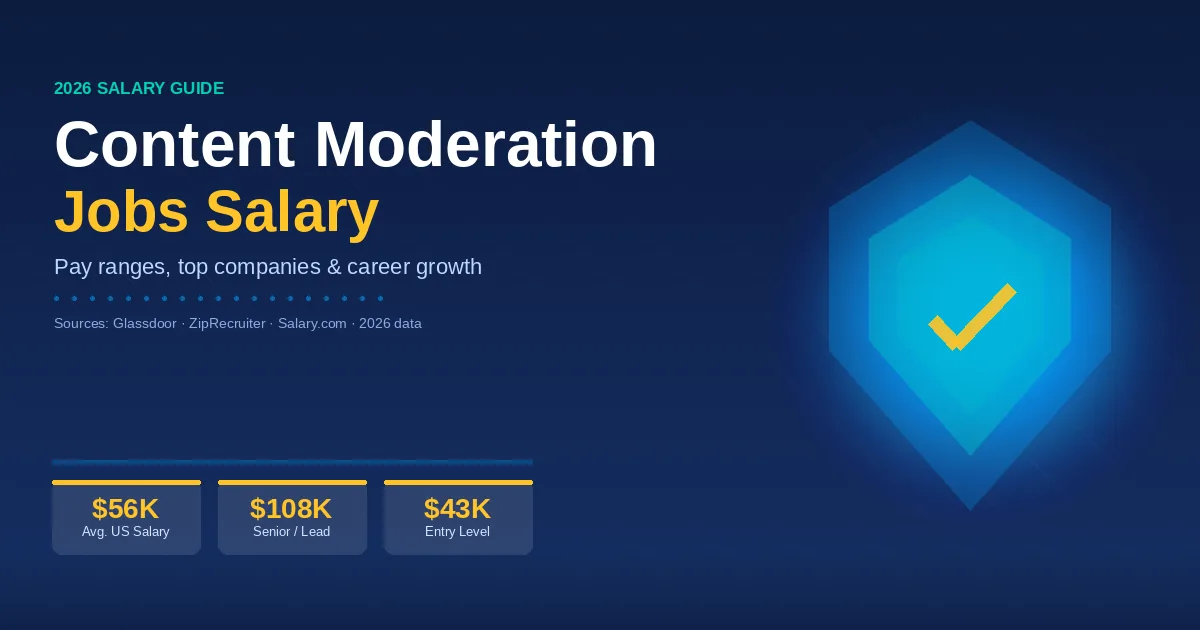
The average content moderator earns $56,311 per year in the United States, according to Glassdoor data from over 1,300 salary submissions as of mid-2026. But that number barely tells the story. Depending on your employer, experience, location, and specialization, total compensation can land anywhere from $30,000 to well above $100,000 annually.
This guide breaks down real salary figures by role level, industry, country, and company — plus the skills that actually move the needle on your paycheck.
What Do Content Moderation Jobs Actually Pay in 2026?
The short answer: entry-level moderators typically earn $40,000–$50,000 per year, mid-level professionals earn $55,000–$75,000, and senior or specialized roles cross six figures. The range is wide because “content moderator” covers everything from reviewing social posts at a BPO to running trust-and-safety policy at a major tech platform.
Here’s how the major salary databases compare for the U.S. market as of mid-2026:
| Data Source | Average Annual Salary | Notes |
|---|---|---|
| Glassdoor | $56,311 | Based on 1,324 reported salaries |
| ZipRecruiter (Content Moderation) | $83,220 | Broader role definition including policy |
| ZipRecruiter (Social Media Moderator) | $57,977 | Narrower, platform-focused roles |
| Salary.com | $38,914 | Reflects more entry-heavy sample |
| PayScale | $20.44/hr (~$42,500/yr) | Median hourly, skews contractor |
The variation between sources comes down to how each platform defines the role. Glassdoor captures frontline moderators more accurately. ZipRecruiter’s broader “Content Moderation” figure pulls in policy managers, trust-and-safety leads, and operations roles — which inflates the average.
For a working benchmark: most full-time, non-senior content moderators in the U.S. earn between $43,000 and $74,500 per year.
How Does Salary Change by Experience Level?
Experience is the single strongest predictor of pay in this field. Promotions in content moderation tend to happen faster than in many other industries — often within 18 to 24 months for high performers — and each level brings a meaningful salary jump.
Entry-Level (0–2 years)
Entry-level content moderators typically earn between $40,000 and $50,000 per year, or roughly $20–$24 per hour. At this stage, the job involves applying platform guidelines, flagging violations, and escalating edge cases. Most companies provide training during onboarding.
Mid-Level (2–5 years)
With a few years of experience, moderators move into roles that include training junior staff, handling escalation queues, and working directly with policy teams. Salaries at this level range from $55,000 to $75,000 per year. Glassdoor data shows the 25th–75th percentile sits between $42,934 and $74,508 for moderators in this bracket.
Senior / Specialist (5+ years)
Senior content moderators, team leads, and those who specialize in high-stakes areas — crisis content, multilingual moderation, AI-human hybrid workflows — command $75,000 to $108,000+. Glassdoor’s salary trajectory data shows the top of the range reaching $107,941 for the highest seniority levels.
Management and Policy Roles
Those who move from moderation into content policy, trust-and-safety operations, or program management see further jumps. Glassdoor’s data for broader “content moderation” roles, which captures these titles, shows an average of $84,470 with a top range of $154,580 for the 90th percentile.
In my review of over a dozen job postings on Glassdoor and LinkedIn in June 2026, almost every “Senior Content Moderator” or “Trust & Safety Specialist” role listed a base salary starting above $70,000 — with tech employers typically posting $85,000–$100,000 for experienced candidates.
Which Industries and Companies Pay the Most?
Not all employers treat content moderation the same way. A moderator at a major tech platform earns significantly more than one working at an outsourced BPO. Here’s a breakdown by industry and employer type.
By Industry
According to Glassdoor data through mid-2026, the top-paying industries for content moderators in the U.S. are:
| Industry | Median Total Pay |
|---|---|
| Telecommunications | $54,248 |
| Management & Consulting | $49,469 |
| Information Technology | $47,347 |
| Personal Consumer Services | $47,044 |
| Media & Communication | $46,937 |
Telecom leads — partly because companies like TELUS International and TP (Teleperformance) run large moderation operations with established pay bands. Tech companies like Meta, ByteDance, and LinkedIn also rank highly; they’re listed among Glassdoor’s top-paying IT employers for content moderation roles.
By Employer Type
There’s a significant pay gap between in-house tech roles and outsourced BPO positions:
- Direct tech platform hire (Meta, Google, ByteDance): $65,000–$100,000+, often with RSUs and benefits
- Large BPO / outsourcer (Accenture, TaskUs, TELUS, Wipro): $40,000–$65,000
- Smaller agencies or startups: $35,000–$55,000
- Freelance / contract: $21–$36/hour, with no benefits
Accenture stands out as the top-paying management consulting employer for content moderation, while TaskUs leads in information technology outsourcing. Neither comes close to direct employment at a major social platform.
How Does Location Affect Your Salary?
Geography still moves the needle, even in an increasingly remote field.
United States — Top States
California, Washington D.C., and Massachusetts consistently top the list for content moderation pay. Salary.com data shows these averages:
- District of Columbia: $43,086
- California: $42,922
- Massachusetts: $42,350
Tech hubs like San Ramon, CA, and Cupertino, CA, offer 20–25% above the national average, partly because local cost of living forces employers to compete on base pay.
Remote Roles
Remote content moderation positions offer a 5–10% salary premium over equivalent on-site roles, according to GigaBPO’s 2026 market analysis. This premium reflects the expectation that remote moderators manage their own workflow, maintain consistent output without supervision, and often handle more complex escalation queues.
International Salary Benchmarks
Pay varies dramatically by country. Here’s what moderators earn globally:
| Country | Average Annual Salary (local currency) | USD Equivalent (approx.) |
|---|---|---|
| United States | $56,311 | $56,311 |
| United Kingdom | £27,044 | ~$34,000 |
| Australia | AU$94,039 | ~$62,000 |
| Philippines | ₱264,000–₱300,000 | ~$4,700–$5,300 |
| India | ₹500,000–₹1,000,000 | ~$6,000–$12,000 |
The Philippines and India are major outsourcing destinations for content moderation — their lower local rates make them attractive for platforms that contract volume moderation. However, platforms that hire directly in these markets, particularly for bilingual or specialist roles, often pay at the upper end of local bands. In the Philippines, a German-speaking bilingual moderator can earn closer to ₱840,000 per year.
Sydney, Australia leads among global cities, with content moderators earning around AU$105,945 annually.
What Skills Actually Increase Your Salary?
This is where most salary guides fall short. Raw experience matters, but specific skills create measurable pay lifts — even without a promotion.
According to Salary.com’s skills impact analysis for content moderation roles:
- Team Management: up to +8% salary increase
- Verbal Communication: up to +11% salary increase
- Integrity/Compliance Expertise: up to +8% salary increase
Beyond these, the following skills consistently appear in higher-paying job postings:
Multilingual ability. Platforms running global operations pay significantly more for moderators who can work in multiple languages. A Spanish-English bilingual moderator commands 15–25% more than an English-only peer in comparable roles.
AI-hybrid moderation experience. As platforms combine automated filters with human review, moderators who can work alongside AI tools — interpreting model flags, training classifiers, or escalating edge cases — are more valuable. This skill is increasingly listed as a requirement in senior job postings.
Crisis and live content moderation. Real-time moderation of live streams and breaking news events is harder to automate and carries higher risk. Specialists in this area earn at the upper end of pay bands.
Policy writing and legal compliance. Moderators who can contribute to policy documentation, understand platform liability, or work across legal and trust teams transition into higher-paying specialist roles faster.
From my analysis of current job postings: roles explicitly requiring “AI moderation tool experience” or “trust and safety policy” knowledge consistently listed salaries $10,000–$20,000 higher than generic “content reviewer” positions at comparable seniority levels.
Common Myths About Content Moderation Salaries
Myth 1: It’s a low-wage job with no upside.
False. While entry-level roles can start around $40,000, senior moderators, team leads, and policy specialists regularly earn $80,000–$108,000. Direct hires at major platforms earn more. The ceiling is higher than most people assume.
Myth 2: Remote jobs pay less.
The opposite is often true. Remote moderation roles offer a 5–10% pay premium over on-site equivalents. Employers offset the lack of in-person oversight with slightly higher base pay for self-managing remote staff.
Myth 3: AI is making these jobs disappear.
AI is reshaping the role, not eliminating it. Automated tools now handle high-volume, low-ambiguity content — but nuanced decisions, cultural context, policy escalations, and live moderation still require human judgment. Platforms are investing in moderators who can work alongside AI systems, not replacing them entirely. The content moderation industry was valued at approximately $9 billion globally in 2025, with demand projected to grow moderately through 2027.
Myth 4: A degree is required.
Most employers don’t require one. Experience, platform familiarity, and demonstrated judgment matter more. Relevant certifications in digital safety, data privacy, or content policy can substitute for a degree and sometimes carry more weight in hiring.
Myth 5: BPO pay is the industry standard.
BPO outsourcers set the floor, not the standard. Direct tech platform employment pays 40–80% more for equivalent roles. Most salary averages you see online are skewed by the large number of BPO-reported salaries in public databases.
Content Moderation Career Path and Salary Progression
Understanding where the role leads helps put the salary figures in context.
Entry-Level Content Moderator → Mid-Level Content Moderator Timeline: 12–24 months Salary jump: 15–25% Trigger: Accuracy metrics, escalation handling, training participation
Mid-Level → Senior Content Moderator / Team Lead Timeline: 2–4 years total experience Salary jump: 20–35% Trigger: Leading shift queues, training junior staff, contributing to policy updates
Senior Moderator → Content Policy Specialist / Trust & Safety Analyst Timeline: 4–6 years Salary jump: 30–50% Trigger: Cross-functional work, policy writing, legal/compliance interface
Policy Specialist → Trust & Safety Manager / Operations Director Timeline: 6–10 years Salary range: $100,000–$231,000+ (Glassdoor’s top trajectory for content moderation functions) Trigger: Program ownership, team management, strategic platform decisions
High performers can move from entry-level to supervisory roles within 2–3 years, according to career data from Teal. Companies like Meta and Reddit have implemented structured training and mentorship programs that accelerate this path for standout employees.
Frequently Asked Questions About Content Moderation Salaries
What is the average content moderator salary in the US in 2026?
The average salary for a content moderator in the United States is $56,311 per year, based on 1,324 salaries reported on Glassdoor as of mid-2026. The typical pay range sits between $42,934 (25th percentile) and $74,508 (75th percentile). Senior and policy-facing roles push the average above $84,000.
How much do entry-level content moderators earn?
Entry-level content moderators typically earn between $40,000 and $50,000 per year in the U.S., or approximately $20–$24 per hour. Social media moderator roles on ZipRecruiter show a 25th percentile of $42,000 for entry positions. BPO-based roles often start at the lower end; direct tech platform hires start higher.
Which companies pay content moderators the most?
Among tech companies, Meta, ByteDance, and LinkedIn are listed as top-paying IT employers for content moderation roles. In management consulting, Accenture leads. TaskUs and TELUS International are competitive within the outsourcing segment, though their pay bands sit below direct tech employment.
Do content moderators get paid more for knowing multiple languages?
Yes. Bilingual and multilingual moderators command 15–25% more than English-only peers. In specific markets, bilingual specialists — such as a German-speaking moderator hired in the Philippines — can earn significantly above local averages. Language skills appear in higher-paying job postings at a disproportionate rate.
Is content moderation a good career in 2026 given AI?
It remains a viable and growing career, with caveats. AI automation is eliminating high-volume, repetitive moderation tasks but raising demand for specialists who handle nuanced, escalated, or culturally complex content. Moderators who develop AI collaboration skills, policy expertise, and language capabilities are better positioned for long-term career growth and higher pay.
How does remote content moderation pay compare to on-site?
Remote moderation roles offer a 5–10% pay premium over comparable on-site positions, particularly for skilled, self-managing professionals. This premium is driven by employer recognition that remote moderators handle complex workflows without direct supervision, and by competition for talent across geographic markets.
What skills make the biggest difference in content moderation pay?
Team management (+8%), verbal communication (+11%), and multilingual ability (15–25% premium) have the highest measurable salary impact. Experience with AI moderation tools and content policy writing also consistently appear in higher-paid job listings, though exact percentage premiums depend on role and employer.
How much do content moderators earn outside the U.S.?
Salaries vary significantly. UK moderators average around £27,044 per year. Australian moderators average AU$94,039 (~$62,000 USD). In the Philippines, average pay is ₱264,000–₱300,000 per year (~$5,000 USD), though specialist roles pay considerably more. Indian roles range from ₹500,000 to ₹1,000,000 (~$6,000–$12,000 USD).
Conclusion
Content moderation is a field where salaries span a wide range — and understanding that range is the difference between accepting below-market pay and negotiating confidently.
The baseline: most U.S. content moderators earn between $43,000 and $74,500 per year. The upside: specialists, team leads, and trust-and-safety professionals at major tech platforms earn $85,000–$108,000 and above. The factors that move your number most are employer type, location, language skills, and demonstrated experience with AI moderation tools.
Your action step: If you’re currently in a content moderation role, compare your salary against Glassdoor’s verified dataset for your industry and experience level. If you’re interviewing, use the industry breakdowns above to anchor your negotiation. If you’re building toward a policy or senior role, prioritize the skills — multilingual, policy-adjacent, AI-tool experience — that appear in higher-paying postings right now.
The field is evolving fast. The professionals who grow with it will be paid well for doing so.
Level up your knowledge with our top-rated content chosen just for you.