Expert Guide to Influencer Assault Charges in 2026
Social media influencers are facing criminal charges at a pace that would have seemed impossible five years ago. In 2026, several high-profile creators with millions of followers have found themselves arraigned, prosecuted, or sentenced for violent and sexual offenses — not manufactured controversies, but criminal court proceedings with booking photos and grand jury indictments.
This guide documents the major verified influencer assault and criminal charge cases of 2026, explains how the legal process works when a creator is charged, and examines what these cases reveal about platform accountability, brand safety, and the growing legal risk that follows online fame. Everything here is sourced from prosecutors’ offices, court records, and established news organizations.
Which Influencers Were Charged With Assault or Violent Crimes in 2026?
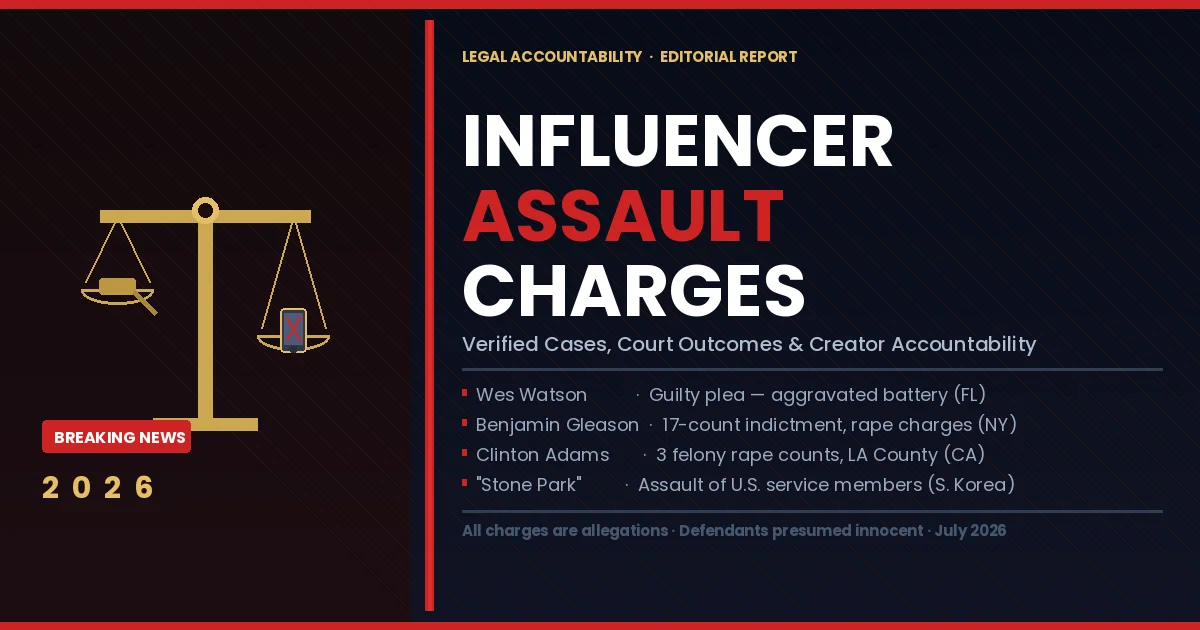
Several documented cases from 2026 involve social media creators facing serious criminal charges. These are not rumors — each involves formal charges, court appearances, and public recordsWes Watson — Fitness Influencer, Aggravated Battery (Miami-Dade, Florida)
The most resolved case of 2026 involves Wes Watson, 42, a fitness influencer who built millions of followers by documenting his post-prison transformation into a motivational fitness personality.
On December 29, 2024, a confrontation occurred at Elevation Fitness, a gym in Miami-Dade County. According to arrest documents, Watson was working out when another man approached and initiated a fight. Surveillance footage captured Watson striking the victim with a weightlifting belt. The victim later reported multiple facial fractures, jaw injuries, a concussion, and dental damage.
On July 2, 2026, Watson pleaded guilty to aggravated battery in Miami-Dade County court as part of a negotiated plea agreement. Prosecutors recommended a sentence of 21 months in prison — including credit for time already served — followed by seven years of probation and court-ordered mental health treatment. His formal sentencing is scheduled for July 17, 2026.
This case does not stand alone. In neighboring Broward County, Watson faces separate pending felony charges including felony battery, aggravated assault, witness tampering, and alleged domestic violence involving his girlfriend. Those charges remain active.
Watson’s defense attorney argued that the gym victim had specifically traveled to confront Watson because of his public profile — buying a plane ticket and flying from New Jersey with the stated intent of fighting him. Regardless of what preceded the altercation, the court found sufficient grounds for a guilty plea on aggravated battery.
Status: Guilty plea entered July 2, 2026. Sentencing July 17, 2026.
Benjamin Gleason — TikTok Influencer (1M+ Followers), Sexual Assault and Rape (New York)
On March 20, 2026, New York State Police arrested Benjamin Gleason, 39, of Columbia County. Gleason had amassed over 1.1 million TikTok followers through lip-sync content, music clips, and videos about living with borderline personality disorder.
His last post went live within 24 hours of his arrest.
A Columbia County grand jury issued a 17-count sealed indictment covering three counts of predatory sexual assault (Class A-II felonies), multiple first-degree rape counts for both forcible compulsion and physically helpless victims, four counts of criminal sexual act in the first degree, aggravated sexual abuse in the second degree, and first-degree sexual abuse.
Authorities say the alleged assaults involved seven victims ranging in age from 17 to 27, with the conduct spanning a decade — from 2011 to 2021. The investigation was launched in February 2026 following a tip to New York State Police, and expanded rapidly as additional victims were identified.
Columbia County District Attorney Chris Liberati-Conant stated publicly that the number of victims reflects a deliberate pattern: “The number of victims here indicates a pattern and somebody who was seeking out these younger women and then regularly abusing them.”
Gleason pleaded not guilty at his March 23 arraignment and was held without bail. He faces a maximum of life in prison if convicted.
Status: Arraigned March 23, 2026. Pleaded not guilty. Held without bail. Next court date April 29, 2026 (as of last report).
Clinton Adams (“Clintnlord”) — Social Media Influencer/Hip-Hop Artist, Rape and Assault (Los Angeles)
The Los Angeles County District Attorney’s Office filed felony charges against Clinton Adams, known online as “Clintnlord,” following allegations that he sexually assaulted two women by luring them to wildfire-damaged vacant areas in the aftermath of the January 2026 LA fires.
Adams, 32, of Northridge, faces three felony counts of forcible rape and one felony count of assault with intent to commit rape. The charges carry a maximum sentence of 90 years to life in state prison if he is convicted as charged.
Adams was arraigned November 21, 2025, pleaded not guilty, and remained in custody on $1,475,000 bail as of early 2026. Prosecutors from the LA DA’s Sex Crimes Division are handling the case, and the LAPD’s Operations-West Bureau Special Assault Section has publicly sought information from additional potential victims.
District Attorney Nathan J. Hochman stated that exploiting disaster-affected areas to commit assault represents a particularly serious aggravating circumstance.
Status: Charged. Pleaded not guilty. In custody. Preliminary hearing proceedings ongoing.
“Stone Park” — American Influencer, Assault of U.S. Military Personnel (South Korea)
In late June 2026, a Korean-American social media personality identified across multiple Korean media outlets as “Stone Park” was arrested in Pyeongtaek, South Korea, near Osan Air Base — a key hub for U.S. Forces Korea (USFK).
According to South Korean police and the Korean Herald, the man, described as in his 30s, became intoxicated and attacked two U.S. service members in their 20s in the Sinjang-dong neighborhood. Witness video that spread widely online showed him kicking one soldier before punching a second in the face and knocking him unconscious. The second soldier remained motionless on the pavement for a period following the punch.
South Korean authorities arrested him on assault charges. The case carries implications under the Status of Forces Agreement (SOFA) that governs jurisdiction over crimes involving U.S. military personnel in South Korea.
Status: Arrested by South Korean police. Case under investigation as of late June 2026.
Gabbie Gonzalez — TikTok Influencer, Alleged Murder-for-Hire Plot (Los Angeles)
In a case that sits outside traditional assault law but underscores the breadth of violent criminal charges facing influencers in 2026, TikTok creator Gabbie Gonzalez, 24, was charged in Los Angeles with attempted murder, conspiracy to commit murder, and solicitation of murder.
Prosecutors allege Gonzalez conspired to arrange the killing of Jack Avery, a former member of the pop group Why Don’t We, with whom she shares a child. Gonzalez was arrested alongside her father and a former boyfriend. All three defendants face up to 25 years to life in prison if convicted. A judge set bail at $2 million.
Under California law, conspiracy and solicitation charges can proceed even when an intended killing was not carried out, provided the prosecution can show meaningful steps were taken to commit the crime.
Gonzalez has not entered a formal plea as of the most recent court date, with her attorney requesting additional time to review the evidence.
Status: Charged. Arraignment postponed. Bail set at $2 million.
How Does the Legal Process Work When an Influencer Is Charged?
When a social media influencer is charged with assault or a violent crime, the legal process follows the same structure as any other defendant — but with significant complications created by their online presence.
Here is how a typical case moves through the system:
- Investigation. Law enforcement gathers evidence, which in influencer cases increasingly includes content the accused posted publicly, direct messages extracted via warrant, and witness testimony from followers or collaborators.
- Arrest and booking. The influencer is taken into custody. Booking photos become public record and often spread across social media within hours — sometimes before news outlets have published a story.
- Arraignment. The accused appears in court, hears the formal charges, and enters an initial plea. Bail is set or denied. In the Gleason case, the court denied bail entirely given the scope and severity of the indictment.
- Grand jury or preliminary hearing. For felony charges in many states, prosecutors must present evidence to a grand jury (New York) or a judge at a preliminary hearing (California) to establish probable cause. The Gleason case resulted in a 17-count grand jury indictment.
- Discovery and pre-trial motions. Both sides exchange evidence. Defendants’ attorneys frequently challenge social media posts as evidence, arguing context, authenticity, or improper collection. Courts generally accept digital evidence when law enforcement can authenticate it through IP records, login history, and chain of custody documentation.
- Plea negotiation or trial. Most cases resolve via plea. Watson’s Miami-Dade case, for example, ended in a guilty plea to aggravated battery with a negotiated sentence recommendation.
- Sentencing. A judge reviews the agreed-upon or jury-determined outcome and imposes a final sentence.
One legal reality that influencers and their attorneys navigate: public posts, viral videos, and even livestreams can be subpoenaed and used as evidence of intent, location, or prior behavior. In the Watson case, his own public content — including documented statements about violence from his prison years — formed part of the broader public record that prosecutors had access to.
How Do Assault Charges Affect an Influencer’s Income and Career?
An assault charge — regardless of whether a conviction follows — typically triggers a cascade of professional consequences that can permanently alter a creator’s financial situation.
Brand Deals and Sponsorships
Brands use automated content-screening tools to monitor influencer histories. Industry data from 2026 shows that 92% of brands now require a clean record for at least 12 months before entering a sponsorship agreement. A single credible criminal allegation can block a creator from the majority of brand marketplace deals on major platforms.
In Watson’s case, his existing partnerships with fitness and supplement brands went silent following his February 2025 arrest. His content output dropped, and monetization across platforms became legally complicated given his Broward County charges remaining active.
Platform Responses
YouTube freezes ad revenue on channels under active criminal investigation for content-related harm. Instagram’s creator marketplace flags accounts with repeated policy violations, restricting them from brand-partnership tools for 90-day periods. TikTok’s process of account review following high-profile arrests is less publicly documented, but creators have reported suspension or demonetization following news coverage of charges.
In Gleason’s case, his TikTok account — which had 1.1 million followers and nearly 51 million likes — was active until hours before his arrest. Following the public arraignment, the account faced scrutiny, and TikTok has policies that allow removal of accounts where the owner is charged with serious violent or sexual crimes.
Audience and Reputation
The parasocial dynamic between influencers and their audiences creates a specific type of reputational crisis that differs from traditional celebrity falls. Followers who built emotional investments in creators’ identities — Watson’s “prison to peak fitness” narrative, Gleason’s mental health advocacy — experience a kind of whiplash that amplifies the controversy.
In most documented cases, the audience response divides into: those who immediately disengage, those who defend the creator until conviction, and a smaller group who redirect support toward victims. None of these outcomes preserves the creator’s earning power.
Why Are Influencer Assault Charges Escalating in 2026?
The increase in documented influencer assault cases in 2026 reflects several overlapping factors. This is not simply a media trend — there are structural reasons why more cases are being filed and prosecuted.
Online Fame Creates Access and Power Imbalances
Influencers who build large followings develop access to people they would not otherwise meet — fans, collaborators, aspiring creators who want proximity to their platforms. The Columbia County DA’s characterization of Gleason’s case explicitly noted that he acknowledged knowing his audience skewed young and female. Platforms that enable creators to monetize their personalities also create conditions where that social capital can be misused.
Social Media Evidence Has Become Routine in Criminal Prosecutions
Law enforcement agencies across the United States now routinely include digital forensics as part of violent crime investigations. In the Clinton Adams case, the LA DA’s Sex Crimes Division worked alongside the LAPD’s Special Assault Section in a coordinated investigation that included digital evidence review. Influencers who document their lives extensively create far more evidentiary material than an average defendant — their own content becomes part of the case file.
Victim Reporting Is Increasing
The New York State Police investigation into Gleason began because a victim came forward in February 2026 — and within weeks, six additional victims had been identified. Public reporting of criminal charges against influencers appears to encourage other victims to report. The LA DA’s office explicitly issued a public call for additional victims in the Adams case, recognizing that visibility matters.
Accountability Infrastructure Has Strengthened
In 2025, three major lawsuits were filed by individuals harmed by influencer-promoted scams, with courts ruling in favor of plaintiffs in two cases, establishing personal liability precedent. The FTC fined 28 influencers in 2025 for undisclosed paid posts. The broader pattern of legal accountability being applied to digital creators has lowered the threshold at which law enforcement treats influencer-related complaints seriously.
Major Influencer Assault Cases: 2026 Comparison
| Influencer | Platform | Charge | Victims/Context | Current Status |
|---|---|---|---|---|
| Wes Watson | YouTube/Instagram | Aggravated battery (gym) | 1 victim; multiple facial fractures | Guilty plea entered July 2, 2026 |
| Benjamin Gleason | TikTok (1.1M) | 17-count indictment: rape, predatory sexual assault | 7 victims, 10-year span | Pleaded not guilty; held without bail |
| Clinton Adams (“Clintnlord”) | Instagram/social | 3 counts forcible rape, assault | 2 victims; wildfire-area luring | Charged; pleaded not guilty; in custody |
| “Stone Park” | Social media | Assault of U.S. military personnel | 2 U.S. service members | Arrested in South Korea |
| Gabbie Gonzalez | TikTok | Conspiracy/solicitation to commit murder | Targeting former partner | Charged; bail $2M |
All charges are allegations. Defendants are presumed innocent until proven guilty in a court of law. Data accurate as of July 2026.
Frequently Asked Questions
What is an influencer assault charge? An influencer assault charge is a formal criminal allegation filed by a prosecutor against a social media creator for physically harming another person. The charge can range from misdemeanor battery to felony aggravated assault depending on the severity of harm, the use of weapons, and the vulnerability of the victim. The influencer’s follower count or platform status has no bearing on the legal process — the same criminal code applies.
Can an influencer be arrested even if they have millions of followers? Yes. Follower count provides no legal immunity. The cases documented in 2026 involve creators with audiences ranging from tens of thousands to over one million. Courts treat influencers as any other defendant under criminal law. Several cases in 2026 saw arraignments proceed within days of arrest, with bail denied where flight risk or severity warranted it.
Does a criminal charge automatically end an influencer’s career? Not automatically, but the practical impact is severe. Brand deals are typically suspended or terminated during active criminal proceedings. Platform monetization tools are often restricted. Audience trust erodes significantly, particularly when charges involve victims from within the creator’s own community. Recovery is possible in some cases, but the documented pattern shows that serious violent or sexual assault charges cause irreversible reputational damage in the majority of cases.
How does social media content factor into assault cases against influencers? Prosecutors can subpoena public posts, private messages, location data, and livestream recordings. Courts accept this digital evidence when law enforcement establishes authenticity through IP records, login history, and proper chain of custody. Defense attorneys routinely challenge social media evidence on grounds of context or improper collection — but courts have increasingly upheld its admissibility.
What happens to a charged influencer’s social media accounts? Platforms differ in their policies. TikTok and Instagram can remove or restrict accounts where the owner is charged with serious violent crimes. YouTube may freeze ad revenue. Brand marketplace tools are typically suspended. In some cases — including Gleason’s — the creator’s account remained publicly visible until shortly after the arrest became widely reported.
Can assault charges affect an influencer’s sponsorship contracts? Yes, and typically immediately. Most modern influencer contracts include morality clauses that allow brands to terminate agreements if the creator is charged with, or convicted of, a criminal offense. Brands proactively monitor creator legal status using automated screening tools. A 2026 industry survey found 92% of brands require a clean 12-month legal record before entering new partnerships.
What is the difference between assault and battery charges in influencer cases? Legally, assault typically refers to the threat or attempt of harmful contact, while battery refers to the actual physical act. In practice, many states combine them into a single charge. In Watson’s case, the charge was aggravated battery — meaning physical harm was inflicted, not merely threatened. The distinction matters for sentencing, as battery charges that result in serious bodily injury carry significantly heavier penalties.
What should followers do when an influencer they support is charged with assault? The appropriate response is to stop engaging with and amplifying the creator’s content while charges are active. Engagement — including comments, shares, and reactions — generates algorithmic reach that benefits the accused. Report any related content to the platform if it appears to glorify the alleged behavior. Following victim support organizations and news outlets directly for case updates is more reliable than creator-adjacent communities that may circulate misinformation.
Conclusion
The influencer assault cases of 2026 are not isolated incidents. They are part of a documented and growing pattern of social media creators facing serious criminal accountability in courts across the United States and internationally.
The cases detailed here — from Watson’s guilty plea to Gleason’s 17-count indictment, from the wildfire-adjacent allegations in Los Angeles to the arrest of an American creator on foreign soil — share a common thread: platform fame does not insulate anyone from the criminal justice system, and in several documented cases, it actively attracted victims and drew additional investigative scrutiny.
For followers, the clearest action is skepticism informed by facts: court records are public, prosecutors’ statements are verifiable, and legal outcomes speak louder than a creator’s curated narrative. For brands and platforms, the pressure to enforce morality clauses and content policies consistently — not selectively — has never been clearer.
As these cases move through courts over the coming months, their outcomes will set precedents for how criminal law engages with the creator economy for years to come
From confused to confident—our step-by-step expert posts guide you through..