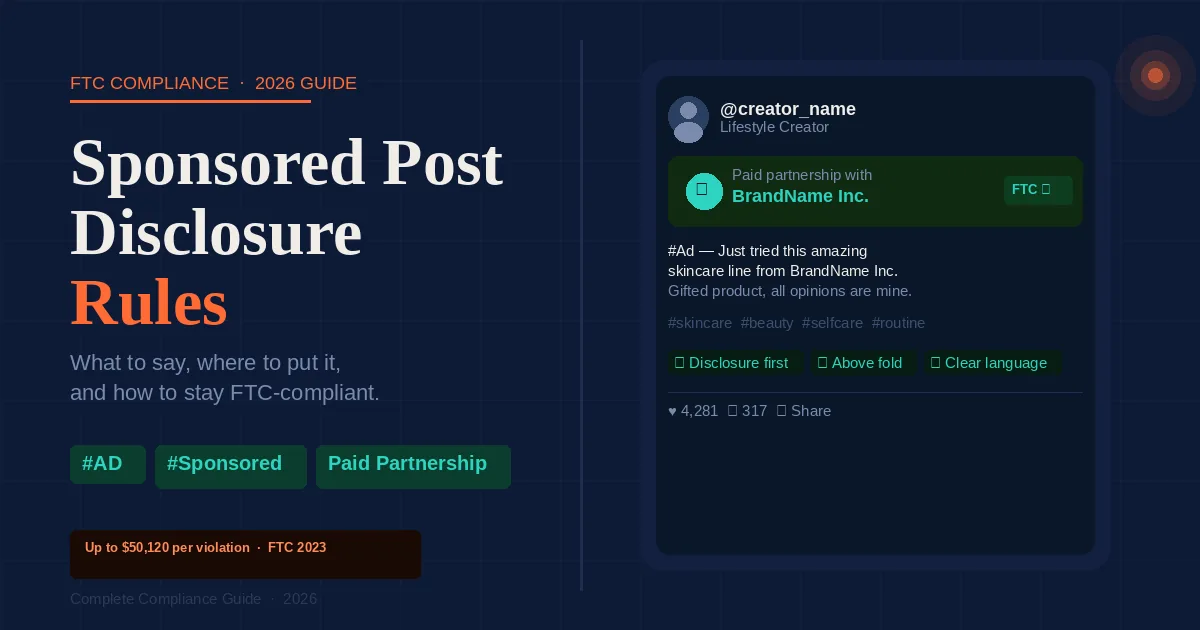
Posting a sponsored photo without a disclosure isn’t just an oversight — the FTC can fine brands up to $50,120 per violation as of its 2023 penalty schedule. And enforcement is accelerating. The commission sent warning letters to over 700 influencers and brands in a single sweep, and the UK’s ASA issues public rulings weekly against creators who simply forgot to label a post.
This guide covers everything you need to know: what the rules actually require, how each major platform handles disclosure, what mistakes get creators flagged, and exactly how to stay compliant — whether you have 500 followers or five million.
What Are Sponsored Post Disclosure Rules — and Why Do They Exist?
Sponsored post disclosure rules are legal and platform-level requirements that compel creators, influencers, and publishers to clearly tell audiences when content has been paid for, gifted, or otherwise influenced by a brand relationship. The core idea is simple: audiences have a right to know when a recommendation has a financial motive behind it.
The foundation in the United States is the Federal Trade Commission Act, which prohibits unfair or deceptive practices in commerce. The FTC operationalizes this through its Guides Concerning the Use of Endorsements and Testimonials in Advertising (16 CFR Part 255), most recently updated in June 2023 — the most significant revision since 2009.
The 2023 revision was a direct response to the influencer economy. It now explicitly covers:
- Virtual influencers and AI-generated personas — yes, even a CGI avatar must disclose paid deals
- Employee and insider reviews — if a company employee posts a review of their employer’s product, it must be disclosed
- Negative reviews purchased to suppress competitors — newly prohibited
- Unclear tags and endorsements — the FTC clarified that a simple tag or follow on social media can constitute a material connection requiring disclosure
Outside the US, the rules differ in name but not in spirit. The UK’s Advertising Standards Authority (ASA) and the Competition and Markets Authority (CMA) enforce similar transparency standards. The EU’s Digital Services Act and individual member-state advertising codes impose their own obligations. If your content reaches international audiences — and most digital content does — you are likely subject to multiple regulatory frameworks simultaneously.
What Counts as a “Material Connection” That Requires Disclosure?
A material connection exists whenever a brand relationship could reasonably affect how an audience perceives your content. Disclosure is required for all of the following:
- Direct payment — any fee, commission, or salary tied to producing the content
- Free or gifted products — even if the brand did not request a review
- Discounts, affiliate commissions, or exclusive codes — a 10% affiliate commission qualifies
- Contest entries, sweepstakes chances — receiving consideration in exchange for a post
- Personal or family relationships — reviewing your sister’s startup without disclosure is a violation
- Employment relationships — employees promoting their company’s products must disclose that connection
- Free travel or experiences — a hotel hosting you at no charge for coverage requires disclosure
The critical test the FTC applies is this: Would knowing about this relationship change how your audience evaluates what you’re saying? If the answer is yes — and it almost always is — you must disclose.
In my own review of the FTC’s enforcement letters, one pattern appears consistently: the most commonly cited violations involve gifted products where the creator believed “I didn’t ask for it, so I don’t have to disclose it.” The FTC’s position is unambiguous — the manner of receiving the benefit is irrelevant. If you received it and you posted about it, disclose it.
How to Disclose Sponsored Content the Right Way (Step-by-Step)
The FTC’s standard is that disclosures must be clear and conspicuous — meaning an ordinary consumer, viewing the content in normal conditions, should notice and understand the disclosure without hunting for it.
Here is how to do it correctly across all formats:
Step 1 — Choose the Right Label
The FTC has confirmed these labels are acceptable:
- “Ad” or “#Ad”
- “Sponsored” or “#Sponsored”
- “Paid Partnership with [Brand]”
- “[Brand] gave me this product to review”
Labels that are NOT sufficient:
- “#spon” — abbreviations consumers don’t universally understand
- “#partner” or “#collab” — too ambiguous
- “Thanks to [Brand]” — implies gratitude, not a paid relationship
- “In association with” — vague
- Burying “ad” inside a string of 30 hashtags at the bottom of a caption
Step 2 — Place It Where People Will See It First
Placement matters as much as the label itself. The disclosure must appear:
- Before the audience engages with the substantive content
- On screen at the same time as the branded message in video
- Above the fold in written content — not in footnotes, end credits, or collapsed caption text
For Instagram specifically: placing #ad as the 15th hashtag in a comment does not satisfy the “clear and conspicuous” standard. It must appear in the first line of the caption, visible before the “more” truncation.
Step 3 — Match the Language to Your Content
If you post primarily in Spanish, your disclosure must be in Spanish. A French-language audience receiving an English “#ad” tag does not meet the standard in the FTC’s view. This is especially relevant for creators who operate in multiple markets.
Step 4 — Disclose on Every Piece of Content, Not Just the Campaign Summary
If a brand pays for a six-post campaign, each of the six posts needs its own disclosure. A disclosure in the first post does not carry over to subsequent posts. The same logic applies to Stories — each Story frame that promotes the brand needs a disclosure overlay.
Step 5 — Keep Records
Maintain documentation of:
- Contracts and briefs from brands
- What you received (payment amounts, product value)
- Screenshots of your disclosed posts at time of publication
- Any brand review or approval communications
This protects you in the event of an FTC inquiry. Regulators have subpoena power — having clean records demonstrates good faith compliance.
Platform-by-Platform Disclosure Rules: What Each Network Requires
Different platforms have built their own native disclosure tools, but using a platform’s tool does not automatically satisfy FTC requirements. You often need both.
| Platform | Native Tool | Is It FTC-Sufficient Alone? | Best Practice |
|---|---|---|---|
| “Paid Partnership” label (via branded content tool) | Generally yes, if placed prominently | Use the paid partnership label + “#Ad” in caption first line | |
| TikTok | “Branded Content” toggle (adds “Paid partnership” label) | Generally yes | Enable toggle + state the brand partnership verbally in the first 3 seconds |
| YouTube | “Includes paid promotion” video label | No — must also verbally disclose in video | Add the YouTube label + verbal disclosure in first 30 seconds + written disclosure in description |
| X (Twitter) | No native tool | N/A | Use “#Ad” in the first 30 characters of the post |
| Blogs / Websites | No native tool | N/A | Disclosure statement at the top of the article, before the content begins |
| Podcasts | No native tool | N/A | Verbal disclosure at the beginning of the episode or segment |
| Newsletters | No native tool | N/A | Clear text at the top of the sponsored section |
| No native tool | N/A | “#Ad” in pin description; label the board if the whole board is sponsored |
YouTube: The Most Misunderstood Platform for Disclosure
YouTube is where I see the most compliance errors. Many creators add YouTube’s “includes paid promotion” checkbox but consider the job done. The FTC does not agree.
YouTube’s own policy states creators must also verbally disclose in the video and include a written disclosure in the video description. The verbal disclosure should appear early — within the first 30 seconds — not as an afterthought after six minutes of content.
A compliant YouTube disclosure sounds like: “This video is sponsored by [Brand]. They provided [payment/product] in exchange for this coverage. All opinions are my own.”
Instagram Stories: The Tricky Edge Case
Stories disappear after 24 hours, which creates a specific documentation challenge. Use the platform’s branded content tool, which applies a persistent “Paid partnership with [Brand]” label to the Story frame. If the brand does not appear in Instagram’s Creator Marketplace, add a text overlay reading “AD” or “Paid partnership” in a clearly visible size and color — not white text on a light background.
Common Sponsored Post Disclosure Mistakes (and How to Avoid Them)
Mistake 1: The Hashtag Graveyard
Placing #ad as the 20th tag in a block of hashtags is the single most common violation I observe. The FTC’s guidance is explicit: disclosures buried in hashtags fail the clear and conspicuous test. Audit every recent post and check where your disclosure actually lives.
Mistake 2: Assuming Gifted Products Don’t Count
A brand sends you a $300 skincare kit, you love it, you post about it — and you assume you don’t need to disclose because no money changed hands. This is wrong. The FTC has held since 2009 that gifted products with material value require disclosure. The 2023 update reinforced this.
Mistake 3: “The Brand Didn’t Tell Me To Disclose”
Compliance is the creator’s responsibility, not the brand’s. Several FTC enforcement actions have targeted creators specifically — not just brands — because the creator failed to disclose even when the brand’s own brief was incomplete or silent on the matter. You cannot shift the legal responsibility to the paying party.
Mistake 4: Platform Compliance ≠ FTC Compliance
Using Instagram’s “Paid Partnership” label or TikTok’s branded content toggle reduces your risk — but neither platform has guaranteed their tools satisfy the FTC’s evolving standard in all cases. Treat platform tools as one layer of a two-layer system. The second layer is your own explicit, prominent label.
Mistake 5: Disclosing Only on the Primary Post
If you share the sponsored post to your Stories, reshare it in a carousel update, or repurpose it as a Reel, each format requires its own disclosure. Repurposed content from a previously disclosed post does not carry the disclosure forward automatically.
Mistake 6: Not Disclosing Affiliate Links
Affiliate links are a material connection. If you earn commission when someone purchases through your link, that financial relationship must be disclosed — even on a “casual” recommendation in a comment, a tweet, or a bio link. The FTC’s 2023 guidance specifically called out undisclosed affiliate links as a priority enforcement area.
Frequently Asked Questions About Sponsored Post Disclosure
Do I need to disclose if I only received a small gift? Yes. The FTC does not specify a minimum value threshold. If you received something of value — even a $10 product sample — and you post about it, a disclosure is required. The materiality test is about the relationship, not the dollar amount.
Does #sponsored work, or do I need to write it out in full? #Sponsored and #Ad are both accepted by the FTC as clear labels. What matters is prominence. Either word must appear where a viewer will notice it before consuming the content — not buried at the end of a caption or in a comment.
Can the brand approve my disclosure language? Brands may review disclosures, but they cannot instruct you to use inadequate labels. If a brand contract tells you not to use “ad” or “sponsored” — that clause is legally problematic and likely unenforceable. The FTC has issued warning letters to brands attempting to suppress proper disclosures.
Do I need to disclose in every Story frame, or just the first? Each Story frame that features or promotes the brand requires its own disclosure. If your sponsored Story is five frames long, each frame needs the paid partnership label or a visible “AD” text overlay.
What are the penalties for not disclosing? The FTC can seek civil penalties of up to $50,120 per violation (2023 schedule). Historically, most enforcement has targeted brands rather than individual creators, but warning letters are issued to creators directly. UK’s ASA issues public rulings — which create reputational damage even without fines. Several platforms also remove or restrict undisclosed branded content when reported.
Does disclosure apply to my personal blog, not just social media? Yes. Any online content — blog posts, newsletters, podcasts, YouTube videos, review sites — falls under FTC jurisdiction if it reaches US audiences. A disclosure statement at the top of the article is the standard for written content.
I received free access to a software tool. Do I need to disclose if I review it? Yes. Free access to software, apps, or digital services is a material benefit. If a SaaS company gave you a free annual subscription worth $500 and you reviewed it, disclose it the same way you would a physical product.
Does the FTC cover international creators? The FTC’s jurisdiction applies when content reaches US consumers, regardless of where the creator is located. So a UK-based creator with a US audience is expected to comply. Additionally, EU and UK creators must comply with local rules, which largely parallel FTC requirements.
Conclusion
Sponsored post disclosure rules exist to protect the audiences that creators have spent years building trust with. The FTC’s framework is not complicated — be clear, be prominent, be early. The platforms’ native tools help, but they are not a substitute for your own explicit, visible label.
The practical takeaway: place your disclosure in the first line of every caption, in the first 30 seconds of every video, at the top of every article. If you have affiliate links, label every post that contains them. Keep records of what you received and when you disclosed it.
Compliance is not a burden — it is what separates credible creators from those who lose audience trust the moment their followers notice they were never told the truth.
Your next step: Audit your last 20 pieces of content. Check where your disclosures actually appear. If any are buried in hashtags, in comments, or missing entirely — update them today. The FTC’s enforcement calendar does not wait.
Tired of generic advice? Our specialist articles go deeper than the rest.