If you earned money from brand deals, AdSense, affiliate links, or Patreon in 2025, the IRS sees you as a business owner — not a hobbyist. That means different rules, different forms, and a tax bill that blindsides creators who aren’t prepared.
The creator economy now includes an estimated 27 million paid content creators in the United States, with full-time creators earning a mean of around $93,000 annually. Yet most receive zero tax education when they start monetizing. This guide fills that gap.
What this article covers: how the IRS classifies influencers, every tax you actually owe, which deductions apply to your work, how to pay quarterly, what happens when brands send free products, and what changed under the One Big Beautiful Bill Act that affects you in 2026. No jargon. No filler. Just a tax roadmap built for creators.
Are Influencers Considered Self-Employed by the IRS?
Yes — and the classification kicks in from your first dollar. If you earn money from content creation and you’re not on a company’s payroll with W-2 withholding, the IRS treats you as a self-employed individual operating a trade or business. The platform doesn’t matter. YouTube, TikTok, Instagram, Twitch, Substack, or a personal blog — same rules apply.
This status comes with real consequences. You’re responsible for tracking your own income, calculating your own taxes, and paying the government proactively rather than having an employer handle it.
What counts as taxable income for creators?
All of the following are reportable on your tax return:
- Sponsorship and brand deal payments
- YouTube AdSense and Shorts revenue
- TikTok Creator Rewards Program payouts
- Instagram and Facebook Reels monetization
- Affiliate commissions (Amazon Associates, LTK, ShareASale, Impact, etc.)
- Patreon, Substack, and subscription platform revenue
- Twitch subscriptions, bits, and donations
- Merchandise and physical product sales
- Digital product and course sales
- Podcast ad revenue
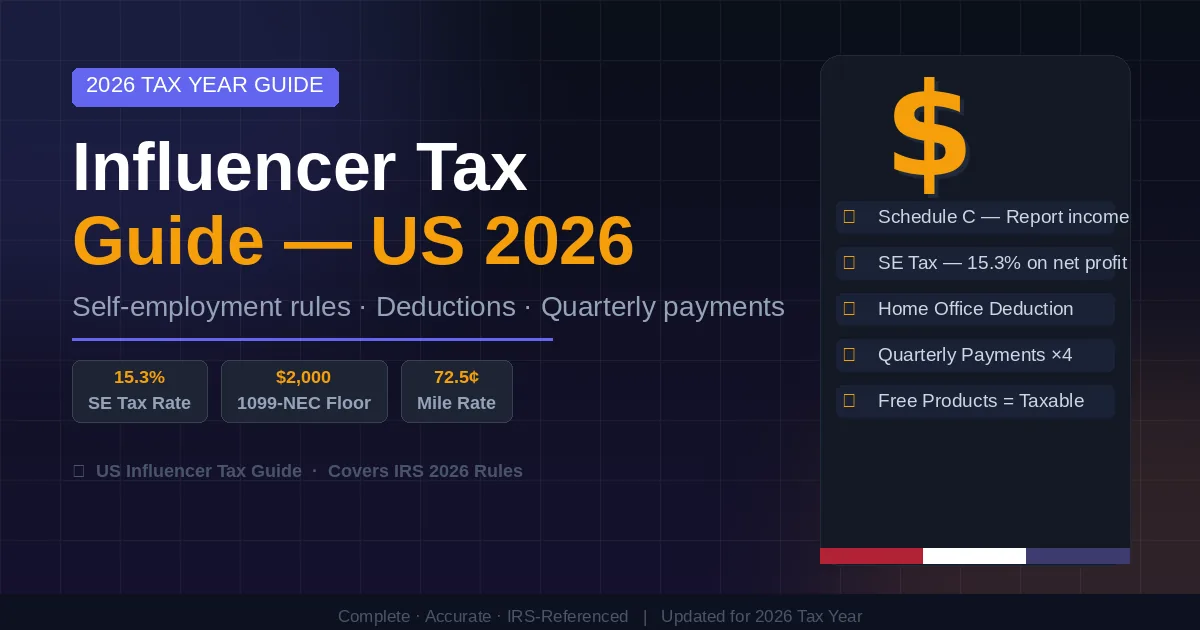
An important 2026 update on 1099 forms: Under the One Big Beautiful Bill Act (OBBBA, signed July 2025), the Form 1099-NEC reporting threshold increased from $600 to $2,000 starting with the 2026 tax year. This means brands are only required to send you a 1099-NEC if they paid you $2,000 or more. However, this change does not create a tax-free zone. You owe taxes on every dollar earned, even if no form is ever issued.
What Taxes Do US Influencers Actually Owe?
Most creators are surprised to discover they owe two separate layers of federal tax — self-employment tax on top of regular income tax — plus applicable state taxes. Understanding all three is essential to avoid large underpayment penalties.
Self-Employment Tax
Self-employment (SE) tax runs at 15.3% of your net self-employment income: 12.4% for Social Security (on earnings up to the 2026 wage base of $184,500) and 2.9% for Medicare. This replaces the payroll taxes that traditional employers split with employees. As a solo creator, you pay both halves.
One immediate offset: you can deduct half of your SE tax from gross income when calculating federal income tax. On net earnings of $60,000, you’d owe approximately $8,478 in SE tax, then deduct roughly $4,239 before income tax applies.
Federal Income Tax
After subtracting the SE tax deduction, the standard deduction (or itemized deductions), and any other eligible above-the-line reductions, your remaining taxable income hits the federal brackets. For 2026 single filers, confirmed by IRS Rev. Proc. 2025-32:
| Taxable Income (Single Filer) | Tax Rate |
|---|---|
| $0 – $12,400 | 10% |
| $12,401 – $50,400 | 12% |
| $50,401 – $105,700 | 22% |
| $105,701 – $201,775 | 24% |
| $201,776 – $256,225 | 32% |
| $256,226 – $640,600 | 35% |
| Over $640,600 | 37% |
The 2026 standard deduction is $16,100 for single filers and $32,200 for married filing jointly — both increased under the OBBBA’s inflation adjustments. These rates were made permanent by the OBBBA, so the expiration threat that hung over TCJA provisions is now resolved.
State Income Tax
Most states also tax self-employment income. Nine states have no personal income tax: Alaska, Florida, Nevada, New Hampshire, South Dakota, Tennessee, Texas, Washington, and Wyoming. If you live in California or New York, expect an additional 9–13% state tax layered on top of your federal obligation. Creators who work with brands headquartered in other states may also face multi-state filing requirements — worth flagging with a CPA if this applies to you.
A Real-World Example
Suppose you’re a beauty creator who earned $85,000 in gross revenue in 2025 and had $18,000 in legitimate business deductions. Your net Schedule C profit is $67,000.
- SE tax (15.3% × 92.35% of $67,000): approximately $9,461
- SE tax deduction: approximately $4,730
- AGI before standard deduction: approximately $62,270
- Taxable income after $16,100 standard deduction: approximately $46,170
- Federal income tax: approximately $5,200
- Combined federal tax burden: roughly $14,650 before any retirement contributions
This is why knowing your deductions — and acting on them — matters significantly.
Which Business Expenses Can Influencers Deduct?
This is where creators leave the most money on the table. A deduction reduces your taxable profit dollar-for-dollar. Spend $1,200 on a camera lens and you reduce your taxable income by $1,200. At a 22% marginal rate plus SE tax, that single purchase saves you roughly $450 in combined taxes.
To qualify, an expense must be ordinary (common in your industry) and necessary (helpful for your business). Here’s what legitimately applies to creators:
Equipment and Technology
Cameras, lenses, lighting rigs, microphones, tripods, and gimbals all qualify. So do computers, tablets, external hard drives, and smartphones — though for the phone, you can only deduct the percentage used for business purposes. Under Section 179 and bonus depreciation, the IRS allows you to deduct the full cost of eligible equipment in the year of purchase rather than depreciating it over several years.
Software and Subscriptions
Adobe Creative Cloud, Final Cut Pro, CapCut Pro, Canva Pro, scheduling tools, music licensing platforms (Epidemic Sound, Artlist), and VPN services used for business all count. Keep screenshots of renewal receipts — subscription charges are easy to forget.
Home Office Deduction
If you use part of your home exclusively and regularly for content creation, you can deduct it. Two methods are available:
- Simplified Method: $5 per square foot, up to 300 sq ft, for a maximum deduction of $1,500.
- Actual Expense Method: Calculate what percentage of your home is used for business and apply that percentage to rent/mortgage interest, utilities, and insurance.
A creator with a dedicated studio room or editing suite almost always benefits more from the actual expense method.
Travel and Transportation
Flights, hotels, and Airbnb costs for brand trips, creator summits, and content-focused travel are deductible when the primary purpose of the trip is business. The 2026 IRS standard mileage rate for business vehicle use is 72.5 cents per mile — an increase from prior years. Keep a mileage log, either manually or through an app like MileIQ or Stride, since the IRS has signaled increased scrutiny of vehicle deductions without supporting documentation.
Business Meals
Meals are 50% deductible when directly tied to a business purpose — a lunch with a potential brand partner, a coffee meeting with a collaborator, or a working meal at an industry event. A solo dinner while “brainstorming content ideas” does not meet the standard.
Professional Services
CPA fees, attorney fees for reviewing brand contracts, and business coaching costs all qualify. Ironically, the cost of preparing your taxes as a self-employed creator is itself a deductible business expense.
Health Insurance Premiums
Self-employed creators can deduct 100% of health, dental, and vision insurance premiums for themselves and their families. This deduction comes directly off your gross income — not as an itemized deduction — which makes it available even if you take the standard deduction.
Retirement Contributions
A SEP-IRA or Solo 401(k) is one of the most powerful tax-reduction tools available to creators. In 2026, the Solo 401(k) employee contribution limit is $24,500 (or $32,500 for those 50 and older). Every dollar contributed reduces your taxable income directly, which lowers both your income tax and the income on which SE tax is calculated.
How Do Influencers Pay Quarterly Estimated Taxes?
Quarterly estimated taxes are required when you expect to owe $1,000 or more in federal tax for the year. Missing these payments triggers an underpayment penalty — even if you pay in full by April filing day.
How to Calculate What You Owe Each Quarter
- Estimate your total annual gross income across all content revenue streams.
- Subtract expected business deductions to arrive at your projected net profit.
- Apply the 15.3% SE tax rate to 92.35% of that net profit.
- Add your expected federal income tax based on your bracket.
- Divide the total by four to determine each quarterly payment.
The safest strategy is the safe harbor rule: pay at least 100% of your prior year’s total tax liability (or 110% if your prior-year AGI exceeded $150,000), split equally across all four quarters. This protects you from underpayment penalties even if your current-year income jumps significantly.
2026 Quarterly Due Dates
| Quarter | Income Period | Payment Due |
|---|---|---|
| Q1 | Jan 1 – Mar 31 | April 15, 2026 |
| Q2 | Apr 1 – May 31 | June 16, 2026 |
| Q3 | Jun 1 – Aug 31 | September 15, 2026 |
| Q4 | Sep 1 – Dec 31 | January 15, 2027 |
Where to Pay
The IRS Direct Pay system at IRS.gov accepts bank transfers at no cost. EFTPS (Electronic Federal Tax Payment System) works well for creators who prefer to schedule payments in advance. Credit and debit card payments go through IRS-authorized third-party processors, though they charge a small convenience fee.
A system that works well in practice: open a separate savings account specifically for tax reserves and transfer 25–30% of every brand payment or platform deposit into it the day it arrives. This eliminates the March scramble of trying to find money you’ve already spent.
What Happens When Brands Send Free Products?
Free products — PR packages, gifted items, complimentary travel, and product-inclusive partnerships — are taxable income at their fair market value (FMV). The IRS treats compensation-for-content arrangements as barter income, not personal gifts.
How the IRS views it: If a skincare brand sends you a $350 product bundle in exchange for a dedicated post, your taxable income includes $350. If that same brand pays you $2,000 and also sends the $350 bundle, your total taxable income from that deal is $2,350.
PR trips: If a brand covers a $4,500 resort trip in exchange for content, that $4,500 is taxable income — even though you never received cash. The brand should issue a 1099-NEC if the value reaches the 2026 reporting threshold, but your reporting obligation exists regardless.
A nuance worth knowing: Per IRS enrolled agent Hannah Cole, “If you exchange your services for something other than money, what each person receives in the trade is considered income by the IRS and is taxable.” If the item has genuine value to you and the brand expected content in return, it’s reportable. Document the FMV at the time of receipt and record what you received, when, and from which brand.
Wardrobe and styled items: Clothing gifted for a specific shoot or content series can potentially qualify as a deductible business expense — but only if it cannot serve as everyday wear. Custom character costumes qualify easily; a luxury blazer you wear off-camera does not.
Common Mistakes Influencers Make — and How to Avoid Them
Treating gross revenue as net income
Every payment you receive is gross income before expenses. A $5,000 brand deal is not $5,000 in profit — it’s $5,000 in revenue from which you subtract costs and then calculate tax. Creators who confuse gross and net frequently underpay taxes significantly.
Mixing personal and business accounts
Running content revenue through a personal checking account creates an accounting nightmare and destroys the clear paper trail the IRS expects in an audit. Open a dedicated business checking account — it takes minutes and costs nothing at most online banks — and route all business income and expenses through it exclusively.
Ignoring quarterly payment deadlines
Treating taxes as an April problem is one of the most expensive habits in the creator economy. The IRS charges underpayment penalties that compound. Set four calendar reminders annually and treat quarterly payments like rent — non-negotiable, due on a specific date.
Missing the home office deduction
Many creators avoid claiming a home office because they’ve heard it “triggers audits.” This fear is outdated. The IRS audits based on statistical anomalies in reported figures, not the presence of specific legitimate deductions. If you genuinely have a dedicated workspace, document it with photos, square footage measurements, and a floor plan, then claim it.
Not reporting gifted product income
Brands rarely issue 1099s for product-only compensation. Creators who ignore this income are underreporting taxable earnings — which creates IRS exposure that dwarfs any tax they’d have owed. Track product and trip FMV at receipt and record it alongside your other income.
Waiting too long to explore business structure
A single-member LLC offers liability protection but doesn’t change tax treatment by default — you still file on Schedule C. However, when net profit consistently exceeds $60,000–$80,000, an S-Corp election through the LLC becomes worth exploring with a CPA. This structure can reduce SE tax meaningfully by splitting income between salary and distributions.
Double-counting 1099 income
Some creators receive both a 1099-NEC from a brand and a 1099-K from the payment platform that processed the same transaction. Report your actual revenue once and use the 1099s as documentation — not as separate income line items. Counting both means overpaying taxes.
Frequently Asked Questions
Do I owe taxes if I made under $600 as an influencer?
Yes. The 2026 reporting threshold for 1099-NEC forms is $2,000 under the OBBBA — but that only determines when brands must send you a form. If your total self-employment income exceeds $400 in a year, the IRS requires you to file and pay SE tax. There is no tax-free floor for self-employed creators, regardless of how many 1099s you receive.
Can I deduct my entire phone bill as a business expense?
Only the business-use portion qualifies. If you use your smartphone 65% for content creation, business communications, and research, you can deduct 65% of your monthly bill. A one-week usage log documenting how you use the phone supports that percentage if the IRS ever questions it.
What is the difference between a 1099-NEC and a 1099-K?
A 1099-NEC (Nonemployee Compensation) comes from brands and companies that paid you $2,000 or more directly in 2026. A 1099-K comes from third-party payment platforms (PayPal, Venmo, Stripe) and applies when you exceed $20,000 in payments across more than 200 transactions. Both reflect income you must report — but if you receive both for the same transaction, report the income once.
Should I form an LLC as a content creator?
Forming a single-member LLC is primarily about liability protection, not immediate tax savings. Your tax filing looks identical to a sole proprietor — Schedule C, Form 1040. The financial benefit appears when high-earning creators elect S-Corp status through the LLC, which can reduce SE tax by splitting creator income between salary and distributions. A CPA conversation makes sense when your net profit consistently exceeds $60,000 annually.
What records should I keep and for how long?
Retain all receipts, invoices, bank statements, brand contracts, and 1099 forms for a minimum of three years from the return’s filing date. If you’ve significantly underreported income, the IRS can look back seven years. Use accounting software — QuickBooks Self-Employed, FreshBooks, or Wave — and categorize expenses in real time rather than scrambling in March.
Are business travel expenses fully deductible?
Generally yes, when the primary purpose of the trip is business. If you travel to a brand activation in Miami and stay two extra days for personal time, transportation costs are fully deductible but only business-day hotel costs qualify. Keep your itinerary, brand contracts, and all receipts organized by trip.
Can I claim the ‘no taxes on tips’ deduction as a creator?
This is actively debated for 2026. The OBBBA introduced a deduction of up to $25,000 for qualified tip income, and some sources list digital content creators among qualifying occupations. However, the IRS has not finalized a comprehensive list of “tipped occupations” that clearly includes creators. Consult a CPA or enrolled agent before claiming this deduction, and do not apply it without documentation of IRS guidance that confirms your eligibility.
What software do most professional creators use for taxes?
QuickBooks Self-Employed integrates bank feeds and automatically flags potential deductions. FreshBooks is popular for creators who also invoice clients. Wave is a solid free option when starting out. Many mid-to-high-income creators work with a CPA who specializes in self-employed clients or digital media — the annual fee typically returns its cost several times over in identified deductions and avoided penalties.
Conclusion
Taxes don’t have to be the most stressful part of your creator business — but ignoring them will make them exactly that. The core structure is manageable: you’re self-employed, you pay SE tax plus income tax, you deduct legitimate business costs, and you pay four times a year.
The 2026 tax year brings real changes: the 1099-NEC threshold is now $2,000, the standard mileage rate increased to 72.5 cents per mile, and the OBBBA made the current rate structure permanent. Knowing these details puts you ahead of the majority of creators who treat taxes as an afterthought.
The biggest financial mistake most creators make isn’t spending too much on equipment. It’s underestimating their tax liability, missing quarterly deadlines, and not tracking expenses from day one.
Your action step today: Open a dedicated business bank account if you don’t have one. Set aside 25–30% of your next payment. Then book a 30-minute consultation with a CPA who works with self-employed clients. That single session often saves creators thousands.
Think differently—our thought-leadership posts challenge your mindset.