You built a Facebook Page with 50,000 followers. You publish a post. Fewer than 800 people see it. That is not a glitch — that is the current reality of organic reach on Facebook in 2026.
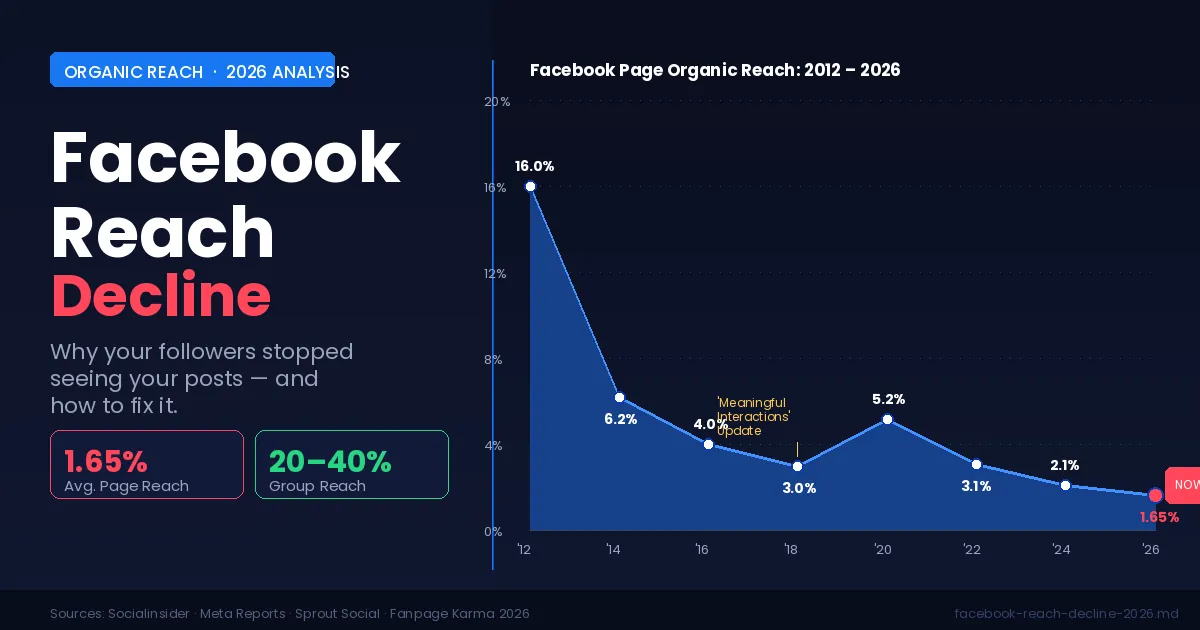
Facebook organic reach has collapsed from around 16% in 2012 to a hard average of 1.65% today, with many business Pages landing below 0.5%. This is not a platform dying — Facebook still has 3.07 billion monthly active users. It is a platform that has fundamentally changed how it distributes content, and most marketers are still operating on a 2018 playbook.
This guide explains exactly why reach fell, how the 2026 algorithm works, and — most critically — what you can do about it right now. No paid ads required for every tactic here.
Why Is Facebook Organic Reach So Low in 2026?
Facebook Page organic reach has been declining since 2014, but the rate of that decline is what most marketers underestimate. In 2026, average organic reach sits at roughly 1.65%–5.9% of Page followers, depending on Page size, niche, and content type — down from over 15% a decade ago.
To make that concrete: a Page with 100,000 followers can expect approximately 2,200 people to see any given post organically — and that estimate assumes the post performs at the mid-range. Post at the wrong time with the wrong format and you are below 1,000.
Three Structural Causes Behind the Drop
1. The “Pay-to-Play” Shift (2012–2018) Facebook began monetizing its News Feed aggressively after its 2012 IPO. More content was competing for limited feed slots. Business Pages, which once had direct access to their followers, started getting systematically downranked. By 2016, organic reach for large Pages had already fallen to single digits.
2. The 2018 “Meaningful Interactions” Update In January 2018, Mark Zuckerberg announced a fundamental change: the feed would now prioritize content from friends and family over brands, publishers, and media companies. This was presented as improving user experience after the Cambridge Analytica scandal. In practice, it crushed organic reach for business Pages overnight. A post that earned strong passive reactions before the update now needed active comments and shares just to reach a fraction of the same audience.
3. The 2024–2026 AI Discovery Engine Transition The most recent — and most misunderstood — shift is the pivot from a Social Graph (showing you content from people you follow) to a Discovery Engine (showing you content the algorithm predicts you will care about). As of 2026, up to 50% of the average user’s feed is recommended content from accounts they do not follow. This means your followers compete not just with each other, but with every piece of content Facebook’s AI thinks is more likely to generate engagement from them.
The algorithm is not punishing your business — it is simply optimizing for user retention. The problem is that most brand content loses that competition badly.
How Does the 2026 Facebook Algorithm Decide What Gets Seen?
Facebook uses a four-step content ranking process: Inventory → Signals → Predictions → Relevance Score. Every piece of content goes through this pipeline for every individual user, and the result is a personalized relevance score that determines feed placement.
Understanding each stage is the difference between guessing and actually moving the needle.
Step 1: Inventory
Facebook catalogues all available content — posts from Pages you follow, friends’ updates, Group posts, Reels, and recommended content from accounts you do not follow. The competition for a single feed slot is enormous. Facebook estimates that, at any given moment, roughly 1,500 posts are competing for each user’s feed.
Step 2: Signals
The algorithm evaluates hundreds of behavioral and content signals. In 2026, the highest-weighted signals are:
- Private shares — when a user sends your post directly to a friend via Messenger or WhatsApp. This is now the single most powerful organic reach signal, outranking likes, reactions, and public shares.
- Saves — bookmarking a post signals high informational value. Facebook’s algorithm treats saves as a quality indicator that expands distribution.
- Comment quality — not just the number of comments, but their depth. The algorithm in 2026 now evaluates whether a comment contributes meaningfully to the conversation, going beyond emoji replies or single-word responses.
- Video completion rate — for Reels and video content, the algorithm tracks whether users watch to the end. A 15-second video that most people finish outperforms a 90-second video that most people abandon.
- Engagement velocity — how quickly a post accumulates comments in its first 30–60 minutes is a strong distribution signal. A post with 10 genuine comments within 30 minutes of publishing will reach 3–5× more people than an identical post that takes 24 hours to generate the same 10 comments.
Step 3: Predictions
Meta’s AI — known internally as the Andromeda update, rolled out progressively from late 2024 — uses deep neural networks to predict specific user actions: Will this person comment? Share privately? Watch to the end? Facebook is not ranking posts. It is ranking predicted user behavior.
In January 2026, Meta also launched the User True Interest Survey (UTIS) model specifically for Reels recommendations. This surveys users in-feed asking whether a video matched their genuine interests — not just whether they stopped scrolling. Internal A/B testing showed a +5.4% increase in high satisfaction ratings and a +5.2% boost in total engagement after the model launched. The point: the algorithm is increasingly separating mindless scroll-stopping from content people actually value.
Step 4: Relevance Score
Your content receives a unique relevance score for every individual user. Two people can open Facebook simultaneously and see completely different feeds from the same creator. If your early-post performance beats the algorithm’s prediction, distribution expands. If it underperforms, the post quietly fades with no notification.
This explains why posting time matters far more than most marketers realize.
What Strategies Actually Recover Facebook Reach in 2026?
After working with multiple brand accounts and studying the 2026 data closely, I found that the pages beating the reach decline share a consistent set of behaviors. They are not posting more — they are posting smarter.
Here is what works, in order of ROI:
1. Switch to a Reels-First Strategy
Meta has unified all video under the Reels category as of mid-2025. Short-form video now receives 22% higher engagement than standard video posts, and Facebook reported that both views and time spent on Reels approximately doubled in the second half of 2025 compared to the same period in 2024.
The critical technical rule: your Reel needs to hook the viewer in the first three seconds. Completion rate is the algorithmic signal that drives distribution. A well-executed 15-second Reel that 80% of viewers finish will consistently outperform a polished 90-second brand video that most people abandon at the 20-second mark.
One more thing that trips marketers up: Facebook Live still delivers the highest reach of any content format — often reaching 10–15% of Page followers — because live video is treated as a time-sensitive community signal. Going live once or twice per week, even for 10 minutes, is one of the fastest ways to restore visibility.
2. Build a Facebook Group Alongside Your Page
This is the single biggest structural mistake I see brands making. Facebook Groups still deliver 20–40% organic reach to members — compared to 1–6% for Pages. The math is brutal: the same 10,000-person audience in a Group would see a typical post reach 2,000–4,000 people. The identical post on a 10,000-follower Page reaches approximately 200–600.
Groups get preferential treatment in the feed because they signal the type of “meaningful interactions” Facebook’s algorithm is explicitly designed to reward. They are one of the last genuine organic reach channels on any major social platform.
The practical approach: create a Group tied to your brand’s niche, not your brand itself. A fitness equipment company does better with “Home Workout Community” than “BrandName Official Group.” Members join communities with shared interests, not corporate spaces.
3. Engineer Engagement Velocity
Post when your most engaged followers are already active. Check your Facebook Insights under “Posts” to see peak activity times for your specific audience — global averages are nearly useless here.
After publishing, respond to every comment within the first 60 minutes. Write detailed replies that invite follow-up — “Thanks!” kills the conversation thread. “Great point — have you also tried [X]? I ask because…” extends it. The algorithm reads active comment threads as high-value signals and expands distribution accordingly.
4. Create “Save-Worthy” Content
Saves are an underutilized lever. Reference-quality content — detailed guides, checklists, step-by-step frameworks, resource lists — prompts users to bookmark posts. Every save signals to Facebook that your content has lasting value, and the algorithm rewards that with wider distribution over a longer post lifespan than typical posts receive.
In testing, posts explicitly designed for saves (formatted as mini-guides or how-tos) consistently outperformed engagement-bait questions on reach metrics, even when the questions generated more raw comments.
5. Post Natively and Keep Users on the Platform
Facebook’s algorithm actively suppresses external links. Data from 2026 shows that 98% of posts US users view contain no link — not because people are not sharing links, but because the algorithm buries them. If you need to drive traffic externally, put the link in the first comment rather than the caption, and reference “link in comments” in the post itself.
For video, never upload a YouTube link. Use native video uploads every time. The algorithm applies a measurable distribution penalty to content that routes users off-platform.
6. Maintain Thematic Consistency
Facebook’s AI scans your last 9–12 posts to define your account’s content identity. If you post about fitness one day, politics the next, and product promotions the day after, the algorithm cannot accurately predict who would be interested in your content — so it reduces your distribution weight as a penalty for unpredictability.
Focus on two core themes maximum. Consistent thematic signals allow the AI to build a precise audience model for your account, which directly increases the reach efficiency of every subsequent post.
7. Use the Hybrid Strategy: Groups for Organic, Pages for Paid
The most effective Facebook marketers in 2026 use a dual-track model. Groups handle organic community building and reach. Pages handle paid advertising, with superior ad targeting tools, custom audiences, and pixel integration that Groups do not offer.
Do not abandon your Page — build it alongside a Group, and cross-promote strategically where platform rules allow.
Pages vs. Groups vs. Reels: What Is Worth Your Time?
The table below summarizes the performance characteristics of each major content surface on Facebook in 2026, based on current benchmark data. Use it to allocate your content effort before deciding where to invest.
| Content Surface | Avg. Organic Reach | Best For | Key Weakness |
|---|---|---|---|
| Facebook Page Post | 1.65%–5.9% of followers | Paid advertising, brand SEO | Lowest organic distribution |
| Facebook Group Post | 20%–40% of members | Community building, organic reach | No ad integration, moderation overhead |
| Facebook Reels | 2–3× more than photo posts | New audience discovery | Requires video production |
| Facebook Live | Up to 10–15% of followers | Real-time engagement, reach spikes | Time-sensitive, requires preparation |
| Link Posts | ~0.5%–1% (lowest category) | External traffic (minimal) | Actively suppressed by algorithm |
| Photo/Carousel Posts | Mid-range | Feed engagement | Lower reach than Reels |
The conclusion from this data is unambiguous. A brand relying solely on Page posts is operating with the most algorithmically disadvantaged content surface available. Adding a Group and Reels strategy is not optional anymore — it is the structural minimum for meaningful organic visibility.
What Are Marketers Getting Wrong About Facebook Reach?
The reach decline conversation is full of myths that lead marketers to waste time on the wrong fixes. Here are the most common ones I encounter, and what the data actually shows.
Myth 1: “Posting more frequently will increase reach.” The 2026 algorithm penalizes overposting. The optimal posting frequency for most Pages is 3–5 high-quality posts per week. Frequent low-quality posts get flagged as “noise,” which reduces your overall account authority score and drags down the reach of future posts — including the good ones.
Myth 2: “More followers means more reach.” Large Pages are actively penalized for scale. A Page with 100,000 followers sees a lower percentage reach than a Page with 5,000 followers. The algorithm prioritizes content from smaller, more specialized Pages as more likely to be genuinely relevant to their specific audience. Building a massive following without a Group or engagement strategy is building a list you cannot reliably reach.
Myth 3: “Likes and reactions are the most important metric.” They are not. As of 2026, the highest-weighted engagement signals are private shares via Messenger, saves, and quality comments — in that order. A post with 200 private shares and 50 deep-comment threads will consistently reach far more people than a post with 500 likes and no comments. Optimizing for likes is optimizing for the wrong metric.
Myth 4: “Engagement bait tactics help reach.” Facebook has a documented enforcement system against engagement bait — posts that explicitly ask for likes, shares, or reactions. Using phrases like “Tag a friend!” or “Like if you agree!” can trigger a distribution penalty. The algorithm is trained to distinguish manufactured engagement from organic conversation, and it is better at this in 2026 than it has ever been.
Myth 5: “Facebook is dying, so it is not worth the effort.” Facebook has 3.07 billion monthly active users in 2026, with projections reaching 3.15 billion by year-end. American adults average 8.2 Facebook sessions per day. The platform is not dying — the free-distribution model is. Those are two entirely different problems with two entirely different solutions.
Frequently Asked Questions
What is the average Facebook organic reach in 2026?
Average organic reach for Facebook Pages sits between 1.65% and 5.9% of followers depending on Page size and methodology, down from over 15% in 2014. Smaller, niche Pages trend toward the higher end of that range, while large Pages with 100,000+ followers often see 2% or below. Facebook Groups remain the exception, consistently delivering 20–40% organic reach to members.
Why did Facebook organic reach drop so much?
Three compounding factors drove the decline: the platform’s post-IPO monetization push starting in 2012, the 2018 Meaningful Interactions update that deprioritized branded content in favor of friends and family posts, and the ongoing shift to an AI-driven Discovery Engine that distributes content based on predicted interest rather than follower relationships. Each update served Facebook’s business model — not marketers’ reach goals.
Does posting more often on Facebook increase reach?
No. More frequent posting typically reduces per-post reach because the algorithm interprets low-engagement posts as noise. Most benchmarks suggest posting 3–5 times per week delivers better average reach than daily posting. Quality and audience-specificity outperform volume in the 2026 algorithm.
What type of content gets the best organic reach on Facebook in 2026?
Facebook Live videos reach the highest percentage of followers (up to 10–15%). Reels come second and deliver the widest non-follower discovery reach, with 22% higher engagement than standard video. Photos and carousels perform mid-range for feed engagement. Link posts receive the lowest organic distribution because Facebook actively suppresses content that routes users off-platform.
Are Facebook Groups better than Pages for organic reach?
Yes, significantly. Groups deliver 20–40% organic reach versus 1–6% for Pages — a 10–15× multiplier on the same audience size. However, Pages remain essential for paid advertising capabilities, brand SEO, and Pixel integration. The highest-performing strategy in 2026 uses Groups for organic reach and Pages for paid campaigns.
What is engagement velocity and why does it matter?
Engagement velocity is the speed at which a post accumulates comments and shares in the first 30–60 minutes after publishing. It is one of the algorithm’s most important early-stage signals. A post that generates 10 genuine comments within 30 minutes reaches 3–5× more people than an identical post that accumulates the same engagement over 24 hours. Posting when your most active followers are online and responding to comments immediately are the two most actionable ways to improve velocity.
Is the Facebook reach decline 2026 affecting all industries equally?
No. Pages in highly conversational niches — personal finance, parenting, health, and local community topics — tend to outperform the average because their content naturally triggers comments and shares. Purely promotional brand content and link-heavy publishing Pages see the sharpest declines. Niche specificity and content that sparks genuine discussion are the two factors that most consistently separate above-average performers from the rest.
Will Facebook reach ever recover to 2014 levels?
It will not for Page posts. The structural monetization model means free distribution to full audiences is incompatible with Facebook’s ad revenue model. However, the overall ecosystem is evolving: referral traffic from Facebook to external publishers reportedly quadrupled year-over-year for some outlets in early 2026 following algorithm adjustments, and Reels continue to expand reach opportunities for video creators. The smart question is not how to restore 2014 reach, but how to get maximum visibility within the current system.
Conclusion
What has changed is that a parallel set of channels — Reels, Groups, engagement velocity, and save-worthy content — now delivers meaningful organic reach for brands willing to rebuild their strategy around the 2026 algorithm rather than the 2016 one.
The Facebook reach decline 2026 is real, measurable, and structural — not cyclical. Business Pages that relied on follower-based organic distribution have lost that channel. It will not return.
The actionable starting point is this: audit your last 30 posts and categorize them by format. If fewer than 30% are native video or Reels, and you have no active Group, those two gaps alone explain the majority of your reach decline. Fix the format mix first. Launch or revive a Group second. Then systematically improve your engagement velocity by posting at peak audience times and responding to every early comment in detail.
Facebook still reaches 3 billion people. The question is whether your content strategy has earned a place in front of them.
From beginner to pro—our step-by-step articles make learning simple.