The internet has a trust problem. Deepfake incidents surged from roughly 500,000 cases in 2023 to over 8 million in 2025 — a 900% increase in two years. At the same time, 74% of consumers now doubt photos or videos even from established news outlets.
Detecting fakes after the fact has become a losing game: AI generators improve faster than classifiers can catch them.
C2PA content credentials take a different approach entirely. Instead of guessing whether an image is real, they attach a cryptographically signed record to the file at the moment of creation — proving exactly who made it, what tools were used, and whether it has been altered since.
This guide explains what C2PA content credentials actually are, how they work technically, which platforms and cameras support them in 2026, and where the system still has genuine weaknesses. No hype — just a clear picture of a standard that’s reshaping media trust.
What Are C2PA Content Credentials?
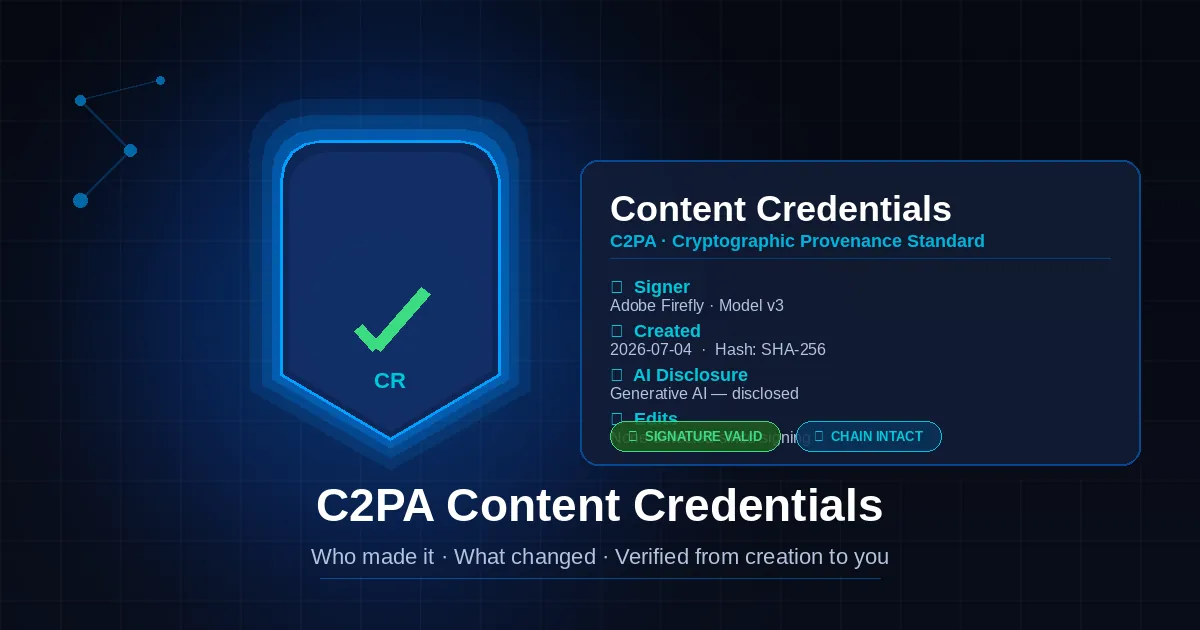
C2PA content credentials are a tamper-evident, cryptographically signed data structure embedded inside a media file — image, video, audio, or document — that records its complete provenance: who created it, when, with what tools, and what edits were made since. Think of them as a digital nutrition label that travels with a file wherever it goes, invisible to casual viewers but verifiable by any compliant application.
The acronym stands for Coalition for Content Provenance and Authenticity. The standard was co-founded in February 2021 by Adobe, Arm, BBC, Intel, Microsoft, and Truepic, and has since grown to more than 6,000 members and affiliates as of January 2026, making it the global reference standard for content authenticity.
Two terms describe the same technology at different levels:
- C2PA Manifest — the technical name for the underlying data structure embedded in the file.
- Content Credentials — the user-facing term for what people actually see: an icon, badge, or information panel showing verified provenance.
The two are interchangeable; the distinction is simply one of audience.
One critical distinction worth getting right from the start: content credentials do not judge whether content is accurate or truthful. They verify that the declared history of the file is intact, tamper-free, and signed by an identifiable entity. The standard certifies chain of custody — not the truth of what the camera or AI was pointed at. A photo can carry a perfectly valid credential and still misrepresent a situation. That constraint matters enormously when evaluating what the system can and cannot do.
The C2PA specification is published as an open, royalty-free standard under the Joint Development Foundation. The current version is C2PA 2.4. Version 2.3, published in December 2025, extended provenance to live video streaming via CMAF segment signing.
How Do C2PA Content Credentials Work?
The C2PA workflow operates in three sequential stages — signing, embedding, and verification. Each stage is technically distinct, and understanding all three reveals both the system’s genuine strengths and its real-world vulnerabilities.
Step 1 — Signing
A Claim Generator — a camera, a piece of software, or an AI platform — assembles a set of assertions about the asset. Assertions are structured statements recording facts such as: when and where content was created, what editing actions were performed, whether AI was involved in creation or enhancement, and who the creator is.
These assertions are bundled into a Claim, which is cryptographically signed using the signer’s private key via the COSE (CBOR Object Signing and Encryption) format. The signer’s X.509 certificate — issued by a Certificate Authority on the C2PA Trust List — travels inside the signed bundle. The asset itself is then hashed using SHA-256, creating a hard binding that cryptographically ties the manifest to the file’s exact byte sequence.
Step 2 — Embedding
The signed manifest is packaged into a JUMBF container (JPEG Universal Metadata Box Format) and embedded directly inside the media file. JUMBF supports JPEG, PNG, MP4, PDF, WebP, AVIF, HEIC, and other common formats. For formats that don’t natively support embedded metadata, a sidecar file carries the manifest alongside the asset.
Step 3 — Verification
When a user opens content in a C2PA-enabled application, the verifier:
- Reads the embedded manifest from the file container.
- Checks the cryptographic signature against the included certificate chain.
- Validates that certificate against the C2PA Trust List.
- Verifies that the SHA-256 hard binding still matches the current file.
If even a single pixel has been altered without a new signed manifest being created, the hash will not match — and the tampering is immediately detectable. Any modification, intentional or accidental, breaks the cryptographic linkage.
Critically, all required certificates travel inside the manifest itself. Verification requires no network call to the original signer. A journalist in a low-connectivity environment can verify a file’s provenance offline just as reliably as a platform with full internet access.
Hard Binding vs. Soft Binding
The specification supports two types of cryptographic binding:
| Binding Type | How It Works | Tamper Detection | Survives Transcoding? |
|---|---|---|---|
| Hard binding | SHA-256 hash of the full file bytes | Any change breaks it | No |
| Soft binding | Perceptual hash or invisible watermark | Survives minor edits | Yes (by design) |
Hard binding provides stronger tamper-evidence. Soft binding — which the specification calls Durable Content Credentials — trades some security rigidity for survivability through real-world distribution pipelines that compress, resize, or reformat files.
When content is edited and a new manifest is created, the old manifest becomes an ingredient reference inside the new one. This chains the edit history into a traceable provenance record across the full life of the asset.
Who Actually Uses Content Credentials Today? Real Adoption in 2026
Adoption in 2026 is genuine but uneven. The C2PA Conformance Program — launched in mid-2025 — maintains a public registry of products that have passed conformance testing, which is the authoritative source for distinguishing real implementation from marketing announcements.
AI Platforms
Adobe Firefly embeds C2PA credentials in all AI-generated output. Every Creative Cloud product — Photoshop, Lightroom, Illustrator — writes content credentials automatically, making Adobe the most comprehensive implementation in the ecosystem.
OpenAI (DALL-E 3, Sora) embeds C2PA metadata in supported generated media. As of May 2026, OpenAI pairs C2PA with SynthID watermarking as a layered approach, because metadata alone is not always durable through distribution pipelines.
Google Imagen embeds C2PA credentials on AI-generated images. Google is rolling out C2PA verification across Gemini, Search, and Chrome. Google Photos can also display compatible provenance information for supported files.
Midjourney is a notable gap: it does not embed C2PA credentials as of mid-2026, despite being one of the most widely used AI image generators. That absence is a significant coverage hole given its user base and output volume.
Cameras and Hardware
- Leica M11-P — Hardware-level signing since October 2023. The first production camera to ship with native C2PA support.
- Google Pixel 10 — Hardware-backed signing via the Titan M2 security chip. Every photo is signed by default.
- Sony α9 III and α1 II — Cloud signing via Sony Imaging Edge. Opt-in per shoot.
- Samsung Galaxy S25 — Signs AI-edited photos. The first mass-market consumer smartphone with native C2PA capability, representing a meaningful shift from professional-only adoption toward mainstream use.
- Nikon Z6 III — Added via firmware in August 2025, then suspended after a signing vulnerability was discovered. Certificates were revoked and the service had not been restored as of early 2026. It serves as a cautionary case in implementation security.
Social Platforms
LinkedIn displays a “CR” icon on images carrying content credentials, which users can click to see the provenance summary. TikTok adopted content credentials in partnership with the Content Authenticity Initiative, applying an “AI-generated” label to videos whose C2PA manifest declares AI generation. Both are genuine adoptions, not just announcements.
Regulatory Tailwinds
Regulation is now the most powerful forcing function in C2PA adoption:
- EU AI Act Article 50 enforcement begins August 2026, requiring machine-readable disclosure on AI-generated content — a requirement that C2PA’s AI assertion type directly satisfies.
- California SB 942 took effect January 2026.
- U.S. Digital Authenticity and Provenance Act (2025) mandates content provenance disclosure in federally regulated media contexts.
- U.S. CISA endorsed content credentials in a January 2025 advisory as a key countermeasure against synthetic media threats.
For organizations producing AI-generated content for public distribution, the compliance clock is already running.
Common Myths and Real Limits: What C2PA Cannot Do
Understanding the genuine limitations of content credentials matters as much as understanding the technology itself. There is meaningful overclaiming in this space.
The Metadata Stripping Problem
The most significant real-world limitation of C2PA is infrastructural, not technical. Standard social media and content distribution pipelines strip embedded metadata during upload, transcoding, and re-encoding. This happens because platforms routinely recompress and reformat media as part of normal processing — it is not deliberate suppression.
A platform can officially “support” content credentials while still stripping them in practice. A simple screenshot eliminates any trace of provenance entirely. The RAND Corporation highlighted this structural tension in a June 2025 analysis, noting that the system’s success requires end-to-end compliance across an open ecosystem — a condition that is realistically difficult without regulatory enforcement.
OpenAI’s decision to pair C2PA with SynthID watermarking exists precisely because of this problem: watermarks embedded in pixel data survive format changes that strip manifest metadata.
C2PA vs. EXIF vs. AI Watermarking
| Feature | EXIF / IPTC | AI Watermarking (SynthID) | C2PA Content Credentials |
|---|---|---|---|
| Cryptographic tamper detection | ✗ | ✗ | ✓ |
| Editable without trace | ✓ (trivially) | Partial | ✗ |
| Survives transcoding | ✓ | ✓ | Soft binding only |
| Offline verification | ✗ | ✗ | ✓ |
| Alters visual content | ✗ | No (imperceptible) | ✗ |
| Full edit chain history | ✗ | ✗ | ✓ |
| AI disclosure support | ✗ | Limited | ✓ (native assertion) |
| Human-readable provenance | Partial | ✗ | ✓ |
The table makes clear why OpenAI’s layered approach (C2PA + SynthID) is rational: each method compensates for weaknesses in the other.
Four Myths, Corrected
Myth 1: “A valid credential means the content is real.” A valid credential means the declared history is intact and signed by a known entity. C2PA confirms a device signed a file at a point in time — it cannot verify the camera was pointed at what the caption claims. Provenance and truth are not the same thing.
Myth 2: “C2PA detects deepfakes.” C2PA asserts positive provenance. It does not analyze pixels or audio to detect manipulation. It is a chain-of-custody system, not a content classifier.
Myth 3: “No credential means the content is fake.” Absence of credentials is essentially meaningless in isolation. Enormous amounts of legitimate older content, screenshots, and transcoded files carry no credentials. Treating unsigned content as suspect without other evidence is not a defensible position.
Myth 4: “C2PA manifests cannot be forged.” Researchers at Hacker Factor demonstrated, using publicly available tools, that a valid forged manifest attributed to a named individual could be created. A separate demonstration showed an AI-generated image being signed by a C2PA-enabled camera with no photographic provenance. The C2PA Trust List and conformance program are designed to limit this risk, but both attack vectors are documented. A valid credential from an unrecognized or low-assurance signer warrants appropriate skepticism.
Frequently Asked Questions
What is the difference between C2PA and content credentials? C2PA is the technical specification — the open standard defining how provenance metadata is structured, signed, and embedded in files. Content credentials is the user-facing term for the same system. Technically, a content credential is a C2PA Manifest. Both refer to the same underlying technology; the distinction is one of technical precision versus plain language.
Can content credentials be removed or destroyed? Yes, and frequently are. Standard platform transcoding, format conversion, resizing, and screenshots all strip C2PA manifests. Durable Content Credentials address this by pairing the manifest with invisible watermarking and content fingerprinting, enabling credential recovery from a manifest repository even after the embedded data is lost. This resilience requires the manifest to have been stored in a repository at creation time.
Does C2PA verification work offline? Yes, by design. All required X.509 certificates travel inside the manifest itself. A validator can verify provenance with no network call to the original signer — which makes it well-suited for newsrooms, courtrooms, and environments where connectivity is limited or the original platform is unavailable.
Does adding content credentials expose my personal data or GPS location? Not necessarily. GPS coordinates are optional and can be omitted entirely or generalized. Creators control which assertions are included. Fields can also be redacted after signing, with the redaction itself recorded in the manifest to preserve chain of trust without exposing the underlying data.
Which cameras support C2PA content credentials in 2026? Confirmed support as of mid-2026: Leica M11-P (hardware signing, since October 2023), Google Pixel 10 (hardware-backed via Titan M2, every photo signed by default), Sony α9 III and α1 II (cloud signing, opt-in), and Samsung Galaxy S25 (AI-edited photos). Nikon’s Z6 III implementation was suspended following certificate revocation in late 2025.
Is C2PA required by law? In some jurisdictions and for some content types, yes. EU AI Act Article 50 enforcement begins August 2026 for machine-readable AI content disclosure. California SB 942 took effect January 2026. The U.S. Digital Authenticity and Provenance Act (2025) mandates provenance disclosure in federally regulated media contexts. For organizations producing AI-generated content at scale, compliance is no longer optional in these jurisdictions.
How does C2PA differ from AI watermarking systems like SynthID? They solve different aspects of the same problem, which is why they are increasingly used together. C2PA attaches a structured, verifiable metadata record to the file container — a cryptographic chain of custody with human-readable provenance assertions. SynthID embeds imperceptible signals directly into pixel data, which survive format changes that strip metadata. Each compensates for weaknesses in the other; the emerging best practice is to apply both.
How do I check if an image has content credentials? Upload any image, video, or PDF to the public C2PA verification tool at contentcredentials.org/verify. It reads the manifest, verifies the cryptographic signature, and displays the full provenance summary. No account or installation required.
Conclusion
C2PA content credentials are not a complete solution to the synthetic media problem — but they are the most technically coherent answer the industry has produced. The standard gives every media file a cryptographically verifiable chain of custody, from the moment of creation through every subsequent edit, to the end viewer.
In examining this ecosystem closely, the pattern that becomes clear is this: the signing infrastructure is mature and increasingly accessible — any Adobe Creative Cloud user or Google Pixel 10 owner can now produce credentialed content. The unsolved gap is preservation through distribution. Metadata gets stripped. Screenshots eliminate provenance. Most social platforms process files in ways that break the chain. Durable Content Credentials and regulatory pressure from the EU AI Act are the most likely forcing functions to close that gap.
For journalists, photographers, brands, and anyone producing or verifying media at scale in 2026: content credentials are worth understanding — not as a guarantee of authenticity, but as a meaningful layer of evidence in an environment where visual trust has become structurally fragile.
Your next step: upload an image to contentcredentials.org/verify to see whether it carries provenance data and what that data says. The tool is free, requires no account, and works on images, videos, and PDFs.
Your time is valuable—our high-impact content makes every second count.