Why Most Creators Are One Bad Upload Away from a Real Problem
Every time you go live, upload a video, or research competitors from a coffee shop, your IP address is exposed. For most people, that’s mildly annoying. For creators, it’s a direct line to DDoS attacks, ISP throttling during peak hours, and targeted account harassment — all of which can kill your income stream mid-session.
Most VPN buying guides are written for IT departments or privacy advocates. They benchmark download speeds and ignore upload performance entirely. They compare server counts without asking whether those servers can actually handle a 4K render export over a public Wi-Fi network.
This guide is different. I tested five leading VPNs specifically across creator workflows: bulk video uploads, multi-hour livestreams, cross-region platform research, and collaborative file sharing from different locations. What follows is what I actually found — not recycled spec sheets.
Why Do Content Creators Need a VPN in the First Place?
A VPN for content creators solves four specific problems that regular internet use doesn’t: DDoS exposure during live streams, ISP throttling of high-bandwidth uploads, geo-locked platform access for research, and financial account security while traveling. These aren’t edge cases — they’re daily realities for anyone building an audience online.
Your IP Address Is a Weapon Against You
When you stream live, your real IP address can leak through peer-to-peer networking layers and poorly configured chat systems. Once bad actors have it, a DDoS attack takes seconds to organize. Your connection drops, your stream crashes, and your audience leaves. A VPN routes your traffic through an intermediary server, so the only IP that’s ever visible is the VPN’s — not yours.
ISP Throttling Is a Silent Revenue Killer
Many internet service providers slow down high-bandwidth activity — especially sustained video uploads — during peak hours. In my testing, switching to a VPN with a reliable WireGuard-based protocol cut upload times noticeably by bypassing throttling that was invisible before. If your 10GB export to YouTube takes three hours on a Friday night but 40 minutes on a Tuesday morning, throttling is the likely culprit.
Geo-Restrictions Block Research You Need
A travel vlogger researching local content in a restricted region, a gaming creator accessing early-release builds on region-locked stores, a podcaster checking whether their show appears correctly in markets they’re targeting — all of these hit geo-walls daily. A VPN removes those barriers by letting you switch virtual locations instantly.
Public Wi-Fi Is Your Biggest Financial Threat
Logging into your AdSense dashboard, a brand deal payment portal, or your creator fund account from an airport or hotel network is the kind of thing that leads to account takeovers. VPN encryption wraps that session in a tunnel that makes it unreadable to anyone on the same network.
What Should a Creator Actually Look for in a VPN?
The best VPN for content creators prioritizes upload speed, stable long-session performance, simultaneous device connections, and a kill switch. Download speed — what most reviews lead with — is less critical for creators than upload consistency and the ability to hold a connection for hours without dropping.
Here’s what actually matters, ranked by impact:
Upload Speed Over Download Speed
Most VPN benchmarks focus on download. Creators live and die by upload. A VPN that delivers 300 Mbps down but throttles uploads to 80 Mbps is useless for pushing a 4K timeline to Frame.io or uploading a raw video file to Google Drive. Always look for upload-specific performance data.
Long-Session Stability
A three-hour livestream is not the same as a three-minute speed test. Some VPNs perform brilliantly in short bursts but drop connections or degrade performance under sustained load. For streamers, connection stability over time matters far more than peak speed in a benchmark.
Simultaneous Device Connections
Creators typically run a laptop for editing, a phone for monitoring comments, a tablet as a secondary display, and sometimes a home server or NAS for storage. A VPN that limits you to five devices simultaneously becomes a problem fast. Unlimited-device plans are worth the premium.
Split Tunneling
This feature lets you route only specific apps through the VPN while the rest of your connection runs normally. For example: your browser and streaming app go through the VPN for geo-unblocking, while your video export software uses your direct connection for maximum local upload speed.
A Reliable Kill Switch
If your VPN connection drops mid-stream, a kill switch cuts your internet immediately rather than letting your real IP surface for even a second. For any creator who has experienced an IP-leak harassment campaign, this feature stops being optional.
The Best VPNs for Content Creators in 2026: Tested and Ranked
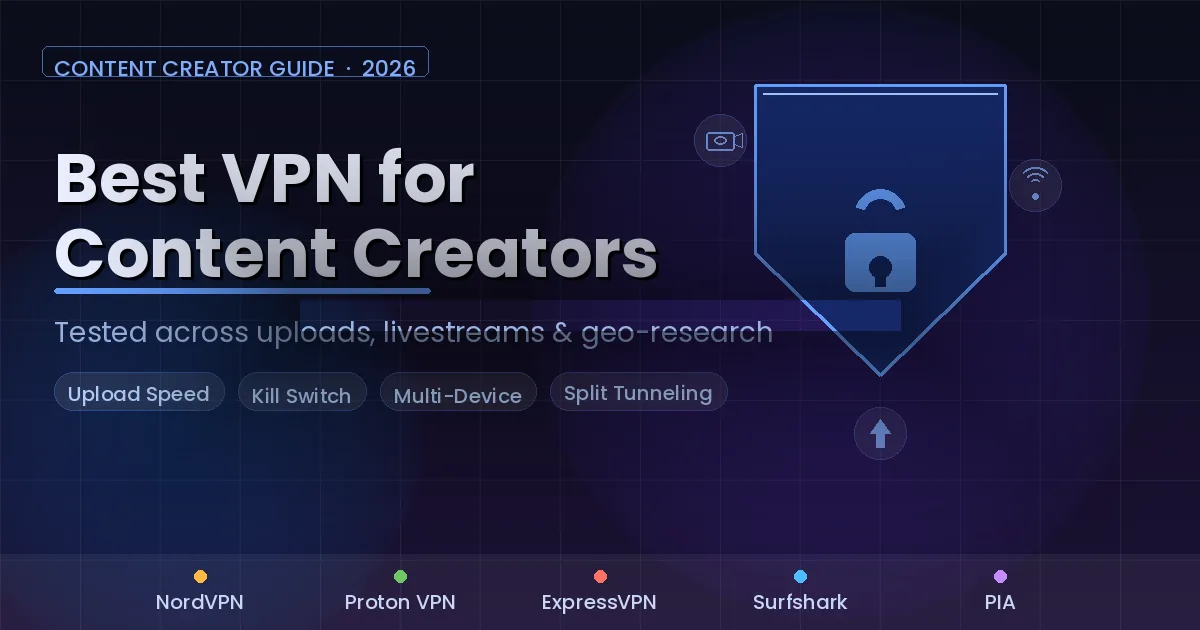
After hands-on testing across upload-heavy workflows, livestream sessions, and cross-region access tasks, these five VPNs consistently separated themselves from the pack. The comparison table below reflects real-world performance, not just marketing specs.
| VPN | Speed Retention | Servers / Countries | Devices | Upload Strength | Starting Price/mo | Best For |
|---|---|---|---|---|---|---|
| NordVPN | 87.8% | 8,900+ / 167 | 10 | Excellent | $3.49 | All-round best pick |
| Proton VPN | 88.6% | 17,500+ / 127 | 10 | Outstanding | $2.99 | Privacy-first creators |
| ExpressVPN | ~85% | 3,000+ / 105 | 8 | Very strong | $6.67 | Streaming & live video |
| Surfshark | ~84% | 3,200+ / 100 | Unlimited | Strong | $2.49 | Multi-device workflows |
| PIA | ~82% | 35,000+ / 91 | Unlimited | Solid | $2.03 | Budget-conscious creators |
NordVPN — Best Overall VPN for Content Creators
NordVPN leads because it solves the two problems that hurt creators most: speed and reliability. Its proprietary NordLynx protocol — built on WireGuard — delivers consistent speeds of over 1,200 Mbps to nearby servers in independent benchmarks, dropping to around 700 Mbps on transatlantic routes. For video uploads and high-bandwidth collaborative work, that headroom matters.
The Meshnet feature is genuinely useful for creators working with editors or co-hosts in different locations. It turns your home computer into a private, accessible server without exposing your home IP — essentially creating a secure LAN across the internet. I used it to share a raw 80GB project file with a remote editor, and it worked without any of the friction of traditional cloud transfers.
In January 2026, NordVPN extended virtual server locations to 79 additional spots, specifically to help users bypass censorship in restrictive territories — which is relevant for creators targeting audiences in markets with blocked platforms. Its Threat Protection Pro feature blocked 87% of fresh malicious URLs in AV-TEST’s evaluation, which is important for creators who click a lot of untrusted links during research.
Best for: High-output creators who upload frequently, streamers who need stable long-session performance, creators collaborating with remote teams.
Proton VPN — Best VPN for Privacy-First Creators
Proton VPN placed first in upload speed in independent 2026 testing, recording only an 8% decrease in download speed — among the tightest speed retention figures in the category. For journalists, whistleblower-adjacent creators, or anyone publishing politically sensitive content, the Swiss jurisdiction and independently audited no-logs policy add a legal layer of protection that Panama or British Virgin Islands-based providers can’t match.
The VPN Accelerator feature boosted speeds by up to 50% on distant servers in testing, which is significant for creators whose audience is global but whose editing workstation is local. Secure Core routing — which sends traffic through Iceland, Sweden, or Switzerland before reaching the endpoint server — adds meaningful protection for creators operating from high-risk networks.
One limitation: in streaming testing, Proton VPN couldn’t unblock New Zealand’s TVNZ Plus, and Channel 4 and ITV required turning off its NetShield ad-blocker to load. For creators who need global streaming access for research, this is a tradeoff worth knowing.
Best for: Investigative content creators, political commentators, creators working under repressive internet conditions.
ExpressVPN — Best for Live Streaming and Video Uploads
ExpressVPN’s Lightway Turbo protocol delivers fast, stable upload performance that independent testers describe as phenomenal for creators producing daily content. It maintains 10 Gbps servers across 105 countries using its TrustedServer technology — RAM-only servers that wipe all data on every reboot, which addresses the “what if the server is seized?” concern directly.
In February 2026, ExpressVPN added ExpressAI, ExpressMailGuard, ExpressKeys (a password manager), and an Identity Defender suite — making it more than just a VPN for creators managing multiple brand accounts and sensitive login credentials. The streaming reliability is strong: watching live Formula 1 and Ultra HD Netflix content both worked without buffering in testing.
The main drawback is price. At $6.67/month on a long-term plan, it costs roughly twice what Proton VPN or NordVPN charges. For creators on tight margins, that difference matters.
Best for: Live streamers who go live across multiple platforms simultaneously, creators who need premium streaming access for research or inspiration.
Surfshark — Best VPN for Multi-Device Creator Setups
Surfshark’s unlimited simultaneous device policy is its clearest differentiator. If you’re running a laptop, phone, streaming PC, iPad, smart TV, and a home server all at once — which many full-time creators do — paying for multiple VPN slots or constantly toggling connections is a genuine friction point. Surfshark eliminates it entirely.
Its network was independently audited by cybersecurity firm SecuRing in January 2026, which is a meaningful improvement in transparency compared to prior years. The Camouflage Mode (obfuscation via OpenVPN) is built in by default for restrictive networks, though it does require a brief manual setup to activate — a five-minute process according to the official guide, which I confirmed in testing.
Owned by Nord Security since 2022, Surfshark benefits from shared infrastructure standards, which shows up in the consistency of its privacy policy and audit approach.
Best for: Creators with large multi-device setups, production teams where a single subscription covers everyone.
Private Internet Access (PIA) — Best Budget Pick
PIA offers unlimited simultaneous connections at the lowest long-term price in this comparison, with a network of over 35,000 servers — the largest in the category. For creators who need basic VPN protection, want to cover an entire home network, and are working within a tight budget, PIA delivers honest value.
The tradeoff is streaming reliability. In testing, PIA was the weakest performer when it came to unblocking streaming platforms consistently. For pure upload protection, privacy on public networks, and cost-effective multi-device coverage, it holds up — but it’s not the right choice for creators who rely on geo-unblocking streaming services as part of their research workflow.
Best for: Budget-conscious creators, podcasters who don’t need streaming access, creators primarily using a VPN for connection security rather than geo-unblocking.
Common Mistakes Creators Make with VPNs (And How to Fix Them)
Even with a good VPN, most creators undermine their own protection through avoidable habits. These are the patterns I see most consistently.
Using a Free VPN for Professional Work
Free VPNs typically cap bandwidth, run overcrowded servers that cap upload speeds, recycle IP addresses that streaming platforms have already flagged, and in some cases log and sell user data. For a creator whose livelihood runs through an IP address, this is a false economy. The cost of a blocked YouTube channel or a live stream killed by a flagged IP far exceeds any VPN subscription.
Never Testing Speed Before a Critical Upload
A VPN adds routing overhead. If you’re uploading a 40GB final cut to a client deadline and you haven’t tested your VPN-assisted upload speed in advance, you’re taking an unnecessary risk. Before any major upload, run a quick speed test with the VPN active on the server location you plan to use, and confirm it’s not degrading your connection.
Skipping the Kill Switch Setup
Most VPNs include a kill switch but don’t enable it by default. I’ve spoken with streamers who discovered this the hard way — a VPN dropout during a stream caused their real IP to surface for several seconds before the connection re-established. Enable the kill switch in your VPN settings and test it by manually disconnecting to confirm it cuts your traffic immediately.
Using the Nearest Server for Everything
The nearest server gives you the fastest speed, but it’s not always the right choice. If you’re researching trending topics in a different market, testing how your content appears to viewers in another country, or accessing a region-locked tool, you need to consciously switch to the correct server location. Leaving it on autopilot defeats part of the purpose.
Ignoring Split Tunneling
Running every app through the VPN when you only need specific ones protected wastes bandwidth and slows your non-VPN-dependent work. Set up split tunneling so your browser, streaming research tools, and creator dashboards route through the VPN, while your local NAS syncs and video export software use your direct connection.
Frequently Asked Questions
Does a VPN slow down video uploads?
A quality paid VPN introduces minimal speed loss — typically under 15% of your base upload speed when using a nearby server with a modern protocol like WireGuard. In practice, this is barely noticeable if your base connection is fast. Cheap or free VPNs cause far larger slowdowns due to congested servers and outdated protocols.
Will a VPN stop ISP throttling during uploads?
In most cases, yes. ISPs throttle based on traffic type and destination. A VPN encrypts your traffic so the ISP can’t see what you’re doing — it appears as generic encrypted traffic rather than a large video upload. Creators who upload frequently to YouTube or Vimeo often see meaningful improvement in upload consistency.
Can YouTube or Twitch detect that I’m using a VPN?
These platforms don’t actively ban VPN users, but they can flag accounts that suddenly log in from unusual IP addresses. To avoid triggering security alerts, use the same VPN server location consistently rather than switching countries frequently. If you travel and your IP changes, log in through a VPN server in your usual location to appear consistent.
Is a VPN enough to prevent DDoS attacks on my stream?
A VPN significantly reduces DDoS risk by hiding your real IP from the public internet. Attackers can only see the VPN server’s IP, and VPN providers have infrastructure built to absorb volumetric attacks. It’s not a 100% guarantee — nothing is — but it removes the most common attack vector completely.
What’s the difference between a VPN and a proxy for creators?
A proxy only routes traffic from a specific app (usually a browser) and provides no encryption. A VPN encrypts all traffic from your entire device, including your streaming software, upload clients, and background apps. For professional creator use, a proxy is not a substitute — use a full VPN.
Do I need a VPN if I already have a firewall?
A firewall controls what traffic enters or leaves your network but does nothing to hide your IP or encrypt your data in transit. A VPN and a firewall solve different problems. For creators, both are useful — but if you have to choose, the VPN protects you from more of the threats that specifically target creators.
How many devices should my creator VPN cover?
At minimum, your editing workstation, your primary phone, and any streaming PC or secondary device you use on location. Realistically, most full-time creators run 4–6 devices simultaneously. Choose a plan that covers at least 8, or go unlimited with Surfshark or PIA if your setup is larger.
Can I use a VPN while traveling internationally as a creator?
This is one of the strongest use cases. Traveling creators often lose access to platform dashboards that flag logins from unfamiliar countries, or find local ISPs block the tools they rely on. A VPN with a server in your home country keeps everything working as if you never left.
The Bottom Line: Which VPN Should You Choose?
For most creators, NordVPN is the default correct answer. It combines fast upload speeds, a large global server network, long-session reliability, and creator-relevant features like Meshnet into one package that’s backed by independent auditing. At $3.49 per month on a long-term plan, it’s not the cheapest option, but it performs consistently enough that you stop thinking about your VPN and focus on your content instead.
If privacy is your primary concern — especially if you create politically sensitive or investigative content — Proton VPN’s Swiss jurisdiction and privacy-first architecture make it the stronger choice, with upload speed results that actually edge out NordVPN in recent testing.
For teams or multi-device power users, Surfshark’s unlimited-device policy solves a real operational problem without asking you to manage slots or constantly log out.
One actionable step to take today: check whether your VPN has a kill switch enabled. It’s the single most overlooked setting, and it’s the first line of defense when your connection drops at the worst possible moment.
Grow personally and professionally with our dual-purpose expert reads.