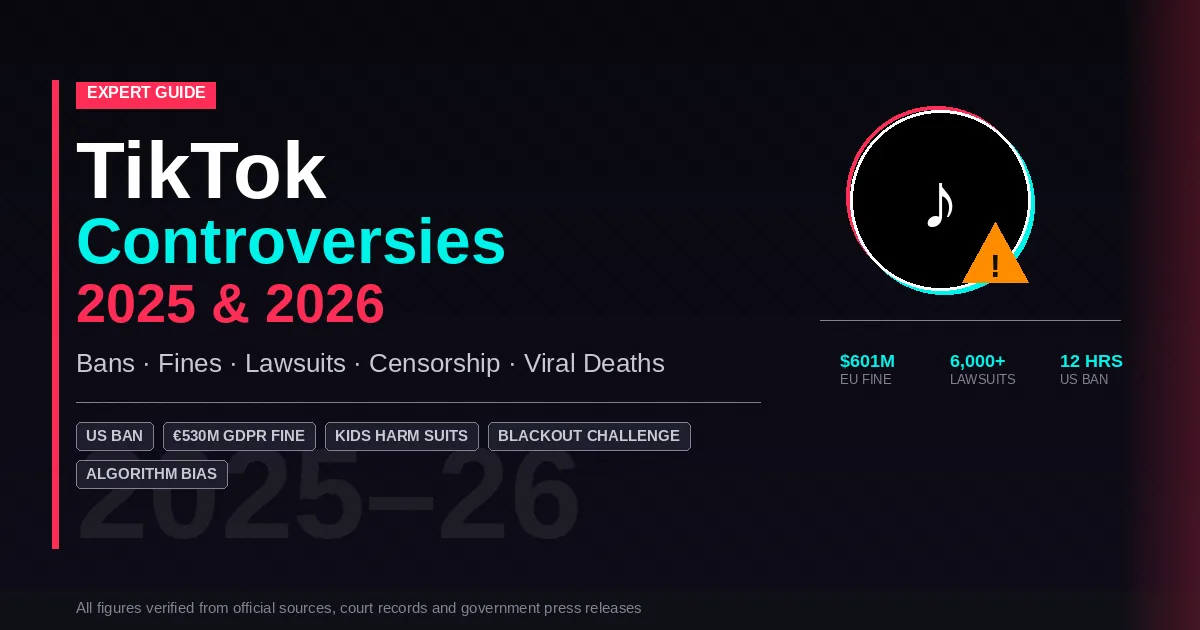
At 10:30 PM on January 18, 2025, TikTok went dark across the United States. For roughly 12 hours, 170 million American users saw a single message: “Sorry, TikTok isn’t available right now.” What followed was one of the most turbulent years in social media history — a year of billion-dollar fines, landmark legal settlements, deadly viral challenges, a $14 billion sale, and political censorship accusations that outlasted the ownership change itself.
TikTok’s controversies between 2025 and 2026 did not arrive from nowhere. They are the convergence of unresolved national security debates, long-delayed regulatory enforcement, and a growing legal consensus that the app’s algorithm caused measurable harm to millions of children. This guide covers every major controversy with verified timelines, confirmed figures, and the context that most coverage misses.
What Actually Happened During the US TikTok Ban?
The US TikTok ban lasted 12 hours on paper and roughly a year in legal limbo — then ended with a $14 billion sale that may not have solved the problem it was designed to fix.
The legal foundation was the Protecting Americans from Foreign Adversary Controlled Applications Act (PAFACA), signed by President Biden in April 2024. It gave ByteDance a deadline: sell TikTok’s US operations to non-Chinese owners or face a complete ban. ByteDance declined to sell. The Supreme Court heard TikTok v. Garland on January 10, 2025, and on January 17 unanimously upheld the law in a per curiam decision. One day later, TikTok voluntarily shut down. Apple and Google removed the app from their US stores.
The shutdown lasted until newly elected President Trump signaled he would delay enforcement after taking office. TikTok restored service in under 12 hours. Trump then signed five separate executive orders extending non-enforcement — dated January 20, April 4, June 19, September 16, and September 25 of 2025 — buying time for a divestiture deal to close.
On January 22, 2026, the deal was finalized. A consortium of investors including Oracle, Silver Lake, and the Emirati investment firm MGX acquired majority control, forming a new US entity called TikTok USDS. ByteDance retained less than 20% ownership. The sale was valued at approximately $14 billion. Trump credited himself with “saving TikTok” in a Truth Social post.
The controversy did not close with the sale. Lawmakers from both parties questioned whether a structure that left ByteDance’s core recommendation algorithm IP under a licensing agreement in Beijing actually satisfied the law’s intent. The algorithm — the engine at the center of every national security concern — remained technically outside US control. Meanwhile, the new ownership brought its own censorship accusations within days (covered below).
The RedNote Irony: In the days before the January 19 shutdown, hundreds of thousands of American users migrated to Xiaohongshu, known as RedNote in English — a Chinese app operating entirely under Beijing’s legal jurisdiction with no data protection equivalent to Project Texas. At its peak, analytics firms estimated RedNote gained around 3.4 million daily active US users. Americans were protesting Chinese data surveillance by flooding a Chinese platform with fewer safeguards than TikTok itself.
Why Did Europe Fine TikTok $601 Million Over Data?
In May 2025, Ireland’s Data Protection Commission (DPC) — TikTok’s lead GDPR regulator in Europe — issued a €530 million ($601 million) fine for illegal data transfers to China. It was TikTok’s largest regulatory penalty to date, and the circumstances made the fine harder to defend than the figure alone suggests.
The investigation began in September 2021 and focused on TikTok’s transfer of European Economic Area (EEA) user data to servers accessible by ByteDance staff in China. The DPC’s Deputy Commissioner Graham Doyle found that TikTok failed to verify that Chinese authorities could not access EEA users’ data under Chinese anti-terrorism and counter-espionage laws — laws that the DPC described as “materially diverging” from EU standards.
The element that elevated the fine beyond routine enforcement: TikTok had initially told regulators it did not store EEA user data on Chinese servers. In February 2025, while the investigation was still active, TikTok disclosed to the DPC that a system issue — identified internally — had resulted in limited EEA data being stored in China after all. The regulator documented TikTok’s earlier inaccurate statements in its final ruling.
TikTok disputed the findings and announced it would appeal, citing its “Project Clover” initiative as evidence of its commitment to European data protection. The DPC ordered TikTok to suspend Chinese data transfers within six months or face further consequences.
This was TikTok’s second significant European penalty in two years. The 2023 fine of €345 million covered children’s data privacy violations — specifically, TikTok making accounts public by default for users aged 13–17 and operating inadequate age verification. Combined, European regulators have now extracted close to €900 million from TikTok in under three years.
Summary of TikTok’s Major European Regulatory Penalties
| Fine | Regulator | Year | Amount | Core Violation |
|---|---|---|---|---|
| Children’s Privacy | Ireland DPC | 2023 | €345M | Public-by-default teen accounts, weak age verification |
| Children’s Privacy | UK ICO | 2023 | £12.7M | Allowing under-13s on platform, data mishandling |
| EEA Data Transfers to China | Ireland DPC | 2025 | €530M | Sending European data to China, misleading regulators |
What Do the Children’s Mental Health Lawsuits Reveal About TikTok?
More than 40 US states have now sued TikTok and ByteDance, and over 6,000 lawsuits from individuals, families, and school districts are active in federal and state courts. The cases collectively accuse TikTok of engineering addiction in children and concealing what internal research showed.
The internal documents themselves are the most damaging evidence. An August 2025 unsealing of video clips from TikTok’s own internal meetings showed employees expressing concern about the platform’s design. In one clip, a former TikTok employee acknowledged: “We do, in a way, encourage some of this content being put up just because of the way the platform is designed. And sometimes I worry about that.”
State filings have cited a specific internal data point that courts have found significant: TikTok’s own researchers determined that after a user watches approximately 260 videos — achievable in under 35 minutes given TikTok’s autoplay speed and short clip lengths — they are “likely to become addicted to the platform.” TikTok knew the threshold and continued optimizing for it.
The legal timeline from 2025 to mid-2026 moved quickly:
- August 2025 — Minnesota Attorney General Keith Ellison sued TikTok in Hennepin County District Court, alleging it preys on the neurodevelopmental vulnerabilities of teenagers and illegally exploits minors through its virtual coin economy.
- September 2025 — The US 9th Circuit Court of Appeals upheld most of California’s Protecting Our Kids from Social Media Addiction Act, preserving requirements that social media platforms offer private modes for minors and limit algorithmic feed exposure.
- November 2025 — Unsealed court filings in a major school district lawsuit quoted an internal TikTok report stating that “minors do not have executive mental function to control their screen time” — knowledge the suit alleged TikTok acted on for engagement purposes rather than safety.
- December 2025 — Hawaii sued ByteDance, alleging TikTok deployed endless scrolling and constant notifications to trap young users while misrepresenting the mental health risks to parents.
- January 2026 — Six US families filed wrongful death suits alleging their children, aged 11–17, died from the Blackout Challenge after TikTok’s algorithm specifically served them related content.
- May 2026 — ByteDance settled with Breathitt County Schools in Kentucky for $8 million — a fraction of the $60 million the district sought to cover 15 years of mental health services it argues TikTok made necessary.
- July 1, 2026 — TikTok reached a confidential settlement with a 15-year-old Florida teenager, identified in filings only as R.K.C., who began using social media at age 8 and alleged the platforms caused compulsive use, depression, and anxiety. The settlement removed TikTok from a high-profile California trial that had been scheduled to begin that month.
The pattern is becoming clear: TikTok is settling cases before they reach juries. In March 2026, a California jury found Meta and YouTube negligent in a similar addiction case, ordering Meta to pay $4.2 million and Google $1.8 million. Avoiding jury verdicts that could set broad legal precedent appears to be TikTok’s current strategy.
How Has TikTok Been Accused of Political Bias and Censorship?
TikTok’s content moderation has drawn accusations from every political direction. What makes the 2025–2026 period distinct is that the censorship concerns did not go away after the US ownership change — they evolved.
Before the sale, Republican lawmakers alleged TikTok suppressed pro-Israel content and amplified pro-Palestinian sentiment during the Israel-Gaza conflict. Senators Mitt Romney and Josh Hawley were among those making this claim publicly. TikTok denied it, stating in its Supreme Court filing that allegations the platform amplified either side of the conflict were “unfounded.”
Research complicated both sides. A 2024 Rutgers University study by the Network Contagion Research Institute found that searching for terms like “Uyghur,” “Xinjiang,” “Tibet,” and “Tiananmen” on TikTok returned proportionally more neutral or positive results regarding China’s human rights record than the same searches on YouTube or Instagram. Separately, researchers found that users spending three or more hours daily on TikTok tended to have more favorable views of China’s human rights record than non-users. TikTok rejected the methodology.
Then, within days of the January 22, 2026 ownership transfer, new accusations emerged in a different political direction. Users — including US celebrities — reported that content critical of Immigration and Customs Enforcement (ICE) was failing to upload or receiving near-zero views. Comedian Megan Statler reported repeatedly failing to upload anti-ICE content related to the death of Alex Pretti in Minnesota before eventually deleting her TikTok account. Singer Billie Eilish posted publicly that her brother Finneas O’Connell’s video criticizing the killing had received only 114 views despite going viral on other platforms.
TikTok said its moderation policies had not changed and attributed upload failures to a data center power outage. California Governor Gavin Newsom announced a state investigation in late January 2026. No independent investigation had published conclusions as of mid-2026.
The deeper problem identified by platform governance researchers: TikTok’s algorithm operates as a black box. Users have no way to verify whether low reach is algorithmic suppression, a technical glitch, or simply the platform’s normal unpredictability. That opacity served ByteDance’s interests; it now serves TikTok USDS’s interests equally well. The censorship accusations have persisted through both ownership structures for exactly this reason.
Which Dangerous Viral Challenges Led to Deaths and Lawsuits?
Dangerous challenges have circulated on TikTok since its early growth years, but 2025–2026 saw a significant escalation in both child fatalities and the legal accountability attached to them.
The Blackout Challenge remains the most lethal. Participants restrict oxygen to the brain — through choking, scarves, or cords — until they lose consciousness. In 2025, a 12-year-old boy in the United Kingdom died alone in his room after TikTok’s algorithm recommended related videos. Six US families filed wrongful death suits in January 2026 over the deaths of children aged 11 to 17, arguing TikTok’s recommendation engine did not merely host the content — it targeted their children with it. Lawsuits from British families, including parents of teenagers as young as 12, alleged the same algorithmic targeting pattern.
The Dusting Challenge — inhaling toxic fumes from aerosol cans or keyboard cleaners — resurfaced in 2025 under a new name, cycling through renamed hashtags after TikTok banned its earlier iterations. The original “Chroming Challenge” version had accumulated over 500 million views before removal. The hashtag #Whiptok has been banned, but challenge videos continue to surface under alternative tags.
The Benadryl (Diphenhydramine) Challenge — taking dangerously high doses of over-the-counter antihistamines for a hallucinogenic effect — triggered new hospitalizations in early 2026, with two Ohio girls aged 12 and 13 hospitalized after consuming approximately 24 tablets each. A 13-year-old Ohio boy had died from the same challenge in a prior cycle.
A 2025 Omega Law Group analysis estimated more than 100 deaths and tens of thousands of emergency room visits linked to social media challenges across platforms, with a 20–30% year-over-year increase. TikTok’s own Digital Services Act transparency report for the EU, covering the second half of 2025, disclosed that automated moderation actioned 93.8% of violating content without human review — but the critical problem is timing. Algorithmic content reaches its most vulnerable audience in the hours before removal, not after.
The structural flaw courts are now examining: TikTok’s recommendation algorithm is optimized to maximize engagement. Dangerous content generates high engagement. Removing specific videos does not prevent the algorithm from recommending functionally identical content under new hashtags — which is precisely what families allege happened in their wrongful death cases.
How Did TikTok’s 2026 Ownership Deal Change the App?
The $14 billion sale was meant to resolve TikTok’s US legitimacy problem. Instead, it generated a fresh wave of controversy that began within hours of the deal closing.
On January 22, 2026, US users opened TikTok to a mandatory pop-up requiring them to accept new Terms of Service and a new Privacy Policy before continuing. The reaction was immediate and widespread. Key concerns users raised included:
- GPS-level location tracking. The updated policy stated TikTok may “collect precise location data” at GPS level, subject to user permission. Prior US policy had not included this language, though TikTok’s UK and EU policies had.
- Immigration and citizenship status data. The policy listed “citizenship and immigration status” among “sensitive personal information” categories. Given public concern about ICE enforcement and data sharing at the time, users feared this data could be accessed by government agencies.
- Ad targeting outside the app. The policy clarified TikTok could personalize advertisements shown to users elsewhere on the internet, not just within the app itself.
- Alleged keyword censorship. Users reported that searching terms including “Epstein” returned no results, suggesting content filtering of certain keywords.
Tech ethics researchers who examined the changes found that several alarming-sounding clauses were not actually new — the immigration status language, for instance, had appeared in TikTok’s prior US privacy policy and mirrored language in Meta’s own policies for regulatory compliance purposes. The location expansion brought US policy in line with TikTok’s UK and European versions. But in a political environment where users had just watched the app go dark under a national security law, the gap between what changed and what users believed changed became its own story.
A contingent of users migrated to UpScrolled, a new short-video competitor advertising itself as censorship-free and algorithm-neutral. The migration echoed earlier platform-to-platform protests, including the Twitter-to-Bluesky moves after Elon Musk’s 2022 acquisition. Whether UpScrolled’s user base stabilized or returned to TikTok — as most RedNote migrants had in early 2025 — remained to be seen at the time of publication.
Platform governance researchers at the University of Bremen noted the fundamental unresolved paradox: US users who feared Beijing’s potential access to their data now faced uncertainty about Washington’s potential access. The national security concern that justified the ban had not been eliminated. It had been transferred to domestic jurisdiction.
Frequently Asked Questions
Is TikTok still banned in the United States? No. The de jure ban that took effect January 19, 2025 formally ended on January 22, 2026, when ByteDance divested TikTok’s US operations to a new American-controlled entity, TikTok USDS. The app is currently accessible to US users under new terms of service and majority American ownership, though concerns about algorithm control remain.
Why have more than 40 US states sued TikTok? The lawsuits allege TikTok deliberately designed an addictive platform that harms children and teenagers. State attorneys general argue TikTok used algorithmic manipulation, infinite scroll, autoplay, and other features to maximize engagement among minors while knowing these features caused depression, anxiety, eating disorders, and compulsive use. Most cases are still active as of mid-2026; some have resulted in settlements.
How much has TikTok been fined in Europe total? TikTok has faced approximately €875 million in European regulatory fines. The largest was a €530 million fine from Ireland’s DPC in May 2025 for transferring EEA user data to Chinese servers without proper safeguards and providing inaccurate information to regulators. A prior €345 million fine in 2023 addressed children’s data privacy violations. The UK ICO issued a separate £12.7 million fine for similar issues.
What is the Blackout Challenge and why is TikTok being sued over it? The Blackout Challenge involves choking or restricting airflow until losing consciousness. A 12-year-old boy in the UK died attempting it in 2025. Six US families sued TikTok in January 2026, claiming children aged 11–17 died after TikTok’s algorithm recommended Blackout Challenge content to them specifically. The lawsuits argue TikTok’s design targeted vulnerable minors — not merely that dangerous content existed on the platform.
Did TikTok suppress anti-ICE political content in 2026? TikTok denied suppressing political content after its January 2026 ownership change. However, multiple users and celebrities — including Billie Eilish — publicly reported that anti-ICE and immigration-related content received near-zero reach on TikTok while performing normally on other platforms. California Governor Gavin Newsom announced a state investigation. TikTok attributed the disruptions to a data center outage. No independent conclusion had been reached by mid-2026.
What is Project Clover? Project Clover is TikTok’s European data security initiative, announced in 2023, designed to store European user data on European servers and limit access by ByteDance’s China-based teams. It mirrors “Project Texas” in the US. Despite the program’s existence, TikTok received a €530 million GDPR fine in May 2025 for data transfer violations that regulators found occurred regardless of the program’s stated protections.
Is TikTok safe for children? Multiple regulatory bodies, courts, and state governments have raised serious concerns. TikTok’s own internal research found that users can form compulsive usage patterns in under 35 minutes. The platform has been fined nearly €900 million over children’s data mishandling and faces thousands of active lawsuits over mental health harm to minors. TikTok offers Family Pairing, Screen Time Management tools, and restricted mode for users under 16. Minimum age to create an account is 13, but internal documents showed TikTok was aware large numbers of under-13 users maintained accounts.
Why did Americans move to RedNote during the TikTok ban? In the days before the January 19, 2025 shutdown, US users migrated to Xiaohongshu (RedNote in English), a Chinese social media platform, partly as protest and partly to find an alternative platform. RedNote reached an estimated 3.4 million daily active US users at peak. The migration drew widespread commentary because users were protesting Chinese surveillance concerns by joining a platform operating under direct Chinese law, with no US data storage arrangement equivalent to Project Texas.
Conclusion
The biggest TikTok controversies of 2025 and 2026 are not discrete events — they are connected chapters in a longer story about what it costs to run one of the world’s most powerful recommendation engines with insufficient accountability.
The US ban saga demonstrated how national security law, political timing, and corporate leverage interact in ways that do not guarantee the stated outcome. The €530 million European fine showed that regulators will eventually act — and that companies should not lie to them during investigations. The mental health lawsuits, now numbering in the thousands, signal that the era of platforms escaping liability for algorithmic harm to children may be ending. The dangerous challenge deaths reveal that content moderation speed and recommendation speed are not the same problem, and TikTok has solved for neither. The censorship controversy after the ownership change suggests that the underlying question — who controls the algorithm and for whose benefit — was never truly answered by the sale.
For parents, the most actionable step is activating TikTok’s Family Pairing feature, setting daily screen time limits, and having direct conversations about how recommendation algorithms work. For policy watchers and digital citizens, the controversies documented here will continue: TikTok’s next regulatory battle, legal settlement, and platform migration are likely already in motion.
All regulatory fines, legal filings, court decisions, and platform developments cited in this article are drawn from official sources, court records, government press releases, and verified contemporaneous reporting through July 2026.
Knowledge is your superpower—fuel it with our expert-selected articles.