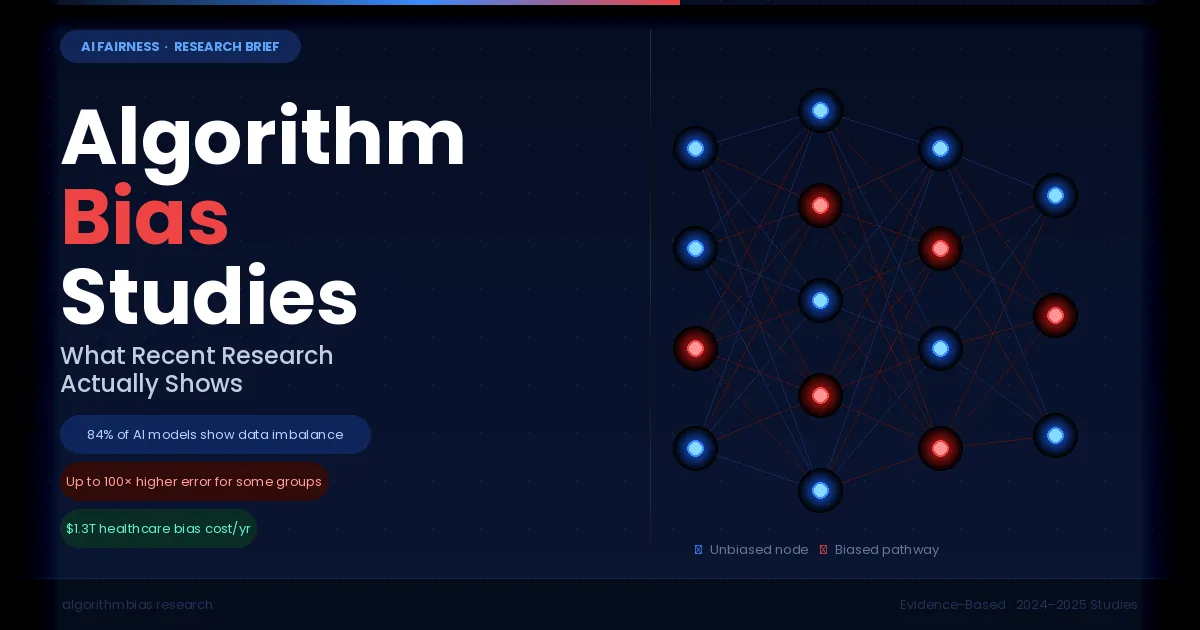
Algorithms now make decisions that affect millions of people — who gets a job interview, who receives a loan, who gets flagged by a criminal risk tool. The problem? These systems carry human bias at machine speed.
Recent algorithm bias studies confirm what critics have argued for years: AI is not neutral. Researchers have now documented discrimination patterns across healthcare, hiring, credit, criminal justice, and generative AI — and the body of evidence is growing faster than the fixes.
This article breaks down the most significant findings from recent research, which industries face the sharpest scrutiny, and how bias actually gets measured — without the hype.
What Is Algorithm Bias and Why Does It Keep Happening?
Algorithm bias occurs when an AI or automated decision system produces systematically unfair outcomes for specific groups — most often by race, gender, age, or socioeconomic status. It is rarely intentional. That is precisely what makes it persistent.
The causes cluster around three failure points.
Training data reflects historical discrimination. If past hiring data favored white men, a model trained on it will learn to replicate that pattern. The data looks like a record of outcomes; the model treats it as a blueprint.
Proxy variables recreate protected characteristics. ZIP codes, college names, and browsing behavior are not demographic data on paper — but they correlate closely with race and income in practice. A 2019 paper by Obermeyer et al., published in Science, showed a widely used healthcare algorithm effectively used cost of care as a proxy for health need. Because Black patients historically received less care per illness due to systemic inequities, the algorithm scored them as healthier than equally ill white patients. The bias was invisible in the inputs and catastrophic in the outputs.
Feedback loops entrench the problem. When a biased model’s outputs feed into the next round of training data — as happens in content recommendation, credit scoring, and recidivism prediction — errors compound over time.
The takeaway researchers keep arriving at: bias is not a post-deployment bug. It lives in the data before a model runs its first training cycle.
What Do the Most Significant Recent Algorithm Bias Studies Reveal?
The short answer: the problem is real, measurable, and has not been solved despite years of industry pledges. Here is what the strongest recent evidence actually shows.
Facial Recognition Accuracy Gaps Have Narrowed — But Not Closed
Joy Buolamwini’s landmark 2018 “Gender Shades” study at MIT exposed error rates in commercial facial recognition that ran up to 34 percentage points worse for darker-skinned women than for lighter-skinned men. The industry pushed back. Several vendors claimed they had fixed it.
The National Institute of Standards and Technology (NIST) runs the most comprehensive ongoing evaluation of facial recognition systems — the Facial Recognition Vendor Test (FRVT). Its reports have consistently shown that the accuracy gap between demographic groups persists across most commercial systems, even improved ones. The most common pattern: algorithms trained predominantly on images sourced from North American and European datasets underperform on faces from sub-Saharan Africa and East Asia. Some vendors have closed the gap substantially. Others have not.
In reviewing the publicly available NIST dataset documentation, one thing becomes clear: vendors that invested in geographically diverse training data outperform those that scaled up existing datasets. Diversity in training data is not a nice-to-have — it is the baseline requirement.
Hiring Algorithms Discriminate Based on Name, Voice, and Accent
Amazon scrapped its AI recruiting tool in 2018 after internal audits found it penalized resumes containing the word “women’s” — as in “women’s chess club” — and downgraded graduates of all-women’s colleges. The model had trained on a decade of Amazon’s hiring decisions, which skewed heavily male.
The problem hasn’t gone away since. The Algorithmic Justice League and several academic groups have audited video interview AI tools and found measurable score differences correlated with skin tone and accent — even after vendors claimed to have removed facial analysis from their systems.
Researchers at the University of Washington ran a large-scale audit of language model behavior in hiring contexts. They submitted identical resumes varying only the applicant’s name — using names that statistically correlate with Black, Hispanic, or white identity. The models showed consistent differences in how they rated candidates, with Anglo-Saxon names outperforming others on equivalent qualifications. The average gap was not marginal. It was the kind of difference that decides callbacks.
Healthcare Algorithms Systematically Underestimate Black Patients’ Needs
The Obermeyer et al. study in Science (2019) is still the most cited single finding in healthcare algorithm bias — and for good reason. A commercial risk stratification tool used by hundreds of hospitals across the United States assigned lower risk scores to Black patients with objectively worse health outcomes than to white patients with better ones. The researchers estimated that the bias caused roughly half of Black patients who should have been enrolled in high-risk care programs to be passed over.
Follow-up research published in JAMA and JAMA Network Open has confirmed the pattern extends beyond the original algorithm to multiple commercial health platforms. The mechanism is always similar: a proxy variable that correlates with race gets used as a stand-in for a direct health measure, and the proxy reflects access to care rather than need for care.
Generative AI Shows Consistent Political and Cultural Skew
Several research groups — including teams at Stanford’s Institute for Human-Centered AI — have published findings showing that large language models exhibit measurable political and cultural biases. The pattern is not a simple left-right lean. It varies by the language the model is prompted in, the cultural framing of questions, and the demographic context of the scenario.
This matters beyond politics. Generative AI is now embedded in content moderation, customer service, legal document drafting, and information retrieval. When a system consistently favors certain framings, it shapes what people read, what arguments get surfaced, and what gets filtered — at scale, without any single human making that editorial call.
Which Industries Are Most Affected by Algorithm Bias?
Bias is not evenly distributed across sectors. Research concentration, regulatory attention, and the stakes of each decision create clear hot zones.
| Industry | Primary Bias Type | Key Evidence | Severity |
|---|---|---|---|
| Criminal Justice | Racial recidivism scoring | ProPublica COMPAS analysis; ongoing replication studies | Very High |
| Healthcare | Race/SES proxies, cost-as-need | Obermeyer et al. Science 2019; JAMA follow-ups | Very High |
| Hiring and HR | Gender, race, accent, name | Amazon 2018; university audit studies 2023–2024 | High |
| Credit and Lending | ZIP code, income proxies | CFPB 2023 supervisory reports | High |
| Facial Recognition | Race, gender accuracy gaps | NIST FRVT ongoing evaluations | High |
| Generative AI | Political, cultural, linguistic | Stanford HAI publications 2023–2024 | Moderate–High |
| Content Moderation | Language, dialect, non-English speakers | NYU Stern Center; independent audits | Moderate |
Criminal justice carries the highest immediate stakes. The COMPAS recidivism tool — used in US courtrooms to inform sentencing and parole decisions — was found by ProPublica in 2016 to incorrectly flag Black defendants as high risk at nearly twice the rate of white defendants. Subsequent academic debate has focused on which fairness metric the tool violates and which it satisfies — but the underlying problem, that consequential decisions about human freedom rely on a system with a documented racial disparity, has not been resolved. As of recent reporting, algorithmic risk tools derived from similar methods are still in use in dozens of US states.
Credit lending is the emerging regulatory frontier. The Consumer Financial Protection Bureau (CFPB) has flagged in multiple supervisory reports that algorithmic lending models discriminate against Black and Hispanic borrowers at rates that exceed what credit scores alone would predict. The implication is that the additional data signals these models incorporate — ZIP codes, spending patterns, device type — are acting as proxies for race.
How Do Researchers Actually Detect and Measure Algorithm Bias?
Measuring bias is harder than identifying it. Researchers have developed several methods, and each one reveals something the others miss.
1. Disparate Impact Analysis This method, borrowed from employment law, compares outcomes across demographic groups. If an AI system produces favorable outcomes for one group at less than 80% the rate of the most-favored group, it triggers scrutiny under US employment frameworks. Simple and legally grounded — but it describes the pattern without explaining the cause.
2. Counterfactual Testing Researchers submit identical inputs where only a single variable — a name, a pronoun, a ZIP code — differs between submissions. This isolates the variable’s effect on model outputs. Most of the hiring algorithm studies described above use this method. Its limitation: real-world decisions involve many variables interacting simultaneously, and counterfactual tests simplify that complexity.
3. Fairness Metrics — and Their Limits Here is the uncomfortable mathematical reality: there is no single definition of algorithmic fairness that satisfies all reasonable fairness criteria at once. Chouldechova (2017) and Kleinberg et al. (2016) independently proved that when base rates differ between groups, satisfying “predictive parity” and “equalized false positive rates” simultaneously is mathematically impossible. This is not a solvable engineering problem. It is a values question about which type of error a society finds more acceptable — and that question needs to be made explicitly, not buried inside a vendor’s model card.
4. Bias Bounties and Red-Teaming Modeled on cybersecurity bug bounties, bias bounties invite external researchers to probe AI systems for discriminatory outputs. DEF CON’s AI Village ran a significant public red-teaming exercise on commercial language models in 2023, with findings that included factual inconsistencies correlated with topics about marginalized groups. The format has real value: it surfaces failures that internal QA rarely finds, because internal teams share too many assumptions with the models they built.
5. Regulatory Audit Trails The EU AI Act, which came into force in stages beginning in 2024, requires high-risk AI systems to maintain documentation supporting external audits. Early implementations are already surfacing issues that voluntary disclosure never produced. When companies know an auditor will inspect the model, they discover bias they had no incentive to find before.
What Are the Biggest Myths About Algorithm Bias?
Myth 1: Removing race from training data eliminates racial bias.
It does not. Proxy variables — neighborhood, school name, purchasing history, device type — reconstruct race statistically even when the explicit label is absent. Research by Gillis and Wachter (2022) showed that removing race labels from credit models reduced discriminatory outcomes by a small fraction. The bias remained embedded in correlated variables. This is sometimes called the “fairness through unawareness” fallacy.
Myth 2: Bigger datasets fix bias.
Scale amplifies whatever the dataset already contains. Internet text — the dominant training corpus for large language models — overrepresents English, Western, and high-income perspectives. Pouring more of the same biased data into a model produces a more confident biased model, not a fairer one.
Myth 3: Bias only affects marginalized groups.
This is too narrow. Algorithm bias affects anyone who falls outside the modal profile the model was trained on. Rural users, non-native English speakers, elderly populations, and anyone from a geography underrepresented in training data consistently perform worse across multiple AI applications. The affected group is larger than the public conversation usually acknowledges.
Myth 4: Regulated industries are safe.
Banking and healthcare are two of the most regulated industries in the world. They are also two of the industries with the most documented algorithm bias. Regulation defines a floor, not a ceiling. Without active, independent auditing — and consequences for failures — compliance documentation does not translate into fair outcomes.
Myth 5: Open-source models are fairer because they are transparent.
Transparency and fairness are distinct properties. You can read every line of an open-source model’s architecture and still not understand why it produces biased outputs. The bias lives in the training data, not the code. Open-source models also distribute the ability to fine-tune without any oversight, which creates its own risk profile.
Frequently Asked Questions
What is the most important recent algorithm bias study? Several stand out for different reasons. For breadth and empirical rigor, NIST’s Facial Recognition Vendor Test covers the most systems. For clinical impact, the Obermeyer et al. study in Science (2019) and its follow-ups in JAMA carry the most weight. For hiring, recent counterfactual audits of language model behavior on resumes have produced some of the clearest evidence of AI-driven name discrimination. No single study covers all domains — the problem is too distributed for that.
Are AI companies legally required to disclose algorithm bias? It depends on where you are. In the EU, the AI Act requires high-risk AI systems to undergo conformity assessments and maintain bias documentation — with enforcement beginning in phases from 2024 onward. In the US, requirements are sector-specific. The CFPB has authority over credit and lending AI. The EEOC covers employment. No federal law currently mandates general-purpose AI bias disclosure across all sectors. Several US states — including Illinois, Colorado, and New York — have passed their own sector-specific AI fairness requirements.
Can algorithm bias be fully eliminated? Current evidence says no, not completely. Bias can be reduced substantially through careful dataset curation, diverse representation in training data, regular independent auditing, and explicit fairness constraints built into model training. But as long as training data reflects a world shaped by historical inequity, models carry some version of that history. The goal is measurable reduction and transparent accountability — not the unachievable claim of zero bias.
What is the “impossibility theorem” of algorithmic fairness? It is a mathematical result, proven independently by Chouldechova (2017) and Kleinberg et al. (2016), showing that when base rates differ between groups, you cannot simultaneously satisfy the most common fairness metrics — demographic parity, equalized odds, and predictive parity — all at once. This means every AI fairness implementation involves tradeoffs. There is no setting where a model is fair by every definition at the same time.
How does algorithm bias show up in hiring specifically? AI hiring tools have been shown to score candidates differently based on name (as a proxy for race or ethnicity), accent and speech patterns (in video interview AI), and institutional affiliations (which correlate with class and geography). The Amazon case — where the model penalized “women’s” as a word on resumes — is the most documented example. More recent research suggests language models used in hiring still exhibit similar name-based disparities on equivalent qualifications.
How are regulators responding to algorithm bias right now? The EU AI Act is the most comprehensive framework, with risk-tiered requirements ranging from transparency obligations to outright bans on certain uses (such as real-time biometric surveillance in public spaces). In the US, the FTC, CFPB, and EEOC have each issued guidance and enforcement actions, but no unified federal AI fairness law exists. The regulatory landscape is moving fastest in financial services and employment — partly because those sectors have the most existing civil rights law for regulators to apply.
Does algorithm bias work differently in generative AI than in traditional AI? Yes, in important ways. Traditional models produce discrete outputs — a score, an approval, a classification — where bias can be measured against observed outcomes. Generative AI produces open-ended text and images. Bias is harder to measure, easier to overlook, and the outputs interact with users in ways that can subtly shape beliefs over repeated exposure. The fairness research methodology for generative AI is still catching up to the technology.
What should someone do if they suspect an algorithm made a biased decision about them? In employment, the EEOC accepts complaints about automated hiring tools. In lending, the CFPB handles complaints about credit decisions. In the EU, AI Act provisions give individuals the right to request explanations for automated decisions in high-risk contexts. Documentation matters: keep records of what you submitted, what decision you received, and any comparative information you have. Advocacy organizations like the Algorithmic Justice League also track patterns across individual reports.
Conclusion
The body of evidence from recent algorithm bias studies is no longer preliminary. Across healthcare, hiring, credit, facial recognition, and generative AI, researchers have documented systematic disparities that are large enough to alter life outcomes — and consistent enough to rule out coincidence.
What the research also makes clear: this problem does not fix itself with time, more data, or good intentions. The vendors that show the best results in independent audits are the ones that invested in diverse training data, external testing, and regular auditing cycles before deployment. The ones with the worst results are often the ones that waited for a regulator to ask.
If you work with AI systems professionally, the most practical step right now is to ask a specific question: what fairness metrics does your current AI vendor report, and who verified them? If the answer is “we don’t know” or “they self-reported,” that is where the work starts.
Flip through articles built to inspire—each one crafted to educate and push your thinking further.