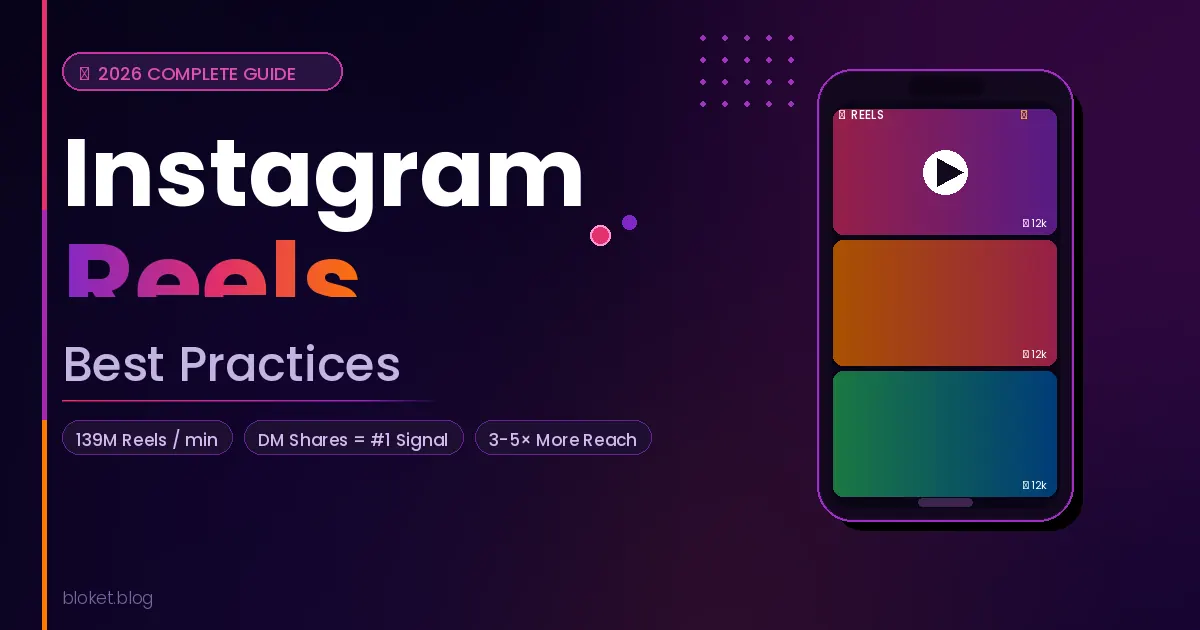
Every minute, nearly 139 million Instagram Reels are watched worldwide. That is not a rounding error — it is where the platform’s attention has gone. Instagram is video-first now, and Reels is the engine behind that shift.
Most advice out there repeats the same three tips: post consistently, use trending audio, add captions. That is fine as far as it goes. It just does not go very far.
This guide covers what actually changes outcomes in 2026 — the ranking signals Instagram confirms it rewards, the content decisions that separate a 1,000-view Reel from a 1-million-view one, the technical setup that matters, and the mistakes that quietly kill reach without anyone noticing. If you want to grow on Instagram right now, this is where to start.
How Does the Instagram Reels Algorithm Actually Work in 2026?
The short answer: Instagram runs separate AI systems for Feed, Reels, Stories, and Explore. They share a per-account trust score but rank content differently on each surface. What works in Feed does not automatically work in Reels, and vice versa.
In January 2025, Instagram head Adam Mosseri confirmed the three signals that drive Reels distribution specifically. Those signals have become more pronounced through 2026, not less.
Watch Time is still the strongest individual signal. Instagram tracks total seconds watched, completion rate, and rewatches. The first three seconds are weighted disproportionately — up to 50% of viewers drop off before the four-second mark, and Instagram’s model interprets that dropout as a sign the content is not worth pushing wider. Reels that clear the three-second threshold get tested with larger audiences. Reels that do not, stall.
Sends Per Reach is the signal that changed the game. When someone DMs your Reel to a friend, Instagram treats that as a stronger quality endorsement than a like. According to data compiled by Shopify and cited by CreatorFlow in February 2026, sends are weighted 3-5x higher than likes for reaching new, unconnected audiences. Mosseri himself called sends “one of the biggest signals we use in ranking.” This one metric explains why some technically average Reels blow up while polished promotional videos sit flat.
Likes Per Reach — the ratio of likes to impressions — still matters, but carries less weight than the two signals above. A Reel seen by 1,000 people with 50 likes outranks one seen by 10,000 people with 100 likes, because the ratio is better.
Two additional signals worth knowing: Saves are weighted roughly 3x higher than likes, according to analysis from SocialBee. And accounts that post 10 or more reposts within a 30-day window are excluded from Explore and Reels recommendations entirely. Aggregator accounts saw 60–80% reach drops after this rule tightened in late 2025. Original creators saw 40–60% reach increases in the same period.
The practical implication of all this: the algorithm is not rewarding polish. It is rewarding content that people finish watching, send to someone, and want to see again.
What Makes a Reel Perform Well in 2026?
A high-performing Reel in 2026 has three things working together: a hook that survives the first three seconds, a format matched to its content type, and a reason for viewers to send it to someone else. Nail all three and you are working with the algorithm, not against it.
The Hook is Non-Negotiable
The opening of a Reel is its most valuable real estate. Gary Vee opens with a hard opinion. Huberman-style clips open with the counterintuitive sentence, not the explanation. The pattern is consistent across creators who perform well: skip the intro, skip the context-setting, go straight to the strongest thing you have.
A working hook does not need to be flashy. It needs to stop the scroll. That could be a bold statement, a surprising visual, a direct question aimed at a specific problem, or a result shown before the explanation. Motion in the first frame also helps — a static opening triggers the same scroll reflex as a pause.
In my experience testing Reels across different niches, the clips that stall almost always share one thing: they spend the first few seconds introducing themselves instead of delivering something.
Length Depends on What You Are Making
Instagram allows Reels up to three minutes now, and longer Reels are eligible for non-follower recommendations through Explore. But longer is not automatically better.
The research is fairly clear on this. Reels between 7 and 90 seconds have the highest viral potential overall. Within that range, the sweet spot splits by content type: 15–20 seconds works for high-velocity entertainment and trend content; 45–60 seconds works better for educational or explanatory content where the viewer needs a bit more to follow along. Avoid the 30–40 second zone without a specific reason — retention data consistently shows a mid-video drop in that range.
A 14-second Reel watched twice often outperforms a 60-second Reel watched once, because Instagram values total watch time, not just completion percentage.
Format: What the Algorithm Rewards as “Original”
Instagram’s 2026 algorithm includes what it calls an “Originality Score.” This is not publicly documented in detail, but its effects are clear. Reposted TikToks with watermarks get penalized. Content that recycles trending clips verbatim gets penalized. Content recorded natively for Instagram — or meaningfully adapted for it — gets a distribution advantage.
The format for Reels is fixed: 1080 x 1920 pixels, 9:16 aspect ratio, full-screen vertical. Beyond that, native-looking content outperforms polished production. Ads and branded Reels that look like organic creator content consistently achieve lower CPMs and higher completion rates than studio-produced spots. The algorithm rewards content that keeps users in the feed experience.
Captions are not optional anymore either. A large portion of Reels are watched without sound. On-screen text, spoken keywords, and caption text now all feed into how Instagram understands and surfaces your content — the platform’s AI “reads” your video through transcription. Using your primary topic keyword in the first three seconds of audio, overlaying it as on-screen text, and repeating it in the caption creates what some analysts are calling “contextual continuity,” which reportedly increases search discoverability by a meaningful margin.
How to Make High-Performing Reels: A Step-by-Step Process
This is the workflow I recommend for anyone serious about building consistent Reels performance rather than chasing one-off hits.
Step 1: Start with the ending. Before filming anything, decide what you want the viewer to do when the Reel finishes — save it, comment, share it with someone, visit your profile. That decision shapes the entire Reel. A tutorial-style Reel earns saves. An opinion clip earns comments. A relatable observation earns DM shares. Build toward that outcome from the first second.
Step 2: Write the hook first. Write five versions of your opening line or opening visual and pick the strongest one. The hook is not the place to save your creative energy. Most Reels are lost here.
Step 3: Film vertically for full-screen viewing. Every shot should be framed for a phone screen. Larger face crop, clean background, readable text with enough margin so Instagram’s interface does not cover the message. If you are repurposing content from a call, webinar, or interview, reframe it — punch in on the active speaker, cut dead space, make it feel native.
Step 4: Choose audio intentionally. Trending audio gives your Reel exposure on that audio’s discovery page, expanding reach beyond your followers. To find trending tracks, look for the small upward arrow next to the audio name while scrolling Reels, or navigate to Profile → Professional Dashboard → Trending Audio. Target tracks with under 5,000 uses to catch trends before saturation. For business accounts with limited music access, voiceovers and original audio actually perform well — they also help establish a recognizable brand voice.
Step 5: Optimize your caption for search, not hashtags. Write the way someone would search. A Reel about Instagram analytics should say “Instagram analytics tips” in the caption, not rely on a hashtag to carry the message. Keywords in captions are now more effective for discovery than hashtags. Use 3–5 specific hashtags for categorization, not for reach.
Step 6: Post when your audience is active, then engage fast. Best posting windows based on aggregated 2025–2026 data are 7–9 AM and 11 AM–1 PM in your audience’s local time zone. Early engagement — in the first 10 minutes — matters because the algorithm tests your content with a small audience first. If your own followers do not engage quickly, the distribution test stops early.
Step 7: Use Trial Reels to test before you commit. Trial Reels show your content to non-followers only, before you post it broadly. If it performs well with cold audiences, that is a signal to push it to your full following. This is the smartest A/B testing tool Instagram has released — use it for hooks especially.
Step 8: Read your metrics, not just your view count. The core measurement stack: watch time, completion rate, saves per reach, sends per reach, and profile visits. Replay rate is worth calculating manually — divide total plays by accounts reached. Above 1.1 means viewers are averaging more than one view. Above 1.3 signals high algorithmic distribution potential.
What Reels Mistakes Are Killing Your Reach?
These are the patterns I see most consistently across accounts that are posting regularly but not growing.
Treating Reels like ads. Overly polished, sales-heavy videos do not feel native to the platform. Instagram prioritizes content that entertains, educates, or creates a moment worth sharing. Selling comes after value — not during the first five seconds.
Ignoring the sends signal. Most creators still optimize for likes and comments. The algorithm has shifted. If your content is not built to be shared in a DM — relatable observations, useful saves, “tag someone who…” moments — you are competing on the wrong metric.
Reposting TikTok content with watermarks. This bears repeating because it is still common. Instagram’s Originality Score detects watermarks and recycled clips. Re-record natively, or at minimum add unique elements. The same concept in original form will always outperform a cross-posted file.
Posting too many reposts overall. Ten or more reposts in a 30-day window gets your account excluded from recommendations entirely. If you manage aggregator or curated content accounts, this policy change fundamentally breaks the old model.
Using hashtags as the main growth lever. Recent data shows posts without hashtags achieved 23% higher reach than hashtag-heavy posts. Hashtags in 2026 function as filing labels — they help Instagram categorize your content but rarely drive significant discovery on their own. Three to five relevant, specific hashtags is the right approach.
Deleting Reels that underperform. This one surprises people. The Instagram Reels algorithm judges each video independently. One underperforming Reel does not hurt future content — every post gets its own fresh distribution test. Archiving a weak Reel for profile aesthetics is fine. Panicking and deleting it because it stalled will not help your next one.
Chasing consistency over quality. Posting every day with weak content does not build momentum. Posting three or four high-quality Reels per week — with strong hooks, clean format, and a reason to send — outperforms daily posting of filler. The algorithm rewards quality consistency, not just frequency.
Reels vs. Other Instagram Formats: A Quick Comparison
| Format | Avg. Reach vs. Static Posts | Engagement Rate | Best For |
|---|---|---|---|
| Reels | 3–5x higher | 3–5% (mid-sized accounts) | Discovery, non-follower reach |
| Carousels | ~1.5x higher | 12% more interactions than Reels | Education, saves, depth |
| Static Posts | Baseline | 0.5–1.5% | Brand aesthetic, announcements |
| Stories | Limited (followers only) | Varies | Community, real-time updates |
Reels wins on reach. Carousels win on engagement and saves. The optimal content mix for most accounts in 2026 is 3–4 Reels per week, 2–3 carousels, and 1–2 static posts. This combination maximizes both discovery and community depth.
Frequently Asked Questions About Instagram Reels Best Practices
How long should Instagram Reels be in 2026?
The highest-performing Reels fall between 15 and 90 seconds, depending on content type. Entertainment and trend content peaks at 15–20 seconds for maximum completion rates. Educational and tutorial content performs better at 45–60 seconds. Avoid the 30–40 second zone without a clear reason — retention data shows consistent mid-video drop-off in that range. Instagram allows up to three minutes, but shorter content with stronger retention almost always outperforms longer content with weaker retention.
What are the most important ranking signals for Reels in 2026?
Adam Mosseri has confirmed three signals matter most: watch time (especially in the first three seconds), sends per reach (DM shares, weighted 3–5x higher than likes), and likes per reach. Saves also carry significant weight — roughly 3x a standard like. Completion rate and replay rate are secondary signals that matter especially for longer Reels. Likes alone are the weakest signal Meta still reports.
How many hashtags should I use on Reels in 2026?
Three to five specific, relevant hashtags is the current recommendation. Hashtags in 2026 function more like content categories than discovery tools. Caption keywords and on-screen text now drive more search-based discoverability than hashtags. Avoid cramming 20–30 hashtags into a caption — it looks spammy, does not boost reach, and wastes space you could use for keyword-rich copy.
Can I repost TikTok videos as Instagram Reels?
The concept, yes. The video file, no. Instagram’s algorithm detects TikTok watermarks and penalizes those Reels in distribution. The 2026 Originality Score extends this further — even watermark-free TikTok reposts that recycle trending content verbatim can see reduced reach. Re-record your content natively for Instagram, or add meaningful changes that make the Reel original to the platform.
What is the best time to post Instagram Reels?
Based on aggregated data across 2025–2026, the strongest posting windows are 7–9 AM and 11 AM–1 PM in your audience’s primary time zone. That said, these are general benchmarks. Your specific audience may behave differently. Use Instagram Insights to check when your followers are most active, test posting times over four to six weeks, and adjust from there rather than applying a universal rule.
What does “sends per reach” mean and why does it matter?
Sends per reach measures how often viewers DM your Reel to someone else relative to total impressions. When someone sends a Reel to a friend, Instagram treats it as a high-quality endorsement — the viewer cared enough to recommend it personally. This signal is weighted 3–5x higher than a like for expanding reach to non-followers. Building content people want to share in DMs — relatable moments, useful information, things that feel like they were made for a specific person — is now the fastest path to organic growth.
Should I delete Instagram Reels that get low views?
No. Instagram evaluates each Reel independently, so a weak-performing video does not damage future content. Archiving a Reel to clean up your profile grid is a reasonable aesthetic decision. But deleting Reels in bulk because they stalled will not reset or improve your account’s standing. Focus on the next Reel, not the last one.
Final Thoughts
The fundamentals of Reels success in 2026 are not complicated, but they are specific. The algorithm rewards watch time in the first three seconds, DM shares above almost everything else, and original content that feels made for the platform. It penalizes watermarks, repost-heavy accounts, and sales-first creative that does not hold attention.
What changes outcomes is not chasing every trend or posting every day. It is building a content system — a repeatable workflow for hooks, format, and follow-through — and then using your analytics to refine it weekly. Start with the sends signal. Look at every Reel you post and ask: would someone DM this to a friend? If the answer is no, that is where to improve first.
Looking for that creative push? Our featured posts bring fresh ideas and seasoned expert perspectives.