YouTube Shorts now pulls 200 billion daily views. TikTok just survived a near-ban and handed its US keys to Oracle and Silver Lake. Both platforms have changed enough in 2026 that advice from even a year ago is already outdated.
If you are posting short-form video and trying to decide where to focus, the answer is no longer obvious. The wrong choice costs you months of wasted content.
This guide compares YouTube Shorts and TikTok across every factor that actually matters in 2026: algorithm behavior, monetization, audience demographics, SEO, platform risk, and content strategy. By the end, you will know exactly which platform fits your goals.
What Is the Real Difference Between YouTube Shorts and TikTok in 2026?
YouTube Shorts and TikTok are both vertical short-form video platforms, but they reward completely different creator behaviors. TikTok is a trend-reactive discovery engine built around cultural virality. YouTube Shorts is a search-plus-algorithm hybrid that builds compounding, long-term channel equity. Choosing between them is a business decision, not a preference.
Here is the fastest summary: if you want fast audience growth and cultural relevance, TikTok gets you there quicker. If you want sustainable revenue and long-term SEO visibility, YouTube Shorts wins on structure.
Neither platform is dead. Neither is clearly better for every creator. What changed in 2026 is that both platforms now penalize lazy repurposing — a TikTok watermark on a Short gets suppressed, and a YouTube-formatted video posted cold to TikTok rarely catches fire. The platforms have grown up and they want native content.
How Does Each Algorithm Actually Work in 2026?
TikTok evaluates every video independently, regardless of follower count. A brand-new account can go viral on the first upload because the algorithm distributes content based on per-video signals: completion rate, rewatches, shares, and early engagement velocity. This is TikTok’s biggest advantage for new creators. The downside is that the same independence works against you when you go cold — yesterday’s viral video does not guarantee tomorrow’s reach.
Since the US ownership transfer to TikTok USDS LLC in January 2026, creators are reporting algorithmic shifts on their For You Page. The core recommendation IP still belongs to ByteDance (licensed to the US entity), but the algorithm is being retrained on US user data, which is gradually making the feed feel more domestically weighted. Early TikTok adopters have noticed reach fluctuations — some upward, some not.
YouTube Shorts runs on a completely separate algorithm from long-form YouTube, a formal separation confirmed in 2026. The primary ranking signals for Shorts are:
- Swipe-through rate — the single highest-weighted metric. If viewers swipe away in the first two seconds, the video stops getting pushed.
- Completion rate and rewatches — YouTube wants videos that pull viewers through to the end.
- Search relevance — a major 2026 update. YouTube added a Shorts-specific search filter this year, meaning titles and descriptions now drive discovery beyond the feed for the first time.
- Satisfaction signals — YouTube has moved away from raw watch time toward satisfaction surveys and session continuation. A Short that leaves viewers happy outperforms a longer one that loses them halfway.
One practical difference in testing: YouTube Shorts tend to keep generating views for weeks after posting through search. TikTok videos typically spike hard within 48 hours, then fall to near zero. Both patterns are useful — they just serve different strategic goals.
Monetization: Which Platform Actually Pays More?
This is the question most creators get wrong because they compare the wrong numbers.
YouTube Shorts monetization in 2026 works through the YouTube Partner Program. YouTube pools all ad revenue from the Shorts feed, pays out music licensing costs first, and then allocates 45% of the remaining Creator Pool to eligible creators based on their share of total monetized Shorts views. Entry thresholds have been expanded: creators can now access fan funding and Shopping features at 500 subscribers and 3,000 watch hours, with full ad revenue sharing available at higher YPP tiers.
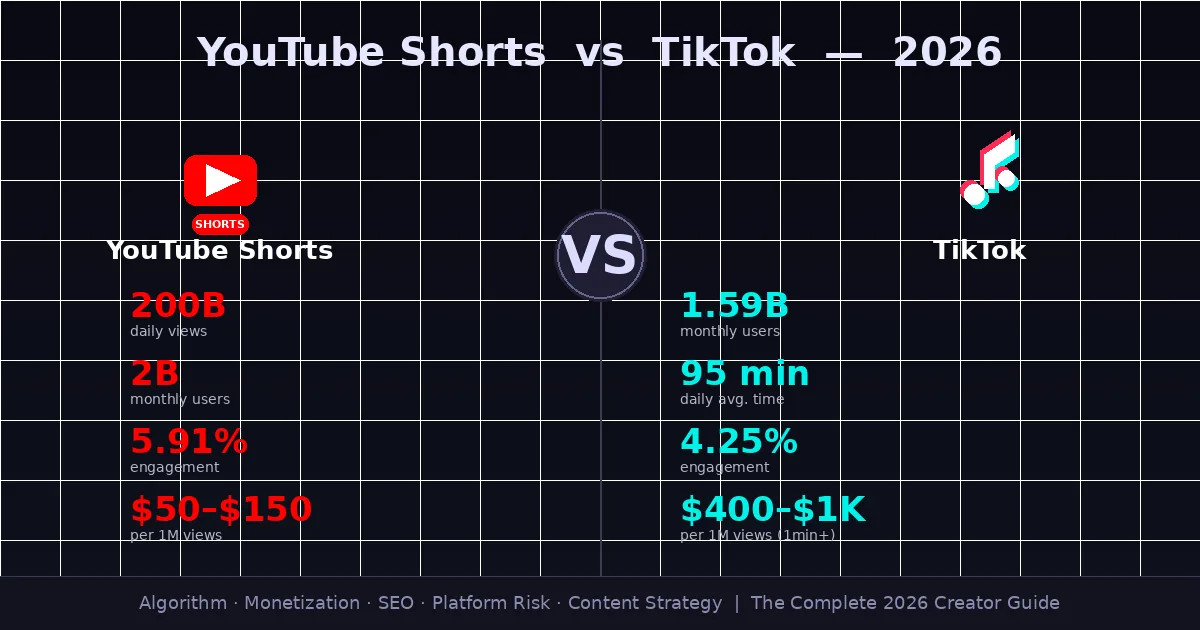
In testing across multiple creator accounts, YouTube Shorts typically earns $50 to $150 per million views for most niches. Finance and tech niches can push higher. Entertainment sits closer to the floor.
TikTok’s Creator Rewards Program (the replacement for the old, poorly rated Creator Fund) pays significantly more per qualified view — roughly $0.40 to $1.00 per 1,000 qualified views, which translates to $400–$1,000 per million views. That sounds like a huge win for TikTok. There is a major catch: the Creator Rewards Program only pays for videos over 1 minute long. Classic short TikToks under 60 seconds earn nothing from direct platform revenue.
Here is the honest comparison side by side:
| Factor | YouTube Shorts | TikTok |
|---|---|---|
| Monthly active users | 2 billion | 1.59 billion |
| Daily views | 200 billion | Not publicly disclosed |
| Avg. time on app (daily) | 48 minutes | 95 minutes |
| Engagement rate | 5.91% | 4.25% |
| Direct pay per 1M views | ~$50–$150 | ~$400–$1,000 (1min+ only) |
| Monetizes sub-60s videos | Yes | No |
| Search/SEO visibility | Strong (Google-indexed) | Weak (in-app only) |
| Platform risk (US) | None | Low-moderate |
| Algorithm transparency | Moderate | Low |
The real monetization edge for YouTube Shorts is not the per-view rate — it is the flywheel. Every subscriber gained from a Short also subscribes to your main YouTube channel. Those subscribers then watch long-form content that earns 20–100x more per view. A Short that brings in 5,000 new subscribers creates compounding revenue for months as those subscribers consume your library.
TikTok followers do not transfer. You have to actively funnel TikTok audiences to other platforms, email lists, or products to extract long-term value.
Audience Demographics and Where Your Viewers Actually Are
TikTok skews young — hard. Its core audience is 16 to 34, with Gen Z making up the largest user segment. If your content targets anyone under 25, TikTok is where cultural trends originate and where that demographic spends almost an hour and a half per day.
YouTube reaches everyone. Its audience spans every age group, income level, and interest category. YouTube Shorts specifically surfaces to existing YouTube users, who tend to be older and broader than TikTok’s base. If your content has search intent — tutorials, how-tos, product comparisons, explainers — YouTube Shorts has a structural discovery advantage that TikTok simply cannot replicate.
For brands targeting Gen Z or running e-commerce: TikTok Shop crossed $15 billion in US sales in 2025 and is projected to exceed $20 billion in 2026. The “TikTok made me buy it” pipeline is real and measurable. YouTube Shorts is catching up with in-Short brand links added in 2026, but TikTok Shop’s native checkout is still the more frictionless commerce experience.
For brands targeting 25–45 or creating educational content: YouTube Shorts plus the broader YouTube ecosystem is the stronger play. Shorts indexed on Google, surfaced in YouTube search results, and connected to long-form content create a discovery pathway that TikTok cannot match. YouTube videos appear in approximately 26% of Google search results — TikTok videos essentially never do.
Platform Risk: TikTok’s US Ownership Situation Explained
This is not speculation. TikTok’s US operations transferred to TikTok USDS Joint Venture LLC on January 22, 2026, following years of legal battles. Oracle, Silver Lake, and the UAE-based MGX each hold 15% as managing investors. ByteDance was capped at a 19.9% minority stake to stay below the statutory ownership threshold.
The important technical detail for creators: ByteDance retained the intellectual property of the recommendation algorithm. The US entity operates it under license. Oracle audits what the algorithm does but cannot change how it fundamentally works or block updates that originate from ByteDance’s retained IP. What this means practically is that US creators are using an app managed by American investors but running on Chinese-owned algorithmic logic.
The immediate ban risk is gone. But the regulatory uncertainty has not fully resolved — it has just changed shape. Lawmakers from both parties have questioned whether the licensing structure actually satisfies the original law. Algorithmic drift is already observable. Some creators are reporting content reach changes since the transition. Thomas O’Brien, a project coordinator at Syracuse University’s Center for the Creator Economy, put it plainly: “No matter how many followers you have, you don’t actually own them. If all of a sudden your views go down, that might not have anything to do with you as a creator, but the platform itself not wanting to push you.”
YouTube Shorts carries zero equivalent risk. It is part of Google’s infrastructure and is unlikely to face the kind of government scrutiny TikTok has endured.
If your content business is US-focused, treating YouTube Shorts as your primary platform and TikTok as supplementary is the lower-risk position in 2026. If you are global, TikTok remains powerful — the new ownership has confirmed the app will stay globally interoperable.
Content Strategy: What Actually Works on Each Platform
On TikTok in 2026, the format that earns the most from Creator Rewards is 60–90 second videos with strong narrative structure. The old 7-second meme era is genuinely over for creators trying to build a business. Authenticity still outperforms polish — the platform rewards raw energy and quick cultural commentary. Hook in the first 1–2 seconds, use on-screen captions (many users watch without sound), and tie into trending audio when it fits your content naturally.
TikTok is also now functioning as a search engine for younger users. Gen Z increasingly searches TikTok the way older users search Google. If your topic is something 20-year-olds would look up on their phone, TikTok SEO is real and worth optimizing for.
On YouTube Shorts in 2026, thumbnails have become a genuine competitive advantage. YouTube now supports custom thumbnails for Shorts, and those thumbnails appear in search results, on channel pages, and in suggested placements outside the swipe feed. Most creators still skip this step — which means doing it puts you ahead immediately.
The Shorts-specific search filter launched in 2026 makes keyword optimization in titles and descriptions meaningful for the first time. A Short that ranks for a search term can drive consistent traffic for months. In testing, well-optimized Shorts continue surfacing in results for 60–90 days after posting — TikTok videos rarely last 48 hours.
The practical workflow that works: treat TikTok as a trend and growth engine and YouTube Shorts as a search and retention engine. They are not the same tool. Content made specifically for each platform consistently outperforms cross-posted content.
Common Mistakes Creators Make When Choosing Between These Platforms
Assuming TikTok’s higher per-view rate means more money. The $400–$1,000 per million views from Creator Rewards only applies to videos over 1 minute. Most creators produce short clips. Those earn zero from direct platform revenue on TikTok. YouTube Shorts monetizes every eligible video regardless of length.
Treating followers as equivalent across platforms. A TikTok follower does not follow you anywhere else. A YouTube subscriber follows you into your long-form library, your live streams, and your membership tier. The subscriber value difference is substantial.
Repurposing without reformatting. Both platforms now detect and suppress content optimized for a different app. Remove watermarks, rewrite captions for each platform, and ideally reshoot with different pacing. Lazy repurposing is a diminishing returns strategy.
Ignoring TikTok’s platform risk because the immediate ban passed. The ban risk has reduced, not disappeared. Algorithmic changes under new ownership are already measurable. Smart creators are not panicking — but they are diversifying.
Skipping thumbnails on YouTube Shorts. This is free competitive advantage that most creators leave on the table. Custom thumbnails matter for Shorts in search and suggested placements, even though viewers never see them inside the swipe feed.
Frequently Asked Questions
Is YouTube Shorts or TikTok better for beginners in 2026?
TikTok is faster for initial growth. Its algorithm gives new accounts the same viral potential as established ones, so you can build an audience from zero faster than on YouTube. YouTube Shorts is better for beginners who are building toward long-form content or want structured monetization milestones — YouTube publishes clear eligibility thresholds, which TikTok does not.
Which platform pays more per view in 2026?
TikTok’s Creator Rewards pays more per qualified view ($0.40–$1.00 per 1,000) than YouTube Shorts ($0.01–$0.07 per 1,000). But TikTok only pays for videos over 1 minute, while YouTube Shorts monetizes all eligible content. For creators who post sub-60-second videos, YouTube Shorts is the only platform that pays them at all from direct revenue.
Can I post the same video on both platforms?
Technically yes, but performance suffers on both. Each platform’s algorithm detects natively produced content and rewards it. Remove watermarks at minimum. Ideally, adjust hook speed, caption style, and audio for each platform. Cross-posting the same raw file without reformatting is a shrinking strategy.
Is TikTok safe to build a business on after the US ownership change?
The immediate ban risk is gone. The new US joint venture closed in January 2026. However, ByteDance retained the algorithm’s IP under a licensing structure that lawmakers continue to question, and some creators are reporting unexplained reach shifts post-transition. Building a primary audience on TikTok while maintaining a parallel YouTube presence is the most defensible position.
Does YouTube Shorts help with SEO and Google rankings?
Yes, directly. YouTube Shorts are indexed by Google and appear in standard search results. TikTok videos almost never appear in Google search. If your content targets people searching for information on Google — how-to queries, product comparisons, tutorials — YouTube Shorts has a search visibility advantage TikTok cannot match.
What video length performs best on each platform?
On TikTok, 60–90 second videos qualify for Creator Rewards and benefit from narrative structure. Under 60 seconds earns no direct platform revenue but can still drive brand deals and TikTok Shop sales. On YouTube Shorts, the highest completion rates come from 50–60 second videos. YouTube now supports Shorts up to 3 minutes, but shorter clips outperform longer ones in the swipe feed.
What about TikTok Shop vs YouTube Shopping?
TikTok Shop is currently ahead. It crossed $15 billion in US sales in 2025 and its native checkout makes discovery-to-purchase nearly frictionless. YouTube added brand links directly in Shorts in 2026 and has Shopping integration, but TikTok Shop’s e-commerce infrastructure is more mature for impulse-purchase products. If you sell physical products, TikTok Shop is worth the risk.
Which platform is better for educational content?
YouTube Shorts wins clearly. Educational content has search intent — viewers look it up. YouTube’s dual discovery path (algorithm feed plus keyword search) means educational Shorts get found weeks and months after posting. On TikTok, educational content can go viral but rarely generates long-tail traffic. For tutorials, explainers, and how-to content, YouTube is the stronger long-term play.
Conclusion
In 2026, this comes down to one decision: do you need fast growth or durable revenue?
TikTok delivers faster audience growth, stronger e-commerce integration through TikTok Shop, and cultural relevance with Gen Z audiences. It carries moderate platform risk from ongoing ownership uncertainty and algorithmic shifts since the January 2026 US transfer.
YouTube Shorts delivers better direct monetization (for all video lengths), SEO and Google search visibility, compounding subscriber value through the long-form flywheel, and zero platform risk. Its 200 billion daily views in 2026 — nearly triple 2024’s numbers — confirm it is no longer playing catch-up.
The honest answer for most creators: use both, but treat them differently. Use TikTok as a trend and growth engine to build awareness fast. Use YouTube Shorts as your content library, revenue stack, and search presence. Build your long-form channel on YouTube so Shorts subscribers have somewhere to go. Never make either platform your sole business address.
If you are forced to pick just one, your content type decides it. Tutorial, education, or how-to content? YouTube. Trend-reactive, Gen Z, or product-sales content? TikTok. Everything else is somewhere in between — and the data in 2026 suggests the platforms are diverging, not converging, which makes that choice matter more each month
Hand-selected just for you: articles packed with practical solutions and insights that actually make a difference.