Most Pinterest advice is recycled from 2023. The platform’s algorithm has changed significantly, and strategies that worked two years ago now actively hurt your reach.
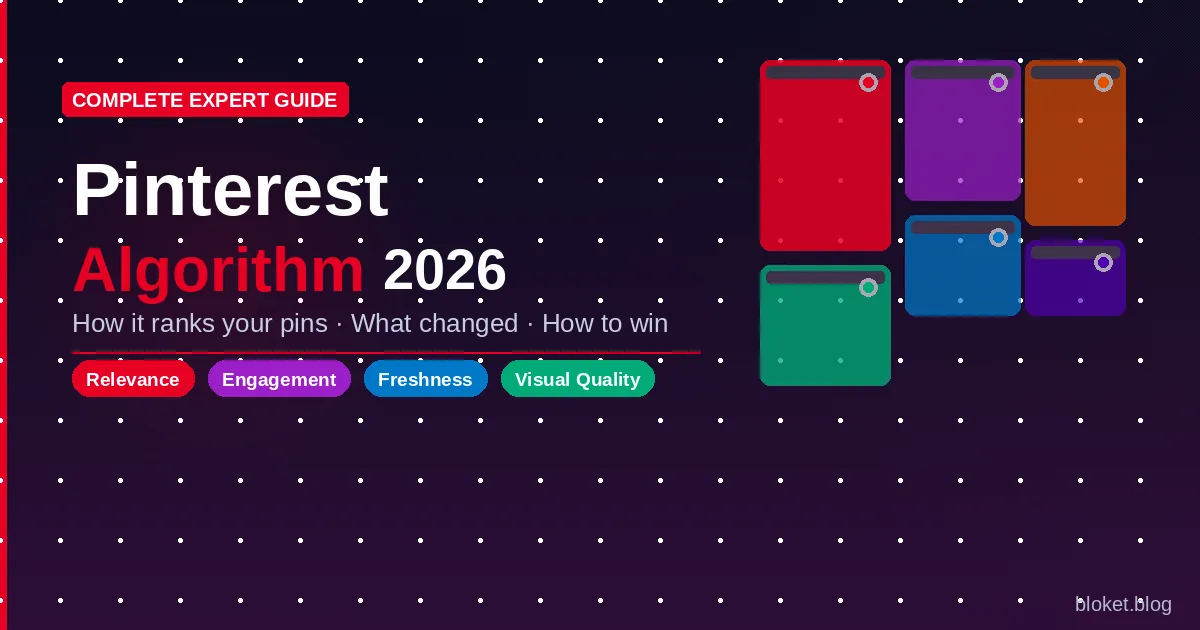
The Pinterest algorithm in 2026 ranks pins based on four core signals: relevance, engagement quality, content freshness, and visual quality. But beneath those four pillars, Pinterest has quietly rebuilt its recommendation engine with real-time signals, entity recognition, and semantic visual search — changes that most guides haven’t caught up to.
This article breaks down exactly how the algorithm works, what shifted in 2026, and what you should actually do about it — starting today.
How Does the Pinterest Algorithm Actually Work in 2026?
Pinterest is not a social network. It is a visual search engine — and that distinction changes everything about how you should approach it.
Unlike Instagram or TikTok, where content lives for 24–48 hours before dying in a feed, a well-optimized pin can surface in search results weeks or months after posting. Users arrive with intent: they are planning a wedding, redecorating a kitchen, or researching a product purchase. The algorithm’s job is to match that intent with the most relevant, high-quality content available.
At its core, Pinterest runs on four evaluation signals for every pin it shows:
Relevance — how closely your pin’s keywords, description, and board match a user’s search query or browsing behavior.
Engagement quality — how real users interact with your content. Saves carry the most weight. Clicks, close-ups, and video watch time also count. A passive scroll-past counts for very little.
Freshness — how recently the pin was created and whether the account publishes consistently. Identical reposts get penalized. New visual and textual content gets a test window.
Visual quality — whether the image is high-resolution, vertically formatted, mobile-readable, and visually distinct from competing content.
One thing worth understanding: Pinterest’s algorithm does not primarily care about your follower count. A brand-new account with 200 followers can outrank an account with 50,000 followers if the pin better matches what someone is actively searching for.
What Are Pinterest’s Core Ranking Signals — and How Much Does Each Matter?
The four signals above are Pinterest’s public framework. In practice, the algorithm weighs several sub-signals underneath each one. Here is how they break down in 2026.
Pin Quality
This covers visual resolution, aspect ratio compliance, and whether the image communicates value immediately. The ideal format remains 2:3 vertical (1000×1500 pixels). Pins cropped to this ratio display better on mobile, where the overwhelming majority of Pinterest browsing happens. Text overlays help — but only when the font is large enough to read on a 6-inch phone screen at normal viewing distance.
The algorithm also runs OCR (optical character recognition) on your image text. Whatever words appear in your text overlay get indexed alongside your written description. This means your overlay copy and your description should be semantically aligned, not contradictory or random.
Domain Quality
Pinterest checks the authority and reliability of the URL your pin links to. A pin pointing to a fast-loading, HTTPS-secured website with relevant content on the landing page performs better than one pointing to a slow page with weak content. Broken links — 404 errors — get caught in real time by the 2026 algorithm, and the affected pin is demoted immediately.
Domain quality is not just about DA scores. Pinterest looks at whether users who click your pin actually stay on the destination page. A high bounce rate from Pinterest traffic is a signal that your pin over-promised what the landing page delivers.
Pinner (Account) Quality
Your overall account behavior matters. Accounts that publish consistently, maintain clear topical focus, and receive regular engagement distribute content further. An account that pins 40 times one week and then goes quiet for three weeks confuses the algorithm — and the algorithm responds by reducing distribution.
In 2026, Pinterest evaluates “topical authority” through what researchers are calling entity recognition. If your account consistently covers one niche — say, sustainable interior design — Pinterest builds a semantic profile of your account as an authority on that topic. Content from your account then gets surfaced to users who engage with related entities, not just exact keyword matches.
Relevance and Keyword Matching
Keywords in your pin title, description, board name, and board description all feed into relevance scoring. Pinterest reads the first 100 characters of your description with extra weight — front-loading your primary keyword phrase here is one of the clearest signals you can send.
Long-tail, intent-specific phrases outperform broad terms. “Small kitchen storage ideas for apartments” outranks “kitchen ideas” because it matches a more specific user query with clearer commercial or planning intent.
What Actually Changed in the Pinterest Algorithm in 2026?
Several meaningful updates rolled out across late 2025 and into 2026. Here is what is actually different — not recycled advice dressed up as new.
Real-Time Recommendation Updates
This is the biggest structural change. Previously, Pinterest updated its recommendation engine through periodic model retraining — meaning your actions today influenced what you saw tomorrow. In 2026, the system responds in real time. If a user saves a pin or clicks on a specific image, the algorithm immediately adjusts the feed to show more content from that topic cluster. For creators, this means a pin that earns early engagement can compound very quickly within a single browsing session.
Entity Recognition Replacing Keyword-Only Ranking
Pinterest now maps your content to semantic entities — concepts, styles, products, and ideas — rather than relying exclusively on keyword matching. This is the same logic Google uses with its Knowledge Graph. If your account pins consistently around “Scandinavian minimalism,” Pinterest links your content to that entity cluster. New pins you publish get distributed not just to people who searched that exact phrase, but to anyone whose browsing behavior signals interest in the parent entity.
The practical implication: scattered content across unrelated topics weakens your account’s entity profile. Niche clarity now produces a measurable distribution advantage.
The 24–48 Hour Test Window
New pins receive a burst of distribution immediately after publishing — a test window where Pinterest measures early engagement signals. If a pin earns saves, clicks, or close-ups within the first 24–48 hours, it gets pushed further. If it generates no interaction, Pinterest scales back distribution. This window existed before, but in 2026 the algorithm is more sensitive to it and reacts faster.
Timing your pins for when your audience is most active is more important than ever. Mid-week mornings and evenings consistently show higher engagement for most lifestyle niches, though your analytics will give you account-specific data.
Contextual Originality as a Ranking Factor
Uploading the same image with a slightly different color filter no longer counts as fresh content. The 2026 algorithm analyzes whether a pin’s visual content adds new semantic information to the topic. It checks whether the image introduces distinct visual ideas, not just a new file hash. Creators who relied on bulk-generating near-identical pins are seeing significant drops in distribution.
Reduced Weight for Group Boards
Group boards used to be a reliable way to extend reach. In 2026, their algorithmic weight has been reduced. Pinterest appears to treat low-relevance group board activity as a noise signal rather than a quality signal. Personal boards with tightly themed, keyword-optimized titles now outperform sprawling group boards with mixed content.
AR Shopping and Collage Pins
On the eCommerce side, the January 2026 update introduced AR try-on features and elevated Collage Pins — a format where users can tap individual items within a collage to shop. If other users repin a product pin within a collage, it remains shoppable. This turns repinners into distribution channels and is particularly effective with Gen Z shoppers. Rich Pins — which pull real-time pricing and availability from your site — still boost click-through performance, though they require setup via the Pinterest tag and the Verified Merchant Program.
How to Optimize for the Pinterest Algorithm in 2026: A Step-by-Step System
There is no magic trick. What works is a repeatable system run consistently over months. Here is what that looks like in practice.
Step 1: Do keyword research before you design anything. Open Pinterest and type your topic into the search bar. Look at the autocomplete suggestions — these are real user queries the platform is actively trying to serve. Use those phrases in your pin titles, descriptions, and board names. Third-party tools like Pinterest Trends and Pin Inspector can help you identify search volume, but the native autocomplete is free and reliable.
Step 2: Build tightly themed boards with keyword-focused names. Instead of naming a board “Food Ideas,” name it “Easy Weeknight Dinner Recipes for Families.” The board name is indexed. A specific, long-tail board name signals your niche to the algorithm far more clearly than a broad category label.
Step 3: Create multiple pin variants per piece of content. The most effective 2026 strategy is to create 4–6 pin designs per blog post or product page, each targeting a different keyword phrase and using a different text overlay. All pins point to the same URL. This gives Pinterest multiple search queries to rank your content against, and gives you A/B data on which visual approach drives more saves.
Step 4: Publish 3–7 new pins per week per topic cluster. Consistency beats volume. Three well-optimized pins per week for 12 weeks outperforms 50 pins in a single week followed by silence. The algorithm identifies a publishing rhythm and begins anticipating your next upload — which influences distribution timing.
Step 5: Front-load keywords in your description. Place your primary keyword phrase in the first 100 characters of the pin description. Follow it with 2–3 semantic variations naturally written into 2–3 sentences. Avoid stuffing a description with 10 keyword phrases — it reads as spam and the algorithm penalizes it.
Step 6: Monitor your analytics at the pin level, not just account level. Pinterest Business Analytics now shows near real-time data at the individual pin level. Identify which pins are earning the most saves relative to impressions — saves-to-impression ratio is your clearest signal of what the algorithm is rewarding. Double down on those formats, topics, and keyword structures.
Step 7: Keep your links clean. Check your top-performing pins every month and verify the destination URLs still resolve. A single 404 error can demote an otherwise strong pin permanently. If a landing page URL changes, update the pin or create a fresh version.
Pinterest 2026 Pin Formats: Which One Does the Algorithm Prefer?
Different formats serve different objectives. This table shows how they compare across the signals that matter most in 2026.
| Format | Algorithm Visibility | Best For | Key Requirement |
|---|---|---|---|
| Static Pin | High (especially search) | Blog traffic, product clicks | 2:3 ratio, keyword-rich title |
| Video / Idea Pin | High (home feed, discovery) | Brand awareness, tutorials | Native upload, 6–15 sec hook |
| Carousel Pin | Medium | Multiple product variants | 2–5 cards, consistent theme |
| Collage Pin | Growing (Gen Z audience) | Shoppable product sets | Each item must be tagged |
| Rich Pin | Medium (boosts CTR, not reach) | Ecommerce, recipes, articles | Requires site metadata setup |
Static pins still drive the most outbound clicks when optimized for search. Video and Idea Pins receive more home-feed placement in competitive niches. The current best practice is to run both — static for search visibility, video for discovery reach.
Common Pinterest Mistakes That Destroy Your Reach in 2026
Understanding what to do is only half the equation. These mistakes consistently sabotage otherwise strong Pinterest strategies.
Pinning to irrelevant boards. A home décor pin saved to a “Marketing Tips” board sends a contradictory signal to the algorithm. Pinterest’s semantic engine reads the board context as part of the pin’s relevance profile. Mismatched boards lower distribution even when the pin itself is strong.
Publishing in bursts and disappearing. Pinning 30 times on a Sunday and nothing for three weeks is one of the fastest ways to shrink your reach. The algorithm interprets irregular activity as low account quality. A steady rhythm of 3–5 pins spread across the week consistently outperforms sporadic bulk posting.
Ignoring mobile readability. Over 75% of Pinterest usage is on mobile. A text overlay that looks perfect on a desktop canvas becomes unreadable at phone size. Test every pin design at 375px width before publishing.
Keyword-stuffing descriptions. Pasting 15 hashtags and 8 keyword phrases into a description might feel thorough. It reads as spam to Pinterest’s NLP system and to actual users. Two or three keyword phrases written naturally into 2–3 sentences work better than any keyword pile.
Assuming saves and followers are the same signal. Follower count is largely decorative in Pinterest’s ranking model. A pin from an account with 500 followers can outrank one from an account with 500,000 followers if it earns stronger engagement from the right audience segment. Focus on saves and click quality, not vanity metrics.
Using automated looping tools. Third-party tools that automatically repin content on rotation are explicitly targeted by the 2026 algorithm. Repetitive pin behavior triggers a spam classification, which can suppress all content from the account — not just the recycled pins.
Pinterest Algorithm 2026: Frequently Asked Questions
Does the Pinterest algorithm favor newer accounts or established ones? Neither, directly. The algorithm favors consistent, high-quality, keyword-relevant content regardless of account age. New accounts can rank quickly if they publish focused content in a clear niche and earn early engagement. Established accounts have the advantage of existing domain authority and historical engagement data, but that advantage fades quickly if they become inconsistent or topically scattered.
How long does it take for a new pin to rank on Pinterest? Most new pins need 2–4 weeks to stabilize in search results. Some gain traction in days if they hit a trending search query with low competition. The general guidance from experienced Pinterest marketers is to evaluate performance at the 30-day mark and judge the full impact at 90 days. Pinterest is a long-term traffic channel, not a short-term spike tool.
Do hashtags still matter on Pinterest in 2026? Their weight has decreased significantly. Pinterest moved toward semantic and keyword-based ranking, where natural language in your description is more important than hashtag clusters. Including one or two specific hashtags is fine — building a strategy around them is a waste of time in 2026.
How many pins should I publish per day? Quality over quantity is the relevant frame. Three to seven new (not reposted) pins per week, spread across your active boards, is the consensus sweet spot from creators and marketers who have tested this consistently. Publishing 20 pins on one day and zero the next does more harm than good.
Can I still use repins or should everything be fresh content? Strategic repins of genuinely strong third-party content are still acceptable and can signal account curation quality. What the 2026 algorithm penalizes is automated looping of your own content and uploading near-identical images. Repinning one or two relevant third-party pins alongside fresh original content each week is fine.
Does Pinterest penalize AI-generated images? Pinterest has not banned AI-generated images outright, but the platform’s visual recognition is improving. In image-dependent niches like recipes and travel, AI images tend to underperform because users find them unconvincing and do not save them at the same rate as real photos. Engagement quality — not the image origin — is what the algorithm measures.
Why did my Pinterest traffic suddenly drop? The most common causes in 2026 are: a broken destination URL (check for 404s), a burst-then-silence publishing pattern, pins saved to mismatched boards, or a domain quality drop from site changes. Check your analytics for the specific pins that declined, verify their links, and compare their board placements to your top performers.
What is the best time to post on Pinterest in 2026? Mid-week evenings (Tuesday through Thursday, 7–11 PM local time for your primary audience) and weekend mornings consistently show above-average engagement across lifestyle, home, food, and fashion niches. That said, your own account analytics will give you audience-specific data that outweighs any general benchmark.
Conclusion
The Pinterest algorithm in 2026 rewards accounts that behave like authoritative publishers: focused on a niche, consistent in publishing rhythm, and genuinely useful to the people searching for their content. The real-time updates, entity recognition, and contextual originality requirements are not obstacles — they are filters that clear the competition for anyone willing to work systematically.
The clearest action you can take today: audit your top five pins. Check that the links work, the boards are topically matched, and the descriptions lead with a specific keyword phrase. That single pass will surface more problems — and more opportunities — than any tool or tactic alone.
Pinterest is one of the few platforms where effort from six months ago still pays off today. The creators building compounding traffic in 2026 are not smarter than everyone else. They just show up consistently.
Your next big idea is just a click away—check out our featured reads.