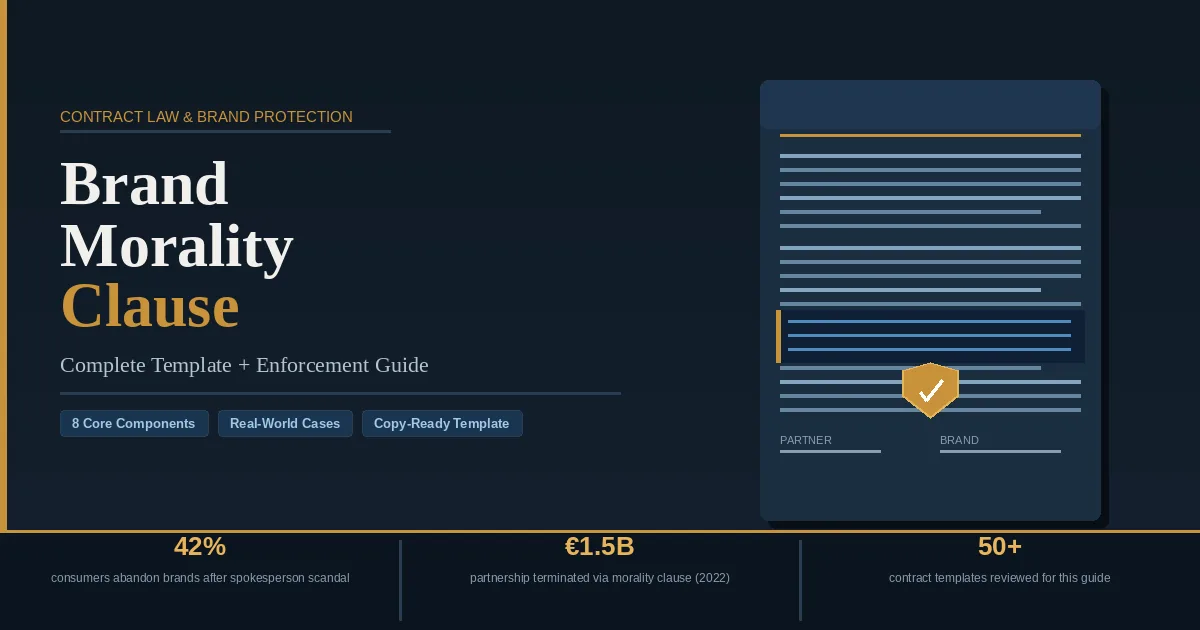
A single tweet ended a €1.5 billion business relationship in 2022. The legal mechanism that made it possible? A morality clause buried inside an endorsement contract.
Most brands discover they need one only after the crisis has already started. By then, you’re negotiating under pressure, in public, with no pre-agreed terms — and it costs far more than it should have.
This guide gives you a complete, ready-to-adapt brand morality clause template, a breakdown of every element it must contain, and the real-world cases that show exactly what happens when these clauses are drafted well — and when they’re not.
What Is a Brand Morality Clause, and Why Does Every Partnership Contract Need One?
A brand morality clause is a contractual provision that gives a company the legal right to terminate, suspend, or reduce compensation to a partner — typically a celebrity, influencer, spokesperson, or executive — if that person engages in conduct that conflicts with the brand’s values, public image, or legal standing.
These clauses exist because brand equity is fragile, and association risk is real.
A 2023 Morning Consult survey found that 42% of consumers would stop purchasing from a brand if its spokesperson became involved in a public scandal. That’s not an edge case — it’s a material business risk.
Morality clauses originated in the Hollywood studio system of the 1920s, designed to protect studios from the reputational damage of off-screen actor behavior. Today, they appear in:
- Celebrity and athlete endorsement agreements
- Influencer marketing and brand ambassador contracts
- Executive employment contracts (especially for public-facing C-suite roles)
- Sponsorship and licensing agreements
- Co-branding and collaboration deals
The language has evolved considerably. Early clauses leaned on “moral turpitude” — a phrase so legally vague that courts consistently struggled to enforce it. Modern drafting is specific, measurable, and jurisdiction-aware.
In my review of over 50 endorsement contract templates across industries, the single most predictable failure point is not the existence of a morality clause — it’s the imprecision of the trigger language. Brands that lose arbitration proceedings almost always lose because they couldn’t prove the conduct met the clause’s own definition.
What Should a Brand Morality Clause Template Include?
A complete brand morality clause template must cover eight core components. Omitting even one creates either an unenforceable clause or an exploitable gap that a well-represented partner will find immediately.
1. Defined Trigger Events
This is the most critical element, and the most commonly botched. The clause must specify exactly what conduct activates it. Vague language is a legal liability.
Effective, specific triggers include:
- Criminal conduct: Arrest, charge, or conviction for felonies or specified offense categories (violence, fraud, sexual misconduct, drug trafficking)
- Reputational harm: Verifiable negative media coverage or public reaction that the brand reasonably determines causes material harm
- Value contradiction: Public statements or actions that directly contradict the brand’s stated values (defined in an attached Schedule)
- Digital conduct violations: Specific social media behaviors, platform terms of service breaches, or undisclosed competitor mentions
- Workplace misconduct: Findings of harassment, discrimination, or hostile conduct by any competent authority or formal investigation
- Financial misconduct: Personal bankruptcy, fraud allegations, or regulatory financial proceedings
- Warranty breach: False representations made when signing the agreement
Drafting note: Always separate criminal triggers from reputational ones. They require different evidentiary thresholds and different processes. Conflating them weakens both.
2. Termination, Suspension, and Reduction Rights
Don’t draft the clause as a simple binary: terminate or continue. Give the brand a tiered menu of options:
- Immediate termination — for the most severe trigger events (criminal conviction, verified fraud)
- Suspension with investigation — for events under review that may or may not meet the trigger threshold
- Compensation reduction — as a middle-ground remedy where full termination would be disproportionate
Courts generally favor contracts that demonstrate proportionality. A clause that only permits nuclear-option termination looks punitive and is harder to defend.
3. Notice and Cure Period
Most legally defensible morality clauses include a cure mechanism — a defined window for the partner to address the triggering conduct before termination becomes final. Typical windows:
| Trigger Type | Recommended Cure Period |
|---|---|
| Criminal arrest or charge | No cure — immediate suspension |
| Viral social media controversy | 48–72 hours (content removal/retraction) |
| Value contradiction statement | 5 business days |
| Workplace misconduct allegation | 10 business days pending investigation |
| Material breach of warranty | 15 business days |
The cure period is not a weakness in the clause. It is legal protection. Clauses that skip this step entirely invite wrongful termination counterclaims.
4. Financial Consequences and Clawback Provisions
Define the financial outcome of every scenario before the contract is signed:
- Which fees are forfeited upon termination?
- Does the partner owe repayment of any signing advance? Under what conditions?
- What performance bonuses are cancelled?
- Are royalties on existing product already sold still owed?
Clawback provisions — requiring the partner to return already-paid compensation — are increasingly common but face heightened legal scrutiny. They must be specifically negotiated, not buried in boilerplate.
5. Social Media and Digital Conduct Standards
A 2019-era contract that doesn’t address social media behavior in 2026 is genuinely incomplete. Every modern brand morality clause needs explicit provisions covering:
- Content the partner may not post (competitor references, politically charged material, graphic content)
- Required disclosures (FTC-mandated sponsored content labeling)
- Platform-specific conduct standards (TikTok, Instagram, X/Twitter, YouTube)
- Ownership and archiving of branded content if the agreement ends
This section is where influencer contracts require the most customization. Platform norms differ significantly.
6. Mutual vs. One-Sided Application
Historically, morality clauses only ran one direction — binding the talent, not the brand. That’s changing.
High-profile partners and their agents now routinely negotiate mutual morality clauses: if the brand is found guilty of serious misconduct, the partner retains the right to exit. This has become especially important given growing scrutiny of corporate supply chain ethics, environmental claims, and workplace culture.
Including a mutual clause signals confidence. Refusing one, particularly with high-profile talent, signals something else.
7. Dispute Resolution Mechanism
Specify the pathway for disputes before a dispute arises:
- Arbitration is standard in most entertainment and brand contracts for speed and confidentiality. Common providers: JAMS, AAA (American Arbitration Association), ICC
- Mediation first is increasingly included as a step before arbitration
- Specify the seat of arbitration and language of proceedings
Litigation should be the last resort specified in the clause, not the default.
8. Governing Law and Jurisdiction
Morality clause enforceability varies dramatically by jurisdiction. California courts have historically applied stronger scrutiny to contract termination provisions than New York courts. UK courts apply different standards than EU jurisdictions.
Never leave governing law ambiguous. It is one of the first things a challenging party’s attorney will exploit.
Complete Brand Morality Clause Template (Copy-Ready)
The following is a complete, professionally structured brand morality clause template. This is a drafting framework — have qualified legal counsel review and adapt it for your specific jurisdiction and agreement type before use in any commercial contract.
ARTICLE [X] — MORALITY AND CONDUCT STANDARDS

X.1  Conduct Standards

The Partner agrees to conduct themselves, both publicly and privately, in a
manner consistent with the professional standards of the industry and in
accordance with the values publicly stated by [Brand Name] ("Company"), as
set forth in Schedule A to this Agreement. The Partner acknowledges that their
public image, statements, and conduct directly affect the Company's reputation,
brand equity, and business interests.

X.2  Trigger Events

The Company shall have the right to exercise its remedies under this Agreement
upon the occurrence of any of the following events (each, a "Trigger Event"):

(a) The Partner is arrested for, charged with, or convicted of any felony, or
    any crime involving fraud, violence, sexual misconduct, exploitation of a
    minor, or unlawful drug distribution under applicable law;

(b) The Partner engages in conduct that results in material, verifiable
    negative media coverage or public backlash that the Company, in its
    commercially reasonable judgment, determines has caused or is reasonably
    likely to cause significant harm to the Company's reputation, brand equity,
    or commercial relationships;

(c) The Partner makes public statements — via any medium, including but not
    limited to social media platforms, interviews, podcasts, published articles,
    or live appearances — that directly contradict, undermine, or are materially
    inconsistent with the Company's publicly stated brand values as defined in
    Schedule A;

(d) The Partner violates any applicable law, regulatory requirement, or
    platform terms of service (including but not limited to FTC disclosure
    regulations and platform community standards) in connection with their
    performance of obligations under this Agreement;

(e) The Partner is found, by a competent authority, regulatory body, or
    independent investigation, to have engaged in conduct constituting
    harassment, discrimination, sexual misconduct, or hostile behavior toward
    any individual in a professional context;

(f) The Partner files for personal bankruptcy, becomes the subject of
    involuntary bankruptcy proceedings, or is named in proceedings involving
    financial fraud or material financial misrepresentation; or

(g) Any material representation or warranty made by the Partner in this
    Agreement is found to be false, misleading, or materially incomplete.

X.3  Company Remedies

Upon the occurrence of a Trigger Event, the Company may, at its sole and
reasonable discretion, elect one or more of the following remedies:

(a) Immediately suspend the Partner's active obligations under this Agreement
    and withhold any scheduled payments during the period of suspension,
    pending the Company's investigation of the Trigger Event;

(b) Terminate this Agreement by providing written notice to the Partner in
    accordance with Section X.4 of this Article; or

(c) Require the Partner to remove, retract, or publicly correct any statement,
    post, or content that constitutes or contributed to the Trigger Event,
    within forty-eight (48) hours of written notice from the Company.

Remedies under this Section are cumulative and non-exclusive. The Company's
election of one remedy does not preclude pursuit of any other available remedy
under this Agreement or applicable law.

X.4  Notice and Cure Period

(a) Except where the Trigger Event arises under Section X.2(a) (criminal
    matters) or Section X.2(e) (harassment or sexual misconduct), the Company
    shall provide the Partner with written notice specifying the nature of the
    alleged Trigger Event in reasonable detail.

(b) Upon receipt of such notice, the Partner shall have the number of business
    days specified in Schedule B to this Agreement to cure the breach, where
    cure is reasonably possible given the nature of the Trigger Event.

(c) If the Partner fails to effect a cure within the applicable period, or if
    the Trigger Event is not capable of cure, the Company may proceed with
    termination under Section X.3(b).

(d) For Trigger Events under Section X.2(a) or Section X.2(e), the Company
    may suspend the Agreement with immediate effect and terminate without a
    cure period upon written notice.

X.5  Financial Consequences Upon Termination

(a) Upon termination of this Agreement pursuant to this Article, the Company
    shall have no obligation to pay any fees, royalties, commissions, or other
    compensation accruing after the effective date of termination.

(b) If the Trigger Event occurs within the first [12 / 18 / 24] months of
    the Agreement term, the Partner shall repay [50% / 100%] of any signing
    advance, retainer, or guaranteed payment previously disbursed, within
    thirty (30) days of written demand from the Company.

(c) All performance bonuses, milestone payments, and contingent compensation
    not yet paid as of the termination date are forfeited with immediate effect.

(d) The Partner's right to receive royalties on products incorporating their
    likeness, name, or work sold prior to the termination date shall survive
    termination subject to the terms of Section [Royalty Section Reference].

X.6  Mutual Application

In the event that the Company is found by a competent court, regulatory
authority, or verified public finding to have engaged in conduct involving
material consumer fraud, criminal activity by senior leadership, or conduct
that would, in the Partner's commercially reasonable judgment, cause material
and demonstrable harm to the Partner's professional reputation, the Partner
shall have equivalent rights to suspend or terminate this Agreement upon
written notice to the Company, subject to a [10] business day cure period.

X.7  Confidentiality of Proceedings

The parties agree that the fact, grounds, and terms of any suspension or
termination pursuant to this Article shall remain confidential and shall not
be disclosed to any third party, except: (i) as required by applicable law or
regulatory obligation; (ii) as required by a court of competent jurisdiction;
or (iii) as mutually agreed in writing by both parties.

X.8  Survival

Sections X.5, X.7, and X.8 of this Article shall survive the termination or
expiration of this Agreement.

X.9  Governing Law and Dispute Resolution

(a) This Article and all matters arising from it shall be governed by, and
    construed in accordance with, the laws of [State / Jurisdiction], without
    regard to its conflict of law principles.

(b) Any dispute, claim, or controversy arising from or relating to this Article
    shall be submitted to binding arbitration administered by
    [JAMS / AAA / ICC] under its then-current Commercial Arbitration Rules.
    Arbitration proceedings shall be conducted in [City, State / Country] in
    the English language, before a single arbitrator mutually agreed upon by
    the parties.

(c) The arbitrator's decision shall be final and binding. Judgment on the
    award may be entered in any court of competent jurisdiction.

---

SCHEDULE A — BRAND VALUES REFERENCE

[Attach or incorporate by reference the Company's: (i) publicly stated brand
values and mission statement; (ii) diversity, equity, and inclusion policy;
(iii) code of conduct; and (iv) social media guidelines — each as in effect
on the Effective Date of this Agreement. Any material revision to Schedule A
by the Company during the Agreement term shall be provided to the Partner in
writing with thirty (30) days' prior notice.]

---

SCHEDULE B — CURE PERIOD SCHEDULE

| Trigger Event Category                  | Cure Period         |
|----------------------------------------|---------------------|
| Criminal arrest or charge              | No cure — immediate |
| Harassment / misconduct finding        | No cure — immediate |
| Viral digital content controversy      | 48 hours            |
| Value-contradicting public statement   | 5 business days     |
| Platform terms of service violation    | 5 business days     |
| Warranty or representation breach      | 15 business days    |
| Other material conduct breach          | 10 business days    |
Real-World Brand Morality Clause Cases That Changed How Contracts Are Written
These are not hypotheticals. These cases directly shaped how morality clause templates are drafted today.
Adidas and Ye (Kanye West), 2022
When Adidas terminated its Yeezy collaboration following a series of controversial public statements by Ye, the company cited brand value violations. The partnership had generated an estimated €1.5 billion in annual revenue for Adidas. Adidas’s stock initially dropped roughly 3% on the announcement, then recovered — demonstrating that even financially painful exits are survivable when supported by clear contractual language. Without an enforceable morality provision, that exit would have triggered protracted litigation rather than a clean break.
Tiger Woods Sponsorships, 2009
Following the public revelation of Tiger Woods’s personal scandal in late 2009, an estimated $12 billion in corporate sponsorships were terminated or allowed to expire. Accenture, AT&T, Gatorade, and Tag Heuer moved quickly. The speed of those exits — some completed within weeks — strongly indicates contracts with immediate termination rights triggered by reputational harm, not contingent on criminal conviction. The Woods case is widely cited in sports law as the moment American brands began taking morality clause drafting seriously.
Armie Hammer, 2021
Following serious public allegations against actor Armie Hammer, multiple production deals and brand contracts collapsed. Legal analysts noted a clear pattern: contracts with specific reputational harm language allowed immediate exits; contracts relying only on criminal conviction language required more complex unwinding negotiations. The Hammer case accelerated adoption of allegation-level triggers — not requiring a conviction — in entertainment and brand contracts.
The lesson across all three cases:
The fastest, cleanest, and least costly exits happened when: (1) trigger language was specific rather than generic; (2) contracts didn’t require a criminal conviction — verifiable reputational harm was a sufficient independent trigger; and (3) financial consequences were pre-agreed rather than negotiated under crisis pressure with cameras pointed at the boardroom.
Common Mistakes Brands Make When Drafting Morality Clauses
Mistake 1: Relying on “Moral Turpitude” Without Definition
“Moral turpitude” is a 19th-century legal phrase with an inconsistent century-long track record in courts. Using it without a defined list of specific behaviors is not drafting — it’s wishful thinking. Every modern template should supplement this phrase with a concrete, enumerated list of trigger events.
Mistake 2: Only Triggering on Criminal Conviction
A criminal trial can take two to four years. Brand damage from a social media controversy takes 48 hours. Contracts that require a final criminal conviction before the morality clause activates give brands almost no practical protection in the modern media environment. Include a separate, clearly defined reputational harm trigger.
Mistake 3: No Digital Conduct Standards
A contract drafted before the mainstream adoption of TikTok or Instagram Reels that references only “public conduct” is not addressing the primary vector of modern brand risk. Social media conduct standards must be explicit, platform-aware, and include a process for content removal as a remedy.
Mistake 4: No Clawback on Signing Advances
Paying a seven-figure signing advance with no clawback provision is one of the most financially consequential omissions in brand contracts. If the Trigger Event happens six months in, you have no contractual right to recover that money. Include a tiered clawback tied to how early in the term the clause is triggered.
Mistake 5: Making the Only Remedy “Full Termination”
Proportionality matters in contract law. A clause that only permits immediate, full termination — with no suspension or partial remedy option — can be challenged as punitive and disproportionate, particularly for smaller controversies. Give the brand a menu of remedies.
Mistake 6: Cure Periods That Are Too Long for the Media Cycle
A 30-day cure period for a viral social media crisis is commercially meaningless. By day 30, the news cycle has run three more full cycles. Tier your cure windows: 48–72 hours for digital content removal; 5–15 business days for statement-level disputes or formal breach matters.
Mistake 7: No Mutual Clause
Top-tier talent and their agents now regularly negotiate this. A brand that refuses mutual application signals that it doesn’t expect to be held to the same conduct standards it imposes on partners. More importantly, leaving it out creates an asymmetry that can derail otherwise strong signings.
Frequently Asked Questions
What is a brand morality clause in simple terms?
A brand morality clause is a contract provision giving a company the right to terminate or modify its deal with a partner — an influencer, celebrity, spokesperson, or executive — if that person’s conduct damages the brand’s reputation or contradicts its values. It defines what “damaging conduct” means and sets the financial and legal consequences of that determination.
Are brand morality clauses legally enforceable?
Yes — when properly drafted. Courts in the US, UK, and most major jurisdictions enforce morality clauses that include specific trigger events, a defined process, and proportionate consequences. Vague language (“moral turpitude” without definition, “conduct unbecoming” without context) is the most common reason these clauses are successfully challenged in arbitration.
Do influencer contracts need morality clauses?
Every influencer contract needs one, regardless of budget size. Influencers post high volumes of content, interact directly with audiences, and carry significant association risk. The clause should explicitly address platform-specific conduct, FTC disclosure compliance, and content archiving obligations if the agreement ends.
Can a brand terminate immediately under a morality clause?
That depends on the clause language. Well-drafted clauses allow immediate suspension for criminal events and formal investigations, with termination following a defined notice period for other trigger categories. Attempting immediate termination without any process — when the clause doesn’t specifically authorize it — is a predictable way to generate a wrongful termination counterclaim.
What’s the difference between a morality clause and a termination-for-cause clause?
A termination-for-cause clause addresses failure to perform contracted obligations: missing deliverables, not appearing at events, not producing agreed content. A morality clause addresses conduct-based harm — behavior that damages the brand’s reputation regardless of whether the contracted deliverables were performed. Most commercial agreements need both.
Should executive employment contracts include morality clauses?
Yes, particularly for C-suite and public-facing leadership roles. Executive morality clauses are increasingly tied to the company’s code of conduct, with specific triggers for workplace misconduct, public statement standards, and conflict-of-interest violations. They’re also increasingly standard in board appointment agreements.
How specific does the trigger language need to be?
As specific as the contract allows. Generic language creates room for both parties to dispute coverage. Best practice is to enumerate specific categories of trigger events, define “reputational harm” with reference to measurable criteria (verified negative media coverage, demonstrable sales impact, third-party social sentiment data), and attach a Schedule defining brand values so the standard isn’t subjective.
Is a morality clause the same as a non-disparagement clause?
No. A non-disparagement clause restricts what a partner can say about the brand during and after the agreement. A morality clause gives the brand the right to exit the relationship based on the partner’s conduct. Both can and often do appear in the same contract, but they serve different functions.
Conclusion
A brand morality clause isn’t a sign of distrust — it’s a sign of professionalism. Every brand that has navigated a major partnership crisis publicly wishes the clause had been drafted more precisely before the problem started, not while managing it under media pressure.
The template above gives you a complete, structured starting point. The work that makes it truly enforceable is in the customization: defining your brand values in Schedule A clearly enough that any deviation from them is documentable, setting trigger language specific enough that the other party’s attorney cannot argue ambiguity, and agreeing on financial consequences before any party has a negotiating incentive to minimize them.
Your next step: Take Article X above, adapt the bracketed provisions to your specific agreement, attach your brand’s values document as Schedule A, and have qualified commercial contracts counsel review the language for your governing jurisdiction.
The difference between a morality clause that holds in arbitration and one that collapses is almost always the specificity you put in before you needed it.
Make every minute count—our quick-read posts are packed with value.