⚠️ Legal Disclaimer: This article is for informational purposes only and does not constitute legal advice. Laws change frequently. Always consult a licensed attorney for guidance specific to your situation. Verify all statutes at your state legislature’s official website before taking legal action.
Sharing intimate images without consent is a crime across nearly all of the United States — and in 2025, for the first time, it’s also a federal issue. Yet millions of people still don’t know what protections exist in their state, what penalties perpetrators face, or what steps victims can take right now.
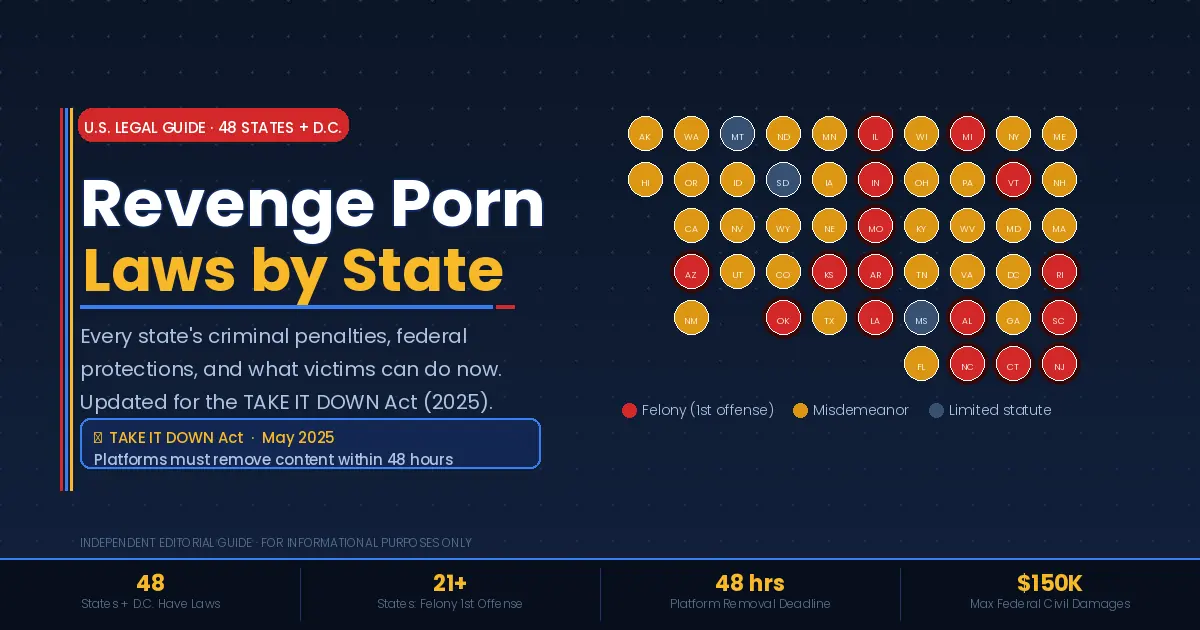
As of 2025, 48 states plus Washington D.C. have enacted specific non-consensual intimate image (NCII) laws. In May 2025, the federal TAKE IT DOWN Act created a national framework requiring platforms to remove such content within 48 hours. And in 2024, the DEFIANCE Act gave victims a federal civil lawsuit option — including for AI-generated deepfakes.
This guide covers every state’s current law, the criminal and civil consequences for perpetrators, the landmark new federal protections, and exactly what to do if you or someone you know is a victim.
What Qualifies as Revenge Porn Under US Law?
“Revenge porn” is the crime of sharing intimate images of someone without their consent. Under state and federal law, three core elements must typically be present for the act to be prosecuted.
Element 1: The image is intimate or sexually explicit. This includes nude images, images depicting genitalia, or images showing sexual acts. Many states go further, covering images that are “intimate in nature” even without explicit sexual content. Context matters — an image that exposes someone in a vulnerable private moment can qualify.
Element 2: The victim did not consent to sharing. This is the most misunderstood element. Consenting to have a photo taken gives the other person zero right to distribute it. Every state statute makes this distinction explicit. Sending a photo privately to one person is not consent to show it to others, post it online, or send it to the victim’s employer.
Element 3: The sharer knew the victim expected privacy. In practice, this is almost never difficult to prove. If an intimate image was shared in a private relationship context, courts consistently find that a reasonable expectation of privacy existed.
What about AI-generated deepfakes? Federal law (the DEFIANCE Act, signed July 2024) explicitly covers computer-generated intimate images. Several states — including California, Georgia, New York, Virginia, and Illinois — have also updated their statutes to include synthetic or AI-manipulated images.
The term “revenge porn” is widely criticized by advocates because it implies the victim provoked the act. Legal bodies increasingly use “non-consensual intimate imagery (NCII)” or “non-consensual pornography.” This article uses both terms — “revenge porn” remains the dominant search term, while NCII is the legally preferred language.
Is Revenge Porn Illegal in All 50 States?
In 2013, only three US states had specific NCII laws. By 2025, 48 states plus Washington D.C. have enacted targeted legislation — and even in the two states with limited dedicated laws, related statutes (criminal harassment, stalking, voyeurism, or extortion) provide a prosecution pathway.
The table below summarizes each state’s current framework. Penalties shown reflect first-offense adult charges. Aggravating factors — targeting minors, commercial distribution, or combining the act with extortion — significantly increase penalties in every state.
State-by-State Revenge Porn Laws — Complete Reference Table
| State | Classification | Max Penalty (1st Offense) | Escalates to Felony? | Civil Remedy? |
|---|---|---|---|---|
| Alabama | Felony (Class C) | Up to 10 years | N/A | ✅ Yes |
| Alaska | Misdemeanor (Class A) | Up to 1 year | ✅ Yes (repeat) | ✅ Yes |
| Arizona | Felony (Class 5) | Up to 2.5 years | N/A | ✅ Yes |
| Arkansas | Felony (Class D) | Up to 6 years | N/A | ✅ Yes |
| California | Misdemeanor | 6 months / $1,000 | ✅ Yes (repeat/minor) | ✅ Yes |
| Colorado | Misdemeanor (Class 1) | Up to 18 months | ✅ Yes | ✅ Yes |
| Connecticut | Felony (Class D) | Up to 5 years | N/A | ✅ Yes |
| Delaware | Misdemeanor | Up to 1 year | ✅ Yes | ✅ Yes |
| Florida | Misdemeanor (1st degree) | 1 year / $1,000 | ✅ Yes (repeat) | ✅ Yes |
| Georgia | Agg. Misdemeanor | 1 year / $5,000 | ✅ Yes | ✅ Yes |
| Hawaii | Misdemeanor | Up to 1 year | ❌ No | ✅ Yes |
| Idaho | Misdemeanor | Up to 6 months | ✅ Yes | ❌ Limited |
| Illinois | Felony (Class 4) | Up to 3 years | ✅ Yes (Class 3) | ✅ Yes |
| Indiana | Felony (Level 6) | Up to 2.5 years | ✅ Yes | ✅ Yes |
| Iowa | Serious Misdemeanor | Up to 1 year | ✅ Yes | ✅ Yes |
| Kansas | Felony (Severity 8) | ~23 months | N/A | ✅ Yes |
| Kentucky | Misdemeanor (Class A) | Up to 1 year | ✅ Yes | ✅ Yes |
| Louisiana | Felony | Up to 2 years | ✅ Yes (5 yrs repeat) | ✅ Yes |
| Maine | Class D Crime | Up to 1 year | ✅ Yes | ✅ Yes |
| Maryland | Misdemeanor | Up to 2 years | ❌ No | ✅ Yes |
| Massachusetts | Misdemeanor | Up to 2.5 years | ✅ Yes (5 yrs) | ✅ Yes |
| Michigan | Felony | Up to 5 years / $5,000 | N/A | ✅ Yes |
| Minnesota | Gross Misdemeanor | Up to 1 year | ✅ Yes (felony) | ✅ Yes |
| Mississippi ★ | Misdemeanor | Up to 6 months | ❌ Limited | ❌ Limited |
| Missouri | Felony (Class E) | Up to 4 years | N/A | ✅ Yes |
| Montana ★ | Misdemeanor | Up to 6 months | ❌ No | ❌ No |
| Nebraska | Misdemeanor | Up to 1 year | ✅ Yes | ✅ Yes |
| Nevada | Misdemeanor | Up to 6 months | ✅ Yes (Cat. D felony) | ✅ Yes |
| New Hampshire | Misdemeanor (Class A) | Up to 1 year | ✅ Yes | ✅ Yes |
| New Jersey | 3rd Degree Crime | Up to 5 years | N/A | ✅ Yes |
| New Mexico | Misdemeanor | Up to 1 year | ✅ Yes | ✅ Yes |
| New York | Misdemeanor (Class A) | Up to 1 year | ✅ Yes | ✅ Yes |
| North Carolina | Felony (Class H) | Up to 25 months | N/A | ✅ Yes |
| North Dakota | Misdemeanor (Class A) | Up to 1 year | ❌ No | ❌ No |
| Ohio | Misdemeanor (1st) | Up to 180 days | ✅ Yes | ✅ Yes |
| Oklahoma | Felony | Up to 2 years | ✅ Yes | ✅ Yes |
| Oregon | Misdemeanor (Class A) | Up to 1 year | ✅ Yes | ✅ Yes |
| Pennsylvania | Misdemeanor (2nd) | Up to 2 years | ✅ Yes (3rd deg. felony) | ✅ Yes |
| Rhode Island | Felony | Up to 3 years | N/A | ✅ Yes |
| South Carolina | Felony | Up to 3 years | N/A | ✅ Yes |
| South Dakota | Misdemeanor (Class 1) | Up to 1 year | ❌ No | ❌ No |
| Tennessee | Misdemeanor (Class A) | Up to 1 year | ✅ Yes | ✅ Yes |
| Texas | Misdemeanor (Class A) | 1 year / $4,000 | ✅ Yes (State jail felony) | ✅ Yes |
| Utah | Misdemeanor (Class A) | Up to 1 year | ✅ Yes | ✅ Yes |
| Vermont | Felony | Up to 2 years | N/A | ✅ Yes |
| Virginia | Misdemeanor (Class 1) | Up to 1 year | ✅ Yes (Class 6 felony) | ✅ Yes |
| Washington | Gross Misdemeanor | Up to 1 year | ✅ Yes (Class C felony) | ✅ Yes |
| Washington D.C. | Misdemeanor | Up to 180 days | ✅ Yes | ✅ Yes |
| West Virginia | Misdemeanor | Up to 1 year | ✅ Yes | ✅ Yes |
| Wisconsin | Misdemeanor (Class A) | Up to 9 months | ✅ Yes (Class I felony) | ✅ Yes |
| Wyoming | Misdemeanor | Up to 6 months | ✅ Yes | ❌ Limited |
★ States with limited dedicated NCII laws — prosecution typically proceeds under related statutes (harassment, stalking). Other states also apply related charges alongside NCII statutes.
Important: This table reflects the general legal landscape as of mid-2025. Statutes are amended regularly. Always verify the current version of your state’s law at your official state legislature website before taking action.
What Are the Criminal Penalties for Revenge Porn?
Criminal charges for NCII fall into two tiers: misdemeanor and felony. The gap between them is significant — not just in prison time, but in long-term consequences for the convicted person.
Misdemeanor penalties (most common for first offenses):
- Jail time: 6 months to 1 year in county jail
- Fines: $500 to $5,000 depending on state
- Probation: typically 1–3 years
- Mandatory counseling in some jurisdictions (California, Colorado)
- Criminal record that can affect employment, housing, and professional licensing
Felony penalties (21 states classify NCII as a felony):
- Prison time: 1 year to 10+ years in state prison
- Fines: $2,500 to $10,000 or more
- Permanent felony record with lifelong consequences
- Loss of voting rights and certain professional licenses during incarceration in many states
Five factors that automatically elevate charges:
- The victim is a minor. This converts virtually every state’s misdemeanor charge to a serious felony and typically triggers mandatory sex offender registration requirements. Federal charges under child exploitation statutes may also apply simultaneously.
- Repeat offense. In California, Texas, Virginia, Florida, Wisconsin, and Washington, a second conviction escalates to felony status.
- Commercial distribution. Sharing images for financial gain — including uploading to ad-supported websites — adds charges in approximately 20 states and increases penalties substantially.
- Using images for extortion (sextortion). This is prosecuted under separate, far more severe statutes. Federal sextortion carries up to 30 years in federal prison under 18 U.S.C. § 2261A.
- Distributing to the victim’s employer, family, or community. Targeted distribution that causes specific professional or social harm increases penalties in more than a dozen states.
Among states with the strongest baseline penalties: Michigan charges a felony with up to 5 years even for first-time offenders. New Jersey treats NCII as a third-degree crime — equivalent to a felony — with up to 5 years. North Carolina’s Class H felony carries a presumptive sentence above 20 months.
Federal Revenge Porn Laws: The DEFIANCE Act and TAKE IT DOWN Act
For most of US history, non-consensual intimate imagery was purely a state-level matter. Federal law changed significantly in 2024 and 2025 with two landmark pieces of legislation.
The DEFIANCE Act (July 2024)
The Disrupt Explicit Forged Images and Non-Consensual Edits Act was signed into law on July 30, 2024. It created a federal civil cause of action for victims of non-consensual disclosure of intimate images — and was the first federal law to explicitly cover AI-generated deepfakes and computer-manipulated images.
Under the DEFIANCE Act, victims can sue in federal court for:
- Actual damages (including lost income and therapy costs)
- Attorney’s fees
- Punitive damages up to $150,000 in cases of malicious or intentional conduct
The federal statute of limitations is 10 years from when the victim discovered the violation — significantly longer than most state civil claims, which typically run 2–3 years.
The TAKE IT DOWN Act (May 2025)
Signed into law in May 2025, the TAKE IT DOWN Act is the most sweeping federal action yet on NCII. It mandates that online platforms and websites must:
- Remove reported non-consensual intimate images within 48 hours of receiving a valid notice
- Maintain a clear, accessible, and functional reporting mechanism for victims
- Prevent re-upload of content that has been flagged and removed
Platforms that fail to comply face enforcement action by the Federal Trade Commission and civil penalties. This is transformative: before the TAKE IT DOWN Act, platforms operated under widely inconsistent voluntary policies with no legal deadline.
What these federal laws do not cover: Neither law creates federal criminal charges for individual offenders sharing non-deepfake adult NCII. For criminal prosecution of the person who shared the images, state law remains the primary vehicle. However, sextortion (using images to extort money or additional images) carries severe federal criminal penalties under existing statutes.
How to Report Revenge Porn — Step by Step
Taking swift, organized action is critical. These eight steps reflect the most effective sequence — doing them out of order, or skipping steps, reduces your legal options.
Step 1: Document everything before you act. Screenshot every instance of the content with URLs, usernames, dates, and timestamps visible. Use a secondary device if possible to create a clean record. Do not wait — content can be deleted or moved at any time.
Step 2: Use StopNCII.org immediately. This free tool, operated by the Internet Watch Foundation, creates a digital “hash” (fingerprint) of your image. Major platforms — including Meta, TikTok, Bumble, Snap, Reddit, and others — use this database to automatically detect and block uploads of that image across their networks. This is the fastest way to prevent viral spread.
Step 3: Report directly to each platform. File reports on Google, Facebook, Instagram, Reddit, X (Twitter), and any other platform hosting the content. Under the TAKE IT DOWN Act, platforms are legally required to respond within 48 hours. Keep records of every report submitted.
Step 4: Request de-indexing from Google Search. Even if a website won’t remove content, Google’s Search removal tool (at google.com/webmasters/tools/removals) can de-index the URL, making it effectively invisible in search results. Google has a specific policy for non-consensual intimate images that allows expedited removal requests.
Step 5: File a police report. Contact your local police department or sheriff’s office and bring your documentation. Cite the specific state statute that applies (reference the table in this article). If officers are unfamiliar with NCII law — which still happens — the Cyber Civil Rights Initiative (CCRI) provides a law enforcement reference guide at cybercivilrights.org.
Step 6: Send DMCA takedown notices. If you are the photographer of the images (which is often the case with selfies), you hold the copyright. A DMCA takedown notice legally compels websites to remove infringing content. CCRI and Without My Consent (withoutmyconsent.org) provide attorney-reviewed template letters.
Step 7: Contact the CCRI Crisis Helpline. The Cyber Civil Rights Initiative operates a free crisis helpline at 1-844-878-CCRI (2274). Staff provide immediate support, referrals to attorneys who specialize in NCII cases, and platform-specific removal guidance. This is one of the most underutilized resources available to victims.
Step 8: Consult a civil attorney. With civil remedies now available in 38+ states and at the federal level, suing the perpetrator for damages is viable and increasingly successful. Many privacy attorneys offer free initial consultations. The CCRI maintains a state-by-state attorney referral list on their website.
Can You Sue Someone for Revenge Porn?
Civil lawsuits for non-consensual intimate imagery have resulted in settlements and verdicts ranging from tens of thousands to millions of dollars — and the legal landscape for victims has never been more favorable.
In one of the most referenced US cases, a Texas woman was awarded a $6.45 million judgment against her ex-boyfriend after he distributed intimate images to her coworkers and family. While not every case results in such awards, six- and seven-figure outcomes are increasingly documented across multiple states.
What damages are available in a civil lawsuit?
- Actual damages: Documented financial losses — therapy costs, lost wages, job search expenses, relocation costs if you moved due to harassment
- Emotional distress damages: Compensation for psychological harm. Courts have awarded substantial amounts in NCII cases because the documented mental health impact is severe and measurable
- Statutory damages: In California and several other states, victims can claim a set statutory amount per violation without having to prove specific dollar losses
- Punitive damages: In cases of intentional or malicious conduct, courts can award punitive damages to deter future behavior. Under the federal DEFIANCE Act, these can reach $150,000
- Attorney’s fees: Many state NCII statutes include fee-shifting provisions — if you win, the defendant pays your legal costs
Civil and criminal cases can proceed simultaneously. A criminal conviction dramatically strengthens a parallel civil case, but a criminal conviction is not required to win in civil court. Civil cases use the lower “preponderance of evidence” standard, not “beyond a reasonable doubt.”
Common Myths That Stop Victims From Taking Action
Myth 1: “I consented to the photo, so I have no legal recourse.” This is the most harmful misconception in NCII law, and it is completely false. Every US state statute distinguishes between consent to create an image and consent to distribute it. A private photo shared with a partner carries zero implied consent to share it with anyone else, ever. Courts have been unambiguous on this point for years.
Myth 2: “It has to be posted publicly online to be illegal.” Most state laws cover texting the image to a single person. Transmission — not publication — is the triggering act. Many states specifically include text messages, emails, and private group chats in their definitions of “distribution.”
Myth 3: “If the website is overseas, I can’t do anything.” The TAKE IT DOWN Act applies to any platform accessible to US users, regardless of where the servers are hosted. Furthermore, Google can de-index content from any domain, making it virtually unfindable even if the underlying site won’t cooperate. Overseas hosting is not the shield perpetrators assume it is.
Myth 4: “Police won’t take this seriously.” Law enforcement response has improved markedly since 2020, when most NCII statutes were younger. Many jurisdictions now include NCII-specific training for officers. If your local department is unresponsive, escalate to your state attorney general’s office — California, Texas, New York, and Florida all have dedicated internet safety or cyber crime units.
Myth 5: “This only happens to women.” Research consistently shows that men, non-binary individuals, and LGBTQ+ people are also significant victims of NCII. A 2023 study published by Data & Society found approximately 1 in 12 people across all demographics have experienced non-consensual intimate image sharing. LGBTQ+ individuals face disproportionately higher rates of victimization, and the law protects all people equally.
Myth 6: “Public figures have weaker protections.” Being a public figure — a politician, influencer, or celebrity — does not diminish NCII legal protections. Intimate images retain privacy protections even for people who have voluntarily entered public life. Courts have consistently upheld this principle across multiple state jurisdictions.
Frequently Asked Questions
Is revenge porn a federal crime in the United States? As of 2025, the TAKE IT DOWN Act makes non-consensual distribution of intimate images a federal offense and requires platforms to remove flagged content within 48 hours. The DEFIANCE Act (2024) provides federal civil remedies including damages up to $150,000. Criminal prosecution of individual offenders for non-child-exploitation cases still primarily runs through state law.
Can I report revenge porn anonymously? Most platform reporting tools (Google, Meta, Reddit, X) allow anonymous submissions. Police reports typically require your identity, but many jurisdictions offer victim confidentiality protections in NCII cases — ask your detective or prosecutor about sealing case records. CCRI’s helpline can assist with anonymous platform removal strategies.
Does the image have to show my face to be illegal? No. Most state statutes cover any image where you are identifiable by any means — including distinctive tattoos, birthmarks, body features, or surrounding context. Image metadata (EXIF data) has also been used to identify victims. Courts have successfully prosecuted cases without facial identification.
What if the perpetrator is in a different state than me? Interstate NCII cases can be prosecuted in either the victim’s state or the perpetrator’s state, depending on where the images were transmitted or received. Federal law (TAKE IT DOWN Act, DEFIANCE Act) can also apply across state lines. Jurisdiction in cross-state cases is genuinely complex — consult an attorney.
How long do I have to file a lawsuit? Statutes of limitations vary by state, but most civil NCII claims allow 2–3 years from the date you discovered the violation (not necessarily when it occurred). Under the federal DEFIANCE Act, victims have a 10-year window to bring a federal civil claim — one of the longest in privacy law. Criminal statutes of limitations are typically set by each state’s general criminal procedure rules.
What should I do if the images are spreading virally right now? Act on all channels simultaneously. File platform reports on every site you can identify. Use StopNCII.org to create a hash immediately — this is the fastest way to trigger automated blocking across major platforms. Submit Google de-indexing requests for every URL. Call the CCRI helpline (1-844-878-CCRI) for real-time guidance. In urgent cases involving rapid spread, some attorneys offer emergency injunctive relief applications.
Is sexting itself illegal under these laws? Sexting between consenting adults is legal. The crime is sharing intimate images without the depicted person’s consent. However, any intimate images involving a person under 18 — even if both parties are minors, even if created voluntarily — can trigger serious federal and state child pornography charges entirely separate from NCII law.
What if I can’t afford an attorney? The CCRI maintains a list of attorneys who take NCII cases on a contingency basis (no upfront cost — they take a percentage only if you win). Legal aid organizations in most states also handle NCII cases, particularly for lower-income victims. Many state bar associations have pro bono referral services. Representing yourself is possible for platform-level actions but strongly not recommended for police reports and lawsuits.
Conclusion
Revenge porn laws in the United States have undergone one of the fastest legislative evolutions in recent memory. What was a largely unaddressed crime in 2013 is now covered by 48 state statutes, Washington D.C., and — as of 2025 — a comprehensive federal framework that imposes legal obligations on the platforms where NCII spreads.
Perpetrators face real, severe consequences: felony charges in 21+ states, civil judgments that can reach millions of dollars, and under the TAKE IT DOWN Act, the near-certain removal of content from major platforms within 48 hours of reporting.
If you are a victim, your first three steps are:
- Document all evidence before doing anything else
- Submit your image to StopNCII.org for automated cross-platform blocking
- Call the CCRI Crisis Helpline at 1-844-878-CCRI (2274) for free, immediate guidance
Laws in this area are still evolving — several states are actively updating penalty structures and expanding definitions to cover deepfakes and AI-generated imagery. Check your state legislature’s official website for the most current version of the applicable statute, and consult a licensed attorney before pursuing criminal or civil action.
Discover what works—our results-driven articles speak for themselves.