Influencer marketing is a multi-billion-dollar industry, yet most agreements between creators and their managers are still handshake deals — until something goes wrong. An influencer manager agreement template protects both sides by defining exactly who does what, who gets paid how much, and what happens when either party wants out.
This guide breaks down every essential clause, shares real-world pitfalls I’ve seen blow up careers, and gives you a working structure you can adapt immediately — whether you’re a creator signing with your first manager or a talent agency onboarding a new client.
What Is an Influencer Manager Agreement — and Why Does It Matter?
An influencer manager agreement is a binding contract between a content creator and the individual or agency managing their career. It defines the scope of the manager’s services, the commission structure, the contract term, exclusivity, and what happens at termination. Without one, disputes over unpaid commissions, brand deal ownership, and post-termination earnings are almost impossible to resolve.
The talent management industry has no universal licensing requirement in most countries (unlike talent agents in California, who must be licensed under the Talent Agencies Act). That lack of regulation makes the written agreement your only reliable protection.
In practice, I’ve reviewed dozens of influencer contracts. The single most common mistake I see is a vague “scope of services” clause. One creator I worked with had no definition of what their manager was actually supposed to do — and spent eight months paying 20% commission on brand deals she sourced entirely herself.
Getting the contract right before money changes hands isn’t optional. It’s the foundation.
What Should Every Influencer Manager Agreement Include?
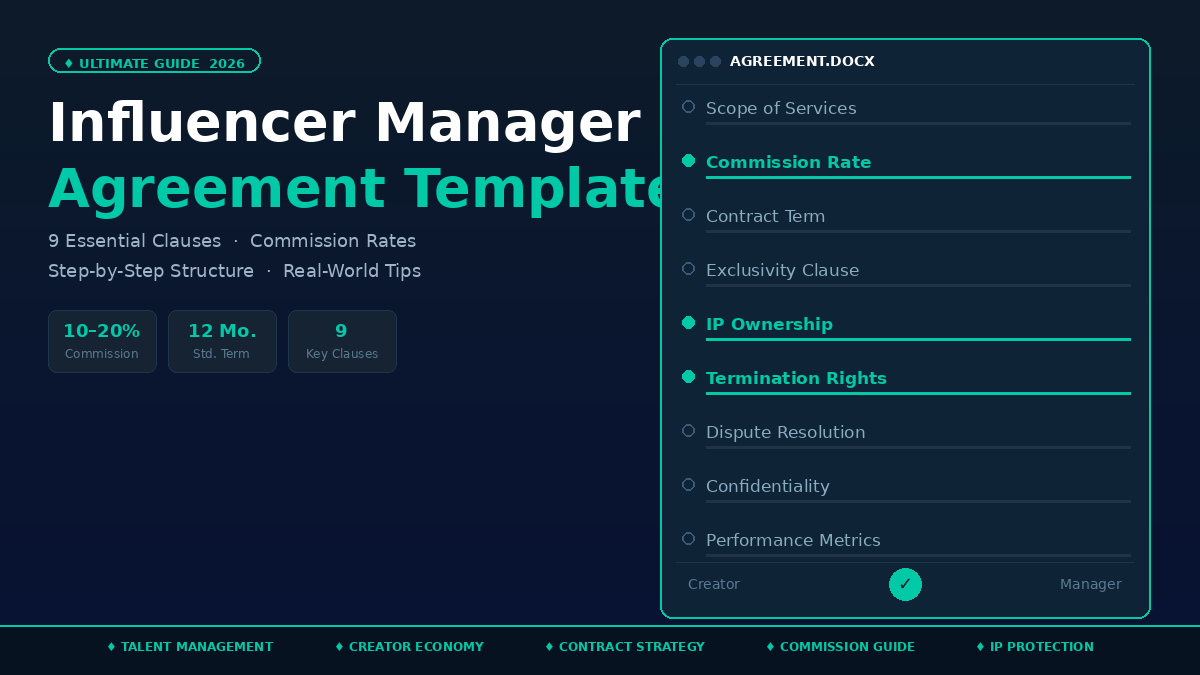
A complete agreement covers nine core provisions. Miss even one and you create a gap that lawyers — or resentment — will later fill.
1. Identification of Parties
State the full legal names of both parties. If the manager operates through an LLC or agency, use the entity name. Specify the jurisdiction (state or country) whose laws govern the agreement. This matters more than most creators realize — California, New York, and the UK each treat talent management differently.
2. Scope of Services
This is the most important clause in the entire document. List exactly what the manager is responsible for:
- Securing brand partnership deals
- Negotiating contract terms on the creator’s behalf
- Career strategy and platform growth consulting
- Connecting the creator with PR, legal, and accounting professionals
- Managing inbound inquiries from brands
Be specific. “General career management” is not a scope. It’s a blank check for disputes.
3. Commission Rate and Structure
Standard influencer manager commission ranges from 10% to 20% of gross earnings from deals the manager sources or materially assists in closing. Key questions to answer in this clause:
- Is commission calculated on gross or net revenue?
- Does commission apply to deals the creator sourced independently?
- Are there different rates for different deal types (e.g., 15% on brand deals, 10% on merchandise)?
- Does commission apply to deals closed after the agreement ends if the relationship was initiated during the term? (This is called a post-term or “tail” commission — typically 6–12 months.)
Define “gross earnings” explicitly. Does it include gifted products? No — it shouldn’t. Does it include affiliate revenue? That’s negotiable. Write it down.
4. Contract Term and Renewal
Most initial influencer management agreements run 12 months, with an option to renew. Some agencies push for 24–36 months. From the creator’s perspective, a shorter initial term with clear renewal terms is always preferable — it lets you evaluate performance before locking in.
Include:
- Start and end date
- Auto-renewal conditions (e.g., auto-renews for 12 months unless either party gives 60 days’ written notice)
- Performance milestones, if any, that trigger early renewal options
5. Exclusivity Clause
Does the manager represent you exclusively, or can you work with other managers in different verticals? Does the agreement prevent the manager from signing competing creators in your exact niche?
Spell out:
- Whether the arrangement is exclusive or non-exclusive
- What “exclusive” actually covers (all platforms? specific platforms? certain deal types?)
- Any permitted exceptions
6. Termination Rights
A good termination clause includes:
- For-cause termination — either party can exit immediately for material breach (e.g., manager misappropriates funds; creator refuses to fulfill obligations)
- Without-cause termination — either party can exit with 30–90 days’ written notice
- Cure period — before a for-cause termination triggers, the breaching party gets a defined window (typically 15–30 days) to fix the problem
Without a without-cause termination right, a creator can be contractually tied to a manager who stops delivering — and have no legal way out.
7. Intellectual Property and Content Ownership
The creator owns their content. Full stop. The agreement should confirm this explicitly and specify that the manager has no claim to the creator’s social media accounts, channel names, trademarks, or content library — during or after the relationship.
8. Confidentiality
Both parties agree not to disclose the terms of the agreement or confidential business information to third parties. This protects deal rates, commission structures, and brand relationships.
9. Dispute Resolution
Specify how disputes are handled:
- Governing law (which state/country)
- Mediation first, then arbitration or litigation
- Venue for any legal proceedings
Arbitration is faster and cheaper than court. Most professional agreements default to it.
How to Structure the Agreement: A Step-by-Step Template Outline
Use this sequence as your working template. A well-structured agreement flows logically and leaves no ambiguity.
Step 1 — Write the Preamble
This Talent Management Agreement ("Agreement") is entered into as of [DATE]
between [CREATOR FULL LEGAL NAME] ("Artist") and [MANAGER FULL LEGAL NAME
or ENTITY NAME] ("Manager").
Step 2 — Define Scope of Services (Numbered List)
Use a numbered list, not a paragraph. Courts interpret numbered lists as exhaustive. Paragraphs invite interpretation.
Manager agrees to provide the following services:
1. Identify and pitch Artist for brand partnership opportunities.
2. Negotiate deal terms on Artist's behalf.
3. Review and advise on all inbound collaboration inquiries.
4. Provide strategic career planning consultation [FREQUENCY].
5. Coordinate with Artist's legal and accounting representatives.
Step 3 — Commission Table
A table is cleaner than prose for financial terms:
| Revenue Type | Commission Rate | Applies To |
|---|---|---|
| Brand partnership (manager-sourced) | 15% of gross | All platforms |
| Brand partnership (artist-sourced) | 0% | All platforms |
| Merchandise / product lines | 10% of gross | Co-developed only |
| Speaking engagements | 15% of gross | Manager-booked only |
| Post-term deals (tail period) | 15% of gross | 6 months post-termination |
This table format also happens to be what Google’s AI Overviews extract directly — it answers “how much does an influencer manager get paid” in a single glance.
Step 4 — Term and Renewal Clause
This Agreement shall commence on [START DATE] and continue for a period of
twelve (12) months ("Initial Term"). Upon expiration, this Agreement shall
automatically renew for successive twelve (12)-month periods unless either
party provides written notice of non-renewal no fewer than sixty (60) days
prior to the end of the then-current term.
Step 5 — Termination Clause
Either party may terminate this Agreement:
(a) For Cause: Immediately upon written notice if the other party materially
    breaches this Agreement and fails to cure such breach within fifteen (15)
    days of written notice.
(b) Without Cause: Upon sixty (60) days' written notice to the other party.
Step 6 — IP Ownership Statement
Artist retains sole and exclusive ownership of all content, social media
accounts, trademarks, and intellectual property created before or during
the term of this Agreement. Manager acquires no ownership rights of any kind.
Step 7 — Signatures Block
IN WITNESS WHEREOF, the parties have executed this Agreement as of the date
first written above.

ARTIST: _________________________  Date: ___________
[Full Legal Name]

MANAGER: ________________________  Date: ___________
[Full Legal Name / Entity Name]
Real-World Data, Expert Insights, and What the Numbers Say
Understanding market standards helps you negotiate from an informed position — not from guesswork.
Commission Benchmarks
According to an industry analysis published by the Creator Economy Institute (2024), the median management commission for mid-tier influencers (100K–1M followers) is 15% of gross brand deal revenue. Top-tier creators with over 1M followers often negotiate this down to 10–12% given their deal volume.
For micro-influencers (10K–100K), I’ve seen commissions as high as 20% — justified when the manager is doing significant outreach work to compensate for the lower individual deal values.
Deal Volume and Manager ROI
A manager earning 15% commission needs to generate meaningful additional revenue to make the relationship worthwhile for the creator. Here’s how the math works:
- Creator baseline: $8,000/month in self-sourced brand deals
- Manager’s target: Generate incremental deals beyond what the creator would close alone
- If the manager sources $25,000/month in new deals at 15% commission = $3,750/month to the manager
- Creator nets $21,250 from manager-sourced deals — a clear positive outcome
The agreement should reflect this logic. Paying commission on self-sourced deals erases the creator’s incentive to source their own work.
What Entertainment Lawyers Actually Say
Entertainment attorneys consistently flag two clauses as the most litigated in influencer management disputes:
- Post-term commission (“tail” clauses) — Managers argue they deserve commission on deals that close after termination if they initiated the relationship. Creators argue they owe nothing once the contract ends. A defined tail period (6 months is standard) eliminates ambiguity.
- “Key Person” clauses — If the creator signed because of a specific individual at a management company, they should have the right to exit if that person leaves the agency. Without this clause, a creator can find themselves managed by someone they’ve never met.
Common Mistakes to Avoid in an Influencer Manager Agreement
Most contract disputes trace back to the same handful of errors — and all of them are preventable.
Mistake 1: No Definition of “Gross Revenue”
“15% of gross” means nothing without a definition. Does “gross” include the value of gifted products? Usage fees paid after the initial post? Affiliate commissions from links the creator manages independently? Define it or expect a fight.
Mistake 2: Unlimited Exclusivity
Some management agreements prohibit the creator from any commercial activity without the manager’s involvement — including selling their own merchandise, teaching courses, or licensing their content directly. That’s not management; that’s control. Exclusivity should be limited to the services explicitly listed in the scope.
Mistake 3: No Performance Benchmarks
An agreement with no minimum performance expectations lets an inactive manager collect commission indefinitely. Consider adding: “Manager agrees to actively pitch Artist for a minimum of [X] brand opportunities per month.” Even a soft benchmark gives the creator grounds to exit under a cause termination if the manager goes quiet.
Mistake 4: No Clear Termination Without Cause
Locking a creator into a 24-month agreement with no without-cause exit right is a serious mistake. Relationships change. Strategies change. Both parties need an escape valve that doesn’t require proving bad behavior.
Mistake 5: Signing a Contract Without Independent Legal Review
I can’t stress this enough: use this template as a starting point, not a final document. A one-hour consultation with an entertainment attorney costs $200–$500. That’s cheap insurance against a $50,000 commission dispute.
Comparison: Key-Clause Differences Between Strong and Weak Agreements
| Clause | Weak Agreement | Strong Agreement |
|---|---|---|
| Scope of Services | “General management” | Numbered list of 5–8 specific duties |
| Commission | “15% of earnings” | 15% of gross brand deal revenue, manager-sourced only |
| Term | 24 months, auto-renews | 12 months, 60-day non-renewal notice |
| Termination | For-cause only | For-cause + without-cause (60 days’ notice) |
| Post-term commissions | Undefined | 6-month tail on initiated deals only |
| IP Ownership | Not mentioned | Explicit creator ownership, all platforms |
| Dispute Resolution | Not mentioned | Arbitration, specified jurisdiction |
Frequently Asked Questions
What is a fair commission rate for an influencer manager?
The industry standard is 10–20% of gross revenue from manager-sourced brand deals. Mid-tier influencers typically pay 15%. Mega-influencers with high deal volume often negotiate 10–12%. Paying commission on deals you sourced yourself is generally unreasonable and should be avoided in your agreement.
Does an influencer manager agreement need to be notarized?
In most jurisdictions, no. A signed written agreement between two parties is legally binding without notarization. However, having witnesses sign or using a digital signature platform (like DocuSign) creates a clearer evidentiary record if a dispute arises later.
How long should an influencer management contract be?
Twelve months is the standard initial term. It gives both parties enough time to evaluate the relationship without creating a multi-year lock-in. Auto-renewal clauses are common — just ensure they include a reasonable notice period (30–60 days) for opting out.
Can I work with multiple managers under one agreement?
Only if the agreement is explicitly non-exclusive. Most management agreements are exclusive within a defined scope (e.g., brand partnerships). Confirm whether “exclusive” applies to all commercial activities or only those listed in the scope of services. Many creators use one manager for brand deals and a separate agent for speaking engagements.
What happens to ongoing brand deals if I terminate my manager?
This depends on the post-term commission clause. A standard tail provision requires the creator to pay commission (typically at the same rate) on deals that were actively in negotiation or initiated by the manager at the time of termination — usually for 6–12 months post-exit. Deals the manager had no involvement in are not subject to commission.
Who owns my social media accounts under an influencer manager agreement?
You do — always. A legitimate management agreement will explicitly confirm that the creator owns all social media accounts, content, and associated intellectual property. Be very cautious of any agreement that grants the manager access to your accounts or co-ownership of your brand assets.
Is an influencer manager the same as a talent agent?
No. Talent agents are licensed in many U.S. states (especially California under the Talent Agencies Act) and legally authorized to solicit employment on a creator’s behalf. Managers are not legally required to be licensed and traditionally focus on career strategy rather than direct deal-making. In practice, the lines blur — which is why the written agreement defining the scope of services matters so much.
Can I use a free template from the internet for an influencer management agreement?
A free template is a useful starting point for understanding the standard clauses, but it should not be your final document. Every creator-manager relationship has specific terms (commission rates, scope, term length, exclusivity) that a generic template cannot anticipate. Use any template — including this one — as a drafting framework, then have an entertainment attorney review and customize it for your situation.
Conclusion: Get the Agreement Right Before the Money Gets Big
An influencer manager agreement isn’t a formality — it’s the document that determines how your revenue gets split, who owns your content, and how you exit a relationship that no longer works. The creators who get into trouble are almost always those who signed fast and read slow.
Start with the nine core clauses outlined here. Customize the commission table to reflect your actual deal types. Make sure the termination clause protects both sides. And never skip independent legal review before you sign anything.
The best time to establish clear terms is before you need to enforce them.
Action step: Use the template outline in Section 3 as your working draft. Bring it to an entertainment attorney, fill in the specific rates and terms you’ve negotiated, and get it signed before your manager’s first pitch goes out.
Everything you need to know, all in one place—start with our featured articles.