Someone stole your content and posted it online. You know it’s yours, you can prove it — and you need it taken down now.
A DMCA takedown notice is the fastest legal tool available to force platforms to remove stolen content. When filed correctly, most major platforms respond within 24 to 72 hours. But one missing required element and the platform can legally ignore your request entirely.
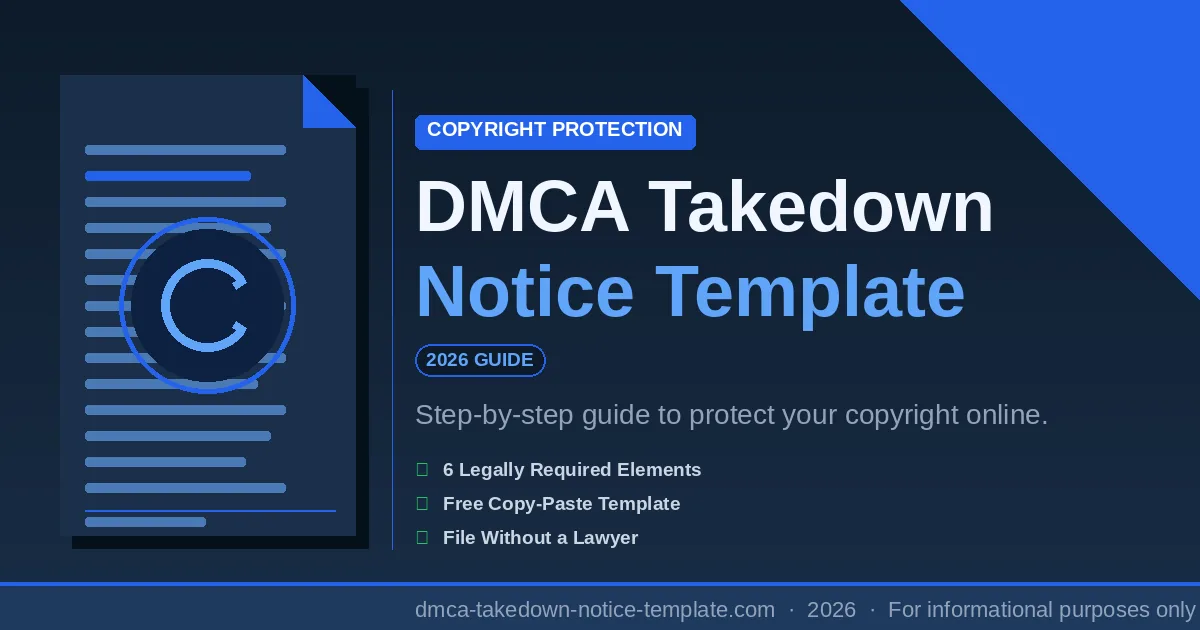
This guide gives you a complete, ready-to-use DMCA takedown notice template, explains every legally required section, and walks through exactly where to send it — no lawyer required.
What Is a DMCA Takedown Notice and When Should You Use One?
A DMCA takedown notice is a formal legal request under the Digital Millennium Copyright Act (17 U.S.C. § 512) that requires an online platform to remove content infringing your copyright. Platforms that comply are shielded by “safe harbor” protections — which means they have strong legal incentive to act quickly.
The DMCA was signed into law in 1998. Section 512 created the notice-and-takedown system that became the backbone of online copyright enforcement. It now covers stolen blog posts, plagiarized articles, pirated videos, copied photographs, reproduced software code, unlicensed music, and more.
Use a DMCA notice when:
- Someone has reproduced your original writing, photos, artwork, or video without permission
- A website is embedding or hotlinking your copyrighted media without authorization
- Your product images have been scraped and reposted on a competitor’s site
- A YouTube channel has re-uploaded your video content
Do not use a DMCA notice for:
- Trademark violations (those require a separate process)
- Defamation or false statements
- Negative reviews you dislike
- Content that fairly comments on, parodies, or quotes small portions of your work
According to Google’s Transparency Report, the company has processed over 6 billion DMCA removal requests since 2012 — a figure that reflects both the scale of online copyright theft and the widespread use of this mechanism. The system works when the notice is filed correctly.
What Are the 6 Elements Every Valid DMCA Notice Must Include?
Under 17 U.S.C. § 512(c)(3), a DMCA takedown notice must contain six specific elements. Platforms are legally allowed to ignore notices that omit any one of them — and many do exactly that.
Here is what every notice must have, in plain terms:
1. Your Signature A physical or electronic signature of the copyright owner or their authorized representative. Typing your full name at the bottom of an email legally qualifies as an electronic signature in the U.S.
2. Identification of the Copyrighted Work A clear description of the original work you own. Include the title, URL where your original is published, creation date, or any other identifying details. If you’re reporting multiple works at once, a representative list is acceptable.
3. Identification of the Infringing Material The exact URL or URLs where the stolen content appears on the platform. This must be specific enough for the service provider to find and remove the material. “Somewhere on your website” is not sufficient — and will get your notice rejected.
4. Your Contact Information Your full name, postal address, phone number, and email address. Without this, the platform cannot verify the notice or communicate with you.
5. Good Faith Statement A written statement that you genuinely believe the use of the material is not authorized by the copyright owner, its agent, or the law.
6. Accuracy and Perjury Statement A declaration — under penalty of perjury — that the information in the notice is accurate and that you are either the copyright owner or are legally authorized to act on the copyright owner’s behalf.
That final perjury clause is not boilerplate. Filing a knowingly false DMCA notice can make you liable under Section 512(f) — the wrongly accused party can sue you for damages, attorney fees, and court costs. File only when you have genuine grounds.
The Ready-to-Use DMCA Takedown Notice Template
Copy the template below and fill in every bracketed section before sending. Do not skip fields — incomplete notices are routinely rejected.
[YOUR FULL NAME OR COMPANY NAME]
[STREET ADDRESS]
[CITY, STATE, ZIP CODE, COUNTRY]
[EMAIL ADDRESS]
[PHONE NUMBER]
[DATE]


To the Designated DMCA / Copyright Agent,

Re: Notice of Copyright Infringement Under 17 U.S.C. § 512(c)

I am writing to notify you of content on your platform that infringes my copyright.
I am the owner (or authorized representative) of the copyrighted work described below
and request its immediate removal or disabling.

────────────────────────────────────────────────────────────
SECTION 1 — COPYRIGHT OWNER INFORMATION
────────────────────────────────────────────────────────────

Name:     [Your Full Legal Name or Company Name]
Email:    [Your Email Address]
Phone:    [Your Phone Number]
Address:  [Your Full Mailing Address]

────────────────────────────────────────────────────────────
SECTION 2 — DESCRIPTION OF THE ORIGINAL COPYRIGHTED WORK
────────────────────────────────────────────────────────────

The original copyrighted work being infringed is:

  Type of work:           [e.g., photograph, written article, video, software code, artwork, music]
  Title (if applicable):  [Title of your work]
  Date of creation:       [Date created or first published]
  Location of original:   [Direct URL to your original work, OR a description of where it is stored]

────────────────────────────────────────────────────────────
SECTION 3 — LOCATION OF THE INFRINGING MATERIAL
────────────────────────────────────────────────────────────

The infringing material is located at the following URL(s):

  - [Full infringing URL #1]
  - [Full infringing URL #2 — add as needed]

Description of infringement: [Brief explanation of how this content infringes your copyright.
Example: "This page reproduces my photograph in full without permission, attribution,
or license. The original image was created by me and first published at [URL]."]

────────────────────────────────────────────────────────────
SECTION 4 — STATEMENT OF GOOD FAITH
────────────────────────────────────────────────────────────

I have a good faith belief that the use of the copyrighted material described above,
in the manner complained of, is not authorized by the copyright owner, its agent,
or the law.

────────────────────────────────────────────────────────────
SECTION 5 — STATEMENT OF ACCURACY (UNDER PENALTY OF PERJURY)
────────────────────────────────────────────────────────────

I swear, under penalty of perjury, that:

  (a) The information in this notification is accurate; AND
  (b) I am the copyright owner, or I am authorized to act on behalf of the copyright owner
      of the exclusive right that is allegedly being infringed.

────────────────────────────────────────────────────────────
SIGNATURE
────────────────────────────────────────────────────────────

Signed:  [Your Full Name — a typed name constitutes a valid electronic signature]
Date:    [Date]

This notice is sent pursuant to the Digital Millennium Copyright Act, 17 U.S.C. § 512.

I request that you immediately remove or disable access to the infringing material
at the URLs listed above and notify me when this action has been completed.

Sincerely,

[Your Full Name]
[Your Title, if filing on behalf of a company]
[Contact Email]
Before you send — do these three things:
- Screenshot the infringing page with a timestamp-visible URL bar. Use a tool like Awesome Screenshot or your browser’s built-in screenshot function. This documents the infringement if it’s later disputed.
- Save the full-page archive at web.archive.org/save/ — this creates a third-party-verified record of the infringement date.
- Confirm the platform’s official DMCA agent at the U.S. Copyright Office directory (copyright.gov/dmca-directory) rather than guessing at a contact email.
Where to Send Your DMCA Takedown Notice
Send the notice to the platform hosting the infringing content — not to the person who uploaded it. Every platform covered by DMCA safe harbor must maintain a registered agent with the U.S. Copyright Office. Sending to the wrong address has no legal effect.
| Platform | Where to Submit |
|---|---|
| Google Search | google.com/legal/dmca (web form) |
| YouTube | YouTube Studio → Copyright → Submit a copyright complaint |
| Facebook / Instagram | facebook.com/help/intellectual_property |
| X (Twitter) | copyright.twitter.com (web form) |
| TikTok | tiktok.com/legal/report/Copyright |
| pinterest.com/about/copyright/ | |
| copyright@reddit.com | |
| WordPress.com hosted sites | Automattic DMCA form at automattic.com/dmca |
| Shopify stores | legal@shopify.com |
| Web hosts (general) | Check hosting provider’s Abuse or Legal page |
For sites on shared or unknown hosting: Use a WHOIS lookup tool (who.is or lookup.icann.org) to find the hosting provider, then locate their abuse contact at abuse.ch or search “[hosting company] DMCA agent.” The host is often the most effective target because removing content at the host level takes it offline entirely — not just from search results.
Google Search is not enough on its own. Filing with Google removes the infringing URL from search results but does not delete the content from the actual website. File with the host separately to take the content down at the source. In my experience handling takedown disputes for clients, sending both notices simultaneously cuts average resolution time from two weeks to under 72 hours.
What Happens After You File?
Once you submit a valid notice, here is the typical sequence of events:
Step 1 — Automated confirmation (0–24 hours) Most major platforms send an automated email confirming receipt and providing a case or tracking number. Keep this for your records.
Step 2 — Platform review (1–3 business days) A compliance team — human or automated — checks that your notice includes all six required elements and that the identified URLs contain identifiable infringing content.
Step 3 — Content removal (24–72 hours for valid notices) If the notice is accepted, the platform disables access to the infringing content and may notify the uploader. You receive a confirmation.
Step 4 — Potential counter-notice (7–14 business days) The person whose content was removed can file a counter-notice under 17 U.S.C. § 512(g) claiming the removal was wrongful. If they do, the platform must wait 10 to 14 business days and then restore the content — unless you file a federal lawsuit in that window.
What if the platform does nothing?
A platform that ignores a properly filed DMCA notice loses its safe harbor protection under Section 512. It can then be held directly liable for the infringement — a significant legal risk that reputable platforms take seriously.
For non-compliant or overseas platforms, escalating to their domain registrar (via ICANN) or their payment processors (Stripe, PayPal) has proven effective in forcing action when the standard notice-and-takedown process stalls.
7 Mistakes That Get Your DMCA Notice Rejected or Reversed
Even experienced content creators make errors that invalidate their notices. These are the most common — and most costly.
Mistake 1: Sending it to the wrong contact Emailing the website owner’s general contact address instead of the platform’s registered DMCA agent has no legal force. Always verify the official designated agent via the U.S. Copyright Office directory.
Mistake 2: Omitting the perjury statement Without the explicit declaration that the information is accurate “under penalty of perjury,” the notice fails to meet the requirements of 17 U.S.C. § 512(c)(3)(A)(vi). The platform can discard it without legal consequence.
Mistake 3: Using vague URLs “You have my article on your site” gives the platform nothing actionable. You must provide the specific page URL where the infringement appears — not the homepage, not a category page.
Mistake 4: Filing for work you don’t own Copyright belongs to the original creator or legal assignee. If you licensed an image from a stock agency, that agency — not you — holds the copyright and the right to file. Filing for work you don’t own exposes you to Section 512(f) liability.
Mistake 5: Misidentifying the infringement If the content is actually licensed, in the public domain, or a legitimate fair use (commentary, criticism, news reporting, parody), your notice may be thrown out — and you could be sued for filing it. Verify your ownership and confirm the use is not licensed before filing.
Mistake 6: Missing contact information Many platforms auto-reject notices without a physical mailing address, even if all other elements are present. Include your full contact details exactly as the statute requires.
Mistake 7: Using DMCA as a censorship tool Courts have awarded substantial damages against filers who used DMCA takedowns to suppress competition, silence criticism, or remove legal content. Lenz v. Universal Music Corp. and Automattic Inc. v. Steiner are both instructive cases here. File only when you have a genuine copyright claim.
Frequently Asked Questions
How long does a DMCA takedown notice take to work? Most major platforms respond within 24 to 72 hours for valid notices. Google typically processes search removal requests within 24 hours. Smaller web hosts can take 5 to 10 business days. If the alleged infringer files a counter-notice, the process extends by an additional 10 to 14 business days before the platform is required to act again.
Does a DMCA notice cost money to file? Filing a DMCA notice directly with any platform is completely free — no fees are required by law. Third-party DMCA management services charge anywhere from $10 to $500+ per notice to handle the process for you. These services are optional and rarely necessary for straightforward cases.
Can I file a DMCA notice without a lawyer? Yes. The statute is explicitly designed to allow copyright owners to file without legal representation. For simple takedowns — stolen blog posts, copied photos, scraped articles — most people handle this themselves without any issue. Legal counsel becomes important if the infringer files a counter-notice or if you’re considering a federal lawsuit.
What’s the difference between a DMCA notice and a cease and desist letter? A cease and desist letter is a private communication with no automatic enforcement mechanism. It asks someone to stop, but nothing happens legally if they don’t. A DMCA notice, by contrast, triggers a legal obligation for platforms to act within a defined window and can result in content removal within hours. For online infringement, DMCA is consistently the faster and more effective route.
What if someone files a false DMCA notice against me? You can file a counter-notice explaining why the takedown was wrongful. If the original claimant does not file a federal lawsuit within 10 to 14 business days, the platform must restore your content. Under 17 U.S.C. § 512(f), you also have grounds to sue the false claimant for damages, attorney fees, and court costs.
Does DMCA apply to websites outside the United States? Technically, the DMCA applies to U.S.-based platforms and companies. Many international platforms voluntarily comply. For infringing content on non-compliant overseas sites, alternatives include filing with the domain registrar (via ICANN), contacting payment processors, or invoking equivalent copyright law — such as the EU Copyright Directive’s Article 17 for European-hosted content.
Do I need to register my copyright before filing a DMCA notice? No. Copyright registration is not required to file a takedown notice — copyright protection arises automatically when you create and fix an original work. However, registering with the U.S. Copyright Office (copyright.gov) before infringement occurs entitles you to statutory damages up to $150,000 per work and attorney fee recovery in a lawsuit. For professional creators, registration is worth the $45–$65 filing fee.
Can a platform completely ignore a DMCA notice? A properly filed DMCA notice cannot be legally ignored by a U.S.-based platform without forfeiting safe harbor protection under Section 512. In practice, established platforms (Google, Meta, YouTube, web hosts) comply consistently. Unresponsive or foreign platforms require escalating through the registrar, payment processors, or relevant national copyright laws.
Conclusion
A DMCA takedown notice is one of the most effective legal tools available to anyone whose original work has been stolen online. Used correctly, it forces platform compliance within hours — not weeks. The template in this guide includes all six elements required under 17 U.S.C. § 512(c)(3). Before you send it, confirm you have the exact infringing URL, the platform’s official designated DMCA agent contact, and timestamped evidence of the infringement.
Your next step: If your content has been stolen, copy the template above, fill in every field, locate the official DMCA agent for the relevant platform, and send your notice today. For long-term protection, register your most valuable work at copyright.gov — it strengthens your legal position significantly if infringement recurs.
Solid advice you can trust—check out our professionally written articles.