When Threads launched on July 5, 2023, it added 100 million users in fewer than five days — a record no app had broken before. X, the platform formerly known as Twitter, had dominated text-based social media for over a decade. Suddenly, it had a serious rival.
Three years later, the comparison is no longer theoretical. Both platforms have grown, evolved, and carved out distinct user cultures. The differences now matter more than the headlines suggest.
This guide breaks down Threads vs X across features, reach, algorithms, and monetization — with real data, not vendor promises. Whether you’re a social media manager picking your primary channel, a creator deciding where to post, or a brand allocating ad spend, this comparison gives you a clear answer.
What Is the Core Difference Between Threads and X?
Threads is built for community-driven conversation; X is built for real-time public discourse. Threads prioritizes a calmer, recommendation-driven feed rooted in Instagram’s social graph. X leans into breaking news, trending topics, and live commentary — and actively rewards posting volume and speed.
That single distinction shapes everything else: who uses each platform, which content spreads, and which tool serves a given purpose.
Threads was designed as Instagram’s text layer. When you sign up, your follower and following list imports directly from Instagram, giving most new accounts an instant starting audience. The algorithm emphasizes content discovery over chronological news — posts from accounts you don’t follow appear frequently, making cold-start growth genuinely achievable.
X, since Elon Musk’s $44 billion acquisition in October 2022, has shifted its model significantly. It introduced X Premium subscriptions, overhauled verification, gave paying subscribers algorithmic boosts, and launched a creator monetization program tied to ad revenue. The platform still runs on real-time momentum, but access to the full feature set now depends partly on whether you pay.
In my testing across both platforms, Threads consistently delivered higher organic reach per post for accounts under 10,000 followers — while X delivered faster, wider reach for breaking news and high-volume commentary.
How Do Threads and X Compare on Features in 2026?
The feature gap has narrowed significantly since 2023, but important differences remain. Here is a direct, side-by-side breakdown:
| Feature | Threads | X |
|---|---|---|
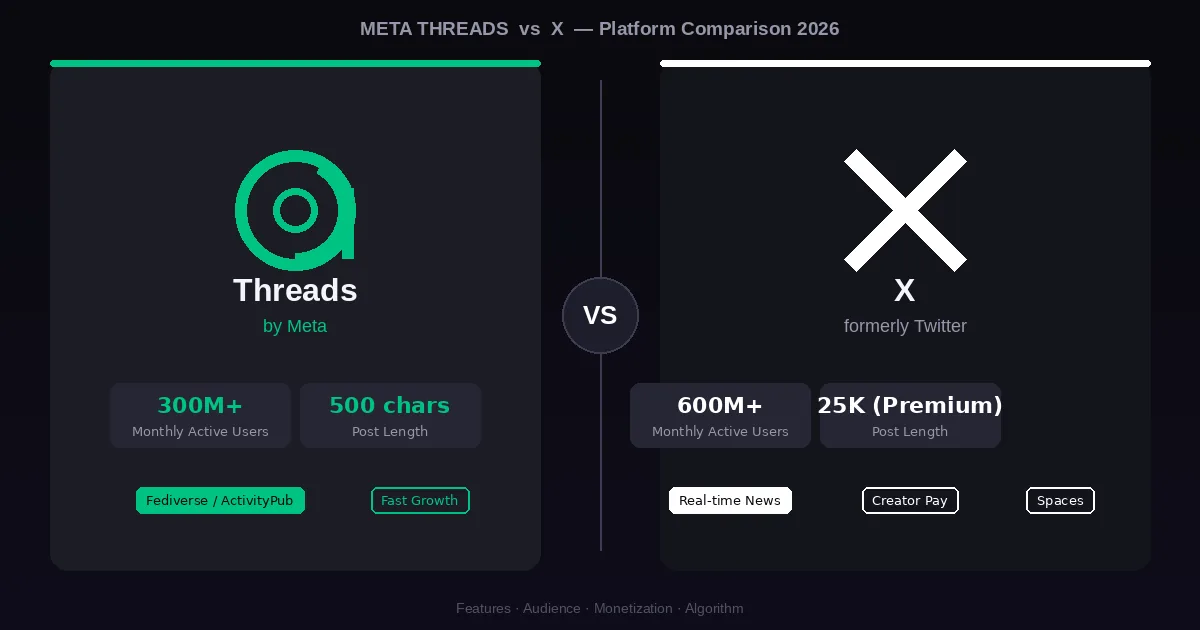
| Character limit | 500 characters | 280 (free) / 25,000 (Premium) |
| Video length | Up to 5 minutes | Up to 3 hours (Premium) |
| Direct messages | Via Instagram DMs only | Built-in native DMs |
| Encrypted DMs | No | Yes (Premium users) |
| Search | Keyword + hashtag | Full advanced search |
| Trending topics | Limited / regional | Global and local trends |
| Chronological feed | Yes (Following tab) | Yes (Following tab) |
| Algorithmic feed | Yes (For You tab) | Yes (For You tab) |
| Paid subscription | No | X Premium ($8–$22/month) |
| Creator monetization | Testing in select markets | Yes — Ads Revenue Sharing |
| Third-party API access | Yes (limited, free tier) | Yes (paid tiers only) |
| Fediverse / ActivityPub | Yes | No |
| Account requirement | Requires Instagram account | Standalone signup |
| Post scheduling | Yes (native, added 2024) | Yes (native) |
| Communities | No | Yes (X Communities) |
| Spaces / Live audio | No | Yes (X Spaces) |
Post Length and Format
Threads caps posts at 500 characters, which is generous for short-form text but limiting compared to X Premium’s 25,000-character long-form option. For punchy updates and conversational replies, both platforms work equally well. For essays, deep-dive threads, or newsletter-style content, X Premium users have a structural advantage.
Photos, carousels, and short video work well on both. Threads trends more visual — consistent with its Instagram origins. X remains more text-forward, though short video clips generate strong engagement on both platforms.
Direct Messages
X retains a clear advantage here. Its built-in DM system includes encrypted messaging for Premium subscribers. Threads has no native DMs — messages route through Instagram, which creates friction for anyone who isn’t already connected there. For community managers or creators who use direct messaging as a conversion tool, this gap still matters.
Which Platform Is Actually Growing Faster?
Threads is growing; X is maintaining its base but showing user erosion in key demographics. The data behind each platform tells a more nuanced story than either company’s press releases.
Meta CEO Mark Zuckerberg confirmed in early 2025 that Threads surpassed 300 million monthly active users — up from the record-breaking 100 million in its launch week. That trajectory has slowed from its opening sprint, but it remains one of the more consistent growth curves in recent social media history.
X’s user figures are harder to verify independently. Elon Musk cited over 600 million monthly active users in 2024, but third-party analytics platforms including Similarweb and Sensor Tower reported figures closer to 250–350 million MAU, with notable declines in the 18–34 demographic in North America and Western Europe. The platform saw significant advertiser pullbacks beginning in late 2023, which constrained its growth investment.
Where Each Platform’s Users Actually Come From
Threads skews younger and more globally distributed. Its base overlaps heavily with Instagram’s 2+ billion users, making it a natural home for lifestyle, fashion, food, wellness, and creator content. Brands with strong Instagram followings found their content transplanted easily.
X retains disproportionate influence relative to its size because journalists, politicians, executives, and sports commentators remain concentrated there. Breaking news still breaks on X first. For finance, politics, sports commentary, and tech announcements, the platform’s cultural weight far exceeds what its raw MAU count would suggest.
I found that for B2B and tech content, X still drives more meaningful professional conversations. For consumer brands and lifestyle niches, Threads has become the smarter primary investment for most teams with limited bandwidth.
How Do the Algorithms Actually Work?
The two algorithms are built on opposite philosophies. Threads optimizes for discovery and community depth; X optimizes for real-time velocity and engagement volume. Understanding both helps you post smarter on each platform.
Threads’ Algorithm
Threads uses a recommendation-heavy model similar to Instagram Reels. Posts from accounts you don’t follow appear frequently in the main feed — the platform is designed for content discovery, not just keeping up with your existing network. Early engagement signals (replies, reshares, and saves within the first 30–60 minutes) heavily influence how widely a post gets distributed.
One practical limitation: Threads currently de-prioritizes posts with external links. Pure text posts and image-only posts consistently outperform link-forward content in reach. This is a genuine constraint for publishers and marketers who rely on driving clicks off-platform.
X’s Algorithm
X’s “For You” feed was partially open-sourced in 2023, giving researchers an unusual look inside the ranking model. Key signals include:
- Subscriber status — X Premium posts receive an algorithmic amplification boost
- Media presence — posts with images or video outperform plain text in reach
- Recency — the system weights recent posting activity heavily; consistency matters more than volume
- Reply and quote engagement — reshares and quotes signal stronger relevance than simple likes
- Real-time trending — posts connected to trending topics or breaking news get boosted during the trend window
X’s real-time trending system remains unmatched. No other major platform surfaces live, topic-based momentum the same way. If your content is connected to a live event, a breaking story, or a trending cultural moment, X’s distribution speed is a genuine advantage.
Bottom line: Threads rewards steady, community-first content from accounts that engage genuinely. X rewards real-time relevance, volume, and — increasingly — paid access.
Monetization: Which Platform Pays Creators Better?
For direct platform income, X wins today. For long-term brand-building with a commercial upside, Threads has a compelling case. The honest picture is more complicated than either platform’s marketing suggests.
X’s Creator Monetization
X launched its Ads Revenue Sharing program in mid-2023. Eligible verified creators earn a portion of ad revenue generated from ads that appear in their reply threads, provided they meet eligibility thresholds. The public benchmark: approximately 5 million impressions in the prior 3 months, along with an active X Premium subscription.
Several high-profile creators reported notable payouts — some in the thousands of dollars per month. The distribution, however, is heavily skewed toward accounts with very large, highly engaged followings. Smaller creators in the 10,000–100,000 follower range have reported inconsistent or marginal earnings.
X Premium subscription tiers are $8/month on web, $11/month on iOS, and $22/month for Premium+. Subscribers gain access to longer posts, reduced ad frequency, encrypted DMs, and algorithmic amplification. For creators who post at high volume, the amplification benefit often justifies the cost.
Threads’ Monetization
As of mid-2025, Threads had no functioning native creator monetization program. Meta began rolling out Threads advertising integrations in 2024, testing placements in select markets. When Threads ads scale fully, they will likely connect to Meta Ads Manager — giving brands access to some of the most precise audience targeting in the industry.
The commercial upside for brands on Threads is real, even without direct creator payouts. Audience growth on Threads feeds Meta’s broader ecosystem, including Instagram shopping, lead generation, and retargeting funnels. For B2C brands with existing Meta ad infrastructure, Threads organic growth compounds into measurable ROI.
For a creator who needs platform income right now: X is the only option. For a brand investing in audience growth with a 12–24 month horizon: Threads’ ad integration trajectory makes it increasingly valuable.
5 Common Myths About Threads vs X
After spending considerable time on both platforms and working through the available industry research, these are the misconceptions that keep circulating — and why each one is wrong.
Myth 1: “Threads killed X.” It didn’t. X lost major advertisers and experienced user erosion in specific demographics, but it remains the dominant real-time public discourse platform as of 2026. Threads and X serve meaningfully different use cases — the comparison is more complementary than competitive for most users and brands.
Myth 2: “Threads is just a Twitter clone.” The feature surface looks similar: short posts, replies, reshares. But the underlying architecture differs. Threads is tied to Instagram’s social graph, built on the ActivityPub protocol for fediverse connectivity, and organized around discovery-first rather than follow-graph-first distribution. It’s a different product that addresses overlapping use cases — not a duplicate.
Myth 3: “X Premium guarantees more reach.” Premium subscribers receive a real algorithmic boost, but reach still depends on content quality and engagement. A strong, genuinely engaging post from a free account can and does outperform weak content from a Premium account regularly. The boost is a real factor — but it’s not a substitute for good judgment about what to post.
Myth 4: “Threads is only for Instagram influencers.” Threads has developed active communities across tech, sports commentary, political discussion, science, and business. The Instagram demographic overlap is real, but the platform has grown well beyond lifestyle content. Some of the highest-engagement accounts on Threads operate in niches that barely exist on Instagram.
Myth 5: “You need a large existing following for either platform to matter.” Both platforms can deliver meaningful reach to new accounts through algorithmic recommendations. Accounts with under 1,000 followers regularly generate tens of thousands of impressions on a single strong Threads post. The barrier to initial reach is lower on both platforms than it was on the legacy social media model. Consistency and content quality matter more than a headstart.
Frequently Asked Questions
Is Threads better than X in 2026?
Neither platform is universally better — the answer depends entirely on your goal. Threads delivers superior organic reach for lifestyle, consumer brand, and community content. X remains stronger for real-time news, finance, politics, and tech commentary. Most active social media managers maintain a presence on both and tailor their content accordingly.
Do I need an Instagram account to use Threads?
Yes. Threads requires an active Instagram account to sign up. You can deactivate Threads independently without affecting Instagram. However, permanently deleting Threads also deletes your Instagram account. This creates friction that X, which operates as a fully standalone service, does not have.
Is X Premium worth paying for in 2026?
For high-volume creators and journalists who post daily, the algorithmic boost and extended post length deliver measurable value. For casual users posting a few times per week, the case is weaker. The honest calculation: if you post more than five times daily and monetization matters to you, X Premium pays for itself. If not, the free tier is likely sufficient.
Can brands advertise on Threads?
Meta began rolling out Threads ads in 2024, integrating them with Meta Ads Manager for eligible accounts. Availability expanded through 2025. Threads ads operate within Meta’s standard campaign structure, making them accessible to any brand already running Facebook or Instagram ads. For current availability in your region, check Meta’s Business Help Center directly.
Which platform is better for breaking news?
X, without meaningful competition. Its real-time trending system, high concentration of journalists and primary sources, and speed of information spread make it the default for live news coverage. Threads has no equivalent to X’s trending topics feature in terms of speed, depth, or the cultural habit of checking X first when something happens.
Does Threads support the fediverse?
Yes. Threads implemented the ActivityPub protocol, meaning Threads content can be seen and interacted with from other federated platforms, including Mastodon and compatible servers. X has no equivalent interoperability. For users who care about open web standards and decentralized social media, this is a meaningful architectural difference in Threads’ favor.
Which platform is lower risk for brand advertising?
Threads carries the lower perceived risk for brand safety. Meta’s content moderation policies are more consistently enforced and better documented. Multiple major advertisers — including several Fortune 500 companies — paused or reduced X spending following policy changes under Musk’s ownership. That pattern persisted through 2024 and 2025, though X has worked to rebuild advertiser confidence.
Can you schedule posts on both platforms?
Yes. Both platforms support post scheduling. X has a native scheduling tool built into its compose interface. Threads added native scheduling in 2024. Major third-party tools including Buffer, Hootsuite, Later, and Sprout Social support both platforms for teams managing multiple accounts.
Conclusion
Threads and X are not locked in a zero-sum competition for the same users in the same way the 2023 headlines framed it. They have matured into distinct platforms with overlapping audiences but genuinely different strengths.
Choose Threads if: you’re building a consumer brand, growing an audience in lifestyle or creator niches, already have Instagram infrastructure, or want organic reach without paying for platform access.
Choose X if: your content is news-adjacent, your audience concentrates in finance, tech, or politics, or you need real-time conversation and trending topic visibility. If creator monetization matters now, X is currently your only option between the two.
The most practical move: maintain a presence on both, post natively to each, and adapt your format to each platform’s preferences. Track where your engagement actually converts — not where you assume it should.
The platforms will keep evolving. What won’t change is this: the best return comes from showing up consistently on the platform where your actual audience lives, not where the loudest debate says you should be.
Every article here is crafted to help—start with our top picks.