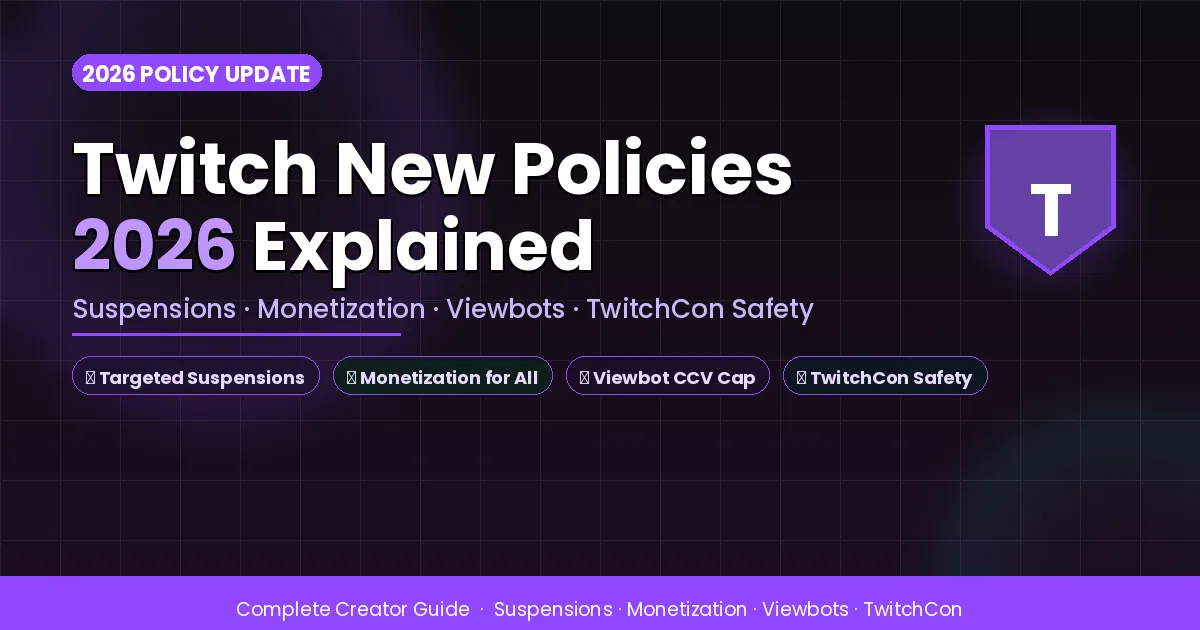
Twitch pushed out more policy changes in the first half of 2026 than in any comparable period in its history. If you stream, watch, or attend TwitchCon, something in this article directly affects you.
The headline changes: a full overhaul of the suspension system (February), open access to monetization tools for every streamer on the planet (May), an aggressive new crackdown on viewbotting, and strict new safety rules for live events. Some changes reward creators. Others carry real risk if you’re not aware of them.
This guide breaks down every major 2026 policy update in plain language, explains what each one means in practice, and tells you exactly what to do next.
What Are Twitch’s Biggest Policy Changes in 2026?
Twitch’s 2026 policy changes fall into four categories: enforcement modernization, monetization expansion, anti-fraud enforcement, and live-event safety. Taken together, they reflect a platform trying to compete more aggressively for creators while cleaning up the behaviors that damage advertiser trust and community health.
The single biggest structural change is the February 2026 suspension overhaul, which ended Twitch’s decade-long “all-or-nothing” ban system. Before this update, a temporary suspension — even for a minor violation — locked you out of everything: streaming, watching, chatting, and your creator dashboard. That blunt instrument is gone. In its place is a targeted enforcement model designed to match the punishment to the actual offense.
The second transformative shift is the May 2026 monetization opening, which eliminated the requirement for Affiliate status before accessing Bits, subscriptions, emotes, badges, and Channel Points. For the first time in Twitch’s history, a streamer with zero followers can activate community-building tools from day one.
Understanding both changes — and the viewbotting crackdown that followed — is essential for any creator operating on Twitch in 2026.
How Does Twitch’s New Suspension System Work in 2026?
Twitch’s new targeted enforcement system, announced on February 24, 2026, replaced the all-or-nothing temporary ban with two distinct suspension types: streaming suspensions and chatting suspensions.
Streaming Suspension Triggered when a violation occurs during a live broadcast, in channel panels, or in Stories. The suspended account cannot go live, and chat on their own channel is temporarily disabled. However, the user can still watch other streams while logged in, participate in chat on other channels, and access their Creator Dashboard. The violation stays contained to broadcast-related activity.
Chatting Suspension Triggered when a violation occurs specifically in chat. The user is blocked from typing in any channel’s chat but retains the ability to stream their own content. Their audience can still watch and chat with them.
Both suspension types run on the same duration ladder Twitch has always used: 24 hours to 30 days, with each subsequent violation extending the length. Accumulating multiple temporary suspensions can still escalate to an indefinite suspension from the entire platform.
According to Christine Weber, Twitch’s Chief Technology Officer, who authored the official announcement: the company’s internal framework maps policy violations to harm levels. At the high end sit violations that pose an urgent risk to physical safety. At the low end are minor disruptions or rule-bending that causes limited damage. Serious violations are still treated with full severity — the new system is not a softening of enforcement, it is a precision upgrade.
What counts as harm under Twitch’s framework? Twitch defines harm as any action that causes or could cause physical, emotional, social, or financial damage to a community member or to the platform. Off-platform behavior remains in scope if it reflects on a creator’s conduct toward their community.
Infractions inside channel panels — things like links or descriptions written in your About section — fall under streaming suspensions because panels are considered part of your broadcast identity. This resolved one of the most confusing gray areas streamers had been dealing with for years.
Twitch has said additional suspension types will roll out in future updates as the system matures.
What Changed for Twitch Monetization in 2026?
Starting May 13, 2026, Twitch opened its core monetization tools — Bits, subscriptions, custom emotes, loyalty badges, and Channel Points — to all eligible streamers worldwide, removing the Affiliate status gate that had previously locked out new creators.
What’s now available to every streamer:
- Channel Points (viewer loyalty rewards)
- Subscriptions (Tier 1, 2, and 3)
- Custom emotes (up to 5 for subscriber tiers)
- Loyalty badges
- Bits (virtual currency tips)
What still requires Affiliate or Partner status:
- Receiving a payout. Twitch’s $50 minimum payout threshold and the Affiliate/Partner requirement for cash disbursement remain in place.
The distinction matters. You can activate all the community tools and start receiving viewer support on day one. You just cannot cash out until you reach Affiliate status and cross the $50 threshold.
Alongside this, Twitch introduced Spendable Balance — a feature that lets streamers use their accumulated Twitch account balance to purchase Bits or gift subs before hitting the payout minimum. It launched in the US first, with a global rollout planned for later in 2026.
Affiliate qualification criteria also got easier in early 2026:
| Requirement | Old Threshold | New Threshold |
|---|---|---|
| Followers | 50 | 25 |
| Total hours streamed | 500 minutes | 4 hours |
| Unique broadcast days | 7 | 4 |
| Average concurrent viewers | 3 CCV (unchanged) | 3 CCV |
The 3-average-viewer requirement remains the hardest hurdle for new streamers. The other three thresholds are achievable with basic consistency.
Twitch’s VP of Monetization Mike Minton framed the change as a direct response to creator feedback: requiring Affiliate status before unlocking engagement tools created a cold-start problem where new streamers had nothing to offer viewers before they had viewers to offer anything to.
The Partner Plus revenue split ladder in 2026:
- Default Affiliate: 50/50 split
- 100 Plus Points: 60/40 split
- 300 Plus Points: 70/30 split
Prime Gaming and gifted subscriptions do not contribute to Plus Points. Build your Plus Point count through paid recurring subscriptions only.
Twitch’s Viewbot Crackdown: What the New CCV Cap Actually Means
On May 7, 2026, Twitch CEO Dan Clancy announced the platform’s most aggressive anti-viewbotting measure to date: a concurrent viewership (CCV) cap applied directly to channels identified as persistently inflating their audience with fake viewers.
The mechanism is straightforward. If Twitch’s detection systems flag your channel as a persistent viewbotter, your displayed CCV across all Twitch surfaces — browse pages, recommendations, directory rankings — gets capped at a number derived from your own historical non-botted traffic. Your real viewers still watch. Your displayed number gets artificially lowered.
This is a deliberate design choice. A ban is a clean break — a streamer gets banned, creates a new account, and the cycle restarts. A CCV cap is slower and more damaging because it compounds: a suppressed view count means lower browse-page ranking, which means fewer new organic viewers find you, which means your real numbers start declining toward the cap. The penalty mirrors the crime.
Repeated violations result in progressively longer cap durations. Streamers receive notification when a cap is applied, including the duration, and can appeal through Twitch’s existing appeals portal. Clancy deliberately withheld specifics about detection triggers to prevent viewbot providers from engineering workarounds.
Why this matters for legitimate streamers:
A Streams Charts whitepaper found that in Q2 2025, at least 10% of Twitch accounts with 50 or more average quarterly viewers showed clear signs of persistent viewbotting. That figure represents a significant distortion of the browse-page rankings that legitimate mid-tier creators depend on for discovery. When a channel with 2,000 fake viewers outranks a channel with 400 real ones, the real channel loses discovery traffic it earned legitimately.
The CCV cap targets this specific distortion. If enforcement holds, the mid-tier browse pages — where genuine growth actually happens — become more accurate and more fair for creators building organically.
The risk of false positives:
Community members raised a valid concern: legitimate viewership spikes, such as a viral clip driving a sudden audience surge, could theoretically resemble bot traffic patterns. Clancy acknowledged the detection challenge and said Twitch’s systems must be precise to avoid penalizing authentic engagement. The appeals portal is the correction mechanism if a cap is applied incorrectly.
TwitchCon 2026 Safety Policy Changes: What Attendees Need to Know
TwitchCon Rotterdam 2026 (May 30–31) and TwitchCon San Diego 2026 arrived with a completely revised safety and IRL streaming policy, driven directly by the October 2025 assault on streamer Emiru during a San Diego meet-and-greet. Twitch CEO Dan Clancy publicly acknowledged in November 2025 that the platform had failed to protect her.
New IRL Streaming Rules at TwitchCon:
- Attendees can wear color-coded no-camera lanyards to signal they do not want to be filmed or approached by streamers.
- IRL streamers are prohibited from interviewing or approaching anyone wearing the designated lanyard or anyone who verbally declines to be on camera.
- “No Recording / No Streaming” zones are installed throughout the venue with prominent signage.
- Streamers must keep pathways clear and must comply with TwitchCon staff instructions to stop streaming or relocate.
Violations of IRL streaming rules result in a temporary streaming suspension for the remainder of TwitchCon, or a ban from future events, depending on severity.
New Meet-and-Greet Rules:
- Walk-up meet-and-greets are prohibited.
- Every meet-and-greet session requires advance reservation per person.
- Plus-ones must also hold individual reservations.
Security investments: Twitch committed to deploying additional trained staff capable of responding quickly to incidents. The platform framed these changes as “significant investments” in event safety rather than cosmetic adjustments.
Community reception has been cautiously skeptical. Many attendees welcomed the lanyard system and the no-walk-up rule but questioned whether enforcement would be consistent enough given previous failures. The effectiveness of these policies will be judged by how rigorously they are applied, not just by their existence in a policy document.
Common Mistakes Streamers Are Making With the 2026 Policy Changes
Mistake 1: Assuming the new suspension system is more lenient The targeted enforcement model is not a lighter touch — it is a more precise one. Serious violations still result in full platform suspension. The change only applies to lower-severity infractions. Do not treat the new system as a reason to push boundaries.
Mistake 2: Misunderstanding the monetization opening Many streamers read the May 2026 news as “anyone can get paid on Twitch now.” That is not accurate. You can activate monetization tools. You cannot receive cash until you reach Affiliate or Partner status and cross the $50 payout threshold. The tools are open; the payouts are not.
Mistake 3: Building Plus Points with gift subs Gift subscriptions and Prime Gaming subs do not count toward Plus Points. If you are trying to move from the 50/50 split to the 60/40 or 70/30 tier, your strategy must be built around paid recurring subscribers. Gift bomb campaigns will not advance you up the revenue ladder.
Mistake 4: Underestimating the viewbot crackdown Some streamers purchasing view-boosting services assume this is a low-risk growth tactic. The CCV cap penalty is specifically designed to be worse than a ban in the long run: it suppresses discoverability for an extended period with escalating durations for repeat violations. The risk-reward calculation has shifted significantly.
Mistake 5: Ignoring the off-platform behavior clause Twitch’s enforcement scope explicitly includes off-platform behavior when it causes harm to the community. Incidents on social media, statements in Discord servers, or conduct at public events can trigger enforcement action on your Twitch account. The platform’s view of “your conduct” extends beyond your live stream.
Frequently Asked Questions About Twitch’s 2026 Policies
What are the two new suspension types Twitch introduced in 2026?
Twitch introduced streaming suspensions and chatting suspensions in February 2026. A streaming suspension restricts going live and disables your channel’s chat, while still allowing you to watch other streams and chat in other channels. A chatting suspension blocks you from typing in any channel’s chat but lets you continue broadcasting your own content.
Can every streamer on Twitch earn money now, even without Affiliate status?
You can activate monetization tools — Bits, subscriptions, emotes, badges, and Channel Points — without Affiliate status as of May 13, 2026. However, you still need Affiliate or Partner status to receive a cash payout, and you must cross the $50 minimum payout threshold.
What happens if Twitch catches you viewbotting in 2026?
Twitch applies a concurrent viewership cap to your channel across all Twitch surfaces. The cap is based on your historical non-botted viewer data. Repeated violations result in progressively longer cap durations. You can appeal through Twitch’s appeals portal.
What are the current Twitch Affiliate requirements in 2026?
You need 25 followers, 4 hours streamed, 4 unique broadcast days, and an average of 3 concurrent viewers — all within a rolling 30-day window. The average viewer requirement is consistently the hardest milestone for new streamers to hit.
What are the new TwitchCon rules for fans who don’t want to be on camera?
Attendees can wear designated no-camera lanyards to signal they prefer not to be filmed. IRL streamers are prohibited from approaching or interviewing anyone wearing this lanyard. Walk-up meet-and-greets are banned, with advance reservations required for all sessions.
Can a Twitch suspension still lock you out of your entire account?
Yes, in serious cases. The new targeted enforcement applies to lower-severity violations. Serious violations — those involving significant physical, emotional, social, or financial harm — still result in full platform suspensions. Multiple temporary suspensions can also escalate to an indefinite platform-wide ban.
How do Plus Points work and what revenue split do they unlock?
Plus Points accumulate through paid recurring subscriptions. Reaching 100 Points moves your revenue split to 60/40 (creator/Twitch). Reaching 300 Points moves it to 70/30. Prime Gaming subs and gifted subs do not contribute Points. This program is open to both Affiliates and Partners.
Did Twitch change its rules for streaming at TwitchCon in 2026?
Yes. IRL streamers at TwitchCon must now avoid filming anyone wearing a no-camera lanyard, comply with “No Recording / No Streaming” zone signage, keep pathways clear, and follow staff relocation instructions. Violations can result in a temporary streaming suspension for the duration of the event.
Conclusion
The first half of 2026 represents a genuine structural shift in how Twitch treats creators and enforces its rules. The suspension overhaul makes enforcement smarter rather than softer. The monetization opening removes the cold-start problem that frustrated new creators for years. The viewbot CCV cap introduces a punishment that is, by design, harder to evade than a ban. And the TwitchCon safety rules attempt to close gaps that caused real harm to real people.
The common thread across all four changes is accountability — Twitch is trying to build a platform where numbers are trustworthy, punishments are proportional, communities feel safe, and creators at every stage have a realistic path to sustainability.
Your action step: Review your channel against the updated Affiliate criteria, enable monetization tools from your Creator Dashboard if you have not already, familiarize yourself with the new suspension categories, and if you attend TwitchCon, know the lanyard and reservation rules before you arrive. The policies are in effect now.
Ready to grow? Our expert-written posts will show you exactly how.