If someone launched a TikTok account, merch store, or YouTube channel under your name tomorrow, you would have almost no legal recourse without a registered trademark. It happens every year to creators who assume that owning a social handle equals legal protection. It does not.
Trademarking your influencer brand is one of the highest-ROI legal moves you can make as your audience and income grow. This guide covers what qualifies for trademark protection, which classes apply to creators, the full step-by-step registration process, realistic costs for 2026, and the mistakes that get applications rejected or invalidated.
What Is a Trademark — and Why Does Every Influencer Brand Need One?
A trademark is a legally registered word, name, logo, or phrase that identifies your brand as the exclusive source of specific goods or services. For influencer brands, federal registration creates nationwide legal protection against anyone using a confusingly similar name, logo, or tagline in overlapping content, merchandise, or services.
The ™ Symbol vs. the ® Symbol
These two symbols are often confused — and the difference is significant.
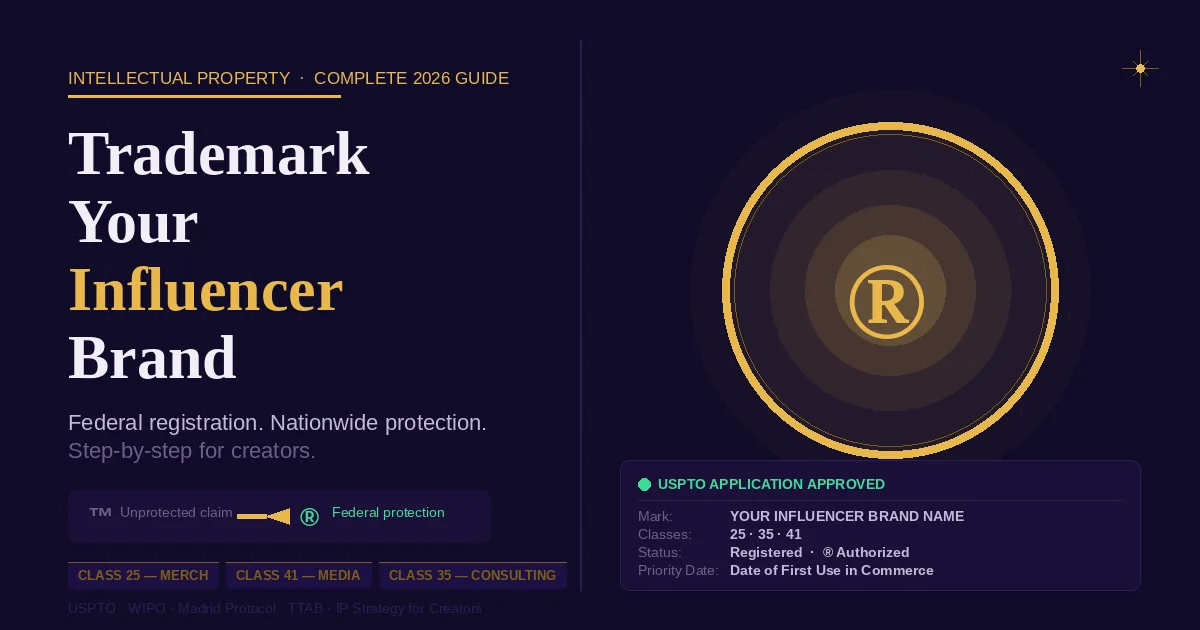
The ™ symbol is free to use the moment you start operating under a brand name. It signals that you claim trademark rights, but it does not legally create or enforce them. Any competitor can challenge a ™ claim and win if they can prove prior use or distinctiveness.
The ® symbol is reserved exclusively for marks that have been officially registered with the USPTO (United States Patent and Trademark Office). Registration gives you exclusive nationwide rights, the authority to sue infringers in federal court, the ability to stop counterfeit merchandise at US Customs, and a permanent public record of ownership. Those are real legal tools — not just a symbol.
In reviewing dozens of influencer brand disputes, the pattern is consistent: creators who register early win quickly. Creators who delay often settle on unfavorable terms, lose access to their brand name, or spend tens of thousands on litigation that a few hundred dollars in filing fees could have prevented.
Common Law Rights vs. Federal Registration
If you have been actively using a brand name in commerce in a specific region, you automatically acquire common law trademark rights in that geographic area — no registration needed. But common law rights stop at the border of where you actually operate.
A creator based in Texas who has built an audience under “The Glow Minimalist” has limited legal standing to stop a California-based creator from using the same name — and virtually no standing against someone operating outside the US.
Federal registration solves this. It creates constructive notice, meaning the entire country is legally presumed to know your trademark exists from the day you file. Combined with a priority date that beats every later applicant, federal registration is the only mechanism that secures your brand identity at scale.
What Can Influencers Actually Trademark?
Influencers can trademark their brand name, logo, tagline, or any combination — provided the mark is distinctive and not already in use in a confusingly similar way. The legal requirement is simple: the mark must function as a source identifier, meaning it tells consumers who is behind the product or service.
Four Things Most Creators Should Trademark
1. Your brand name or persona name This is the single most important registration. If you go by “The Budget Traveler” or “Coach Dana Reyes,” that name can be registered as a word mark, protecting the name regardless of font, color, or style. Word marks offer the broadest protection.
2. Your logo Logo marks protect a specific design. Most established creators register both a word mark and a logo mark separately. If your logo changes later, the word mark still holds.
3. Your tagline or catchphrase If your audience consistently associates a phrase with your identity, it may be registrable — but only if it functions as a brand identifier rather than a generic expression. “Let’s get into it” as a standalone tagline may qualify; “Amazing content” never will.
4. Your show, podcast, or series name A podcast named “The Real Glow-Up” or a YouTube series called “Unfiltered with Mara Cole” can be trademarked as entertainment series titles under the relevant class. This protects the show name independently of your personal brand.
Which Trademark Classes Apply to Influencer Brands?
Trademark law divides goods and services into 45 international classes, and you must specify which classes you are filing in. Filing in the wrong class means you get protection where you do not operate — and zero protection where you do.
| Class | What It Covers | Relevant For |
|---|---|---|
| Class 9 | Digital downloads, apps, e-books, software | Digital product and course creators |
| Class 25 | Clothing, branded merchandise, apparel | Creators who sell branded merch |
| Class 35 | Marketing, advertising, business consulting | Brand deal services, social media consulting |
| Class 41 | Entertainment, education, media production | YouTube channels, podcasts, online courses |
| Class 44 | Beauty, wellness, personal care services | Beauty and health creators offering consultations |
Most influencer brands need at minimum Class 41 (entertainment and media) and Class 25 (merchandise). Adding Class 35 makes sense if you offer brand partnerships, paid consultations, or coaching. Each class requires a separate filing fee.
How to Trademark Your Influencer Brand — Step by Step
Registering a trademark through the USPTO is a defined process. The most common reason applications fail is not lack of eligibility — it is rushing the clearance search or writing an imprecise goods-and-services description.
Step 1: Run a Comprehensive Trademark Clearance Search
Before filing anything, search the USPTO’s TESS database (Trademark Electronic Search System) for marks that are identical or confusingly similar to yours in the same classes. A 30-minute search here can save the entire filing fee and a year of waiting.
Do not stop at TESS. Search state trademark databases, Google, social platforms, domain registries, and Etsy. An existing common law user with priority use — even without federal registration — can file an Opposition and block your application.
Step 2: Identify Your Filing Basis
The USPTO requires you to declare one of two bases at filing:
- Use in Commerce (1(a)): You are already using the mark in commerce. You will need a specimen — real evidence of the mark in active use (a product photo, a website screenshot showing your branded content, a YouTube channel header).
- Intent to Use (1(b)): You plan to use the mark but have not yet. You file first, then submit proof of use later through a Statement of Use. You have up to 36 months after the Notice of Allowance to submit that proof.
Most working influencers file under 1(a) since they are already operating under their brand name.
Step 3: Prepare and File Your Application
Applications go through TEAS — the Trademark Electronic Application System on the USPTO website. For each class, you need:
- The mark itself (typed word mark, or a PNG/JPG design file for logo marks)
- A clear description of the goods and services
- A specimen showing the mark in actual commercial use
- Payment of the filing fee
Write your goods-and-services description precisely. Vague language (“social media content”) gets rejected. Specific language (“providing entertainment services in the nature of ongoing video programming in the fields of beauty and lifestyle via an online platform”) gets accepted. The USPTO’s pre-approved ID Manual has thousands of approved descriptions — using one verbatim qualifies you for the lower TEAS Plus fee.
Step 4: USPTO Examination
The USPTO assigns your application to an examining attorney, typically within 3 to 5 months after filing. The examiner reviews it for:
- Likelihood of confusion with existing registered marks
- Descriptiveness (a mark that simply describes your service is not registrable without proof of acquired distinctiveness)
- Proper identification of goods and services
- Correct and sufficient specimen
If the examiner finds issues, they issue an Office Action — a formal letter stating objections. You have 3 months to respond (extendable to 6 months for a fee). Ignoring an Office Action results in automatic abandonment.
Step 5: Publication for Opposition
If your application clears examination, the USPTO publishes it in the Official Gazette for 30 days. Any trademark owner who believes your mark conflicts with theirs has this window to file an Opposition — essentially a legal challenge heard before the Trademark Trial and Appeal Board (TTAB).
Step 6: Registration
If no opposition is filed — or if an opposition is resolved in your favor — the USPTO issues your Certificate of Registration. You can now legally use the ® symbol on every platform, product, and piece of branded content.
Total timeline in 2026: 8 to 14 months for a straightforward application with no office actions or oppositions.
How Much Does It Cost to Trademark an Influencer Brand?
Cost depends on how many classes you file in, whether you hire an attorney, and whether complications arise during examination.
| Cost Item | DIY | With Attorney |
|---|---|---|
| TEAS Plus filing fee (per class) | $250 | $250 |
| TEAS Standard filing fee (per class) | $350 | $350 |
| Attorney flat fee — application prep | — | $800–$2,000 |
| Office Action response | — | $300–$1,500 |
| Statement of Use (Intent to Use filers) | $100/class | $100 + attorney fees |
| Typical total — 2 classes, no issues | $500–$700 | $1,800–$3,500 |
TEAS Plus vs. TEAS Standard: TEAS Plus requires selecting your goods and services from the USPTO’s pre-approved ID Manual. TEAS Standard allows custom descriptions. Most first-time applicants use TEAS Plus to keep costs down — and it works well if you find an accurate pre-approved description for your services.
DIY or Hire a Trademark Attorney?
Doing it yourself is viable if your brand name is clearly distinctive, you have done a thorough clearance search, and you are registering in one or two well-understood classes. The USPTO system is accessible, and the USPTO provides free video tutorials and a phone helpline.
Hire an intellectual property attorney if:
- Your brand name is descriptive or even partially generic
- You have already received a cease-and-desist letter
- You are building a team around the brand or plan to license it
- You want international protection
- Your application receives an Office Action you do not understand
The filing fee is non-refundable, even if your application is rejected. A few hundred dollars in professional review before filing is worth it in most cases.
The Trademark Mistakes Influencer Brands Make Most Often
These errors cost creators money, time, and sometimes their brand identity entirely.
1. Treating a social handle as a legal right
Instagram, TikTok, and YouTube handles are platform permissions — not property rights. A platform can suspend your account, reassign your handle to a verified public figure, or shut down entirely. Trademark registration exists entirely outside any platform’s terms of service.
2. Filing in the wrong classes
Registering only in Class 41 (entertainment) when you also sell branded apparel means your merchandise is completely unprotected. Every revenue stream you operate — courses, merch, consulting, live events — maps to a specific trademark class. Identify all of them before filing.
3. Waiting until you feel “established enough”
Trademark applications are processed on a first-to-file basis (with priority given to prior users, but proving prior use is expensive). The creator with 8,000 followers who files today has priority over the creator with 800,000 followers who files next year. Early filing costs the same as late filing.
4. Using a descriptive mark
“The Best Beauty Tips” is not registrable. Neither is “Affordable Fashion Weekly” or “Daily Fitness Guru.” The USPTO rejects marks that merely describe the service offered. Your mark must be distinctive — invented words (like “Kodak”), arbitrary words applied to unrelated goods (like “Apple” for computers), or suggestive marks that imply something without directly stating it.
If your current brand name is descriptive, you have two options: rebrand to something more distinctive, or prove acquired distinctiveness — that the public has come to associate the term specifically with your brand through years of exclusive use. The second path is slower and harder.
5. Ignoring international audiences
A US federal trademark gives you no rights in the UK, EU, Canada, Australia, or anywhere else. If you have meaningful international revenue, an international audience, or you sell products globally, consider filing under the Madrid Protocol — a WIPO-administered system that allows a single international application to extend protection to 130+ member countries. You need a base registration (or pending application) in your home country first.
6. Not maintaining the registration
Registration is not the finish line. The USPTO requires a Declaration of Continued Use between years 5 and 6, and renewal every 10 years thereafter. Beyond maintenance filings, you must actively police your mark. If you allow widespread unauthorized use without taking action, a court can find the mark abandoned or weakened through non-enforcement. Set a calendar reminder and watch for your brand name appearing on other accounts, Etsy shops, or product listings.
Frequently Asked Questions
Do I need a trademark if I already own the domain name and social handles?
No, domain names and social handles provide no trademark rights. They are revocable licenses with the registrar or platform. Trademark registration is the only legal mechanism that creates exclusive nationwide rights to your brand identity in commerce. Domain ownership is useful corroborating evidence of use, but it is not a substitute for registration.
Can I trademark my own name as an influencer?
Yes, in most cases — provided your name has acquired secondary meaning, meaning the public associates it with you as a brand and not solely as a private individual. Creators with established audiences tend to qualify. Kim Kardashian has registered trademarks on “KIM K,” Kylie Jenner holds multiple marks including “KYLIE SKIN,” and MrBeast has registered “MRBEAST” across several classes. The earlier you file, the easier the process.
What happens if someone copies my brand before I register?
If you have been using the brand name commercially before they have, you may retain priority under common law rights. But proving common law priority requires documented evidence — invoices, website analytics with date stamps, social media post archives, email marketing records. It is a significantly harder and more expensive fight than presenting a registration certificate. This is the most common argument for filing early.
How do I trademark a brand in multiple countries?
File through the Madrid Protocol via WIPO (World Intellectual Property Organization). You need a base application or registration in your home country first, then file an international application designating which member countries you want protection in. Each country examines the application under its own standards, but the process is far more efficient than filing separately in each jurisdiction.
Can I lose my trademark if I stop creating content for a long time?
Yes. If you stop using a registered mark in commerce for three or more consecutive years, it becomes vulnerable to cancellation for abandonment. Document any continued commercial use during extended breaks — merchandise sales, a seasonal newsletter, or even a limited product launch. This evidence preserves your rights.
What is the difference between a trademark and a copyright for creators?
Copyright protects original creative works automatically — your videos, photos, written content, and music are protected the moment you create them, whether registered or not. Trademark protects brand identifiers — your name, logo, and tagline — and requires active registration to obtain full federal enforcement rights. Both matter for influencers; they protect entirely different things and are not interchangeable.
Do I need a registered business entity to file a trademark?
No. Individuals can file and hold trademarks in their personal name. Many attorneys recommend forming an LLC or corporation before filing so that the business entity owns the trademark as an asset — which simplifies licensing, brand acquisitions, and liability protection. If you plan to build a team or eventually sell your brand, entity ownership is the cleaner structure.
How long does trademark protection last?
Indefinitely — as long as you continue using the mark in commerce and file the required maintenance documents. Unlike patents (which expire after 20 years) or copyrights (which expire after the creator’s lifetime plus 70 years), trademarks have no fixed expiration tied to filing date. Consistent use and proper maintenance filings are what keep the registration alive.
Conclusion
Your influencer brand is a business asset — one that generates income, drives sponsorships, and builds equity over time. Every year you operate without trademark protection is a year someone else can legally file your name and force you to rebrand.
The process is slower than most creators expect — 8 to 14 months from filing to registration — but it is far more accessible than the legal system’s reputation suggests. A clearance search, a precise goods-and-services description, and the right class selections are the three decisions that determine whether your application succeeds.
Start with the TESS search tool on the USPTO website. If your brand name comes back clear, either file the TEAS Plus application yourself or schedule a one-hour consultation with an IP attorney who works with content creators. Most offer flat-rate trademark packages.
The strongest influencer brands in 2026 treat their name, logo, and audience relationship as protected intellectual property. That protection starts with a filing, not a follower count.
Stay curious and keep growing with our weekly recommended reads.