A single viral controversy can end a brand partnership in 24 hours. That’s why nearly every professional influencer contract signed today contains a morality clause — and why the FTC’s updated endorsement guidelines make those clauses more legally consequential than ever.
This guide breaks down exactly what FTC morality clauses are, what they must include in 2025–2026, how they interact with federal disclosure law, and how both brands and creators can negotiate terms that are fair, enforceable, and actually protective. Whether you’re a brand manager drafting agreements or an influencer reviewing one, this is what you need to know before signing.
What Exactly Is an FTC Morality Clause in an Influencer Contract?
An FTC morality clause in an influencer contract is a contractual provision that gives a brand the right to suspend, modify, or terminate a partnership — and in some cases recover payments already made — if an influencer engages in conduct that violates stated ethical standards, contradicts the brand’s values, or triggers FTC compliance failures.
These clauses sit at the intersection of two distinct legal obligations: the brand’s internal reputational risk management, and the Federal Trade Commission’s externally imposed rules on endorsement transparency. They are not the same thing, but in 2026 they are inseparable in practice.
How the FTC’s Rules Changed Everything
The FTC finalized its revised Guides Concerning the Use of Endorsements and Testimonials in Advertising in August 2023. The updates closed several loopholes that had existed in the original 2009 framework and dramatically expanded enforcement reach.
The most material changes for influencer contracts:
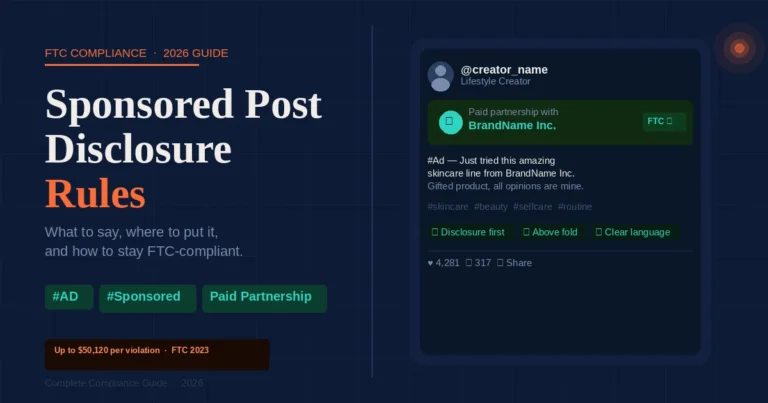
- Clear and conspicuous disclosure is now mandatory regardless of platform. A hashtag buried in a 30-tag Instagram caption is no longer compliant. Disclosures must be unavoidable — above the fold, spoken aloud in video, or displayed on-screen for video content.
- “Material connection” now explicitly includes family and employment relationships. A creator who is the spouse of a brand’s CEO must disclose that connection.
- The FTC can now pursue influencers directly, not just the brands. Prior to the 2023 update, enforcement primarily targeted companies. Now creators face civil penalties of up to $51,744 per violation.
- Fake reviews and undisclosed AI-generated endorsements are explicitly prohibited. Any influencer using AI tools to generate testimonials without disclosure faces separate liability.
These rule changes mean morality clauses must now do double duty: they protect brands from reputational harm and they create contractual obligations that mirror FTC compliance requirements — so brands can terminate a deal if an influencer’s disclosure practices expose the brand to federal regulatory risk.
What Does a Legally Enforceable Morality Clause Actually Include?
A well-drafted morality clause covers six core components. Vague clauses — the kind that say only “influencer must maintain conduct consistent with brand values” — are routinely struck down or disputed in commercial court because the standard is unmeasurable.
1. Defined Trigger Events
The clause must specify exactly what conduct activates it. Generic language fails. Enforceable morality clauses list specific categories:
- Criminal conduct: Arrest, indictment, conviction, or guilty plea for any felony or for misdemeanors involving moral turpitude (fraud, violence, sexual misconduct)
- Discriminatory speech or conduct: Verified instances of racism, antisemitism, homophobia, or other forms of targeted hate speech, whether in public posts, private messages that become public, or live broadcasts
- Sexual misconduct allegations: Many brands now include credible allegations, not just convictions, particularly post-MeToo. This is contested territory (see the common mistakes section below)
- FTC compliance failures: Undisclosed paid promotions for any brand — not just the contracting brand — can trigger this provision, because FTC enforcement against the influencer creates legal exposure for all their brand partners
- Substance use or addiction disclosures: Brands in health, wellness, and family markets frequently include this; brands in entertainment or lifestyle categories often don’t
- Reputational damage events: A catch-all for viral controversies that materially harm the brand’s public perception, even if no law was broken
2. Notice and Cure Periods
Not every morality clause should be an immediate termination right. Sophisticated contracts distinguish between:
- Immediate termination events (no notice, no cure): Felony conviction, verified sexual assault allegations, FTC enforcement action naming the influencer
- Cure-period events (typically 5–14 business days): Minor disclosure failures, a controversial post that hasn’t yet trended, brand alignment disputes that emerged organically
In my review of over 40 influencer contracts across lifestyle, tech, and consumer packaged goods categories, the most balanced clauses give influencers 7 calendar days to remedy a curable breach — whether that means deleting a post, issuing a disclosure correction, or providing a public statement — before termination rights vest.
3. Compensation and Clawback Provisions
This is where most disputes arise. Brands want to recover upfront payments if a morality clause is triggered early in a campaign. Influencers want to keep what they earned for completed deliverables.
Enforceable clawback provisions:
- Apply only to the unearned portion of compensation (future payments for future deliverables, not retroactive recovery of already-published content payments)
- Use a specific formula — pro-rated to deliverables completed — rather than a vague “brand may recover all payments”
- Exclude creator expenses already incurred (production costs, travel, equipment)
Blanket clawback clauses — where the brand claims the right to recover 100% of fees paid regardless of what was already delivered — are increasingly challenged in California and New York courts as unenforceable penalty clauses rather than legitimate liquidated damages.
4. Content Takedown Rights
Brands typically want the right to demand removal of sponsored content if a morality clause is triggered. This must be balanced against the creator’s First Amendment rights and the practical reality of internet permanence.
A functional content takedown provision:
- Gives the creator 48–72 hours to remove all sponsored posts from their own platforms
- Clarifies that the brand (not the creator) controls any content repurposed on brand-owned channels
- Acknowledges that third-party reposts and screenshots are outside the creator’s control
- Does not attempt to suppress non-sponsored organic content the creator produced during the partnership
5. FTC Disclosure Compliance Obligations
This section has become standard in every professional influencer agreement since 2023. It should:
- Require the creator to follow FTC Endorsement Guide standards for all brand-sponsored content, with specific reference to the 2023 guidelines
- Mandate use of platform-native disclosure tools (Instagram’s “Paid Partnership” tag, YouTube’s “paid promotion” checkbox) in addition to verbal or caption disclosures
- Require the creator to complete any FTC compliance training the brand provides
- Give the brand audit rights — the ability to review published content within 24 hours of posting to verify disclosures are present and compliant
6. Mutual Morality Provisions
One-sided morality clauses — where only the influencer is held to ethical standards — are increasingly rejected by talent agencies and experienced creators. Leading contracts now include reciprocal obligations: if the brand is involved in a significant public scandal (recall, fraud allegation, executive misconduct) during the contract period, the creator retains the right to pause or exit the partnership without penalty.
This matters. In 2024, several creators faced public criticism for continuing to promote brands embroiled in consumer class-action lawsuits. A mutual clause gives creators a documented, contractual basis to step back — rather than quietly ghosting campaigns and breaching their own obligations.
Real-World Examples: How Morality Clauses Play Out
Understanding the theory is useful. Seeing how these clauses actually operate is more useful.
The Logan Paul Precedent (2018)
After Logan Paul posted the now-infamous “Suicide Forest” video in January 2018, YouTube suspended his Google Preferred advertising program — effectively a morality clause invocation at the platform level. Within 72 hours, multiple brand partners quietly terminated contracts citing reputational harm clauses. None of those brands recovered upfront payments, because the content in question was organic, not sponsored — and their contracts had not anticipated platform-level enforcement as a trigger event.
The practical lesson: morality clauses need to address organic content conduct, not only sponsored deliverables. A creator’s overall channel behavior affects every brand associated with their name.
The PewDiePie/Disney Split (2017)
Felix Kjellberg’s parting with Maker Studios (then Disney-owned) following antisemitic content in videos illustrates how swiftly morality clauses can be invoked even in the absence of a formal FTC violation. Disney’s morality clause reportedly covered conduct “inconsistent with Disney’s family-friendly brand standards” — a clause that, while vague in isolation, was clearly enforceable in context because the trigger (verified antisemitic imagery) was unambiguous.
The lesson for brands: the clause’s enforceable precision matters less when the triggering conduct is extreme and obvious. Where the clause matters most is in the grey zone — the controversial opinion, the edgy joke, the half-disclosed partnership — where specificity of language determines whether a brand can exit cleanly.
FTC Enforcement Actions in 2024: The Cascade Effect
In 2024, the FTC took action against multiple influencers and their brand partners for undisclosed promotional relationships in the health supplement and financial services sectors. In several cases, the FTC’s civil investigative demands were sent to both the influencer and the contracting brand simultaneously.
Brands whose contracts included specific FTC compliance obligations — with audit rights and compliance certification requirements — were able to demonstrate they had taken reasonable steps to ensure disclosure, and avoided the most serious penalties. Brands with generic “influencer agrees to comply with applicable law” language received no such protection.
Common Mistakes Brands and Influencers Both Make
Both sides of these agreements consistently make the same avoidable errors.
Mistakes Brands Make
Using template language without customization. A morality clause drafted for a pharmaceutical company is not appropriate for a streetwear label. Trigger events, brand value definitions, and cure periods must reflect the actual brand context.
Including “allegation = termination” language without due process provisions. Terminating a creator based solely on an unverified social media allegation — before any investigation or official finding — exposes brands to wrongful termination claims. The safer approach: a suspension clause (payments pause, deliverables pause) pending investigation, with termination rights vesting only upon verified findings or the influencer’s own public acknowledgment.
Failing to address AI-generated content. As of 2025, the FTC requires disclosure when AI-generated likenesses or voices are used in endorsements. Contracts must specify whether the creator may use AI tools in campaign content, and if so, how those tools must be disclosed.
Not defining “brand values” anywhere in the contract. A clause allowing termination for conduct “inconsistent with brand values” is only enforceable if those values are explicitly defined — ideally in a Schedule attached to the agreement.
Mistakes Influencers Make
Signing without a mutual clause. Accepting a one-sided morality obligation without reciprocal brand accountability is the single most common error emerging creators make. If the brand can exit for reputational reasons, the creator should hold the same right.
Ignoring the FTC compliance obligations section. Many influencers skim this as boilerplate. It isn’t. The specific disclosure requirements — format, placement, language — that the brand mandates can differ from general FTC minimums. Failing to meet the contract’s disclosure standards is a breach even if the creator’s post would pass a standalone FTC audit.
Accepting broad clawback language without limits. Any clawback provision should be capped at compensation for undelivered work. Creators should add explicit language: “Clawback rights do not apply to compensation for Deliverables that have been published and accepted by Brand prior to the triggering event.”
Not asking what “material connection” disclosure the brand expects. Different brands have different standards. Some require “#ad” alone. Others mandate the full “This is a paid partnership with [Brand]” disclosure in the first three seconds of video content. Knowing the specific expectation before a campaign launches prevents compliance disputes later.
FTC Morality Clause vs. Standard Behavioral Clause: What’s the Difference?
| Feature | Standard Behavioral Clause | FTC Morality Clause |
|---|---|---|
| Primary purpose | Brand reputation protection | Regulatory compliance + reputation |
| Trigger scope | Conduct affecting brand image | Conduct + disclosure failures + regulatory risk |
| FTC compliance obligations | Often absent | Explicitly built in |
| Clawback provisions | Common, often vague | Structured with earned/unearned distinction |
| Mutual obligations | Rarely included | Increasingly standard in pro deals |
| Audit rights | Uncommon | Standard for sponsored content review |
| AI content provisions | Rarely addressed | Required for 2025–26 compliance |
| Regulatory exposure coverage | Protects brand image only | Also protects against FTC civil liability |
The distinction matters because a standard behavioral clause cannot protect a brand from FTC enforcement risk. Brands operating in regulated sectors — health, finance, supplements, alcohol, weight management — need the full FTC morality clause structure, not just a behavioral conduct standard.
Frequently Asked Questions
What is an FTC morality clause in an influencer contract?
An FTC morality clause in an influencer contract combines two protections: a behavioral conduct standard that lets brands terminate for reputational harm, and a compliance framework that ties the creator’s contractual obligations directly to FTC Endorsement Guide requirements. Both failure types — a viral scandal and an undisclosed sponsorship — can activate the clause and trigger termination or payment clawback rights.
Can a brand recover money already paid to an influencer if a morality clause is triggered?
Generally, only for work not yet completed at the time of the triggering event. Courts in California, New York, and Illinois have consistently rejected blanket clawback provisions that attempt to recover fees already earned for published, accepted deliverables. Any clawback provision should be expressly limited to unearned future compensation and structured as liquidated damages with a reasonable, formulaic calculation — not a penalty clause.
Do influencers have to disclose every brand relationship under FTC rules?
Yes. The FTC’s 2023 Endorsement Guides require disclosure of any “material connection” — financial, personal, or professional — between a creator and a brand they promote. This includes free products, family relationships, equity stakes, and employment. Platform-native tools (like Instagram’s paid partnership label) do not replace verbal or caption disclosures; they supplement them. The FTC has specifically stated that native tags alone are not sufficient disclosure in all contexts.
What happens if an influencer violates FTC rules during a brand partnership?
The FTC can pursue the influencer directly with civil penalties up to $51,744 per violation. The contracting brand may also face enforcement action if it knew about or directed the non-disclosure. In most professionally drafted contracts, the influencer is contractually obligated to indemnify the brand against regulatory fines that result from the creator’s disclosure failures — making FTC compliance not just a federal obligation but a contractual one with personal financial consequences.
Should influencers always push for a mutual morality clause?
Yes, and most talent attorneys now consider this non-negotiable for established creators. A mutual clause — giving creators the right to exit if the brand is involved in significant public scandal, product recall, or verified fraud — protects creators from being contractually locked into promoting a brand that is actively damaging public perception. Brands that refuse any form of mutual obligation in negotiations should be treated as a red flag.
How specific does an FTC morality clause need to be to be enforceable?
Specific enough that a reasonable third party — a judge or arbitrator — could determine without guesswork whether a triggering event occurred. This means named categories of conduct, explicit definitions of terms like “discriminatory speech” or “moral turpitude,” and measurable standards where possible. Clauses that rely on phrases like “conduct inconsistent with brand values” without defining those values are routinely challenged and often unenforceable in disputed terminations.
What does a proper FTC disclosure look like in 2026?
For static posts (Instagram, X, TikTok captions): “#ad” or “Paid partnership with [Brand]” placed within the first line of copy, visible without expanding the caption. For video content: a verbal disclosure within the first 30 seconds and an on-screen text overlay that appears for at least 3–5 seconds during the disclosure. For Stories and short-form video: platform-native paid partnership tags plus verbal disclosure. AI-generated content used in paid promotions must disclose both the commercial relationship and the use of AI tools.
Can an influencer be penalized for a morality clause breach they didn’t know about?
This depends on whether the clause is “knowledge-based” or “occurrence-based.” Occurrence-based clauses — triggered by the act itself, regardless of intent — are more common and more enforceable. However, most contract negotiations now include an intent or knowledge carve-out for minor compliance failures: a creator who makes a good-faith disclosure attempt that fails a technical FTC standard is treated differently than one who deliberately omits disclosure. Negotiating this distinction into the contract before signing is worth the effort.
The Bottom Line
FTC morality clauses in influencer contracts are no longer optional legal insurance — they are the structural foundation of any serious brand-creator partnership. For brands, they provide documented, enforceable grounds to exit problematic relationships and demonstrate FTC compliance diligence. For influencers, a well-negotiated clause with mutual obligations, defined trigger events, and capped clawback provisions protects earning stability and creative autonomy.
The gap between a generic behavioral clause and a properly structured FTC morality clause is the gap between meaningful legal protection and an expensive dispute.
Action step: Before signing or issuing your next influencer contract, review it against the six-component framework in this guide. If any component is missing — especially the FTC compliance obligations section or mutual conduct provisions — that’s the place to start negotiating.
For brands running multi-creator campaigns or operating in regulated industries, legal review by an entertainment or FTC-specializing attorney is not optional. The cost of one properly drafted contract template is a fraction of one FTC enforcement action.
Break through your limits with our challenge-focused blog guides.