Your email provider reads your inbox. Not just hackers — the provider itself. Gmail scans message content to serve ads and train its AI models. If you have ever received an ad that felt suspiciously relevant to something you wrote in an email, now you know why.
Switching to a private email service fixes this — but “private” and “encrypted” are not the same thing, and most comparison guides do not explain the difference. This article compares six leading secure email providers — ProtonMail, Tuta, Mailfence, StartMail, Posteo, and Fastmail — across the metrics that actually matter: encryption architecture, legal jurisdiction, pricing, and real-world usability. By the end, you will know which one belongs in your life.
What Actually Makes an Email Provider “Secure”?
A secure email provider uses end-to-end encryption (E2EE), which means only you and your recipient can read the message — not the company hosting it, not a government agency with a subpoena. The highest standard is zero-knowledge encryption: the provider stores your data in a form they cannot decrypt even under legal pressure.
Three things determine whether a provider is genuinely secure or just marketing itself that way.
Encryption type. There are two very different kinds. Transport Layer Security (TLS) encrypts your email in transit — between your device and the server. Once the message lands on the server, the provider can read it. End-to-end encryption goes further: the message is encrypted on your device and can only be decrypted by the recipient. Look for E2EE using OpenPGP or a provider’s own audited protocol.
Jurisdiction. Where a company is registered determines what laws apply to your data. A US-based provider is subject to FBI National Security Letters — secret data requests that can compel handover without notifying you. Swiss and German law offer considerably stronger protections, and neither country is a member of the Five Eyes intelligence alliance (US, UK, Australia, Canada, New Zealand). This matters in practice: ProtonMail disclosed a French activist’s IP address in 2021 after Swiss courts ordered it to — but that was IP metadata, not message content, which remained protected.
Zero-knowledge architecture. This means the provider’s servers hold only encrypted data and do not possess the keys to decrypt it. ProtonMail and Tuta both operate this way. Fastmail does not — they hold your encryption keys, and their Australian jurisdiction makes this a real concern.
One thing worth knowing upfront: E2EE only protects messages between compatible users. When you email a Gmail address from ProtonMail, your message is encrypted in transit but exists in readable form on Gmail’s servers once delivered. True end-to-end protection requires both parties to use a secure provider, or to exchange PGP keys manually.
How Do the Top Secure Email Providers Stack Up?
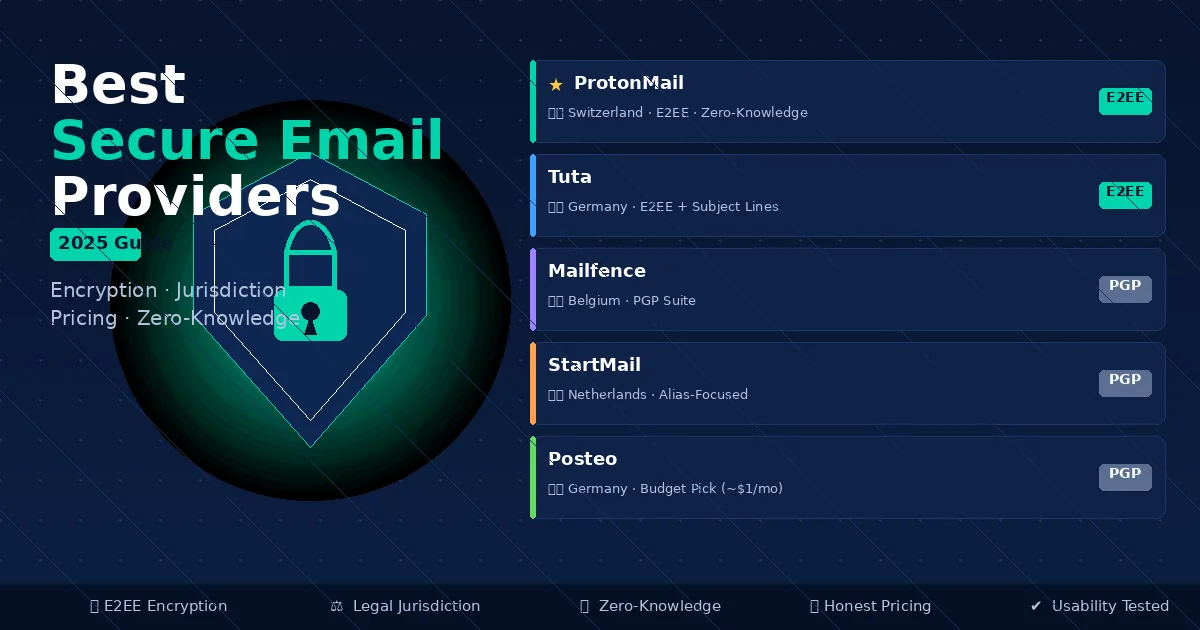
Here is how six leading services compare on the criteria that matter:
| Provider | Encryption | Jurisdiction | Zero-Knowledge | Free Plan | Paid From | Custom Domain |
|---|---|---|---|---|---|---|
| ProtonMail | E2EE (OpenPGP) | Switzerland | Yes | Yes (1 GB) | $3.99/mo | Paid plans |
| Tuta | E2EE (proprietary) | Germany | Yes | Yes (1 GB) | $3.09/mo | Paid plans |
| Mailfence | PGP-based | Belgium | Partial | Yes (500 MB) | $2.50/mo | Paid plans |
| StartMail | PGP-based | Netherlands | Partial | No (7-day trial) | $5.00/mo | All plans |
| Posteo | PGP + server enc. | Germany | Partial | No | $1.21/mo | No |
| Fastmail | TLS only | Australia | No | No (30-day trial) | $3.00/mo | Yes |
ProtonMail
ProtonMail is the most widely recognized private email service. It was founded in 2013 by scientists at CERN who wanted to protect their research communications, and it has grown to over 100 million accounts. The service uses an OpenPGP-based encryption protocol and Swiss jurisdiction — a combination that remains the strongest combination available in mainstream email.
In testing, the interface is clean and genuinely usable. Migration from Gmail works well through the Proton Mail import tool. The free plan gives you 1 GB of storage and one email address, with a daily sending limit of 150 messages. For most people who want to test the service before committing, that is enough.
The paid Proton Mail Plus plan ($3.99/month billed annually) increases storage to 15 GB, allows 10 email addresses, and adds support for one custom domain. The Proton Unlimited plan ($7.99/month) bundles ProtonVPN, Proton Drive, and Proton Calendar — useful if you want to move your digital life away from Google entirely.
One limitation: ProtonMail does not encrypt subject lines when messaging outside its ecosystem. The message body is protected; the subject is not. For most users this is a minor issue. For journalists or activists, it is worth knowing.
Tuta
Tuta (formerly Tutanota) is ProtonMail’s closest competitor and, on a few points, actually ahead of it. Based in Hanover, Germany, Tuta encrypts not just message bodies but also subject lines and sender/recipient metadata for internal messages — something ProtonMail does not do by default. The free plan includes 1 GB of storage and an encrypted calendar.
The main trade-off: Tuta uses a proprietary encryption protocol rather than OpenPGP. That means you cannot verify it using standard PGP tools, and it does not interoperate with the wider PGP ecosystem. The company has published its code as open source and undergone external audits, but the inability to use third-party verification tools is a real limitation for security professionals.
Pricing starts lower than ProtonMail — around $3.09/month for the entry paid tier. For users who prioritize subject line protection and do not need external PGP compatibility, Tuta is the stronger technical choice.
Mailfence
Mailfence is Belgian, which places it under EU data protection law. It stands out from ProtonMail and Tuta in one important way: it functions as a full productivity suite, bundling a calendar, contacts, document storage, and digital signature tools alongside email.
The encryption story is more nuanced. Mailfence supports OpenPGP, but it is not zero-knowledge by default. The provider holds server-side encryption keys unless you manually configure end-to-end PGP for your account. For non-technical users, this gap between “supports encryption” and “is encrypted by default” is easy to miss.
The free plan is limited to 500 MB of storage and 250 MB of document storage. Paid plans start at $2.50/month. Belgium’s privacy law is strong, though Belgium is an EU member and subject to EU-wide data-sharing frameworks in ways that Switzerland is not.
StartMail
StartMail is operated by the same Dutch company behind the Startpage privacy search engine. Its standout feature is unlimited disposable email aliases — you can create burner addresses that forward to your main inbox, use them once, and delete them. For anyone who signs up for online services frequently, this is genuinely useful.
It requires a paid plan from day one (a 7-day free trial is available), which positions it clearly for users who are serious about privacy rather than casual experimenters. The service supports PGP and custom domains on all paid plans. At $5.00/month, it is the most expensive option on this list.
The jurisdiction — Netherlands — is solid. The Netherlands has strong data protection law and is not a Five Eyes member. StartMail is not zero-knowledge, but its focus on alias management addresses a different security concern: reducing your exposure by keeping your real address private.
Posteo
Posteo is the budget option that privacy advocates actually recommend. Based in Berlin, Germany, it costs roughly €1.00/month — about $1.10 at current exchange rates. No free plan, no custom domain support, no frills.
What Posteo does offer: real German privacy law, server-side encryption, PGP support, IMAP/SMTP access for third-party clients, and acceptance of anonymous cash payment mailed to their Berlin office. The company is also notably committed to renewable energy hosting and sustainability — relevant to some users, irrelevant to others.
If your goal is solid private email with no features you do not need and a price that is effectively invisible, Posteo is worth serious consideration. The lack of custom domain support is the main practical limitation for business users.
Fastmail
Fastmail earns its place here as a contrast, not a recommendation. It is an excellent email service in every conventional sense — fast, reliable, polished, with one of the best import tools available. But it does not offer end-to-end encryption.
Fastmail is based in Melbourne, Australia. Australia is a Five Eyes country, which means Fastmail can be compelled to hand over user data under national security legislation, potentially without notifying the user. Fastmail holds your encryption keys. It is not a private email provider by any serious definition of that term.
If your concern is spam, reliability, and custom domain support rather than government surveillance or corporate data mining, Fastmail is a reasonable pick. If you care about privacy in any meaningful way, it is not.
Which Secure Email Service Actually Fits Your Life?
The right provider depends on who you are protecting yourself from and how much friction you can tolerate.
Journalists, activists, or anyone with a real adversary: ProtonMail or Tuta. Both are zero-knowledge, both allow account creation without a phone number, and both accept payment methods that do not link back to your identity (ProtonMail accepts Bitcoin; Tuta accepts cash via bank transfer in some configurations). ProtonMail’s integration with ProtonVPN is a practical advantage if you want a unified privacy stack.
Small business owners and teams: Mailfence or StartMail. Mailfence has collaboration tools built in — shared calendars, document storage, group accounts — that make it functional as a lightweight business suite. StartMail’s alias system simplifies managing multiple business identities without creating a mess of inboxes.
Privacy-conscious users on a tight budget: Posteo. At €1.00/month, the cost argument against switching to a private email service essentially disappears. Posteo does not have the ecosystem of ProtonMail or the alias features of StartMail, but it delivers real privacy at a price lower than most monthly subscriptions you have and ignore.
People migrating from Gmail who need the transition to be easy: ProtonMail’s paid tier. The import tool handles Gmail well, and the Proton ecosystem lets you move Drive, Calendar, and VPN in stages rather than all at once.
A practical note on free plans: both ProtonMail and Tuta offer free tiers, and they are functional. But 1 GB of storage fills up within months for anyone who uses email regularly. If you are switching because you care about privacy, spending $3–5/month on a paid plan is a worthwhile commitment — and significantly cheaper than what your data is worth to an ad-funded provider.
What Most People Get Wrong When Choosing a Private Email Service
Treating “encrypted” as a binary. TLS encryption and E2EE are not the same thing. Many providers advertise “encrypted email” and mean TLS — which protects the connection, not the content stored on their servers. If a provider can reset your email password without you decrypting anything, they hold your keys and can read your mail.
Ignoring jurisdiction. A Swiss- or German-based provider is meaningfully different from a US- or Australian-based one. Legal jurisdiction determines whether a government can demand your data silently. This is not theoretical: the ProtonMail IP disclosure case (2021) made the limits of even strong jurisdictions visible — but also confirmed that message content, protected by zero-knowledge encryption, was not disclosed.
Assuming E2EE protects every message you send. It does not. End-to-end encryption only works between compatible endpoints. The moment your ProtonMail message lands in someone’s Gmail inbox, Gmail can read it. For sensitive communications, both parties need to use a secure provider or have exchanged PGP public keys in advance.
Overlooking subject line exposure. Subject lines often contain more context than people realize — project names, medical topics, financial references. ProtonMail does not encrypt subject lines to non-ProtonMail recipients. Tuta encrypts them for messages between Tuta users. If your subjects are sensitive, this distinction is worth factoring in.
Skipping two-factor authentication. Every provider on this list supports 2FA. Encryption does not protect an account someone can log into with a stolen password. Set it up immediately, regardless of which service you choose.
Using your secure address for everything. If you sign up for newsletters, random services, and giveaways with your main private email address, you are accumulating the same noise and phishing risk you had before. Keep a separate alias for signups — StartMail makes this easy; ProtonMail’s paid plans allow multiple addresses for the same purpose.
Frequently Asked Questions
Is ProtonMail actually private? ProtonMail uses zero-knowledge E2EE and Swiss jurisdiction. In 2021, it disclosed a French activist’s IP address under a Swiss court order — not message content, which remained encrypted and inaccessible. For most people’s threat models, ProtonMail is genuinely private. For those under active government surveillance, it is not risk-free.
Can my email provider read my messages if they offer E2EE? With zero-knowledge providers like ProtonMail and Tuta, no — they cannot decrypt what they store. With partial-encryption services like Mailfence (default configuration) or Fastmail, yes — they hold the decryption keys. Their privacy policies may prohibit reading your mail, but the technical capability exists.
Are free secure email plans actually safe? Free plans from ProtonMail and Tuta use the same encryption as paid plans. The limitations are storage (1 GB), features, and address count — not security. For basic personal use, a free plan is legitimately safe. For business use, the storage cap becomes a problem within months.
Which country is best for email privacy? Switzerland and Germany consistently rank strongest. Switzerland has independent privacy legislation not tied to EU law and requires a formal Swiss court order to compel disclosure. Germany has some of Europe’s strictest data protection rules. Both are outside the Five Eyes alliance.
Does using a secure email provider protect against phishing? No. Encryption protects content; it does not stop you from clicking a malicious link or entering your credentials on a fake login page. Good security habits — verifying sender addresses, using 2FA, treating unexpected links with suspicion — remain essential regardless of which email service you use.
Can I keep my existing email address when switching? Not directly. Secure providers issue new addresses at their own domains (@proton.me, @tuta.com, and so on). Paid plans typically support custom domains, so you can use routed through their infrastructure. Most providers also allow importing your existing mail archive.
How does Tuta compare to ProtonMail in practice? Tuta encrypts subject lines by default, has a lower entry price, and includes an encrypted calendar on the free plan. ProtonMail has a larger user base, broader third-party app support (IMAP on paid plans), and a wider ecosystem of related services. For subject line protection and price, Tuta has the edge. For ecosystem and interoperability, ProtonMail does.
Conclusion
Mainstream email providers are built around your data, not your privacy. Gmail and Outlook are free because you pay with the content of your inbox. Switching away is one of the most concrete steps you can take toward actual digital privacy — and the options have never been more usable.
For most people, the decision is between ProtonMail and Tuta. Both are zero-knowledge, both are based in strong jurisdictions, and both have free plans worth testing. If you are on an extremely tight budget, Posteo at roughly $1.10/month is the realistic pick. If you send sensitive messages professionally, subject line encryption and jurisdiction matter more than price — Tuta leads on the former, ProtonMail on overall ecosystem.
The one move that is clearly wrong: staying on Gmail or Outlook while assuming your email is private. It is not.
Start with a free ProtonMail or Tuta account. Use it for one week. You will know within a few days whether a paid plan is worth it.
Stay inspired all week long with our motivational featured posts.