No employer. No pension. No automatic contribution match. If you’re a content creator, your retirement depends entirely on you — and most creators aren’t ready for that.
A 2023 MBO Partners study found that nearly 60% of self-employed workers have no formal retirement savings in place. For creators whose income swings wildly with algorithms, brand cycles, and platform policies, the stakes are even higher.
This guide covers exactly what retirement planning for creators looks like in practice: which accounts to use, how much to save on unpredictable income, and the common traps that quietly destroy creator financial futures.
Why Is Retirement Planning Harder for Creators Than for Employees?
Creators lack the automatic retirement infrastructure salaried employees get by default — no employer match, no payroll deduction, no HR department to nudge them into a plan. Add in self-managed taxes, unpredictable cash flow, and platform income that can vanish overnight, and retirement planning becomes simultaneously more urgent and more complex.
The Three Problems No One Talks About
No automatic system. A corporate employee gets enrolled in a 401(k) plan on their first day, often with employer contributions they don’t even have to think about. Creators must research accounts, open them independently, fund them manually, and track their own contribution limits — a friction point that causes most creators to delay for years.
Variable income breaks fixed rules. Classic advice like “save $500 per month” doesn’t apply when you earn $3,000 in February and $19,000 in March. Income volatility forces creators to rethink how savings rules even work.
Platform dependency amplifies risk. A monetized YouTube channel, a newsletter, a Patreon — any of these can be disrupted by algorithm changes, demonetization, or market shifts. A creator who earned $180,000 in 2022 might earn $60,000 in 2024. Planning for a 30-year retirement requires building financial resilience that platforms simply cannot provide.
The creator economy now includes over 200 million people globally, according to Goldman Sachs Research. Yet most of the retirement infrastructure available — Solo 401(k)s, SEP-IRAs, self-directed investment accounts — was built for independent contractors and small business owners decades before “content creator” was a job title. The accounts work well. Creators just need to know how to use them.
Which Retirement Accounts Actually Work for Content Creators?
The best retirement accounts for self-employed creators are the Solo 401(k) and SEP-IRA, both designed specifically for people without employer plans and offering contribution limits far higher than standard IRAs. The Roth IRA works well as a complementary vehicle, especially in lower-income years. The right combination depends on your income level, tax situation, and how much administrative simplicity you want.
The Four Main Options — Compared
| Account | 2024 Contribution Limit | Best For | Tax Treatment | Admin Complexity |
|---|---|---|---|---|
| Solo 401(k) | Up to $69,000 ($76,500 if 50+) | High-earning full-time creators | Pre-tax or Roth | Medium |
| SEP-IRA | 25% of net income, max $69,000 | Simpler setup, high income | Pre-tax only | Low |
| Roth IRA | $7,000 ($8,000 if 50+) | Low-to-mid income years | Tax-free growth | Very Low |
| SIMPLE IRA | $16,000 ($19,500 if 50+) | Creators who have employees | Pre-tax | Medium |
Solo 401(k): The Power Account for Creators
The Solo 401(k) — also called an Individual 401(k) or Self-Employed 401(k) — is the strongest retirement vehicle for most full-time creators earning above $50,000 net annually. You contribute in two roles simultaneously:
- As the employee: up to $23,000 in 2024 (plus $7,500 catch-up if you’re 50+)
- As the employer: up to 25% of your net self-employment income
Combined, contributions can reach $69,000 per year. A creator earning $120,000 net can contribute far more to a Solo 401(k) than to any other available account. You can also elect the Roth option within a Solo 401(k), meaning contributions go in after-tax and withdrawals in retirement are completely tax-free.
Fidelity, Vanguard, and Charles Schwab all offer Solo 401(k)s with no fees and access to low-cost index funds. Setup takes under an hour online.
SEP-IRA: Simpler, But With a Trade-Off
The SEP-IRA (Simplified Employee Pension) offers the same dollar ceiling as the Solo 401(k) — $69,000 in 2024 — but the calculation is contribution-only: you can contribute up to 25% of your net self-employment income. A creator earning $80,000 net can contribute a maximum of $20,000. A Solo 401(k) holder at the same income could contribute significantly more by combining the employee and employer portions.
SEP-IRAs are genuinely simpler to open and maintain, making them a solid choice for creators who want a straightforward setup without annual filings. The trade-off is a lower effective contribution ceiling at lower income levels.
Roth IRA: The Complement, Not the Foundation
A Roth IRA should sit alongside a Solo 401(k) or SEP-IRA, not replace one. Contributions are capped at $7,000 per year in 2024, and you lose eligibility entirely if your modified adjusted gross income exceeds $161,000 as a single filer.
Where the Roth excels: in years when creator income is lower. If you had a slow year and net $40,000, you’re in a relatively low tax bracket. Contributing to a Roth IRA at that rate means you’ve pre-paid taxes cheaply — and those dollars grow tax-free forever.
How Much Should a Creator Save for Retirement?
A creator should save 15–20% of gross annual income toward retirement, using a percentage-based approach rather than a fixed dollar amount. This scales naturally with income: high-earning months contribute more, lean months contribute proportionally less, and the total builds consistently over time regardless of income volatility.
Why the Percentage Method Works for Variable Income
Fixed savings rules break on creator income. Committing to “$1,200 per month” fails the moment a brand deal falls through or a platform CPM drops 30%.
The alternative: apply a percentage to every payment received. I’ve worked through this framework with multiple self-employed clients — the rule is 20% of every deposit moves out of the main checking account before it gets spent. Not at month end. Not when it feels comfortable. Immediately.
Working example: A creator receives $6,000 in January, $21,000 in April from a sponsorship campaign, and $4,500 in July. Applying 20% consistently yields $6,300 in retirement contributions across those three months — without any willpower decisions on each occasion.
The Retirement Number Creators Should Target
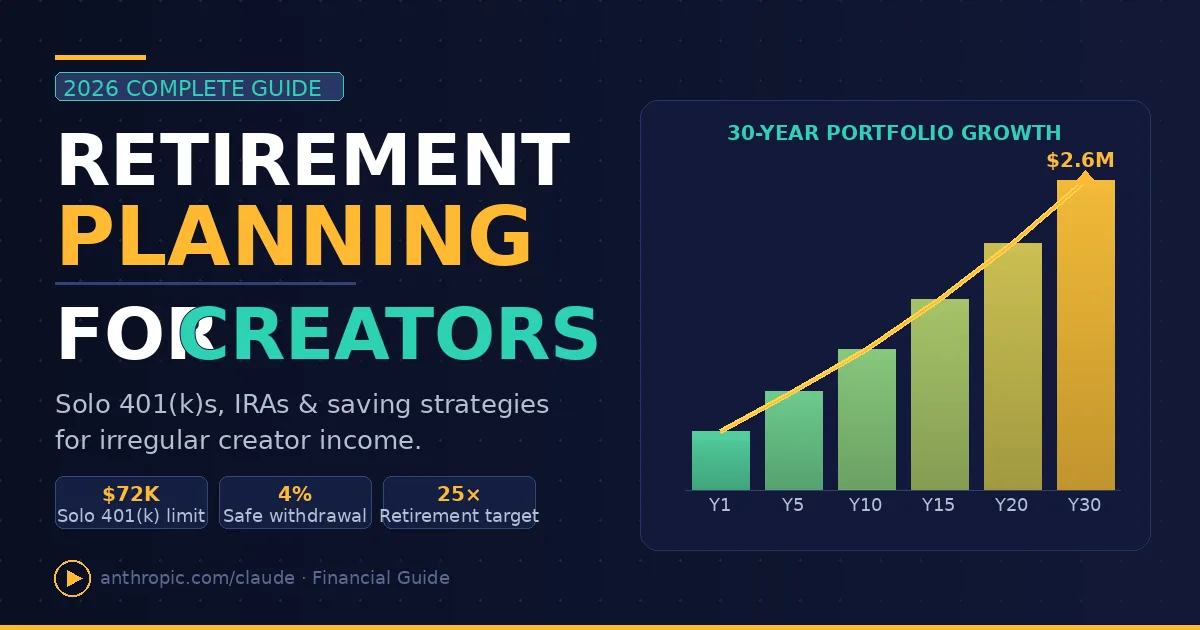
Use the 25x Rule: multiply your desired annual retirement income by 25 to find your savings target.
- Want $60,000 per year in retirement? Target: $1,500,000
- Want $90,000 per year? Target: $2,250,000
These numbers are based on the 4% withdrawal rate, a widely used benchmark derived from the Trinity Study — the principle that a diversified portfolio can sustain 4% annual withdrawals over a 30-year retirement with high historical success rates.
The math favors creators who start early:
| Start Age | Annual Savings | Years to $1.5M (at 7% return) | Reached at Age |
|---|---|---|---|
| 25 | $12,000/yr | 35 years | 60 |
| 30 | $18,000/yr | 30 years | 60 |
| 35 | $28,000/yr | 25 years | 60 |
| 40 | $46,000/yr | 20 years | 60 |
Each decade of delay roughly doubles the annual savings required. Starting at 25 vs. 40 on the path to the same $1.5M goal is the difference between saving $12,000 per year and $46,000 per year. That gap alone should make starting immediately the highest-priority financial decision a young creator makes.
How Do You Build a Retirement System Around Irregular Income?
Creators should use a “hold and allocate” cash flow system where all income first lands in a business checking account, then gets split automatically between tax reserves, retirement accounts, and operating expenses on a fixed schedule. This removes day-to-day savings decisions and prevents income volatility from disrupting long-term retirement progress.
The Creator Retirement Framework — Step by Step
- Open a dedicated business checking account. All creator income — AdSense, Patreon, brand deals, course sales, affiliate payments — deposits here only. Never mix personal and business cash flows.
- Set aside 25–35% for taxes immediately. Self-employment tax runs 15.3% on net earnings (both employee and employer Social Security and Medicare). Add federal and state income tax on top. Move this to a separate high-yield savings account on the day each payment arrives.
- Automate a retirement transfer on a fixed date. Set a recurring transfer — 15–20% of your average monthly income — to your Solo 401(k) or SEP-IRA on the 1st of each month. Treat it like a payroll expense. Automate it so the decision doesn’t exist.
- Open a taxable brokerage account as a bridge layer. Solo 401(k)s and IRAs have withdrawal restrictions before age 59½, with a 10% early withdrawal penalty. A taxable brokerage account gives you investment growth without those restrictions — useful if you want flexibility before traditional retirement age.
- Contribute lump sums after strong quarters. Quarterly revenue check-ins reveal strong periods. A creator who earns $40,000 in Q4 should make an above-average contribution to their Solo 401(k) or SEP-IRA before December 31st to reduce that year’s taxable income.
- Review your strategy every 12 months with a fee-only advisor. A fee-only fiduciary advisor charges a flat fee — not a commission on products they sell. Once annual income crosses $100,000 net, professional tax and contribution optimization typically saves more than the advisory fee costs.
Multiple Income Streams Make Retirement Planning More Stable
A creator relying entirely on YouTube ad revenue is one algorithm change away from a financial crisis. Creators with diversified income — combining ad revenue, sponsorships, courses, licensing, newsletters, and merchandise — maintain more consistent cash flow for retirement contributions even when one stream dips.
Consider a creator generating $130,000 annually: $45,000 from YouTube, $40,000 from brand deals, $30,000 from a digital course, $15,000 from a newsletter. If YouTube CPMs fall 40%, they still have $112,000 in income. Retirement contributions stay largely intact. That diversification is itself a retirement strategy.
What Are the Most Expensive Retirement Mistakes Creators Make?
The five most costly mistakes creators make are: waiting to save until income “stabilizes,” raiding retirement accounts to cover tax bills, treating the Roth IRA as their only retirement account, underestimating health insurance costs in retirement, and keeping long-term savings in cash. Each mistake compounds quietly — and can cost hundreds of thousands in lifetime retirement wealth.
Mistake 1: Waiting for Stable Income to Start
“I’ll start saving when things are more consistent” is the most expensive sentence in creator finance. Creator income never fully stabilizes. And waiting from age 27 to 32 — just five years — can cost $200,000+ in compound growth by retirement.
Mistake 2: Withdrawing From a Retirement Account for Taxes
Creators sometimes hit a tax bill they didn’t budget for and withdraw from their IRA or 401(k) to cover it. This triggers a 10% early withdrawal penalty plus full income tax on the withdrawn amount — effectively doubling the cost of that money. The fix is simple: always keep a separate tax reserve account and never touch retirement funds before 59½.
Mistake 3: Assuming Social Security Closes the Gap
Self-employed creators pay the full 15.3% Social Security and Medicare tax on net earnings — both the employee and employer share. So contributions do accumulate. But the average Social Security benefit in 2024 runs approximately $1,907 per month. That’s $22,884 per year — far below what most creators would consider a livable retirement income.
Treat Social Security as a supplement to your savings, never the foundation.
Mistake 4: Ignoring Healthcare Costs Before Medicare
Medicare eligibility begins at 65. A creator who retires at 55 or 60 faces up to a decade of private health insurance costs — averaging $7,000–$12,000 per year for an individual in 2024. This is a line item that retirement projections frequently omit, and it can derail an otherwise solid plan.
Self-employed creators can deduct 100% of health insurance premiums during working years, which reduces the effective cost. But post-retirement, that deduction disappears.
Mistake 5: Keeping Investments in Cash “While Things Are Uncertain”
High-yield savings accounts returned 4–5% in 2024. That feels productive — better than nothing. But over a 30-year investment horizon, a 4% return barely keeps pace with average inflation. Equity index funds have historically returned 7–10% annually over long periods. The difference between 4% and 7% compounded over 30 years on $100,000 is roughly $430,000 in final portfolio value.
Creators need real equity exposure through diversified index funds to build retirement wealth. Fidelity’s FZROX, Vanguard’s VTI, or iShares’ IVV are well-regarded starting points with expense ratios below 0.10%.
Frequently Asked Questions
Can a part-time creator open a Solo 401(k)? Yes. Any creator earning self-employment income — even part-time — qualifies for a Solo 401(k), provided they have no full-time employees other than a spouse. You can also hold a salaried job elsewhere and still contribute to a Solo 401(k) separately from your creator income. The two accounts operate independently.
What if my income changes by 50% year to year? Neither the Solo 401(k) nor the SEP-IRA requires fixed annual contributions — you decide how much to contribute each year based on income. In low years, contribute what you can. In strong years, maximize contributions and make lump-sum top-ups before the contribution deadline. The accounts are designed to flex with self-employment income.
When should I open a retirement account as a creator? The day you earn your first dollar of self-employment income. Even contributing $500 in year one establishes the account and the habit. The compounding advantage of starting at 24 versus 30 is worth more than any single year’s contribution amount. Open the account first, then optimize contributions over time.
Is a Roth IRA or Traditional IRA better for creators? It depends on your current tax bracket versus your expected bracket in retirement. If you’re in a lower bracket now (under $50,000 net income), a Roth IRA wins — you pay taxes now at a low rate, and withdrawals are tax-free. If you’re earning above $100,000 net, pre-tax contributions to a Solo 401(k) or SEP-IRA reduce your current bill and likely make more sense.
Do creators receive Social Security benefits at retirement? Yes. Self-employed creators pay both the employee and employer portions of Social Security tax — 12.4% of net earnings up to $168,600 in 2024 — and accumulate Social Security credits like any other worker. Benefits are calculated based on your earnings history. However, average monthly benefits are modest relative to most creators’ income expectations, making personal retirement savings essential.
How do retirement contributions reduce a creator’s tax bill? Contributions to a Solo 401(k) or SEP-IRA directly reduce your taxable income in the year you contribute. A creator who nets $95,000 and contributes $30,000 to a Solo 401(k) reports only $65,000 in taxable income — potentially dropping them into a lower federal bracket and saving thousands in taxes. Retirement saving and tax strategy are the same action.
What investment funds should creators use inside their retirement accounts? Most financial planners recommend low-cost, broadly diversified index funds for long-term retirement investing. Vanguard Total Stock Market (VTI), Fidelity Total Market (FZROX), and iShares Core S&P 500 (IVV) are consistently recommended options with expense ratios under 0.05%. Diversify across domestic equities, international funds, and bonds as you approach retirement age.
What is the Solo 401(k) contribution deadline for 2024? The plan must be established by December 31, 2024, to make employee contributions for that tax year. Employer contributions (the 25% profit-sharing portion) can be made up to the tax filing deadline including extensions — typically October 15 of the following year. This gives creators meaningful flexibility to optimize contributions once final annual income is known.
The Bottom Line
Retirement planning for creators isn’t glamorous. It doesn’t go viral. But it is the financial decision that separates creators who build lasting security from those who build impressive income with no long-term floor beneath it.
The structure is clear: open a Solo 401(k) or SEP-IRA today, save 15–20% of every payment using a percentage-based approach, automate transfers so behavior doesn’t rely on motivation, diversify income streams, and review your strategy every year.
The creators who retire well aren’t always the highest earners. They’re the ones who treated retirement savings as a non-negotiable line item — not a “someday” task they planned to get around to after the next brand deal closed.
Your action step this week: Open a Solo 401(k) with Fidelity, Vanguard, or Charles Schwab. It takes under one hour online and costs nothing to set up. Contribute whatever your budget allows in month one — even $200. The most important variable in retirement planning is when you start. Start now.
Stay informed and ahead of the game—our editor’s favorites bring clarity to your feed.