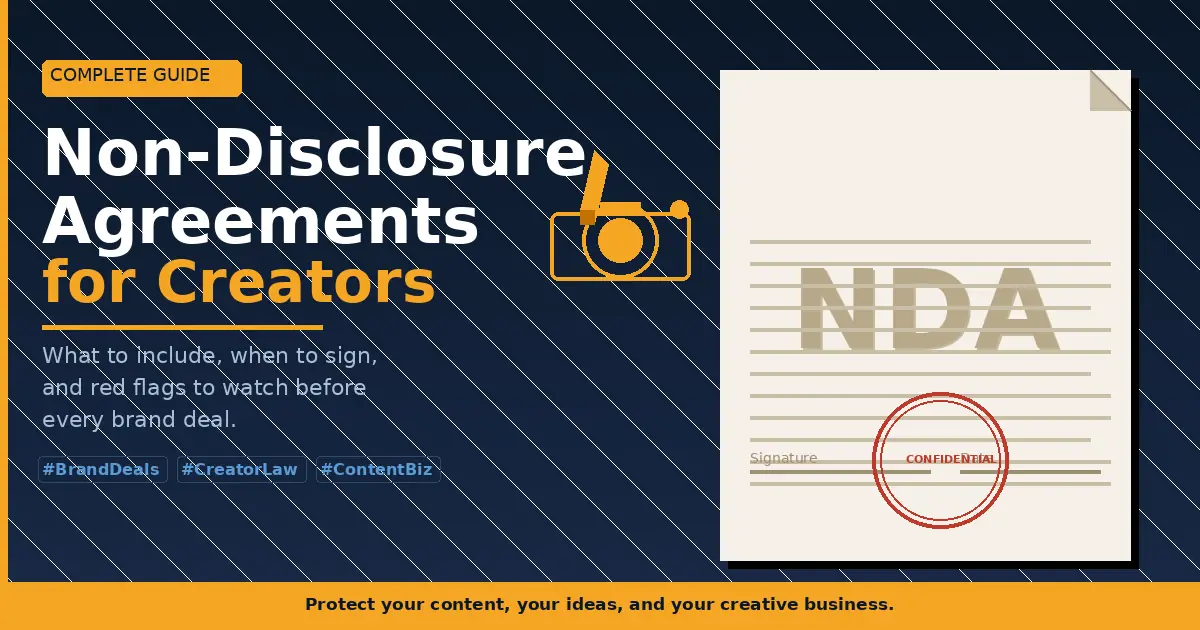
A brand slides into your DMs. They want to send you their unreleased product — but only after you sign an NDA. Do you know what you’re agreeing to?
A Non-Disclosure Agreement is one of the most common legal documents content creators encounter, yet most sign without reading past the first paragraph. That single mistake can cost you content ownership, creative freedom, and sometimes your ability to work with competitors for years.
This guide breaks down everything you need to know: what an NDA actually is, when you need one on both sides of a deal, what it must contain, how to negotiate it, and the red flags that should make you pause before putting your name on anything.
What Is an NDA and Why Do Content Creators Actually Need One?
An NDA (Non-Disclosure Agreement) is a legally binding contract that keeps specific information confidential between two parties. For content creators, it works as a legal shield — protecting unreleased ideas, client strategies, brand campaign details, or any sensitive information shared during a partnership from being exposed or misused.
Intellectual property theft is not a minor problem. According to Forbes, IP theft costs the U.S. economy up to $600 billion annually, and creative industries absorb a significant share of that damage. The creator economy hit $250 billion in 2025, and as more money flows through brand deals, collaboration agreements, and content licensing, the legal stakes get higher for creators at every level.
In the content world, an NDA serves two distinct purposes: protecting a brand’s confidential information when they share it with you, and protecting your own creative work or strategies when you share it with others. Most creators only think about the first scenario — but the second one matters just as much. The moment you pitch an original series concept to a potential collaborator, or hand your email list over to a new virtual assistant, your information is exposed.
When Should You Use an NDA as a Content Creator?
A content creator needs an NDA any time sensitive, non-public information changes hands — whether you’re the one sharing it or receiving it. The clearest triggers are pre-launch brand campaigns, original content pitches, exclusive collaboration negotiations, and bringing contractors into your backend business systems.
When a Brand Will Send You an NDA
Pre-launch product campaigns. A brand shares an unreleased product or campaign brief before the public announcement date. This is the most common scenario in influencer marketing. The brand needs your silence until launch day, and the NDA creates the legal mechanism for that.
Exclusive partnership negotiations. Before disclosing payment terms, exclusivity windows, or full campaign strategy, brands often ask creators to sign an NDA so competitors can’t learn their plans if the deal falls through.
Brand ambassador agreements. Long-term partnerships frequently carry NDA clauses that cover internal business processes, audience targeting data, and pricing the brand shares over the course of the relationship.
Working with production companies. If you’re pitching a scripted show, podcast format, or branded content series to a production house or network, they may issue you a release form that functions as an NDA — protecting them from unsolicited submission claims. Understand the difference between a standard release form and a true mutual NDA before signing.
When You Should Issue an NDA
Hiring a VA, editor, or creative assistant. Virtual assistants often gain full access to your email lists, sales funnels, revenue dashboards, and content calendars. Without an NDA, there is no legal obligation for them to keep that information private. One page of clear language changes that entirely.
Sharing original content concepts with collaborators. If you’re pitching a newsletter concept, YouTube series format, or podcast structure to a potential co-creator, protect the idea before the conversation happens — not after.
Bringing in a launch consultant or marketing strategist. Course creators and coaches regularly share proprietary frameworks, client data, and revenue figures with launch teams. An NDA creates a clear obligation before that access begins.
Pitching to investors or platform partners. If you’re seeking funding, a platform acquisition deal, or a major distribution partnership, discussing your growth strategy and audience data under an NDA protects you if negotiations collapse.
The rule worth internalizing: sign first, share second. If you would not want that information to appear in a competitor’s strategy deck or on someone’s public social account, an NDA should be in place before the conversation starts.
What Must Be in an NDA for Content Creators?
A solid NDA for content creators must define exactly what information is confidential, how long the obligation lasts, what both parties can and cannot do with the information, and what happens if either party breaks the agreement. Without all four of those pillars, the contract may be unenforceable if it ever goes to court.
Here are the essential clauses, what each one covers, and why it matters:
| Clause | What It Covers | Why It Matters for Creators |
|---|---|---|
| Definition of Confidential Information | Specifies exactly what is protected (campaign briefs, product details, revenue data, etc.) | Vague definitions make NDAs unenforceable — be specific |
| Parties Involved | Full legal names and roles (disclosing vs. receiving party) | Establishes who is legally bound and in what capacity |
| Permitted Use | States how the recipient may use the information | Prevents misuse beyond the agreed purpose |
| Exclusions | Lists what is NOT confidential (public domain, independently developed work) | Protects you from inadvertently breaching over publicly available information |
| Duration | The time period the NDA stays active (typically 1–3 years) | Indefinite NDAs are regularly challenged in court |
| Obligations of Each Party | Specific duties — keeping info secret, limiting internal sharing, using reasonable care | Clarifies what compliance actually looks like day to day |
| Consequences of Breach | Legal remedies if the NDA is violated (injunctions, financial damages) | Makes the agreement enforceable when it matters most |
| Governing Law | Which jurisdiction’s laws apply to the agreement | Determines where disputes are resolved — this affects costs significantly |
| AI Usage Restriction | Prohibits use of disclosed information as input to AI/LLM tools | New in 2026; without this clause, your strategy could legally be fed into a competitor’s AI |
The AI clause deserves specific attention. As of 2026, this restriction is becoming standard language in professionally drafted agreements. Without it, a counterparty could argue that running your proprietary framework through a language model does not constitute traditional “disclosure” under the original agreement. Include it explicitly.
On cost: drafting a custom NDA through a lawyer typically runs between $175 and $1,500, with a flat-fee average around $285. For creators managing multiple partnerships, customizable platforms designed specifically for the creative industry offer a more accessible starting point. Either way, any template you use should be reviewed for creator-specific situations like platform usage rights and content ownership.
How to Read and Negotiate a Brand NDA Before You Sign
Most brands send their own NDA template first, and their document is written to protect their interests — not yours. That is not inherently dishonest, but it means you need to read it critically before signing. Here is how to do that systematically.
Step 1: Read the definition of confidential information first. This is the highest-risk clause in any NDA. If it says something like “all information shared in any form,” that is a problem — it means even a publicly available fact about the brand could technically be a violation. Push for specific language: campaign names, product SKUs, launch dates, internal pricing structures.
Step 2: Check the duration. A 1–2 year term is standard for most brand deals. An NDA that runs “in perpetuity” or “indefinitely” should always be negotiated to a fixed term. Courts have struck down indefinite NDAs as unreasonable restraints on trade, but you don’t want to find out about that in litigation.
Step 3: Confirm the exclusions exist. A fair NDA always carves out exceptions: information already in the public domain, information you knew independently before the deal, and anything you develop on your own after the agreement. If these exclusions are missing, add them before you sign.
Step 4: Understand the permitted use clause. You need to know exactly what you can do with the information. Can you share campaign details with your editor for content production? Your manager? A photographer on set? The NDA should name the categories of internal parties you’re allowed to include.
Step 5: Examine the non-disparagement clause carefully. Many brand NDAs include one, and some are broad enough to prevent you from leaving an honest negative review of the brand’s product even after the partnership ends. Negotiate for language that explicitly allows truthful statements of fact, as opposed to a blanket prohibition on all criticism.
Step 6: Look for one-sided penalties. If the NDA imposes severe financial consequences on you for breach but places no equivalent obligations on the brand, request reciprocal terms. Fair agreements protect both parties.
Step 7: Search for buried non-compete language. This is one of the most frequently missed issues in creator NDAs. A clause restricting you from working with competitor brands for 12 months is a significant business impact — it should be negotiated openly as part of the main deal, not buried inside a confidentiality document.
Step 8: Add an AI clause if it’s missing. Ask that the agreement explicitly prohibit either party from using disclosed confidential information as input to artificial intelligence or machine learning systems. If the other party resists, that tells you something important about how they intend to handle your information.
Pushing back on NDA terms is normal. Legitimate brands that regularly work with creators expect it. If a brand becomes hostile because you asked a reasonable question about a legal document before signing it, you now have valuable information about how the partnership will actually run.
NDA Red Flags and Common Mistakes Content Creators Make
Three Myths Worth Correcting
“If a brand sends me an NDA, I have to sign it as-is.” You don’t. An NDA is the beginning of a negotiation, not a final demand. Brands that operate professionally with creators understand that legal documents get reviewed and marked up before signing.
“An NDA protects my ideas from being stolen.” An NDA protects specific information shared under its terms — not ideas in general. If you describe a content concept verbally before any agreement is in place, that conversation is unprotected. The order matters: sign, then share.
“NDAs are only for big creators with big deals.” Creators with 30,000 followers get burned by vague confidentiality clauses in brand agreements just as often as those with millions. The agreement doesn’t know your follower count — and neither does a court.
Four Red Flags That Should Stop You from Signing
🚩 Overly broad confidentiality definition. Language like “all information shared during the partnership” with no further specifics is a documented trap. One creator signed an agreement with this wording and was later warned not to mention even unrelated details about the brand — effectively blocking her ability to discuss the same product category with any other client. Always push for specific, bounded definitions.
🚩 Missing content ownership language. If the NDA does not clarify who owns the sponsored content you create, the brand can later claim exclusive rights to all posts produced during the partnership — preventing you from including your own work in your portfolio or reusing it on other platforms. Ownership of created content should be stated explicitly.
🚩 No time limit on confidentiality. A perpetual NDA exposes you to obligations you cannot reasonably plan around. Courts often look unfavorably at indefinite confidentiality obligations for standard business information. Get a specific end date in writing.
🚩 Residuals clauses. Some NDAs include language allowing the receiving party to use information “retained in the unaided memory of their employees.” This is a significant loophole. It means someone can memorize your proprietary framework, walk out the door, and use it legally by claiming they “just remembered” it. If you see a residuals clause, remove it entirely before signing.
A cautionary example illustrates the real cost of poorly drafted NDAs: a startup that shared proprietary algorithms with investors later found a competitor had launched a nearly identical product. When they pursued legal action, the court found the NDA nearly unenforceable — the confidential information definition was too broad, the duration was unclear, breach conditions were undefined, and remedies were unspecified. The legal fees reached the equivalent of more than $100,000 over 18 months, with no recovery. A properly drafted agreement at a fraction of that cost would have changed the outcome entirely.
FAQ: NDA for Content Creators — Your Questions Answered
Does a content creator always have to sign an NDA for a brand deal?
No. An NDA is not a legal requirement for brand partnerships — it is a choice the brand makes when they want to protect specific sensitive information. Many standard sponsored content campaigns do not include a separate NDA at all; instead, a confidentiality clause is embedded within the main influencer agreement. Standalone NDAs are most common before campaign details are finalized.
Can I negotiate an NDA a brand sends me?
Yes, and in most cases you should. Legitimate brands that work regularly with creators expect some degree of review and markup. Focus your negotiation on four things: narrowing the definition of confidential information, capping the duration to a specific term, ensuring obligations are mutual, and confirming that you retain ownership of the content you create.
What happens if I accidentally break an NDA?
The consequences depend on what the breach clause in your specific agreement says. Typical remedies include injunctive relief — a court order requiring you to stop the disclosure immediately — and financial damages. If the breach clause is vague or missing, enforcement becomes significantly harder for the other party, but that does not mean you face no risk.
Should I issue an NDA to my VA or freelance video editor?
Yes, especially if they have access to your subscriber lists, course content, revenue data, or unreleased material. A VA or editor with full backend access is one of the most commonly overlooked NDA scenarios for creators. A one-page agreement with clear language covers the essentials and creates a documented legal obligation.
How long should an NDA last for a brand deal?
The standard range is 1–3 years for most creator brand partnerships. For agreements involving genuinely sensitive trade secrets — such as a proprietary product formula or technical system — 5 years is not unusual. Indefinite or “perpetual” NDAs should always be negotiated down to a fixed term before signing.
Is an NDA the same as a confidentiality clause in my influencer contract?
They serve the same purpose but are different documents. A confidentiality clause lives inside a larger influencer agreement. A standalone NDA is a separate document, typically signed before the main contract — most often because a brand needs to share sensitive pre-launch information before the full campaign terms are finalized.
Do I need a lawyer to create or review an NDA?
For high-value deals — five figures and above — professional legal review is worth the cost. For smaller partnerships, a reputable contract template platform built for creators provides a solid foundation. Never use a generic business NDA template without adapting it for creator-specific concerns like content ownership, platform usage rights, and the AI clause that 2026 contracts increasingly require.
Conclusion
An NDA for content creators is not administrative paperwork. It is the legal architecture that protects your ideas, your content, your business relationships, and your ability to keep working freely after any given partnership ends.
The single most valuable habit to build: read before you sign, and sign before you share. Most of the costly NDA mistakes creators make happen because they treat the agreement as a formality rather than a contract that could affect their business for the next two or three years.
Your action step from here is concrete. Audit your current brand agreements — do they include a confidentiality clause? Do you have a template NDA ready for the contractors and collaborators you bring into your business? If the answer to either question is no, that is the gap to close before your next deal.
Skip the guesswork—our proven tips and strategies are ready for you.