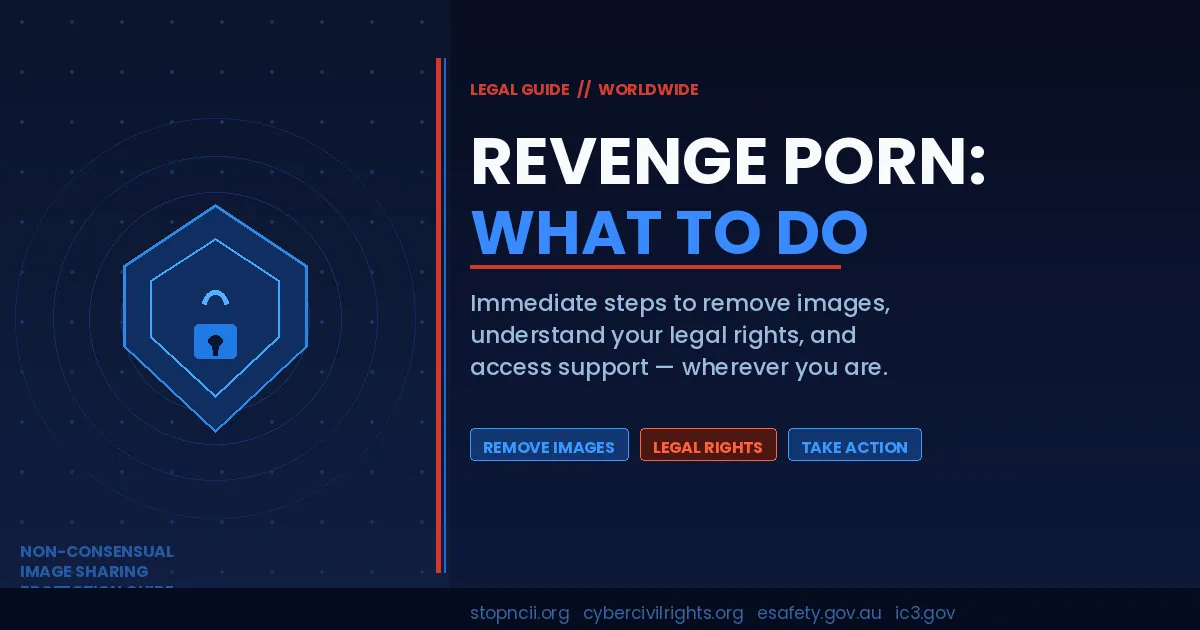
Finding out that intimate images of you have been shared without your consent is one of the most violating experiences a person can face. The shock is immediate. So is the fear: who has seen them, where they are, and whether the spread can be stopped.
The answer is yes — it can be stopped, or significantly limited. There are concrete legal, technical, and emotional steps that work. This guide walks through every one of them, from the first hour after discovery to long-term legal protection, in clear order so you know exactly what to do next.
What Is “Revenge Porn” — and Why the Term Matters
Non-consensual intimate image sharing (NCII) is the distribution, posting, or threatened release of private sexual or intimate images without the subject’s consent. The popular term “revenge porn” is misleading, and that matters legally and emotionally.
The word “revenge” implies the victim provoked the act. They did not. The word “porn” implies the material is pornographic by design — it is not. These are private images shared without any intent for public viewing. Over 40 countries and most legal systems now use the terms NCII or “image-based sexual abuse” specifically to remove blame from victims and accurately name the perpetrator’s behavior.
Who is typically targeted?
Research by the Cyber Civil Rights Initiative (CCRI) — the leading U.S. nonprofit on this issue — estimates that approximately 1 in 25 Americans has experienced or been threatened with NCII. Women account for approximately 70–80% of documented victims, though men, LGBTQ+ individuals, and minors are also targeted at significant rates. Importantly, perpetrators are not always ex-partners; they can be acquaintances, strangers who hacked accounts, or organized sextortion networks.
What counts as NCII?
- Sharing intimate images without the subject’s knowledge or consent
- Threatening to share images unless demands are met — money, continued contact, or sexual favors (this is sextortion)
- Creating fake intimate images using someone’s real face through AI or editing (deepfakes)
- Screen-recording or photographing intimate video calls without consent
The common element is the absence of consent — not the relationship between the people involved, not how the original images were created.
What to Do Right Now: 7 Immediate Steps
The first 24–72 hours after discovery are critical. Acting quickly and correctly limits the spread and protects your legal case. Follow these steps in order.
Step 1: Document everything before you report or remove anything
Take screenshots of the images, posts, and the profile of whoever shared them. Record URLs and timestamps. Do this before filing any removal report — once content is taken down, the evidence is gone. Store your documentation somewhere secure and private, ideally a new email account or encrypted storage not connected to the perpetrator.
Step 2: Do not pay any blackmailer
If someone is threatening to release images unless you pay, do not comply. Payment rarely ends the abuse; in most documented cases it escalates demands. Report extortion directly to law enforcement. The FBI, UK’s Action Fraud, and equivalent agencies in most countries treat sextortion as a serious criminal offense — they have the tools to investigate it.
Step 3: Report to the platform hosting the images
Every major social media and content platform has a reporting mechanism for NCII. Many now have dedicated, expedited review teams. Use the exact phrase “non-consensual intimate images” in your report — it triggers a specialized queue. Reporting within the platform is often the single fastest removal route available.
Step 4: Register with StopNCII.org immediately
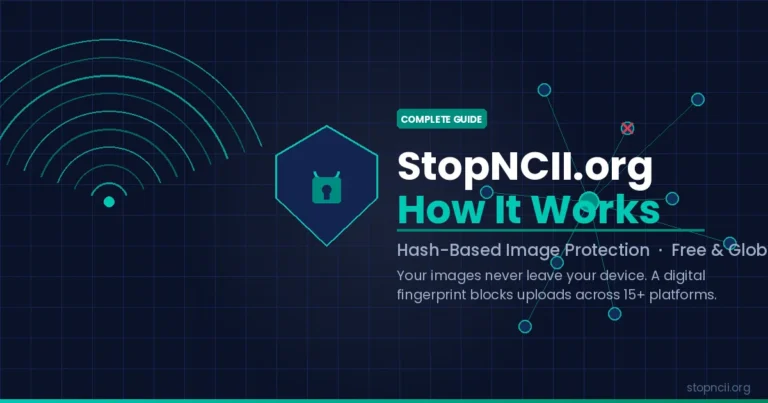
StopNCII is a free, confidential tool that creates a digital fingerprint (hash) of your image — without you ever uploading the actual image to their servers. This hash is then shared with partner platforms including Meta, TikTok, Reddit, Snap, and Pornhub, which actively prevent that image from being uploaded or spread. Go to stopncii.org and follow the guided process. It takes less than 10 minutes and works globally.
Step 5: Secure all your personal accounts
Change passwords on every account, enable two-factor authentication everywhere, and audit who has access to your cloud photo storage (Google Photos, iCloud, OneDrive). Perpetrators often exploit initial access to harvest additional images. This step is prevention as much as it is response.
Step 6: Tell one trusted person
Isolation intensifies psychological harm significantly. You do not need to tell everyone — but telling one trusted person (a friend, family member, or counselor) gives you support and a witness to the situation. You do not have to carry this alone.
Step 7: Contact a specialist support organization
Organizations listed at the end of this article offer free, confidential guidance specific to your jurisdiction — including legal referrals, platform support, and emotional support. They have helped thousands of people in exactly your situation.
How to Remove Your Images from the Internet
Image removal is not a single action — it is a coordinated, multi-channel effort. Content can exist in many places simultaneously: the original post, search engine caches, and third-party sites that have reposted it. Work through each channel systematically.
Google and Bing Search Removal
Google has a dedicated removal request tool specifically for non-consensual intimate images. Submit at: support.google.com/websearch/troubleshooter/9685475. Google will de-index the URL from search results — the content may still exist on the original site, but it becomes nearly invisible to anyone searching. Bing and Yahoo have equivalent tools. This step is critical because search engines are how most people discover content.
StopNCII.org — Prevention and Cross-Platform Removal
StopNCII does not just prevent new uploads — it also prompts partner platforms to remove existing content that matches your image’s hash. As of 2024, partners include Facebook, Instagram, TikTok, Snap, Reddit, Pornhub, OnlyFans, and others. Register once; the system works continuously across all partners. It is free, global, and does not require you to identify yourself publicly.
Platform-by-Platform Reporting Guide
| Platform | Where to Report | Typical Response Time |
|---|---|---|
| Facebook / Instagram | Report > Nudity or Sexual Activity > Non-consensual | 24–72 hours |
| Google Search | NCII-specific removal form | 1–5 days |
| Twitter / X | Report > Privacy > Exposed Intimate Images | 24–48 hours |
| Report > Non-consensual Intimate Media (NCIM) | 24–48 hours | |
| TikTok | Report > Sexual Content > Non-consensual | 24–48 hours |
| Pornhub / major adult sites | Dedicated content removal pages on each site | 1–7 days |
| Snapchat | In-app report > Sexual Content > Non-consensual | 24–72 hours |
| YouTube | Report > Sexual Content > Graphic sexual content | 24–48 hours |
For sites that do not respond or are hosted overseas, a legal takedown letter from a lawyer — citing applicable NCII laws — often accelerates action dramatically. Many platforms respond faster to formal legal correspondence than to standard user reports.
Reverse Image Search
Use Google Images, TinEye, and Yandex Images to search for your images across the web. This gives you a complete picture of where the content exists so you can file targeted removal requests for every location. Repeat this search every few weeks as content can re-emerge on new sites.
Your Legal Rights: How to Report Revenge Porn to Authorities
Most countries have criminalized NCII. Knowing your legal rights is essential for two reasons: pursuing justice against the perpetrator, and obtaining emergency legal relief such as court orders that compel platforms to remove content.
United States
As of 2024, 48 U.S. states plus the District of Columbia have laws specifically criminalizing NCII. Penalties vary by state but include fines and imprisonment. Federal options also exist: the FBI’s Internet Crime Complaint Center (IC3.gov) handles sextortion and cases involving interstate distribution. The Violence Against Women Act (VAWA) provides additional civil remedies. Contact CCRI (cybercivilrights.org) for state-specific legal referrals.
United Kingdom
The UK criminalized revenge porn under the Criminal Justice and Courts Act 2015. The Online Safety Act 2023 significantly strengthened enforcement, adding specific offenses for threatening to share intimate images and for creating deepfake intimate images without consent. Report to:
- Action Fraud: actionfraud.police.uk or 0300 123 2040
- Revenge Porn Helpline: 0345 6000 459 (Mon–Fri, 10am–4pm)
Australia
Australia’s Online Safety Act 2021 empowers the eSafety Commissioner to compel platforms to remove NCII — often within 48 hours. Federal criminal offenses also apply under the Criminal Code. Report to the eSafety Commissioner at esafety.gov.au or call 1800 web safe (1800 932 723).
Canada
Section 162.1 of the Criminal Code of Canada criminalizes non-consensual publication of intimate images with penalties up to five years’ imprisonment. Report to local police or use Cybertip.ca.
European Union
Most EU member states have NCII-specific laws or cover the offense under broader harassment and privacy legislation. The EU’s Digital Services Act (DSA) also compels platforms operating in the EU to respond swiftly to removal requests for illegal content.
What to bring when reporting to police
- All screenshots, saved URLs, and timestamps
- Any threatening messages or demands
- The perpetrator’s profile URLs and usernames
- Any context about how they obtained the images
Request a crime reference number immediately. If local police seem unfamiliar with NCII law, ask to be referred to a specialist cybercrime unit — most police forces in developed countries have one.
Common Mistakes That Victims Make — and What to Do Instead
Many victims, acting on instinct or under extreme stress, accidentally harm their own legal case or unintentionally increase the spread. These are the most common errors.
Contacting the perpetrator directly
Confronting someone who has shared your images can escalate the situation and give them material to use against you legally. Do not initiate contact. If they contact you, do not respond — but screenshot and save every message. Let law enforcement or a lawyer manage communication.
Deleting evidence before documenting it
The impulse to delete everything immediately is completely understandable. Resist it until you have documented everything. Evidence of where images were posted, who posted them, and what was said is essential to any legal action. Document first, report second, remove third.
Posting about it publicly before seeking legal advice
Going public with your story before consulting a lawyer can compromise a criminal prosecution, expose you to secondary harassment, and paradoxically increase awareness of the images. Speak to a support organization or legal professional before making any public statements.
Assuming images are too widespread to remove
The spread of NCII can feel catastrophic and permanent. In practice, coordinated removal requests across platforms, combined with search engine de-indexing and StopNCII’s hash system, have successfully contained image spread in thousands of cases. The process requires persistence, not luck.
Blaming yourself
Sharing intimate images with someone you trusted is not a mistake you made — it is a normal human behavior. The violation is the non-consensual sharing, which is entirely the choice and responsibility of the person who shared them. NCII is an act of abuse. The cause is the perpetrator’s behavior, not yours.
Frequently Asked Questions
What is the very first thing I should do if my images are shared online?
Document everything before taking any other action — take screenshots of the content, save URLs, and record any messages. Then report to the hosting platform, register on StopNCII.org, and contact a specialist support organization. Acting in the right order protects both your legal case and limits how far the content spreads.
Is revenge porn illegal where I live?
In most countries, yes. The US (48 states), UK, Australia, Canada, New Zealand, Ireland, Germany, France, and most of the EU all have laws specifically addressing NCII. If you are unsure about your jurisdiction, contact the CCRI’s international resources page at cybercivilrights.org or reach out to your local cybercrime police unit for guidance.
Can images ever be completely removed from the internet?
Complete removal is not always achievable, but near-complete containment usually is. Search engine de-indexing, coordinated platform reports, and StopNCII’s hash-matching system together prevent most ongoing spread. Many victims achieve effective removal when all available channels are used systematically and persistently.
What if I know who shared my images but have no hard proof?
Law enforcement can subpoena IP address records, account data, and device metadata from platforms — evidence you cannot access on your own. Report what you know and let investigators pursue the digital forensics trail. Circumstantial knowledge combined with platform metadata has been sufficient for prosecution in many documented cases.
Can deepfake intimate images be reported and removed?
Yes. AI-generated intimate images using someone’s real face cause equivalent harm to real images and are increasingly illegal. The UK criminalized creating deepfake intimate images under the Online Safety Act 2023. Several U.S. states and Australia have similar provisions. Report deepfakes through exactly the same channels as real images.
Will reporting to police make the situation public?
Police reports are not automatically public. Prosecutors can also request reporting restrictions in NCII cases to protect victim identity. Ask specifically about privacy protections when you file your report — specialist cybercrime units are familiar with this request.
What support is available if I am struggling emotionally?
Specialized emotional support is available through the CCRI Hotline (1-844-878-2274), the UK Revenge Porn Helpline (0345 6000 459), and Australia’s eSafety Commissioner. Many organizations also connect victims with therapists experienced in trauma related to image-based abuse. You do not need to manage the emotional impact of this alone.
Can I sue the person who shared my images?
Civil lawsuits for NCII damages are possible in many jurisdictions and have resulted in significant financial awards. Several high-profile civil cases in the U.S. and UK have ended in six-figure settlements or judgments. Contact a lawyer specializing in privacy or cyber law — organizations like CCRI maintain free referral lists of attorneys with NCII experience
Conclusion: What to Do Next
If your intimate images have been shared without your consent, the path forward is this: document first, report to platforms, register with StopNCII.org, contact law enforcement, and reach out to a specialist support organization. None of these steps requires you to face this alone, and every one of them is reachable regardless of where in the world you are.
Fresh ideas, expert voices—our curated content hub has it all..